Biblical wisdom, historical insight, and personal growth — all in one place

Category: Content Type (Page 2 of 6)

Top Category for grouping content types

Teacher’s Notes on the U.S. Constitution

  1. The Constitution Cannot Be Separated from the Declaration of Independence. The U.S. Constitution did not emerge in a vacuum; it was crafted as the direct remedy to the abuses detailed in the Declaration of Independence. The Declaration’s 27 Grievances form the context: the lived experience of a people whose rights had been repeatedly violated. Without understanding those grievances—what the colonists endured, why each injustice mattered, and how those abuses shaped their political imagination—the Constitution appears merely structural. In truth, it is a deliberate response to tyranny. Every article, every clause, and every protection within the Constitution reflects a specific grievance the Founders sought never to repeat. To study the Constitution faithfully, one must begin with the Declaration, where the moral purpose and historical urgency of American self‑government are first revealed.
  2. The Convention was originally called to revise the Articles of Confederation, not to write an entirely new Constitution. This is a teaching point because it shows how delegates moved from “fixing” the old government to replacing it with a stronger federal system; the Library of Congress notes that the delegates gathered intending to revise the Articles, but the process ultimately led to the creation of a new national framework.
  3. The U.S. Constitution is the oldest written national constitution still in use.
    This makes it an unusual example of a plan for self-government that has lasted for generations. The National Archives describes the Constitution as the foundation that united the states under “We the People,” and the National Archives Museum virtual exhibit notes that it is among the oldest and shortest written constitutions still in effect.
  4. Constitution Day is observed on September 17 because that is the day the Constitution was signed in 1787.
    The National Archives explains that September 17 marks the signing of the U.S. Constitution in Philadelphia, and the Department of Education identifies it as Constitution Day and Citizenship Day.
  5. The Constitution begins with the phrase “We the People,” which points students to the idea of government by the people.
    The National Archives highlights the Preamble’s wording and explains that the Constitution placed the power of the union in the people, not in the states alone.
  6. Only 39 delegates signed the Constitution.
    The National Constitution Center notes that 55 delegates attended the Constitutional Convention, but only 39 signed the final document. Three delegates dissented and refused to sign:

    1. George Mason of Virginia
    2. Edmund Randolph of Virginia
    3. Elbridge Gerry of Massachusetts
    4.  They objected mainly because the original Constitution did not include a bill of rights, and they were also concerned that the new federal government would have too much power.
  7. The Constitution was written in Philadelphia’s Pennsylvania State House, now known as Independence Hall.
    The Declaration of Independence was also signed in that building, making it one of the country’s most important civic sites, according to the National Constitution Center.
  8. The Constitution was prepared in secrecy.
    Delegates met behind closed doors guarded by sentries so they could debate freely. Important contributors to the drafting and final wording included James Madison, Gouverneur Morris, James Wilson, the Committee of Detail, and the Committee of Style, according to the National Constitution Center.

    1. The Committee of Detail included John Rutledge of South Carolina, Edmund Randolph of Virginia, Nathaniel Gorham of Massachusetts, Oliver Ellsworth of Connecticut, and James Wilson of Pennsylvania. Their job was to turn the Convention’s agreed ideas into a working draft. [teachingamericanhistory.org]
    2. The Committee of Style and Arrangement included William Samuel Johnson of Connecticut, Alexander Hamilton of New York, Gouverneur Morris of Pennsylvania, James Madison of Virginia, and Rufus King of Massachusetts. This committee cleaned up and arranged the near-final text. Gouverneur Morris is often credited with shaping the Preamble’s “We the People” wording.
  9. The Constitution did not take effect as soon as it was signed.
    It first had to be ratified by nine of the thirteen states. The Congressional Research Service explains that the Constitution was formally adopted after New Hampshire became the ninth state to ratify it on June 21, 1788. Rhode Island was the last of the original thirteen states to ratify it, on May 29, 1790. Rhode Island did not send delegates to the Constitutional Convention. This helps students understand that the Constitution was not instantly or universally accepted. The Library of Congress notes that 55 men from 12 states gathered and that Rhode Island refused to participate.
  10. The Bill of Rights was not part of the original Constitution.
    The first ten amendments were added in 1791 after many Americans argued that the Constitution needed clearer protections for individual rights, according to the National Archives and the National Constitution Center.
  11. Congress first proposed 12 amendments that became the Bill of Rights, but only 10 were ratified at the time.
    The National Archives states that 10 of the 12 proposed amendments were ratified on December 15, 1791.
  12. One of the original 12 proposed amendments became the 27th Amendment more than 200 years later.
    The National Archives Museum virtual exhibit explains that the congressional pay amendment proposed in 1789 was finally ratified in 1992 as the 27th Amendment. “Any law changing the pay of members of Congress cannot take effect until after the next election for the House of Representatives.”
  13. Benjamin Franklin was the oldest delegate at the Constitutional Convention, and Jonathan Dayton was the youngest.
    The National Constitution Center reports that Franklin was 81 and Dayton was 26.
  14. Thomas Jefferson and John Adams did not sign the Constitution because they were serving abroad.
    This is a useful “surprising fact” for students who assume every major Founder was present. The National Constitution Center explains that Thomas Jefferson was in France and John Adams was in Great Britain.
  15. More than 11,000 constitutional amendments have been introduced in Congress, but only 27 have been ratified.
    This helps students see that the Constitution can be changed, but that change is intentionally difficult, according to the National Constitution Center.
  16. The “six big ideas” of the Constitution.
    Limited government, republicanism (people choose leaders to represent them in government), checks and balances, federalism, separation of powers, and popular sovereignty (the people are the ultimate source of government power).

A declaration is a formal statement of principles, beliefs, rights, or intentions. In American history, a declaration often explains why people are taking an important action, such as declaring independence or stating shared values.

A constitution is the basic plan for a government. It explains how the government is set up, what powers it has, how leaders are chosen, and how laws are made.

A bill of rights is a list of rights and freedoms the government must protect. It helps limit what the government can do to individuals.

Summary: A declaration states the reasons or principles behind an important action, such as declaring independence; a constitution establishes the government; and a bill of rights lists protections that the government must respect.  Students need all three ideas together, so the documents make sense in context.
Ideas for Final Exams for 27 Grievances Explained

Cause & Effect–Based Essay Prompts (High School Level)

Write a well‑developed paragraph for each question. Support your ideas with reasoning, examples, and connections to the Declaration and Constitution.

1. Cause → Effect: Why Governments Lose Legitimacy

Explain how a government’s repeated violations of people’s rights can cause citizens to withdraw their consent. How does this idea help explain why the Declaration of Independence was written?

2. The Purpose of Government

Describe the Founders’ belief about the purpose of government. How does this belief shape the structure and limits placed on government power in the Constitution?

3. Abuse of Power as a Cause of Revolution

Choose one type of abuse described in the grievances (such as unfair laws, misuse of the military, or interference with justice). Explain how this abuse could cause a society to demand major political change.

4. The Rule of Law vs. Rule by One Person

Explain why the Founders believed that a government ruled by laws—not by the will of a single ruler—is essential for a free society. What effects does this principle have on how the Constitution is designed?

5. Citizenship and Responsibility

Describe how the Declaration and Constitution imply responsibilities for citizens. What happens to a nation when citizens fail to participate, stay informed, or hold leaders accountable?

6. Separation of Powers as a Preventive Measure

Explain how dividing government power among branches is an effect of the grievances listed in the Declaration. Why did the Founders believe this structure would prevent future abuses?

7. Consent of the Governed

Discuss why “consent of the governed” is a foundational idea in American government. What are the effects when leaders ignore or override the will of the people?

8. Limited Government and Human Nature

The Founders believed that human nature makes concentrated power dangerous. Explain how this belief caused them to design a limited government, and what effects those limits have on citizens’ freedoms.

9. Justice and Fair Legal Processes

Many grievances deal with unfair trials, biased judges, or ignored laws. Explain why fair legal processes are essential to liberty and how the Constitution responds to these concerns.

10. The Declaration as a Cause of the American Identity

Explain how the ideas in the Declaration of Independence helped shape the long‑term identity and values of the United States. What effects do these ideas still have on American citizenship today?


Cause & Effect–Based Questions (Younger Students)

Answer each question in 3–4 complete sentences.

1. Why do people create governments?

Explain what people expect the government to do and what happens when it stops doing those things.

2. What makes a government unfair?

Describe one way a government can treat people unfairly and how that might cause people to speak out or protest.

3. Why did the colonists feel they needed to separate from Britain?

Explain one major problem they had and what effect it had on their decision.

4. What does “consent of the governed” mean?

Explain why leaders need permission from the people and what happens when they ignore them.

5. Why is it important for laws to apply to everyone?

Describe what happens when leaders don’t follow the same rules as the people.

6. How does dividing government power protect freedom?

Explain why the Founders didn’t want one person or group to have all the power.

7. What responsibilities do citizens have in a free country?

Describe one responsibility and explain why it matters.

8. Why is a fair court system important?

Explain how unfair trials or biased judges can harm people and why the Constitution protects against that.

9. How can too much government power become a problem?

Describe what might happen when a government has no limits.

10. How do the ideas in the Declaration still affect us today?

Explain one idea from the Declaration and how it shapes the way Americans think about freedom or citizenship.


Scoring Guidelines for Teachers

1. Understanding of the Concept (0–4 points)

4 – Excellent

  • Demonstrates a clear and accurate understanding of the core idea (e.g., purpose of government, limited government, consent of the governed).
  • Connects the idea to the Declaration and/or Constitution in a meaningful way.
  • Shows insight into the cause-and-effect relationship described in the prompt.

3 – Proficient

  • Shows a generally accurate understanding with minor gaps.
  • Makes a reasonable connection to the founding documents.
  • Identifies a cause/effect relationship but may not fully develop it.

2 – Developing

  • Shows partial or vague understanding.
  • Mentions the Declaration or Constitution, but without clear relevance.
  • Cause/effect relationship is weak or incomplete.

1 – Beginning

  • Shows minimal understanding or confuses key ideas.
  • No meaningful connection to the founding documents.
  • Cause/effect relationship missing.

0 – No Response / Off Topic

2. Use of Reasoning and Explanation (0–3 points)

3 – Strong Reasoning

  • Provides logical explanation, examples, or reasoning to support the idea.
  • Shows the student can explain rather than memorize.

2 – Adequate Reasoning

  • Some explanation is present, but it may be general or partially developed.

1 – Limited Reasoning

  • Statements are made without explanation or support.

0 – No reasoning provided

3. Clarity and Organization (0–2 points)

2 – Clear and Well‑Organized

  • Paragraph is coherent, stays on topic, and flows logically.
  • Sentences connect smoothly.

1 – Partially Organized

  • Some clarity, but ideas may jump around or lack transitions.

0 – Disorganized or difficult to follow

4. Writing Quality (0–1 point)

1 – Competent Writing

  • Grammar, spelling, and sentence structure do not interfere with meaning.
  • Student writes in complete sentences.

0 – Frequent errors that interfere with understanding

Total Possible Points per Question: 10 – 100 for a full test/quiz


Structured Lesson Plans & a Few “Bell Ringers”

Are you looking for quick, 5–10-minute bell ringers or even full 45-minute lesson modules you can use immediately? Because 27 Grievances Explained is built around clear, discrete complaints in the Declaration of Independence, here are a few ready-to-use classroom routines that help students analyze language, connect grievances to historical events, and debate which complaints mattered most.

  • The “Modern Translation” Challenge: Provide a worksheet where students are given the original text of a grievance and must translate it into modern slang or contemporary English. This helps students decode eighteenth-century language while preserving the original meaning.
  • Primary Source Matching: Create a detective-style activity in which students match a specific historical event, such as the Stamp Act, the Tea Act, the Quartering Act, or the closure of colonial legislatures, to the grievance it most directly inspired.
  • Rank the Grievances: Ask students to sort the 27 grievances into a “most serious to least serious” order and defend their ranking in writing or discussion. This encourages prioritization, argumentation, and the use of textual evidence.
  • Which Grievance Is This? Use short classroom prompts that describe a situation in plain language, and ask students to identify which grievance it matches. This works well as a warm-up, exit ticket, or review game.
  • Then and Now Connections: Invite students to compare one grievance to a modern civic issue involving government power, rights, or representation. The goal is not to claim the situations are identical, but to help students see why these complaints mattered.
  • One Grievance, One Mini-Lesson: Build a series of short lessons where each class opens with a single grievance, its historical background, and a short discussion question. Over time, students build familiarity with all 27 without feeling overwhelmed.
  • Cause and Effect Chains: Ask students to trace how one British policy led to colonial resentment, protest, and then inclusion in the Declaration. This helps students move beyond memorization to historical reasoning.
  • Perspective Rewrite: Have students rewrite a grievance from the viewpoint of a Patriot, Loyalist, colonial merchant, or royal official. This adds nuance and supports historical empathy while still grounding the lesson in understanding the issues a play during the Revolution.
  • Bell Ringer Debate Cards: Create quick prompts such as, “Was this grievance a violation of rights or just an unpopular policy?” Students can respond in two or three sentences before discussing with a partner.
  • Socratic1The Socratic method is a philosophical approach developed by the ancient Greek philosopher Socrates (470–399 BC) that uses systematic doubt and questioning to help others clarify and refine their understanding of a topic, ultimately leading to a clearer expression of truth Seminar Prompts: Deep-dive questions that don’t have a simple “yes/no” answer. For example: “If Grievance #17 (taxation without consent) had been resolved, would the other 26 have been enough to start a revolution?”
  • The “Break-Up Letter” Assignment: A popular middle-school activity involves students writing a “break-up letter” to King George III, using at least 3 of the grievances from “27 Grievances Explained.”
  • Mock Trial Outlines: A guide for a classroom mock trial where students “sue” the Crown using 27 Grievances Explained as their primary evidence.
  • The King’s Rebuttal: An interesting “Wildcard” exercise would be a section exploring how the British Parliament or King George III might have defended their actions. This encourages critical thinking and historical empathy by showing students the “other side” of the legal argument.
  •  
  • 1
    The Socratic method is a philosophical approach developed by the ancient Greek philosopher Socrates (470–399 BC) that uses systematic doubt and questioning to help others clarify and refine their understanding of a topic, ultimately leading to a clearer expression of truth ↩︎

Color‑Coded Constitutional Mapping Chart

27 Grievances → Constitutional Fixes

Color Key (Print‑Friendly):

  • 🟦 Legislative Fix — Congress gains power/limits on the executive
  • 🟥 Rights Fix — Bill of Rights protections
  • 🟩 Judicial Fix — Courts, jury trials, due process
  • 🟨 Structural Fix — Federalism, separation of powers
  • ⬛ No Direct Clause — Principle addressed indirectly

Grievances 1–5: Attacks on Self‑Government & Representation

Grievance

Constitutional Fix

Category

1. King refused necessary laws

Preamble; Article I; 17th Amendment

🟦 Legislative

2. Blocked urgent laws & neglected them

Article I, Sec. 8; 10th Amendment

🟨 Structural

3. Demanded colonists give up representation

Article II limits; Senate confirmations

🟦 Legislative

4. Forced legislatures to meet far away

10th Amendment; 2nd Amendment

🟨 Structural

5. Dissolved legislatures

Article I; 10th Amendment

🟦 Legislative

Grievances 6–12: Military Abuse & Loss of Civil Authority

Grievance

Constitutional Fix

Category

6. Refused new elections

Article I, Sec. 8 (militia & army limits)

🟦 Legislative

7. Restricted immigration & settlement

Article I, Sec. 8; Article II, Sec. 1

🟦 Legislative

8. Obstructed justice

Article III; 6th & 7th Amendments

🟩 Judicial

9. Judges dependent on King

Article II, Sec. 2; state constitutions

🟩 Judicial

10. “Swarms of officers” enforcing taxes

Article I, Sec. 7–8; voting amendments

🟦 Legislative

11. Standing armies in peacetime

Article I, Sec. 8 (2‑year funding rule)

🟦 Legislative

12. Military above civil authority

Civilian control; Insurrection Act

🟨 Structural

Grievances 13–17: Foreign Jurisdiction, Trade, & Taxation

Grievance

Constitutional Fix

Category

13. Foreign jurisdiction & admiralty courts

Commerce Clause; judicial review

🟩 Judicial

14. Quartering troops

3rd Amendment

🟥 Rights

15. Mock trials protecting soldiers

Article III; 6th & 7th Amendments

🟩 Judicial

16. Cutting off trade

Commerce Clause

🟦 Legislative

17. Taxation without consent

Article I, Sec. 7–8

🟦 Legislative

Grievances 18–22: Destruction of Legal Rights & Government Forms

Grievance

Constitutional Fix

Category

18. Denial of jury trials

Article III; 6th & 7th Amendments

🟩 Judicial

19. Transporting colonists overseas for trial

Article III; 6th Amendment

🟩 Judicial

20. Arbitrary government in Quebec

Article IV, Sec. 3; 1st Amendment

🟥 Rights

21. Taking away charters & altering governments

Article VI (Supremacy); Oath Clause

🟨 Structural

22. Suspending legislatures

Article I (Congress legislates)

🟦 Legislative

Grievances 23–27: War, Mercenaries, Impressment, Frontier Conflict

Grievance

Constitutional Fix

Category

23. Declared colonies out of protection & waged war

Article I, Sec. 8 (Congress declares war)

🟦 Legislative

24. Attacks on coasts & towns

Shared war powers

🟨 Structural

25. Use of foreign mercenaries

No direct clause; Congress controls war

⬛ Indirect

26. Forcing Americans into British service

No direct clause; principle of liberty

⬛ Indirect

27. Inciting frontier violence

Congress controls tribal relations

🟦 Legislative


Interesting Facts for the Teacher

Here are a few engaging, classroom-friendly facts drawn directly from the book about the 27 Grievances of the Declaration of Independence. These work beautifully as lesson openers, discussion starters, or sidebar notes in worksheets.

The Declaration’s official title is longer than most people realize

Its full name is: “The unanimous Declaration of Independence of the thirteen united States of America.” The words “unanimous” and “united” were adjectives, not nouns, meaning the colonies were describing themselves as united rather than naming a country yet.

The grievances were heavily influenced by John Locke

Historians note that the structure and logic of the grievances closely mirror Locke’s writings on natural rights and the social contract.

The Iroquois Confederacy had a constitution long before the U.S.

The Great Law of Peace (c. 1450) included:

  • Checks and balances
  • Defined roles for leaders
  • Protection of individual rights
  • Religious freedom
  • A model of unity that Benjamin Franklin admired
  • It even inspired symbols like the bundle of arrows in the Great Seal.

Magna Carta (1215) is a direct ancestor of several U.S. rights

The Magna Carta was introduced:

  • Rule of law applying even to kings
  • The right to a fair trial
  • Limits on arbitrary power
  • These ideas echo through the Constitution and Bill of Rights.

The Statue of Liberty’s tablet displays the Declaration’s date

The Roman numerals July IV, MDCCLXXVI appear on the tablet she holds — a reminder that liberty begins with the principles of the Declaration.

Some grievances were triggered by very specific events

For example:

  • Grievance 14 (quartering troops) was tied to General Thomas Gage’s occupation of Boston.
  • Grievance 15 cited a real case in Annapolis in which British soldiers were acquitted despite strong evidence.

The Quebec Act terrified the colonists

It expanded French civil law, enlarged Canadian territory, and protected Catholic practice — while colonists were still required to follow Anglican norms. They saw it as a blueprint for imposing “arbitrary government” on them next.

The first naval battle of the Revolution wasn’t famous — but it was bold

Residents of Machias, Maine, captured the British ship Margaretta in 1775, marking the first naval engagement of the war.

The Constitution mentions voting 39 times — but never grants a “right to vote.”

The page notes that the Founders described voting procedures but did not explicitly guarantee a universal right to vote in the original Constitution. That came later through amendments.

The colonists believed the King had “abdicated” by declaring them rebels

When George III declared the colonies in open rebellion and removed his protection, the Founders saw it as the King abandoning his duties, effectively dissolving the political relationship.

The Two Dollar Bill celebrates the Declaration of Independence

The engraving on the back of the modern U.S. two‑dollar bill depicts John Trumbull’s Declaration of Independence — specifically the moment the Committee of Five presents the draft document to the Continental Congress, not the signing itself. 

Teacher’s Guide

The Goals:

  • The 27 Grievances Explained: A clear, accessible exploration of the Declaration’s original complaints and their modern relevance.
  • Teaching Aids for Adults & Youth: Worksheets, timelines, and guided study materials for classrooms, civic groups, and homeschoolers.
  • 250th Anniversary Resources: Tools to help families and communities reflect on the founding principles that shaped our nation.

A 10 Step Teaching Guide for the 27 Grievances Explained

(Designed to pair with your book and/or the free online content on Lostpine.com)

Step 1: The notion that human rights are not granted by government authority is paramount. These rights are inherent, bestowed upon us by our Creator.

Step 2: Establish the Historical Setting. Introduce colonial life, British policies, and rising tensions to give students the context needed to understand why grievances were written.

Step 3: Explain the Purpose of the Declaration. Clarify that the Declaration was both a statement of principles and a legal justification for separation from Britain.

Step 4: Introduce the 27 Grievances. Present the grievances as specific complaints against King George III, grouping them into themes such as justice, military control, and self-governance. Their order is irrelevant to understanding the Declaration.

Step 5: Study Each Grievance in Sequence within its grouping. Walk through the grievances using short explanations, encouraging students to connect each one to real colonial experiences.

Step 6: Connect Grievances to Constitutional Solutions: Show how the Constitution later addressed the abuses listed in the Declaration through checks, balances, and enumerated rights.

Step 7: Engage Students in Discussion Activities. Use debates, role-play, or small-group analysis to help learners interpret the Founders’ reasoning and evaluate their relevance today.

Step 8: Reflect on Civic Principles and Legacy. Conclude with a discussion on how the grievances shaped American identity and why understanding them strengthens modern civic literacy.

Step 9: Introduce the distinction between a democracy and a republic to better understand the grievances. Discuss how these concepts shaped the Founders’ intentions and influenced the principles laid out in the Declaration and the Constitution, reinforcing the importance of protecting individual rights against the tyranny of the majority.

Step 10: In small groups, take 5 minutes to discuss the 27 grievances. Focus on two main questions:

  • Which grievance do you think was the most significant for the colonists, and why?
  • How do you see the relevance of these grievances today?

Closing Message for Teachers

The grievances are not just historical complaints — they are the blueprint for the Constitution. Teaching them helps students understand:

  • Why the Founders distrusted concentrated power
  • How rights are protected
  • Why civic participation matters
  • How history shapes modern freedoms

This guide, combined with your worksheets, gives students a complete, meaningful understanding of America’s founding principles.

Introduction to 27 Grievances Explained

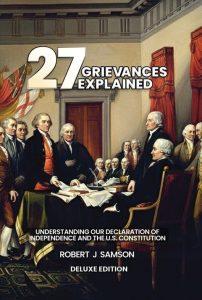
Lostpine.com has released a guide to the Declaration of Independence and the U.S. Constitution to complement its book.  The book is a practical, low-cost resource designed for classrooms, homeschool families, and civic groups. Teaching materials are free.

The new book helps readers understand the Declaration of Independence, the U.S. Constitution, and the historical context behind the 27 grievances the American colonists presented to King George III. Written in clear, approachable language, the book is designed to make America’s founding documents accessible to students, families, and lifelong learners.

Available now through Barnes & Noble in eBook, paperback, and a Deluxe Edition hardcover, the book offers a concise yet meaningful exploration of the ideas that shaped the nation. Its low price point reflects Lostpine’s goal of providing an affordable educational tool for classrooms, homeschool programs, and civic education initiatives.

Many people recognize the Declaration and the Constitution, but fewer understand why the Founders wrote them. By explaining the grievances in their historical context, readers can better appreciate the principles that guided the birth of our nation.

The books include:

  • A clear explanation of each of the 27 grievances
  • Historical background on colonial life and British policies
  • Connections between the grievances and the structure of the Constitution
  • Discussion-friendly sections ideal for group study

Educators, civic leaders, and community organizations have increasingly sought accessible resources to support Constitution Day programs, American history units, and discussions about the nation’s founding principles. These books provide a ready-made solution for those looking to deepen understanding without overwhelming readers.

 Available Editions

Ebook 

  • A clean, three‑column layout: 
  • Instant access
  • Great for students and digital classrooms

Paperback

  • Standard edition
  • Ideal for classroom sets and reading groups

Deluxe Hardcover 

  • Additional content
  • Perfect for libraries, civic groups, and collectors

Available now at Barnes & Noble:

eBook: https://www.barnesandnoble.com/w/27-grievances-explained-robert-j-samson/1148200394?ean=2940184531335
Paperback: https://www.barnesandnoble.com/w/27-grievances-explained-robert-j-samson/1148200394?ean=9798218774523
Deluxe Edition Hardcover: https://www.barnesandnoble.com/w/27-grievances-explained-robert-j-samson/1148200394?ean=9798995703204

Please note: Barnes & Noble has introduced new minimum pricing for its self-published authors. Pricing increases are for this reason. Lostpine remains dedicated to making faith, history, and civic understanding accessible to every generation. There is no cost for the teaching materials availabe on this website.

The Declaration of Independence

The Declaration of Independence is one of the most influential documents in American history and one of the most challenging for students to understand fully. Its eighteenth-century language, complex arguments, and powerful ideas about liberty and government require careful guidance and thoughtful instructional choices.

This section is based on our book, “27 Grievances Explained.” This section is designed to help teachers bring the Declaration of Independence to life in the classroom. The materials here support students as they move beyond simply recognizing the document’s importance to actively engaging with its ideas, structure, and historical context. Through close reading, discussion, and analysis, students are invited to explore why the Declaration was written, how it makes its arguments, and why its principles still matter today.

Whether you are introducing the document or deepening students’ analysis, these resources are flexible, classroom-ready, and easy to adapt to your instructional goals.

What You’ll Find in This Section of Lostpine

Understanding the Declaration’s grievances isn’t just an exercise in history — it’s a foundation for responsible citizenship. This section equips readers, teachers, and lifelong learners with tools that make the principles behind the Declaration clear, relevant, and actionable. If you want to strengthen civic literacy, teach the responsibilities of freedom, or deepen your own understanding of America’s founding ideals, these resources are designed to guide you.

  • What does it mean to be an informed citizen?

Explore clear explanations of each grievance to understand the principles that shaped our nation.

  • How can we teach civic responsibility with confidence?

Use concise study guides that make foundational ideas easy to grasp and share.

  • Why do historical documents still matter today?

Connect past struggles for liberty with the responsibilities we carry in modern society.

  • What skills should every student of citizenship develop?

Apply worksheets and activities that strengthen critical thinking and civic awareness.

  • How can one person make a meaningful difference?

Discover practical insights that turn historical understanding into everyday action.

Using These Materials

You can use these resources as a complete unit, select individual activities to supplement your curriculum, or adapt them to fit your students’ needs. Each item is designed to stand on its own while also working within a larger instructional progression.

The goal throughout is not just comprehension, but understanding, helping students see the Declaration of Independence as a carefully crafted argument about rights, government, and responsibility, rather than simply a famous historical text.

When using the [PRINT] button in the upper right corner to obtain pages for use as teaching materials, you can click any graphic image after clicking the print button but before you actually print, email, or download a PDF, and the graphic will be removed.

Introduction to the 27 Grievances

John Locke: The Ideas Behind American Liberty

Thomas Paine: The Voice That Made Independence Plain

Faith and the Founders: Spiritual Influences on Independence

What the Grievances Teach Us About Preserving the Republic

Why the 27 Grievances Still Belong in the Classroom

Teacher’s Guides

Teacher’s Notes on the Declaration

Teacher’s Notes on the Articles of Confederation

Teacher’s Notes on the U.S. Constitution

From Grievances to Guarantees – Six Misunderstood Grievances

Teacher’s Notes on the Articles of Association (Bonus Activity)

A Timeline of Events Leading to the Declaration of Independence

Mapping of Grievances

Student Worksheets

Structured Lesson Plans & a Few “Bell Ringers”

Curriculum Ideas for 3-, 5-, and 10-DAY Teaching Programs

Ideas for Final Exams for 27 Grievances Explained

Closing Message for Teachers

Please remember that the grievances are not just historical complaints — they are the blueprint for the Constitution. Teaching them helps students understand:

  • Why the Founders distrusted concentrated power
  • How our Constitution protects rights
  • Why civic participation matters
  • How history shapes modern freedoms

This guide, combined with your worksheets, gives students a complete, meaningful understanding of America’s founding principles.

The materials on Lostpine.com are subject to our Terms of Use.

Photo Gallery

The photos are of PASSIONS, those activities that combine faith and interests, making life fun. These will include historical reenactments from Revolutionary times, 18th-century camping at living history events, educational programs with kids, and more.  An additional organization that Lostpine is associated with is a living history group reenacting the 18th century in Florida. You can find additional photos of past activities HERE.

Living History Events

Photos are taken over recent years. Living history has shifted to a smaller campsite, shorter events.

Fort Foster Rendezvous

Fort Foster is located in Hillsborough River State Park FL. In February each year, they host a rendezvous for 5 days. The first 3 days are for school children and the weekend for adults. Great place to visit but more fun to bring history alive.

St. Augustine Night Watch

Colonial Night Watch has moved to the Colonial Quarter Museum. Still the first Saturday each December in St. Augustine. We camp in the museum, spend time teaching children Florida History. These are pictures of the East Florida Ranger unit and a few of the Spanish Garrison.

Colonial Night Watch

On the first Saturday in December, reenactors representing the Spanish, British and East Florida Rangers get together and enjoy St. Augustine FL. This period in history represents the time when the British held the fort in the city during the American Revolution.

Alafia River Rendezvous 2014

Every rendezvous takes on its own personality. This year was filled with new events and experiences. Enjoy the photos.

Park Lake Presbyterian Church

A few photos of a fund raiser for Park Lake's active scholarship program held June 5, 2013.

Teague Middle School

A Teach In at a Florida Middle school provides an opportunity to share history with 6 separate classes. Each is only 40 minutes long but with props and attentive children, you can accomplish a lot. The classes were on November 19, 2013.

Maundy Thursday

Each year a group of men set out to reenact the famous painting of Leonardo Da Vinci's Last Supper. There is a video to see the monologue (about 40 minutes) of our 2012 monologue. It includes each Apostle coming out to the congregation and taking a few minutes to talk about their life with Christ. The intent was to provide the same feelings that Da Vinci may have felt at the time of the painting. No real attempt was made to match the clothing. Ladies at the church provided lighter robes so that the imagery would stand out better in the low light.

Patriot Camp Photos

This was the 2nd annual Patriot Camp held July 30 to August 3rd, 2012 at the Westview Baptist Church in Sanford Florida. Over 50 children participated. The camp not only included history but games, snacks and special exercises in charity and the U.S. Constitution.

Alafia Church Services

Photos represent church services held in a tent on 323 acres of camping area.  The span of time covers 2006 to 2016.

2009 Mission Trip

Called "Lost and Found," this mission trip was a mystery.  One a few of the adult leaders knew where we were going and what the daily activities would be.  It was to learn and practice "stepping out in faith."  We ended up at the Palmer House for Children, located in Columbus MS.

Protests

History is a wonderful teacher. Nothing is more meaningful than to be transported back in time to understand the struggles of our forefathers. You can find photos of my 2009 Tea Party activity here as well as the message that was given. Their is a  12 minute Tea Party talk done August 22, 2009. These are non-political representations to help people understand the history behind the freedoms we all enjoy.

2009 Orlando Tea Party from Bob Samson on Vimeo.

whywewerehere
waitingtogoon
viewofthecrowd
typicalofthemessages
thousandscheeronspeakers
theperfectbackdrop
theintro
ourclosing
orlandoteapartyaugust222009
norain
lloydmotivates
lakeeolaswans
johnbethandbob
engaged
bobwaitsonthecrowd
bobgivesthekickoffmessage
bobandlloydmarcusmasterofceremony
Pride ran high at the event - What a history behind this flag

The August 2009 message is here.

In 2011, there was a presentation made at an April 15th Tax Day event. You can find the message here.

anearlyvisitor
smallcrowdthisyear
senatorlemieux
representativeadamhasner
floridafrontiersmenmembers
bobspeaksattheteaparty
bobisintroducedtosenatorlemieux
anothercrowdview
Bob is speaking to an early visitor who was there to protest unfair treatment by the courts


« Older posts Newer posts »

"For it is by grace you have been saved" - Ephesians 2:8-9  

Copyright: © 2001 - 2026 Lostpine

Translate »