
A brief companion to 27 Grievances Explained
Why Paine Matters
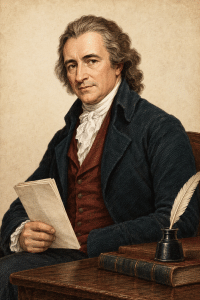
Thomas Paine (1737–1809) did not draft the Declaration of Independence or command an army. He served differently: he made the case for independence understandable to ordinary readers. Arriving in America from England in 1774, Paine entered public life as the conflict with Britain was becoming a war. His direct, energetic prose helped turn a dispute over rights within the British Empire into a public argument for creating a new nation.
From Protest to Independence
When Common Sense appeared anonymously on January 10, 1776, many colonists still hoped for reconciliation with Britain. Paine argued that the real question was no longer whether Parliament had imposed unjust policies, but whether a distant monarchy should rule America at all. He attacked hereditary monarchy, rejected the idea that an island should govern a continent, and presented independence as practical, necessary, and morally defensible.
Paine’s importance was not that he invented the desire for independence; Patriot leaders had already debated separation. His achievement was to carry the argument beyond legislatures and elite circles. Writing in a forceful style for a broad audience, he gave readers language for discussing monarchy, self-government, and the colonies’ future. Common Sense circulated widely—although surviving records do not support a precise sales total—and made independence a subject of urgent public debate in the months before July 1776.
Its extraordinary reach helped move the independence debate beyond political institutions and into everyday colonial life.
Words for a Difficult War
Paine continued writing for the revolutionary cause after independence was declared. His American Crisis essays, which began appearing late in 1776, spoke to people facing military setbacks, hardship, and uncertainty. Rather than laying out a plan of government, the essays urged Americans to hold their ground. Paine’s message was straightforward: liberty came at a cost, and independence would mean little unless people were willing to defend it.
From Argument to Action
Common Sense and the Declaration performed different tasks. Paine addressed the public to build support for separation; the Declaration announced and justified that separation on behalf of the united colonies. Yet the two belong in the same story. Paine helped make independence imaginable and immediate. The Declaration gave independence an official voice and grounded it in principles of equality, rights, consent, and resistance to destructive government.
Paine’s contribution was both political and educational. He turned complicated questions into choices ordinary readers could understand: monarchy or self-government, inherited power or public consent, submission or independence. By addressing citizens rather than specialists, he demonstrated how political writing could move people to act. Locke had explained why people may resist a government that violates their rights; Paine challenged Americans to decide whether that moment had arrived.
Questions for Students
- Why did Paine believe reconciliation with Britain was no longer realistic?
- How did his criticism of monarchy support the case for self-government?
- What made his style effective for a broad colonial audience?
- How do the purposes of Common Sense and the Declaration of Independence differ?
- Which of Paine’s arguments would have been most persuasive in early 1776, and why?
Read Paine for Free
Common Sense — Project Gutenberg
The Writings of Thomas Paine, Volume 1: The American Crisis
Use note: Paine’s original writings are in the public domain. The summary above is written in original language and does not reproduce extended passages from those works. Modern introductions, translations, annotations, and edited layouts may carry separate rights, so the links above favor collections that identify their access or public-domain status.
Study Material on Lostpine: Divine Dignity: How the Bible Forged Human Rights
You can find more on Thomas Paine’s wisdom by clicking HERE. You can find a short biography by clicking HERE.