
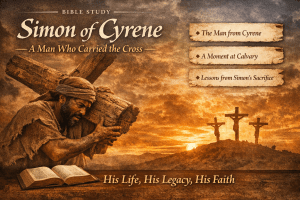
The New Testament story of Jesus includes a diverse cast of individuals, some of whom remain largely unknown to us. One notable figure is Simon of Cyrene, who was compelled by Roman soldiers to carry the cross for Jesus on the way to the crucifixion. Though Scripture offers only a handful of details about Simon, each one carries important implications for our understanding of God’s Kingdom. This study explores the significance of Simon’s story, revealing themes of compassion, unexpected discipleship, and the principle of shared burdens.
(Luke 23:26)1NIV New International Version Translations – “As the soldiers led him away, they seized Simon from Cyrene, who was on his way in from the country, and put the cross on him and made him carry it behind Jesus.”
Jesus needed assistance in carrying the cross due to the severe physical trauma He had already endured. After being flogged, mocked, and provoked all night, Jesus was led out to be crucified. Along the way, the soldiers “seized” Simon, compelling him to carry the cross behind Jesus. This was necessary to ensure the procession continued smoothly, allowing Jesus to die before Passover began.
Cyrene, located in North Africa (modern-day Libya), had a notable Jewish population during the first century as part of the Jewish diaspora.2In a biblical context, the term “diaspora” refers to the scattering of the Jewish people outside their homeland, particularly after events such as the Babylonian captivity in 586 BC. It signifies a community that maintains cultural and religious ties to its ancestral homeland while living in various regions around the world. While we do not know exactly what brought Simon to Jerusalem, we might assume that he was being drawn back to his ancestral homeland for a visit during Passover.
Simon, described as a bystander “coming in from the country,” was likely entering Jerusalem when he encountered the procession to Golgotha. Both Mark and Luke indicate that he was not part of Jesus’ group, suggesting that he became involved in the moment by chance. The accounts emphasize Simon’s lack of choice; he was compelled to assist Jesus. All three Synoptic Gospels underscore this compulsion, reflecting a broader Roman practice of forcing locals to carry loads, like Jesus’ teaching about going the extra mile. Even in His final hours before death, Jesus’ story continues to reach out to us with the powerful message of the Gospel.
(Matthew 5:41) – “If anyone forces you to go one mile, go with them two miles.”
Key Lessons from the Story of Simon of Cyrene
- God Uses Unexpected People for His Purposes: Simon, an ordinary passerby, played a crucial role in this significant event. His story highlights how “ordinary obedience” can manifest through answering unexpected needs and calls to action. It invites reflection on how we might respond in similar situations, emphasizing the impact of even small, everyday decisions.
- Cross-Bearing in Discipleship: Carrying the cross was undoubtedly a difficult task, especially for Simon, who was compelled to do so rather than choosing it willingly. Following Jesus often presents unexpected challenges that we may not have created ourselves. This highlights the deep commitment required to embrace these difficulties, as true discipleship involves accepting and overcoming such challenges.
- Walking in the Footsteps of Jesus: Simon’s act of carrying the cross behind Jesus symbolizes the essence of the Christian walk. It emphasizes the importance of following Christ closely, which involves suffering, humility, and obedience, and of modeling our lives after the example set by Jesus.
- From Interruption to Testimony: Simon is referred to as “the father of Alexander and Rufus,” indicating that his encounter with Jesus affected his family and became part of the early church narrative. Moments of faithfulness can create ripples throughout our families and communities, often in ways we may not foresee.
- Sharing in Burdens: While Jesus bore the cross alone, He invites us to share in one another’s burdens, fostering a sense of community and support among believers. This act reflects the heart of service and the greater purpose in following Christ.
At the same time, Simon’s assistance should never be confused with Jesus’ unique work. Simon could share a physical burden for a moment, but only Jesus could bear the weight of sin and accomplish salvation through His death and resurrection. That distinction keeps our service in its proper place: we help others as an expression of love, not as a substitute for the Savior.
Our Lesson for Today
We live in a world where evil is real, hearts can be hardened, and spiritual opposition is not imaginary. Yet the cross shows us both the seriousness of sin and the depth of God’s mercy: Jesus suffered not because humanity was mostly good, but because we were lost and could not save ourselves. As we help the hungry, the burdened, and those seeking a better life, we do so with open hands and clear conviction, refusing to confuse compassion with compromise. We can meet urgent needs, love our neighbors, and still speak the Truth that every person, religious or irreligious, near or far, must turn from sin and turn to Christ for Salvation.
Simon carried the cross “behind Jesus,” and that is still the path for every disciple: to follow our Savior in humility, obedience, and courageous witness. God’s invitation is not merely to receive aid, community, or comfort, but to come to Him, to recognize Jesus as Lord, repent, and believe the good news. So let us stand together as one worldwide body of believers: resisting evil, holding fast to what is true, and extending Christlike mercy to those in need, praying that many will not only be helped for a moment, but be transformed forever as they turn and follow Jesus.
Before you move into the contemplations below, pause and ask God to make this story personal: Where are you resisting an interruption, and where is Jesus inviting you to follow Him more closely? This week, choose one concrete act of burden-sharing, a meal, a ride, a prayerful visit, a generous gift, a word of encouragement, and let it point beyond you to Christ, who alone saves and who calls all people everywhere to repent and believe.
Contemplations
- Luke says Simon carried the cross “behind Jesus” (Luke 23:26). What might that phrase communicate about what it means to follow Christ?
- Ideas to Explore: Simon was forced to carry the cross (Matthew 27:32). What are some modern examples of “unasked-for” burdens, and how can God meet us there?
- Compare Luke 23:26 with Jesus’ call in Luke 9:23. How does Simon’s experience help you understand “take up their cross daily” in a practical way?
- Ideas to Explore: Simon carried a cross he did not choose that day—yet Luke notes he carried it “behind Jesus.” What do daily “crosses” look like in your life (inconvenience, sacrifice, obedience, faithfulness under pressure), and how can you practice carrying them as an act of following rather than resentment? Notice the word “daily” in Luke 9:23. What small, repeatable practices could help you “take up your cross” in ordinary life (e.g., choosing forgiveness, serving when unnoticed, saying no to sin, showing up in prayer), and how might those habits reshape your view of discipleship over time?
- Mark identifies Simon by his sons (Mark 15:21). Why might Mark include that detail? What might it suggest about witnesses and community?
- Ideas to Explore: As your family observes you engaging with the community through service, compassion, and prayer, what example do you set for those who see you humbly follow Jesus? How might your actions impact their own faith walk?
- 1NIV New International Version Translations ↩︎
- 2In a biblical context, the term “diaspora” refers to the scattering of the Jewish people outside their homeland, particularly after events such as the Babylonian captivity in 586 BC. It signifies a community that maintains cultural and religious ties to its ancestral homeland while living in various regions around the world. ↩︎