
A brief companion to 27 Grievances Explained
Why Locke Matters
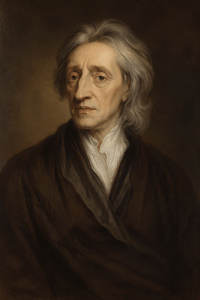
John Locke (1632–1704). AI-generated interpretation based on Godfrey Kneller’s 1697 public-domain portrait; source reference: Wikimedia Commons.
John Locke did not write the Declaration of Independence or the Constitution. He did something just as important: he supplied much of the language and logic that made those documents possible. Long before the American colonies declared independence, Locke had argued that people possess rights by nature, that government exists to protect those rights, and that political power is legitimate only when it rests on the consent of the governed.
From Natural Rights to the Declaration
Locke’s argument in the Second Treatise of Government is easy to recognize in the Declaration. His natural rights—life, liberty, and property—appear in American form as “Life, Liberty and the pursuit of Happiness.” His belief that government receives its authority from the people becomes “the consent of the governed.” His conclusion that a people may replace a government that betrays its trust becomes the Declaration’s case for independence.
Jefferson and the Continental Congress were not merely borrowing a few memorable phrases. They were adopting a moral framework. Rights come before government. Government is a trust, not a master. When rulers repeatedly violate the purpose for which government was formed, the people are not bound to submit forever. The 27 grievances supplied the evidence; Locke’s reasoning helped explain why that evidence justified separation.
From Principle to a Constitution
The Constitution does not repeat Locke word for word, nor was he the Founders’ only influence. Yet its structure reflects the problem he placed at the center of political life: how can a people create a government strong enough to protect liberty without allowing it to become a threat to liberty? Written powers, representative institutions, regular elections, and the ability of citizens to hold officeholders accountable all rest comfortably within Locke’s understanding of government by consent.
His defense of religious toleration also belongs in this story. Locke insisted that faith could not be produced by force and that civil authority should not command the conscience. The American protection of religious liberty developed through many voices and experiences, but Locke helped give the principle a durable intellectual foundation.
Locke’s wisdom was indispensable because he helped turn resistance to tyranny into a reasoned defense of liberty. He taught that freedom was not a gift handed down by a ruler. It belonged to the people, and government was responsible to them. The Declaration gave that conviction a national voice. The Constitution gave it a working form.
Read Locke for Free
- Two Treatises of Government — Project Gutenberg. The essential political work, including the Second Treatise.
- John Locke’s author page — Project Gutenberg. Free editions of the Second Treatise and An Essay Concerning Human Understanding.
- Two Treatises of Government and A Letter Concerning Toleration — Internet Archive. An online collection marked for public-domain use.
- John Locke: Complete Works — Internet Archive. A broad public-domain collection for further study.
Use note: Locke’s original writings are in the public domain. A modern introduction, translation, annotation, or edited layout may carry separate rights, so the links above favor collections that identify their access or public-domain status.
You can find more on John Locke’s wisdom by clicking HERE. You can find a short biography by clicking HERE.