 It is amazing that of the over1,000 pages of Lostpine’s website, the most popular Biblical story is the children’s story about the prophet Amos. When you consider that those who wrote the Bible lived at different times, some separated by hundreds of years. In many cases, they were strangers to one another. Some Bible writers were businessmen or traders; others were shepherds, fishermen, soldiers, physicians, preachers, kings, and human beings from all walks of life. They served under different governments and lived within contrasting cultures and systems of philosophy. However, the wonder of it all, the 66 books of the Bible with their 1,189 chapters making up of 31,173 verses (NIV) present a perfect harmony in the message they convey. Yet of the twenty years that this website has been published, a children’s story about a minor prophet is number one! That being the case, maybe there is an adult lesson in Amos too.
After Solomon’s death (930 BC), an open insurrection led to the breaking away of the ten northern tribes and the division of the country into a northern kingdom, Israel, and a southern kingdom, Judah, on the territory of the tribes of Judah and Benjamin. The Kingdom of Israel, with its capital Samaria, would last more than 200 years under 19 kings, while the Kingdom of Judah, ruled from Jerusalem, would be ruled for 350 years by an equal number of kings from the lineage of David. The expansion of the Assyrian and Babylonian empires would bring war, first to Israel and later, to Judah. Surprisingly, the cause of ancient Israel splitting into two lies at the feet of King Solomon. That is a study for another day. The problem was compounded by the Northern Kingdom’s appointment of terrible kings. Solomon had laid the foundation of sin for the Israelites and the people adopted it well. They enjoyed their sinful lives, and then their enemies came in and finished the job. The Assyrians would eventually enslave them.
Amos was one of the Twelve Minor Prophets, an older contemporary of Hosea and Isaiah, and was active 760–755 BC during the rule of kings Jeroboam II and Uzziah. Amos was a sheep herder and a sycamore fig farmer turned prophet. Not a “professional prophet,” his ministry and prophecies concluded around 762, two years before a great earthquake (Zechariah 14:5). Amos wrote at a time of relative peace and prosperity but also a long period of neglect of God’s laws. He spoke against an increased disparity between the very wealthy and the poor. His message was simple: Amos proclaimed that an ethical God required ethical relations between people to assure God’s divine favor. When one ponders the state of political unrest and division in our country, it is a comparative message for our present time.
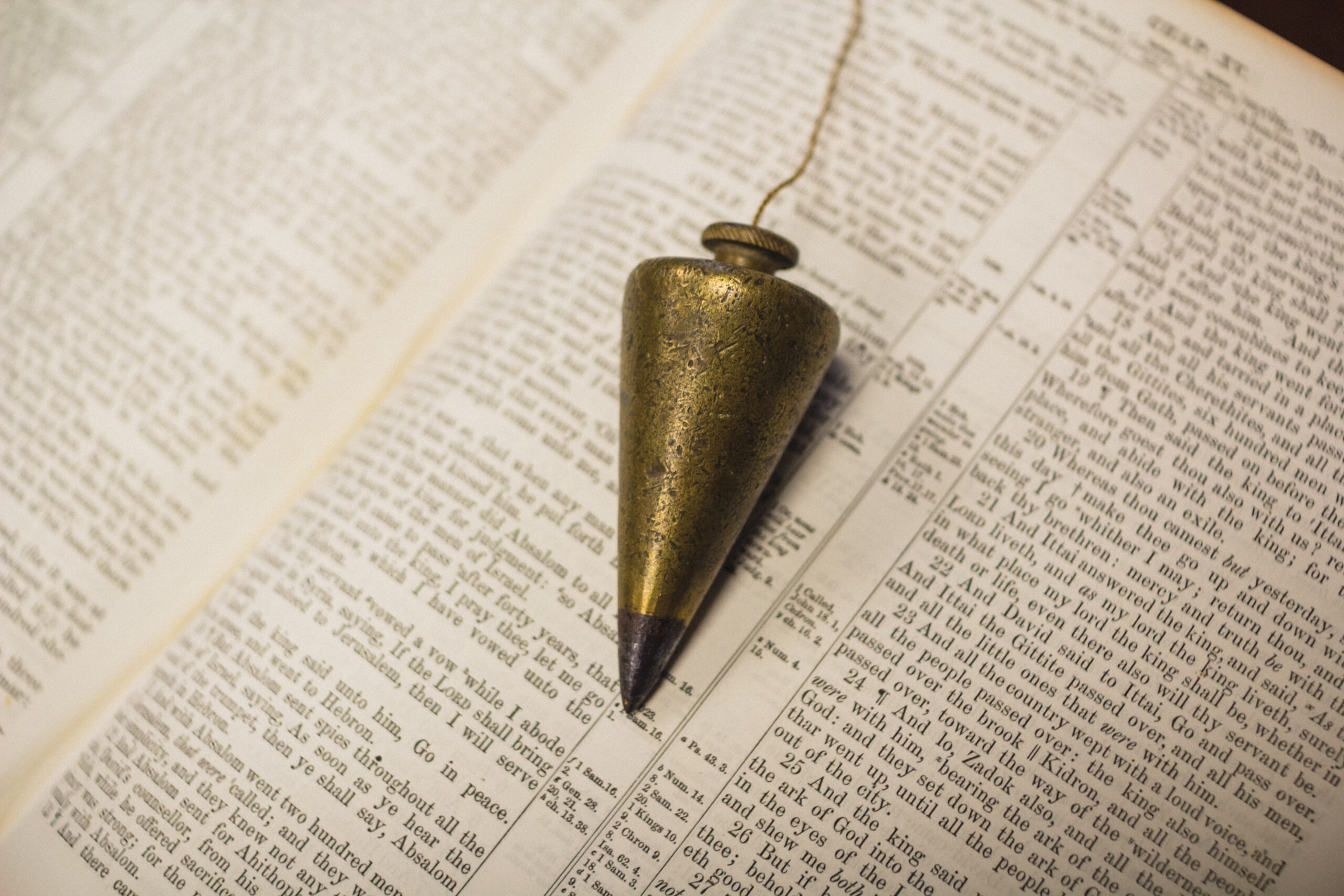
Prophets were sent by God because He loved His people and with each prophet, a warning would come forth to direct God’s people to change their behavior. Amos’s lament (Amos 5) and warning were because ten of the tribes (excluding Judah and Benjamin) which had lasted for about 210 years, would be destroyed by Assyria in 722 BC. Amos is instructed by God with this well-known narrative (Amos7:7-8) that includes a reference to a plumb line. However, let us read all the verses, those before and after the ones we typically give to our children:
(Amos 7:1-9) – This is what the Sovereign Lord showed me: He was preparing swarms of locusts after the king’s share had been harvested and just as the late crops were coming up. When they had stripped the land clean, I cried out, “Sovereign Lord, forgive! How can Jacob survive? He is so small!” So the Lord relented. “This will not happen,” the Lord said. This is what the Sovereign Lord showed me: The Sovereign Lord was calling for judgment by fire; it dried up the great deep and devoured the land. Then I cried out, “Sovereign Lord, I beg you, stop! How can Jacob survive? He is so small!” So the Lord relented. “This will not happen either,” the Sovereign Lord said. This is what he showed me: The Lord was standing by a wall that had been built true to plumb, with a plumb line in his hand. And the Lord asked me, “What do you see, Amos?” “A plumb line,” I replied. Then the Lord said, “Look, I am setting a plumb line among my people Israel; I will spare them no longer. “The high places of Isaac will be destroyed, and the sanctuaries of Israel will be ruined; with my sword, I will rise against the house of Jeroboam.”
The problem pointed out here is that those who claim God, live lives that were inconsistent with such a claim. These so-called believers were accused by God of singing idle songs, drinking wine from bowls, and anointing themselves with the finest oils (living the good life). In and of themselves these things (singing, anointing, even drinking) were not the problem. The problem was that these practices were carried on even while “their ship is sinking (their country was in trouble),” and the people simply did not care. The questions that Amos was asking were:
- How can you feast when some have nothing to eat?
- How can you anoint yourselves when the least among us have no honor?
- How can you celebrate as the worlds of so many others are falling apart around them?
God is ANGRY, MAD! Amos is laying it out as clearly as he can. Such behavior, God declares through Amos, is senseless, and this is exactly what the people are doing: “But you have turned justice into poison and the fruit of righteousness into bitterness” (6:12b). God then goes on in chapter 7 where Amos is making an appeal to God, praying on behalf of the people. God is about to send locusts and fire. They were spared because of Amos’s prayers. However, God lays it out quite clearly. He is setting a standard, a plumb line, and will measure His people by this standard. God is not going to let them off the hook. History shows, that people never did measure up.
Why is a plumb line such a perfect metaphor? It is a simple tool, requiring no training to use. It needs no manuals, everyone can be an expert with a plumb line, and even in our high-tech age, no one has ever electrified or computerized, a plumb line. There is no advanced model, no Pro version, and it never needs updating. A plumb line always gives us a perfect vertical to measure against. Now the Israelites failed to grasp this simple concept. The Assyrians would take care of them some 40 years later. But today, we are not quite in that same dilemma. Today, we have Jesus Christ, our perfect plumb line, to measure our own lives and character against. Today we have no excuses.
Before you relax and say things are great, you are saved and hallelujah Jesus, let us reflect on reality. In Jurgen Moltmann’s (famed theologian) book, “The Crucified God,” Moltmann brings forward a wakeup call to everyone that professes Christ as their savior: “Jesus was folly to the wise, a scandal to the devout and a disturber of the peace in the eyes of the mighty. That is why he was crucified. If anyone identifies with him, this world is ‘crucified’ to him, as Paul said. He becomes alienated from the wisdom, religion, and power politics of his society. The crucified Christ became the brother of the despised, abandoned, and oppressed.” So, are you ready to be despised, abandoned, and oppressed? Following Jesus, measuring up against the “plumb line” is not an easy thing to do. Our world is against you! However, God has made it painfully clear, that the people of this world, especially those who call themselves people of God, must be different. They must set standards of compassion and love that this world has never seen. God’s expectations are for His people to be discerning and seek His Truth. The hungry must be fed, the killing of the born and unborn must stop, and divisiveness must make way for progress against the issues in our world that matter most to God.
The story of Amos the shepherd-turned-prophet is much more than a children’s story. It is a contemporary view of our society. It calls out to all of us to re-examine our priorities and to learn to live lives pleasing to God. We have no excuses either. Christ already came, He set the standard for how to live, Christ is with us today to help, and He even gave us simplified instructions:
(John 13:34) – “A new command I give you: Love one another. As I have loved you, so you must love one another.
It will not be an easy thing to do, but we all must start, one prayer at a time, one charitable act, and one forgiving moment at a time. While the short children’s story about Amos is number one, my prayer for this study would be that this adult story about Amos becomes number two.
Contemplations:
- Do you think that the “ship is sinking,” that our country is in deep trouble and the people don’t care?
- Ideas to Explore: If we are divided, what does each group represent and believe? Do some people not care about God? What type of national sins do you see? What are the similarities between our country and Northern Israel that caused God to be upset and send Amos? Do we have prophets among us today?
- Why is it hard to walk with Christ?
- Ideas to Explore: Are we persecuted? Exactly what is hard? Is being a Christian beneficial in your circle of friends? Are you fearful? What causes you to hesitate on your walk?
- Why do you think so many people hate Christians?
- Ideas to Explore: They envy the peace Christ brings to one’s life. They are afraid that you will hold them accountable if you see some immoral act. The truth of Jesus convicts one’s soul – Do you think people like their sinful life and just don’t want to change? Are we too smug about being saved and judgmental or sanctimonious? Do Christians talk too much about their salvation? Is the promise of salvation an excuse to be a lazy Christian?
- Why if we are hated and persecuted so much should we be open with our testimonies about Christ?
- Ideas to Explore: What does it mean to be a disciple of Christ? Does it help to learn how to give a testimony? Could God’s plan even work if no one shared their faith? Who wins if all Christians are quiet?
- How do you get to know Christ well enough to use Him as a plumb line, to guide your own life?
- Ideas to Explore: What are all the ways one can learn about Christ and how He lived? What impact do prayer and the Holy Spirit have on our faith walk?
 The Story