
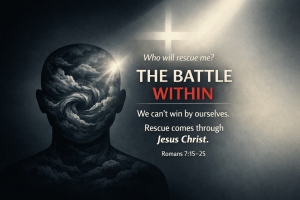
Have you ever found yourself torn between two conflicting desires? One moment, you strive for patience and trust in God, but the next, anxiety rears its head and takes control. It’s a universal struggle, an internal tug-of-war that all too often leaves us feeling broken, a failure in our faith. Imagine wanting to embrace forgiveness only to find that past hurts resurface as if they happened yesterday. This type of battle within reveals a deeper truth: we are often caught between the person we aspire to be and the reality of who we currently are. In this dance of duality, we explore the complexities of human experience, grappling with the contradictions that shape our lives.
That inner tug-of-war isn’t new, and it isn’t proof that you’re the only one struggling. The apostle Paul describes the conflict with uncomfortable clarity in Romans 7. It reads like a journal entry from someone who knows the difference between what is right and what is easy, and who has discovered that knowing is not the same as being free.
(Romans 7:15-25)1NIV New International Version Transations – “I do not understand what I do. For what I want to do I do not do, but what I hate I do. And if I do what I do not want to do, I agree that the law is good. As it is, it is no longer I myself who do it, but it is sin living in me. For I know that good itself does not dwell in me, that is, in my sinful nature. For I have the desire to do what is good, but I cannot carry it out. For I do not do the good I want to do, but the evil I do not want to do—this I keep on doing. Now if I do what I do not want to do, it is no longer I who do it, but it is sin living in me that does it. So I find this law at work: Although I want to do good, evil is right there with me. For in my inner being I delight in God’s law; but I see another law at work in me, waging war against the law of my mind and making me a prisoner of the law of sin at work within me. What a wretched man I am! Who will rescue me from this body that is subject to death? Thanks be to God, who delivers me through Jesus Christ our Lord! So then, I myself in my mind am a slave to God’s law, but in my sinful nature a slave to the law of sin.”
Paul isn’t describing a minor self-improvement project. He is describing a deeper human problem, one that lies somewhere beneath habits and intentions. Notice the emotional weight of Paul’s words: conflict, frustration, war, captivity, and then a sudden pivot toward rescue. Listen to his words: “I do what I hate,” “sin living in me,” “waging war,” “prisoner.” We tend to live our lives as if better information, motivation, or discipline would finally make us the perfect person. But Romans 7 suggests something more sobering: there is a force at work inside us that can overpower what we know, what we value, and what we promise ourselves. That’s why willpower can make you feel like a hero for a day, and an exhausted loser by the end of the week.
Why We Can’t Win This Fight by Ourselves
Scripture doesn’t flatter us, but it does tell us the truth. The struggle is not only “out there” in the world around us; it is also “in here” in the world within us. Three realities show up repeatedly: our hearts can deceive us, our desires can pull us in opposite directions, and sin can act like a power that holds us captive.
The heart problem
We like to believe that our hearts are basically reliable, especially when our intentions feel sincere. Yet Scripture warns that the heart can be deceitful and “beyond cure” (Jeremiah 17:9). Jesus goes even further by tracing the mess of human life back to an internal source (Mark 7:20–23). In other words, the deepest problem isn’t merely bad influence or bad luck; it’s a bent center. That’s why “trying harder” can trim branches while the root keeps growing.
The desire problem
Even when we want what is good, we can feel competing cravings inside us. Paul describes it plainly: the flesh and the Spirit desire different things (Galatians 5:16–17). This isn’t just a moment of temptation; it’s a pattern of internal pressure. It explains why we can be honest about our faith and still feel pulled toward comfort, control, approval, escape, or revenge.
The bondage problem
Romans 7 uses words like “war” and “captivity” for a reason. Sin is not described as a small weakness that politely steps aside when we get serious. It behaves like power, something that can dominate a person’s choices even while they protest. If the problem is power, then the solution cannot be mere advice. We don’t only need a map; we need a rescuer!
The Bottom Line: Without Jesus, We Don’t Win
Paul’s honesty raises a question many of us have asked in private: “Who will rescue me?” Romans 7 does not end with a pep talk. It ends with deliverance through Jesus Christ. That is the Christian claim: the deepest battle in us cannot be won by the best version of us. We need someone outside the prison to open the door.
This is why grace matters. God does not wait for us to become strong enough to qualify for help. He meets us in weakness and supplies what we do not have (see 2 Corinthians 12:9). The point is not that Christians never struggle; rather, the struggle is no longer fought alone.
The way ahead isn’t about trying too hard to be perfect, but a new way of living: walking by the Spirit rather than feeding the flesh (Galatians 5:16–17). In simple terms, living a faithful life means relying on something greater than yourself. It can involve reaching out for help through prayer when you’re feeling vulnerable or scared. Instead of hiding your mistakes, you’ll choose to confess and be honest about them. When you’re tempted to make excuses for your actions, you focus on the truth instead. And when you feel the urge to procrastinate or avoid doing what you know is right, you choose to obey and act. It’s about being open, honest, and willing to do what’s best, even when it’s tough.
A Human Example of the “Good Fight”
Paul is helpful here not because he presents himself as flawless, but because he refuses to pretend. You can hear the struggle in Romans 7, and you can also see the endurance of a man who keeps moving forward, imperfectly, but faithfully. Later, he describes his life as pressing on toward what God has called him to (Philippians 3:12–14). Near the end, he can look back and say he fought the good fight and kept the faith (2 Timothy 4:7–8). Paul’s “win” is not a sinless performance; it is a life of sustained trust in Christ. Through his Spirit-inspired letters, gospel-driven courage, and steadfast surrender to Jesus. All of this from the Apostle Paul, who became a foundational voice who shapes our faith and shows us what it looks like to follow Christ, no matter the cost.
Contemplations
- Where do you feel the “two selves” conflict most right now, your intentions versus your actions?
- Ideas to Explore: Reflect on specific situations where your desires clash with your choices. How does this inner tension impact your daily life and relationships?
- What patterns of behavior do you notice in yourself, trigger → desire → action → regret?
- Ideas to Explore: Consider how these patterns affect your overall well-being. What insights can you gain to break the cycle and make more aligned choices?
- How do you rationalize your choices in the moment, and what does this reveal about your internal struggles?
- Ideas to Explore: What justifications do you use for decisions that don’t align with your values? How can understanding this help you shift your perspective and take accountability?
- In moments of weakness, do you rely on self-sufficiency or turn to God?
- Ideas to Explore: Reflect on your default response when faced with challenges, and how 2 Corinthians 12:9 encourages you to embrace your weaknesses. What steps can you take this week to practice dependence on God through prayer, confession, and obedience?
Do you ever feel like you’re losing the same battle on repeat—saying you’ll change, meaning it, and then doing the very thing you hate anyway? This study goes straight into that frustration (Romans 7) and shows why willpower isn’t the answer—and why Jesus is.
- 1NIV New International Version Transations ↩︎