
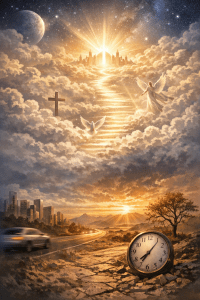
Eternity is time with no end, an infinite duration. Plato described time as the “moving image of eternity,” suggesting that eternity is a realm of unchanging perfection existing outside the bounds of temporal change. To humanity, we are bound by time. As Henry Van Dyke, a prominent American author, poet, Presbyterian clergyman, educator, and diplomat, has stated, “Time is too slow for those who wait, too swift for those who fear, too long for those who grieve, too short for those who rejoice, but for those who love, time is eternity.” In a religious context, we define eternity as the infinite nature of God, who exists beyond our temporal limitations.
Do you have an eternal perspective? Do you believe in the promise of everlasting life, a spiritual existence that transcends physical death? Eternity transcends ordinary understanding, representing infinite or unending time, timelessness, or a state beyond temporal existence. It is central to our faith, to the very nature of God, to the afterlife, and to the ultimate destiny of our souls.
(Genesis 2:7)1NIV New International Version Translations – “Then the LORD God formed a man from the dust of the ground and breathed into his nostrils the breath of life, and the man became a living being.”
Your soul, my soul, came from God’s very breath. It sets you apart from every living creature in our world. Humanity is special, God’s very own creation, modeled after Himself, establishing every person as worthy of eternal life. We are told in Psalm 90:2 and Genesis 21:33 that “God is the everlasting Creator and Sustainer, without beginning or end.” If we do not understand God’s eternal nature, we lack an eternal perspective.
The Apostle Peter tells us that we are “aliens and strangers” in this world (1 Peter 2:11). Our true citizenship is in heaven (Philippians 3:20). Life is temporal; our eternal home was created to exist with God. Humanity is called to focus on eternal realities instead of becoming consumed by earthly matters. “Set your minds on things above, not on earthly things” (Colossians 3:1-2). Humanity is told, “You ought to live holy and godly lives as you look forward to the day of God… In keeping with his promise, we are looking forward to a new heaven and a new earth, the home of righteousness” (2 Peter 3:11-14).
When we have an eternal perspective, our lives prioritize holy living. Those around us can see God’s Glory in the love and grace you reflect. It means you have chosen to honor God and contribute to His eternal kingdom! It reflects the same rationale that someone who has planted a tree, knowing the shade and fruit will benefit the next generation, not themselves.
There are practical implications for having an eternal perspective. Our choices in life are different from those of the world. The Apostle John tells us in 1 John 2:15-17, “Do not love the world or anything in the world. If anyone loves the world, the love of the Father is not in him. For everything in the world—the lust of the flesh, the lust of the eyes, and the pride of life—comes not from the Father but from the world. The world and its desires pass away, but whoever does the will of God lives forever.”
Every person is responsible to God for their actions. According to 1 Corinthians 3:12-14, our deeds will be evaluated, and we will receive rewards for them. The Holy Spirit plays a vital role in helping us maintain focus on eternity (as highlighted in Ephesians 5:18 and Galatians 5:16). We are encouraged to seek the Holy Spirit’s guidance in our daily choices and spiritual development.
To keep our focus on eternity, we need to incorporate this perspective into our everyday lives. Stewardship involves managing our time, talents, and resources wisely for God’s purposes. Serving others means investing in relationships and performing acts of kindness. Additionally, regular practices like prayer, meditation on Scripture, and worship help us remain mindful of eternal matters.
In our fast-paced world, distractions abound, so it’s important to be prepared for that challenge. When we support one another, our communities become stronger. Imagine how different our communities would be if everyone focused on storing up treasures in heaven rather than accumulating things in their attics or garages.
(Matthew 6:19-21) – “Do not store up for yourselves treasures on earth, where moths and vermin destroy, and where thieves break in and steal. But store up for yourselves treasures in heaven, where moths and vermin do not destroy, and where thieves do not break in and steal. For where your treasure is, there your heart will be also.”
Jesus invites us to see wealth through a larger, lasting perspective. He reminds us that earthly treasures are fragile and temporary, while the things we invest in for God’s purposes endure. When we choose generosity, we participate in something that outlives us. Wealth can be a meaningful tool for good, not something to cling to, and every act of giving shapes our character in ways that carry into eternity. In this light, sharing what we have becomes a joyful and secure investment, one that aligns our hearts with what truly matters.
We celebrate the incredible journey of the crucifixion, resurrection, and the promise of a final judgment, culminating in the joyous hope of forgiveness, reconciliation, and a new heaven and a new earth. Yes, we have Jesus Christ! He assures us, “Look, I am coming soon! My reward is with me, and I will give to each person according to what they have done” (Revelation 22:12). The hope of eternal life shines brightly through our Savior, God’s Son. While humanity may feel distanced from eternity due to sin, there is no sin in God’s Kingdom, only boundless peace and love. By turning towards repentance, faith, and hope in Jesus Christ, we break free from our temporary world. Remember, “For God so loved the world that he gave his one and only Son, that whoever believes in him shall not perish but have eternal life” (John 3:16). Our earthly struggles are fleeting, but the promise of eternal glory is everlasting! Embrace the hope and love that awaits us!
Contemplations
- What does it mean to live with an eternal perspective?
-
- Ideas to Explore: Consider how your daily choices would change if you viewed them through the lens of eternity. For example, would you prioritize relationships, kindness, and spiritual growth over temporary achievements or material possessions?
- How do Jesus’ teachings challenge your priorities?
-
- Ideas to Explore: Examine passages such as Matthew 6:19-21, where Jesus encourages us to store up treasures in heaven rather than on earth. What practical steps could you take to align your priorities with these teachings?
- In what areas of your life do you find it most challenging to maintain an eternal perspective?
-
- Ideas to Explore: Situations, such as work, family, or finances, where it’s easy to become absorbed in immediate concerns. How might you remind yourself to view these through the lens of eternity?
- How can focusing on eternity change your daily decisions?
- Ideas to Explore: Consider how investing in things that last for eternity, such as love, faith, and service, could reshape your priorities and bring deeper meaning to everyday choices.
- 1NIV New International Version Translations ↩︎