
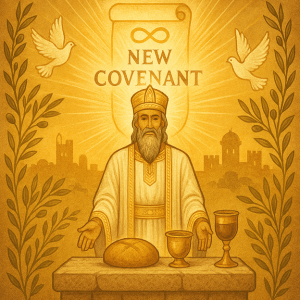
As we embark on our journeys through Scripture, we often encounter people who may seem obscure at first glance—individuals whose names can be challenging to pronounce and whose stories receive little exploration. One such figure is King Melchizedek, a character whose significance resonates deeply within our faith. First introduced in Genesis 14:18-20 as the “king of Salem and priest of God Most High,” Melchizedek appears briefly, bringing forth bread and wine, bestowing a blessing upon Abraham, and receiving a tithe (a tenth of the plunder) after Abraham’s victory over several kings. Yet, his true importance unfolds only in the New Testament, where he stands as a striking foreshadowing of Jesus Christ. The word “Salem” is widely understood to be an ancient name for Jerusalem. In Hebrew, “Salem” (Shalem) is closely related to “shalom,” meaning peace, wholeness, or completeness. Therefore, “King of Salem” literally means “King of Peace.” Melchizedek ruled over a city whose very name signified tranquility and righteousness.
For Christians today, the study of Melchizedek is vital in grasping the profound nature of Jesus as our ultimate High Priest, a truth elaborated upon in the Book of Hebrews. Prepare to delve into the depths of Melchizedek’s legacy and its pivotal role in our understanding of the roots of faith and redemption through Jesus Christ.
The Book of Hebrews is distinct among the New Testament writings because it does not identify its author. Unlike the letters of the Apostle Paul, which usually begin with a personal greeting, Hebrews opens without one. This absence has led to centuries of debate and speculation regarding the author’s identity. Whoever the author may be, they demonstrate a strong familiarity with the Old Testament. The author recounts the story of Abraham, from whom the Levitical priests descended, highlighting that Abraham paid a tithe to Melchizedek and was blessed by him. Melchizedek’s priesthood is presented as superior to the Aaronic/Levitical priesthood of the Old Covenant.
(Hebrews 7:3-7)1NIV New International Version Translations – “Without father or mother, without genealogy, without beginning of days or end of life, resembling the Son of God, he remains a priest forever. Just think how great he was: Even the patriarch Abraham gave him a tenth of the plunder! Now the law requires the descendants of Levi who become priests to collect a tenth from the people—that is, from their fellow Israelites—even though they also are descended from Abraham. This man, however, did not trace his descent from Levi, yet he collected a tenth from Abraham and blessed him who had the promises. And without doubt the lesser is blessed by the greater.”
The author of Hebrews uses this to argue that if a greater priesthood (Melchizedek’s) existed before the Mosaic Law, then God has a right to change the law and institute a better, permanent priesthood through Jesus (a new Covenant). Unlike the Levitical priests who died and had to be replaced, the biblical text presents Melchizedek as “without father or mother, without genealogy, without beginning of days or end of life, resembling the Son of God, he remains a priest forever” (Hebrews 7:3). This eternal nature points us directly to Jesus, who has a “permanent priesthood” because “he lives forever to intercede for them” (Hebrews 7:24-25).
We find affirmation of this also in Psalm 110:4, as a Messianic prophecy, where God swears an oath to the Messiah (Jesus Himself): “The Lord has sworn and will not change his mind: ‘You are a priest forever, in the order of Melchizedek.‘” In Hebrews 5, 6, and 7, the full significance of Jesus Christ is revealed, demonstrating how Jesus is the complete and perfect fulfillment of the “order of Melchizedek,” establishing a better covenant (Hebrews 7:22) for all who come to God through Christ.
Studying Melchizedek helps us appreciate the uniqueness and supremacy of Jesus Christ’s ministry. He is not just a temporary priest under the Old Law, but an eternal High Priest who perfectly fulfills the ancient pattern set by Melchizedek, allowing us to “draw near to God through him” (Hebrews 7:19). Jesus did not become the High Priest based on a regulation or His ancestry but based on His indestructible, perfect life, and His eternal, resurrected nature (Hebrews 7:18-19). God set aside the former rules because they were useless. Instead, God gave us a better hope —a perfect hope — to bring us to Him via His Son.
(Hebrews 7:20-22) – “And it was not without an oath! Others became priests without any oath, but he became a priest with an oath when God said to him: ‘The Lord has sworn and will not change his mind: You are a priest forever.’ Because of this oath, Jesus has become the guarantor of a better covenant.”
Contemplations
- How does Melchizedek’s role as King of Salem/Peace challenge our understanding of leadership and spiritual authority today?
- Idea to explore: Consider how combining the roles of king and priest in Melchizedek’s example might influence our expectations of modern leaders—should authentic leadership always strive for both justice and peace? Reflect on the implications for spiritual communities: What does it mean for a leader to be both a source of righteousness and a bringer of peace?
- In what ways does the “order of Melchizedek” shape our view of Jesus as the ultimate High Priest and mediator?
- Idea to explore: How does the eternal and unchangeable nature of Melchizedek’s priesthood point to the permanence and sufficiency of Jesus’ role in redemption? How might this concept affect personal faith—does seeing Jesus as a priest “forever” offer new hope or assurance in your spiritual journey?
- 1NIV New International Version Translations