
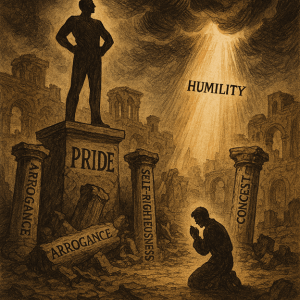
There is danger lurking in “Pride” and the “Sins of Self.” For those who claim intellectual superiority in their skills and knowledge, our Bible has much to say about arrogance and a refusal to admit error. The Bible is filled with stories that contrast human fallibility and pride with God’s perfect truth and wisdom. As we explore this topic, we will discover that humility is a crucial path to genuine wisdom.
King Nebuchadnezzar (“I am always right“)
The story of Nebuchadnezzar II is about a powerful, intelligent ruler brought to utter humiliation for attributing his success to his own power and wisdom rather than to God. Nebuchadnezzar was the king of the Neo-Babylonian Empire, reigning from about 605 BC to 562 BC. He was the eldest son of Nabopolassar, who founded the Chaldean dynasty. He is best known for his military conquests, his defeat of the Egyptians at the Battle of Carchemish, and for expanding the Babylonian Empire to its greatest extent and influence in the ancient world.
Nebuchadnezzar is also renowned for his ambitious building projects in Babylon, including the legendary Hanging Gardens (one of the Seven Wonders of the Ancient World), and for making Babylon a center of power and culture. Biblically, Nebuchadnezzar is best known for conquering Jerusalem, destroying Solomon’s Temple, and initiating the Babylonian Captivity, during which many Jews were exiled to Babylon. Let’s look at the Book of Daniel to understand more.
In Daniel 4:30, Nebuchadnezzar surveys his kingdom and proudly exclaims to Daniel, “Is not this the great Babylon I have built as the royal residence, by my mighty power and for the glory of my majesty?1NIV New International Version Translations” Before he can finish his proclamation, a voice from heaven pronounces judgment, and he is struck with madness, living like an animal until he acknowledges that it is God who rules the kingdom of men. After some time, Nebuchadnezzar finally raised his eyes toward heaven, and his sanity was restored. Then he praised God, honored Him, and glorified Him. The king’s honor and splendor were restored. Nebuchadnezzar’s story is chronicled in Daniel 4:1–37.
The Parable of the Pharisee and the Tax Collector
In Luke 18:9-14, Jesus tells a story that sharply contrasts self-righteousness with genuine humility. A Pharisee, respected for his religious knowledge, stands apart and thanks God that he is not like other people, especially the tax collector. He boasts about his good deeds. Meanwhile, the tax collector stands at a distance, beats his chest, and pleads, “God, have mercy on me, a sinner!” Jesus explains that it was the humble tax collector, not the self-assured Pharisee, who God accepted. The lesson is clear: those who lift themselves will be brought low, but those who humble themselves will be lifted.
(Luke 18:14) – “For everyone who exalts himself will be humbled, and he who humbles himself will be exalted.”
The Fall of King Uzziah
King Uzziah, also called Azariah, was the tenth ruler of Judah and reigned for approximately 52 years during the 8th century BC. He ascended to the throne at just 16 years old after his father, Amaziah, was assassinated. Uzziah’s leadership brought great prosperity, military victories, and national growth to Judah. He strengthened Jerusalem’s defenses, fortified cities, and expanded the nation’s territory.
In his early years, Uzziah dedicated himself to seeking God, resulting in abundant blessings and notable victories for Judah. However, as his power grew, so did his pride, leading to a tragic downfall. Defying God’s law, Uzziah brazenly entered the temple to burn incense, a sacred task reserved solely for the priests. When he was confronted with this grave mistake, instead of repenting, he became angry. Therefore, God struck him with leprosy, forcing him to live with this devastating disease until his death. During his affliction, his son Jotham assumed control of the kingdom, taking over the government in a time of crisis.
Uzziah is primarily chronicled in 2 Kings 15:1-7 and 2 Chronicles 26:1-23. His reign intersects with the prophetic ministry of Isaiah, as evidenced by Uzziah’s death, which profoundly impacted Isaiah’s life and calling, as described in Isaiah 6:1.
God’s Opinion on Pride and Humility (The Sin of Self)
The danger of pride, especially when one is “wise in one’s own eyes,” becomes the spiritual root of the question “Are you ever wrong?“
- Proverbs 26:12: “Do you see a person wise in their own eyes? There is more hope for a fool than for them.” (This verse is a profound indictment of intellectual conceit, suggesting it’s a more challenging obstacle than simple foolishness.)
- Romans 12:3: “For by the grace given to me I say to everyone among you not to think of himself more highly than he ought to think, but to think with sober judgment, each according to the measure of faith that God has assigned.” (A New Testament instruction for a humble, realistic self-assessment.)
- 1 Corinthians 8:1-2: “Knowledge puffs up, but love builds up. If anyone imagines that he knows something, he does not yet know as he ought to know.” (A key critique of intellectual arrogance without humility and love.)
Fixing the Problem
The antidote to believing “I am always right” is recognizing that God is always right. God’s actions are always just and correct (Psalm 145:17: “The Lord is righteous in all his ways and kind in all his works.”). We have a God of faithfulness and without injustice. He is righteous and upright. A declaration of God’s perfect justice and truth is made in Deuteronomy 32:4. This should humble the human mind by showing the incomparable superiority of divine wisdom.
(Isaiah 55:8-9) – “For my thoughts are not your thoughts, neither are your ways my ways, declares the Lord. For as the heavens are higher than the earth, so are my ways higher than your ways and my thoughts than your thoughts.”
The life of Jesus provides the ultimate model of humility, directly contrasting with self-exaltation.
Philippians 2:3-8 should be our standard for humility. It speaks of Jesus, who, being in the very nature of God, did not count equality with God a thing to be grasped, but emptied himself, taking the form of a servant. He demonstrates that true greatness comes not from asserting superiority but from embracing service and humility, the antithesis of being unwilling to be wrong.
Conclusion
Our world today needs each of us to confront the dangers of pride and the illusion of always being right. Through the stories of Nebuchadnezzar, the Pharisee and the tax collector, and King Uzziah, we see a consistent biblical warning: self-exaltation and intellectual arrogance lead to downfall. At the same time, humility opens the door to true wisdom and God’s favor. We need to challenge our beliefs by aligning them with God’s truth. Always remember, humanity was never given the right to define sin. That is the exclusive right of our Creator. Our task is to search for understanding!
Nebuchadnezzar’s pride in his achievements brought him to humiliation until he acknowledged God’s sovereignty. The Pharisee’s self-righteousness blinded him to his own need for grace, while the humble tax collector found acceptance with God. King Uzziah’s early faithfulness brought prosperity, but his later pride led to his tragic fall.
Scripture makes it clear that being “wise in our own eyes” is a spiritual trap. God values a humble heart that recognizes its own limitations and seeks His guidance. True greatness is not found in asserting our superiority, but in admitting our need for God and serving others with humility, just as Jesus did. Admitting we are wrong is not a weakness but may well be the first step toward wisdom, growth, and a deeper relationship with God.
Contemplations
- Why is it so difficult for people to admit when they are wrong, especially in matters of faith, knowledge, or leadership?
- Ideas to explore: The role of pride and fear of losing respect or authority. How cultural or personal backgrounds shape our willingness to admit mistakes—the difference between healthy confidence and destructive arrogance.
- What practical steps can we take to cultivate genuine humility in our daily lives and spiritual walk?
- Ideas to explore: The importance of self-examination and honest prayer. Seeking feedback and accountability from others. How serving others can help shift our focus from self to God and community.
- How can we practice humility in a culture that often prioritizes pride and self-promotion?
- Ideas to explore: Do you keep your work and faith separate? What boundaries would you set on your values to uphold humility?
- 1NIV New International Version Translations