
Wisdom is all around us, intricately woven into the rich tapestry of cultures and communities worldwide! In today’s fast-paced world, our most significant opportunity lies not in a lack of wisdom but in our ability to recognize and welcome it when we truly see it. Wisdom goes beyond mere knowledge or experience; it’s the beautiful art of distinguishing what is true, correct, and enduring, then applying that understanding in meaningful, ethical, and insightful ways. As we embark on a journey of discovery, let’s open our hearts and minds to the many forms of wisdom, actively seeking insight and sound judgment from God and from the diverse perspectives around us. Just as Solomon humbly asked God for an “understanding mind” in 1 Kings 3:9 to guide his people, let us embrace that same spirit today! Together, we can cultivate a deeper appreciation for wisdom and its vital role in shaping a brighter, more compassionate world.
This study draws on wisdom from a non-biblical source. We can appreciate what is good in it, but we must never forget that God’s truth is greater and stands above all other wisdom. Our goal is not only to discern wisely, but also to listen carefully—so that when we share the Gospel, we do so in a way that speaks meaningfully into the lives of others. This kind of open, respectful exchange is precisely what our nation’s First Amendment was designed to protect, ensuring that such bidirectional communication about faith and truth can always take place.
The example we will use today comes from around 4 BC. Zhuangzi (also known as Zhuang Zhou or Master Zhuang) was a prominent Chinese philosopher. He is best known for the text that bears his name, the Zhuangzi, which is a foundational work of Daoism (Taoism). His philosophy explores themes such as spontaneity, freedom, the relativity of things, and the limitations of language. Zhuangzi’s teachings have profoundly influenced Chinese thought, literature, Buddhism, poetry, and painting. But today, we will look at a simple parable:
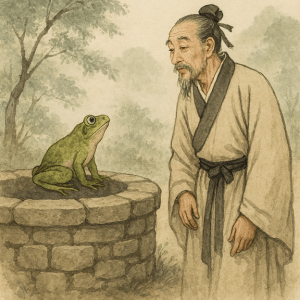
Zhuangzi’s parable tells of a frog who lives contentedly in a well, believing its small world is all there is. When a turtle from the vast Eastern Sea visits, the frog cannot comprehend the ocean’s immensity. The parable concludes that “You can’t explain the ocean to a frog who lives in a well.”
The parable warns against narrow-mindedness and encourages us to seek wisdom beyond our limited perspectives. To grasp wisdom, we must look beyond intelligence or human knowledge. Wisdom is a divine attribute and gift from God—more than mere intelligence, it involves moral and spiritual discernment that guides our daily decisions and ethical behavior. The Bible teaches that “The fear of the Lord is the beginning of knowledge; fools despise wisdom and instruction” (Proverbs 1:7), and encourages us, “If any of you lacks wisdom, let him ask God, who gives generously to all without reproach, and it will be given him” (James 1:5). True wisdom is practical and accessible to those who seek it in faith and humility: “For the Lord gives wisdom; from his mouth come knowledge and understanding” (Proverbs 2:6). Like Solomon, we are invited to open our hearts and minds to wisdom from God and from the diverse perspectives around us, recognizing its vital role in shaping a brighter, more compassionate world.
How often are we like the frog contentedly residing in a deep well, convinced that our limited world is all there is? We have everything we need: water, sunlight, and the comfort of familiar company. It’s easy to see the futility in trying to convey our broader perspective to those who remain comfortable in their own narrow confines. Like the turtle that has ventured into the vast, open ocean, we yearn to share the depth and beauty of our faith, the joy and understanding that come with it. Yet, we find that the frog, rooted in its well, cannot fathom what the ocean represents.
This challenge of sharing one’s faith can be daunting. People can become defensive when their beliefs are questioned, cling tightly to their existing views, or feel overwhelmed by new ideas. It’s like trying to describe the grandeur of the ocean to someone who has never even left their small pond—words can seem inadequate, and we can feel discouraged.
To navigate these waters, we might start by fostering genuine relationships, allowing trust to build over time. Sharing personal experiences—the moments when our faith has brought us hope or joy—can be more impactful than explaining concepts abstractly. It’s also vital to listen actively, to understand where others are coming from, and to acknowledge their beliefs as valid, even if they differ from our own.
Ultimately, while the task may seem complicated, it’s not impossible. With patience, empathy, and a willingness to engage in open-hearted dialogue, we can begin to bridge the gap between our little wells and the vast oceans of possibility that lie beyond.
(Matthew 28:19-20)1NIV New International Version Translations – “Therefore go and make disciples of all nations, baptizing them in the name of the Father and of the Son and of the Holy Spirit, and teaching them to obey everything I have commanded you. And surely I am with you always, to the very end of the age.”
The Value of Wisdom from All Cultures
The Bible affirms that wisdom is not confined to one people or place. God’s creation is vast, and every culture reflects aspects of His creativity and truth. Revelation 7:9 states, “After this I looked, and there before me was a great multitude that no one could count, from every nation, tribe, people, and language, standing before the throne and before the Lamb.” Acts 17:26 affirms, “From one man he made all the nations, that they should inhabit the whole earth…” Genesis 1:27 declares, “So God created mankind in his own image…” These verses remind us that God’s wisdom is available to all, and every culture can offer insights that enrich our understanding of the world.
Recognizing and Avoiding Bias
The “frog in the well” is a powerful metaphor for bias—believing that our own experience is the only reality. The Bible repeatedly warns against favoritism and partiality: “Believers in our glorious Lord Jesus Christ must not show favoritism” (James 2:1), “For God does not show favoritism” (Romans 2:11), “To show favoritism in judging is not good” (Proverbs 24:23), and “There is neither Jew nor Gentile… for you are all one in Christ Jesus” (Galatians 3:28). We are called to judge fairly, seek understanding, and love our neighbors regardless of background.
Biblical Example: Wisdom from Outside the Well
A powerful biblical example is the story of the Magi (Wise Men) in Matthew 2. These scholars came from the East, outside Israel, seeking the newborn Jesus. Their wisdom, drawn from their own culture and studies, led them to recognize God’s work. Another example is Daniel in Babylon (Daniel 1–6), who learned from and influenced a foreign culture while remaining faithful to God.
Conclusion
True wisdom calls us to look beyond the walls of our familiar perspectives. The Scriptures remind us that God shows no favoritism and that all are one in Christ Jesus, urging us to judge fairly, seek understanding, and love our neighbors regardless of their background. As we conclude, let us commit to examining our own “wells,” opening our hearts to the richness of diverse cultures, and embracing the unity that comes from God’s boundless wisdom. In doing so, we not only grow in understanding but also reflect the love and justice at the heart of the gospel.
Contemplations
- In what ways have you been a “frog in the well” in your own life?
- Ideas to Explore: Consider times when you have stayed within familiar environments, routines, or social circles, and how this may have limited your understanding of other perspectives or opportunities for growth. Ask yourself what beliefs or habits keep you from exploring new ideas or experiences.
- How can you actively seek wisdom from other cultures and perspectives?
- Ideas to Explore: Do you engage in conversations with people from different backgrounds—listen to their stories, beliefs, and experiences with an open mind, seeking to understand rather than to judge or compare? How do you expose yourself to differing viewpoints?
- What steps can you take to guard against bias and favoritism in your community?
- Ideas to Explore: Regularly examine your own assumptions and decisions, asking yourself whether you are showing partiality or overlooking specific individuals or groups. Seek honest feedback from others to help identify blind spots and areas where bias may be influencing your actions. Intentionally build relationships with people from different backgrounds, and create opportunities for diverse voices to be heard and valued in your community. Encourage open dialogue and learning from one another to foster a culture of fairness and inclusion.
- 1NIV New International Version Translations