
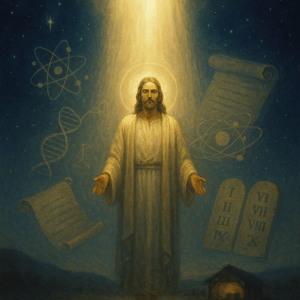
It is worth pausing for a moment and asking, what is truth, and whether your sources have a record of reliability? Before we answer, there are a few things that we must agree on to understand how humanity responds to the revelation of something truthful. First, it may be worth considering whether God exists. His evidence is observable, His presence is detectable, and His grace is necessary to find truth in this world. If you agree that God is real, then you should decide whether God, sustaining sufficient wisdom to create our world, established all its natural laws. Natural laws are necessary not only for our world to exist, but also for it to function. Chaos has no rules. Chaos is what existed before we had a world. God’s natural laws are truths He created from chaos.
What are natural laws? Natural laws come in differing types. We have Natural Laws in Science. In science, natural laws are universal principles that describe how the physical world operates. They are discovered through observation, experimentation, and reasoning, and are considered objective, predictive, and verifiable. You can find examples of natural laws on the website, exampleslab.com. There are also Natural Laws in Philosophy and Theology. These are the ones we will consider in this study. They refer to a system of moral principles believed to be inherent in human nature and discoverable by reason. This tradition dates to ancient Greek philosophers, such as Aristotle, and was further developed by thinkers like Cicero, St. Augustine, and especially St. Thomas Aquinas.
This second group of Natural Laws is universal and objective. They apply to all humans, regardless of their culture or time period, here on earth. Because they are rooted in human reason, we can discern right from wrong by examining human nature and the world. These are part of God’s eternal law, accessible to all through reason, while divine law is revealed through Scripture. The Ten Commandments, the Golden Rule (“Do unto others as you would have them do unto you”), and the innate sense of justice and conscience are often cited as expressions of this second group of natural laws.
Thomas Aquinas (c. 1225–1274) was an Italian Dominican friar, philosopher, and theologian, widely considered one of the most influential thinkers in Western philosophy and Christian theology. Aquinas defined Four Types of Law:
- Eternal Law: God’s wisdom governing the universe.
- Natural Law: The part of eternal law accessible to human reason.
- Divine Law: Revealed through scripture.
- Human Law: Laws created by societies and governments.
To discover God’s natural laws, of which there are many, requires several disciplines:
- Common Sense — You must use discipline, knowledge, and self-correction to discover the mysteries within our created world.
- Discernment — A capacity to recognize the truth and use one’s intellect to gain understanding, recognizing what is true from what is false. It sounds simple, but the prince of chaos and confusion appears to be running our world.
- Revelation — Unless you have a belief in a power greater than yourself, and unless you have accepted our Creator’s plan for salvation (Jesus Christ), you would be missing the power of God Himself, the Holy Spirit. It is through revelation that humanity comes to recognize its separation from its Creator and its inherent sinfulness. It is through the power of the Holy Spirit that we confess our inadequacy and become repentant, opening our minds to receive God’s saving grace. It is through revelation that we then discover God’s Truth!
(John 1:14) – “The Word became flesh and made his dwelling among us. We have seen his glory, the glory of the one and only Son, who came from the Father, full of grace and truth.”
What then would be the natural law of “Christmas?” Christmas is the Christian belief that God became human in the person of Jesus Christ. This means that Jesus is both fully God and fully human. Christians believe that through the Incarnation, God entered the world to reveal Himself, teach humanity, and ultimately save it. The Incarnation, in which God becomes human in Jesus, is the essence of Christmas. Our belief in Christmas is important because it explains to us God’s plan. His word, the Scriptures, describes the workings of the physical universe. Universal moral principles inherent in human nature are discoverable by reason. God’s natural emphasis is on universality, objectivity, and discoverability—not invention—by humans.
As we approach the joyous season of Christmas, our hearts are filled with anticipation and hope! Christmas is not just a holiday—it is the celebration of the most incredible truth ever revealed: God became human in the person of Jesus Christ. Through the Incarnation, God entered our world to teach, guide, and save us, showing us the depth of His love and the power of His grace. The natural laws we discover—both in the world around us and within our hearts—point us to the Creator’s wisdom and His eternal plan. This Christmas, let us rejoice in the promise that Jesus is coming! His arrival brings light to our darkness, order to our chaos, and hope to our souls. Let us prepare our hearts to receive Him, embrace His truth, and share the good news with the world. Jesus is coming—let us celebrate with joy and gratitude!
Contemplations
- What does it mean to you that God became human in Jesus Christ?
- Ideas to explore: Consider how the Incarnation changes your understanding of God’s love and presence in your life. Reflect on how Jesus’ humanity helps you relate to Him personally and how His divinity offers hope and salvation.
- How do the natural laws—both in the world and in our hearts—point us toward God’s wisdom and eternal plan?
- Ideas to explore: Think about examples of natural laws in science (like gravity or the laws of motion) and in morality (like conscience or the Golden Rule). How do these universal truths help you recognize order, purpose, and goodness in creation?
- As Christmas approaches, how can you prepare your heart to receive Jesus and share His truth with others?
- Ideas to explore: Reflect on practical ways to embrace the spirit of Christmas—such as acts of kindness, prayer, and gratitude. Consider how you can share the message of hope and joy with your family, friends, or community.