
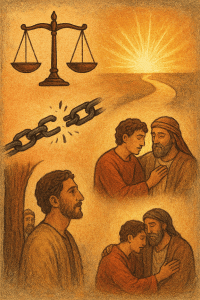
Over the past six months, “fraud” has been a prominent topic in the media. Let’s explore what it truly means and the insightful guidance that God has offered us.
Fraud occurs when an individual deceives another for personal or financial gain. This often involves lying or hiding the truth. Legally, fraud means that the person committing it is aware of their dishonesty and intends for the victim to believe their false information, which ultimately leads to harm. The harm discussed here relates to the misappropriation of tax dollars to individuals or groups under false pretenses.
Allowing fraud to persist is unacceptable. It erodes trust, victimizes individuals and businesses alike, and inflicts lasting harm on a society. Embracing dishonesty breeds an environment where unethical behavior flourishes. Fraud must be rejected in all its forms, and integrity must be demanded in interactions involving a nation’s resources. Standing firm against fraud is not just a choice; it’s a necessity for a just society.
God’s Standard for Honesty
The Bible consistently teaches that honesty and integrity are core values for living a righteous life. Fraud, intentional deception for personal gain, is condemned because it violates God’s command to act justly.
(Leviticus 19:11)1NIV New International Version Translations – “Do not steal. Do not lie. Do not deceive one another.”
When someone believes it is “OK” to defraud others simply because they can, this is a rationalization, a justification for wrongdoing to oneself. Biblically, this mindset is a form of self-deception and pride, which leads people to ignore God’s standards and the harm caused to others. You can search for “wiggle room” if you must, but God has been firm on misrepresentations since our very creation.
(Proverbs 20:17) – “Food gained by fraud tastes sweet, but one ends up with a mouth full of gravel.”
God also makes a direct condemnation. One of the 10 commandments, Exodus 20:15, states, “You shall not steal.” Our New Testament adds even more clarity: “Anyone who has been stealing must steal no longer, but must work, doing something useful with their own hands, that they may have something to share with those in need.” (Ephesians 4:28)
Three Examples of Fraud in the Bible
Our first example is Genesis 27. Jacob deceives Isaac into stealing Esau’s blessing. Jacob, with his mother’s encouragement, disguises himself as his brother Esau to trick their father, Isaac, who is old and nearly blind. By pretending to be Esau, Jacob receives the special blessing meant for the eldest son, securing rights and privileges that would have belonged to Esau. This act of deception leads to significant family conflict and lasting consequences, illustrating the dangers and fallout of fraud and dishonesty.
Our New Testament tells the story of Ananias and Sapphira (Acts 5:1-11). Ananias and Sapphira were a married couple who sold a piece of property and secretly kept back part of the proceeds, claiming to have donated the entire amount to the early Christian community. Their attempt to deceive the apostles and the community was exposed, and both faced immediate and severe consequences for their dishonesty—each died after being confronted about their lie. This story serves as a powerful warning about the seriousness of fraud and the importance of integrity, showing that deceit, especially in matters of faith and community, can have devastating consequences.
One more story can be found in Joshua 7. Achan committed a secret act of disobedience by taking items that had been specifically forbidden during the conquest of Jericho. Although the Israelites were instructed to dedicate all their valuable goods to God, Achan hid some of them for personal gain. His actions brought guilt and defeat upon the entire nation, leading to Israel’s loss in battle and prompting a search for the culprit. Once Achan’s theft was discovered, he and his family faced severe punishment, serving as a warning about the consequences of hidden wrongdoing and the importance of collective integrity.
The above stories show us that there were consequences for the perpetrators of fraud. The Consequences were immediate: For Ananias and Sapphira, death because of lying to God, and for Achan, execution and loss for his family. There were spiritual consequences, too. Proverbs 21:6 states, “A fortune made by a lying tongue is a fleeting vapor and a deadly snare.” Galatians 6:7 tells us, “Do not be deceived: God cannot be mocked. A man reaps what he sows.”
We are also given stories of repentance and encouragement (Luke 19:1-10). After Zacchaeus, a fraudulent tax collector, repented, he publicly declared his intention to give half of his possessions to the poor and to repay anyone he had cheated four times the amount taken. In response to this act of restitution, Jesus announced that salvation had come to Zacchaeus’s house, affirming that he, too, was a son of Abraham. This moment highlighted both the transformative power of genuine repentance and the grace extended to those who turn from wrongdoing.
When fraud is encountered
(Micah 6:11) – “Shall I acquit someone with dishonest scales, with a bag of false weights?”
Micah 6:11 invites us to reflect on the importance of integrity in our dealings. In ancient times, some merchants unfortunately resorted to dishonest practices, like tampering with weights and scales. This verse passionately condemns such behavior, reminding us that fairness and honesty are timeless values. Today, these principles still resonate in every aspect of business, finance, and personal relationships. It encourages us to uphold integrity, knowing that acting honestly is not just a moral obligation, but also a reflection of the values we hold dear.
Micah poses a rhetorical question about whether it is right to excuse someone who uses dishonest measures, such as false weights and scales, in their dealings. The verse highlights that God disapproves of cheating or deception in business or personal transactions, emphasizing the importance of honesty and integrity. As a Christian society, we are called to stand firm against fraud. Micah also reminds us to avoid shortcuts and dishonesty in our lives, whether at work, in business, or in our personal relationships. It’s a call for openness, accountability, and standing firm in our truths, even when we face pressure. This verse emphasizes that genuine success comes from inner integrity, honest actions, and fair treatment of others, truly defining our character. Embracing these values can lead us to a brighter, more meaningful relationship with God!
(Psalm 15:1-2) – “Lord, who may dwell in your sacred tent? … The one whose walk is blameless, who does what is righteous, who speaks the truth from their heart.”
Integrity and honesty are essential in all dealings, as they form the foundation of trust and credibility. Even when dishonest practices seem common or socially accepted, such behavior is unequivocally condemned. God’s standard for justice and fairness remains non-negotiable, reminding us that ethical conduct is not just a guideline but a commitment we uphold. Ultimately, fostering an environment of integrity and fairness not only builds trust but also strengthens the very fabric of our communities.
All that is necessary for the triumph of evil is that good men do nothing. ~ Edmund Burke
Contemplations
- Why is integrity essential in preventing fraud, both personally and in society?
- Ideas to Explore: Consider how personal choices and values—such as honesty and accountability—can influence the broader culture of a community or organization. Reflect on the biblical teachings about honesty (e.g., Leviticus 19:11, Proverbs 20:17) and how these principles apply to everyday decisions, especially when faced with opportunities for dishonesty.
- What are the consequences of fraud, and how can genuine repentance lead to restoration?
- Ideas to Explore: Think about the immediate and long-term effects of fraud on individuals, families, and society, using the biblical stories of Jacob, Ananias and Sapphira, and Achan as examples. Reread the story of Zacchaeus (Luke 19:1-10) to understand how acknowledging wrongdoing and making restitution can transform lives and relationships, and why forgiveness and change are essential in addressing fraud.
- 1NIV New International Version Translations ↩︎