
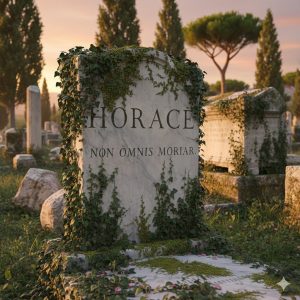
Horace, a remarkable Roman poet and satirist, lived from 65 BC to 8 BC and is celebrated as one of the greatest lyric poets of ancient Rome. His full name, Quintus Horatius Flaccus, carries a legacy of profound literary contributions, particularly through his captivating Odes and insightful Satires. These works are not only filled with wit but also offer deep reflections on life, mortality, and the impact we leave behind. One of his most famous phrases, “Non omnis moriar” (“Not all of me shall die”), beautifully captures the idea that our creative and virtuous legacies will live on. A powerful testament to this enduring spirit can be found at “The Foot of the Cross.”
Horace’s insightful words remind us that through Christ’s profound sacrifice and our unwavering faith in Him, our spiritual legacy truly transcends death. Philippians 1:21 beautifully illustrates the Christian belief that death is not our end, but rather a magnificent release and victory for those who trust in Christ. At the Cross, we witness a powerful transformation of death into a gateway to eternal life. It signifies the fulfillment of Christ’s mission on Earth. For believers, this serves as a reminder that a life rooted in Christ finds its greatest purpose and completion.
What would you bring to the foot of the Cross? The journey must start with humility. Humility is the posture that allows us to recognize our need for God’s grace. Without it, we remain closed to the transformative power of Christ’s sacrifice. Bowing down or kneeling before our Savior is our acknowledgment of the need for His incredible grace. This sacred act symbolizes surrender and dependence, reminding us that we can’t save ourselves but must rely on Christ’s precious sacrifice for our redemption. Embracing humility opens our hearts wide to receive God’s boundless love and forgiveness, allowing us to let go of pride and self-reliance.
The Cross serves as a powerful symbol of humility, beautifully illustrating Christ’s incredible willingness to sacrifice Himself for each of us. When we embrace Christ’s spirit of humility, we open our hearts to His immense love and embark on a journey of spiritual growth. As Philippians 1:21 reminds us, “To me, to live is Christ and to die is gain.” Approaching God with humility means letting go of pride and self-reliance, creating space for His love and forgiveness to work in our lives. It’s important to remember that true victory lies not in worldly accomplishments but in surrendering our lives to Christ. The legacy we build is a spiritual one that lasts far beyond our earthly days. By living humbly, we reflect Christ’s love and find fulfillment through acts of service and faith each day.
(John 19:25-30)1NIV New International Version Bible – “Near the cross of Jesus stood his mother, his mother’s sister, Mary the wife of Clopas, and Mary Magdalene. When Jesus saw his mother there, and the disciple whom he loved standing nearby, he said to her, ‘Woman, here is your son,’ and to the disciple, ‘Here is your mother.’ From that time on, this disciple took her into his home. Later, knowing that everything had now been finished, and so that Scripture would be fulfilled, Jesus said, ‘I am thirsty.’ A jar of wine vinegar was there, so they soaked a sponge in it, put the sponge on a stalk of the hyssop plant, and lifted it to Jesus’ lips. When he had received the drink, Jesus said, ‘It is finished.’ With that, he bowed his head and gave up his spirit.”
These passages describe the crucifixion of Jesus, His final moments, and the fulfillment of His earthly mission. Jesus’s sacrifice at the Cross is portrayed as the ultimate act of love and humility, transforming death into a gateway to eternal life. Can you imagine kneeling before our Lord as a witness to His very own suffering and death? Thankfully, He rose from the dead just a few days later, providing eternal hope to all humanity.
Horace’s phrase suggests that something of us survives death. John 19:25-30 clarifies that what endures is not just reputation or memory, but a greater legacy made possible by Christ’s sacrifice. Through faith in Jesus, we have been promised eternal life—death is not the end, but a new beginning. Horace’s idea of legacy takes on a deeper meaning through the Cross. Jesus’s death is not a defeat, but the crowning achievement (“finis coronat opus”—the end crowns the work) of His mission. For Christians, the Cross transforms the concept of legacy from mere remembrance to something with an eternal impact.
As we reflect on John 19:25-30 and Horace’s timeless phrase, “Not all of me shall die,” we discover that true legacy lies not merely in what we leave behind. Legacy, in the Christian sense, is not measured by worldly accomplishments or reputation, but by the spiritual impact we make through our faith, love, and service. True humility is not weakness, but a conscious choice to surrender at the foot of the Cross, trusting that Christ’s sacrifice is sufficient for our redemption. Let us embrace humility, trusting that a life rooted in faith will echo far beyond our earthly days. As you conclude this study, take time to consider: What will you bring to the foot of the Cross? How will you allow Christ’s love to shape your legacy and daily choices? Let this be your call to step forward in humility and surrender, knowing that your spiritual legacy can endure forever. Christ’s sacrifice transforms our understanding of legacy: what endures is not just memory, but the promise of eternal life and the lasting influence of a life rooted in Him.
Contemplations
- How does Christ’s sacrifice shape our understanding of legacy?
- Ideas to Explore: How does Christ’s selfless act redefine legacy from worldly achievements to spiritual impact? Consider how Jesus’s sacrifice invites us to focus on the eternal significance of our actions, rather than temporary recognition or success.
- Reflect on the ways our faith and daily choices can leave a lasting spiritual legacy.
- Ideas to Explore: Discuss how acts of love, service, and humility—rooted in Christ’s example—can echo beyond our lifetime and influence others for generations. In what ways does the Cross transform our view of death and eternity?
- How does the Cross turn death from an end into a gateway to eternal life?
- Ideas to Explore: Think about the Christian belief that, through Christ’s sacrifice, death is not defeat but a new beginning and a victory for those who trust in Him. Consider how the Cross invites us to let go of fear and uncertainty about death, and to embrace the promise of resurrection and eternal life.
- What does it mean for “the end to crown the work” in our own lives?
- Ideas to Explore: Think about the idea that the way we conclude our life—through faith, humility, and surrender—can be the crowning achievement of our spiritual walk. How do each choice, act of service, and moment of humility contribute to a life whose “end crowns the work,” echoing Christ’s fulfillment of His mission at the Cross?
- 1NIV New International Version Bible ↩︎