
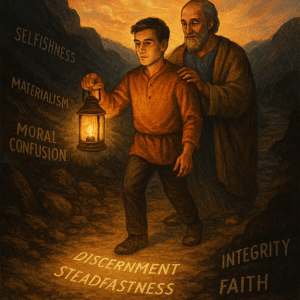
If the world feels confusing or overwhelming, you are not alone. History reminds us that humanity has faced chaos before—and when we forget its lessons, we risk repeating its pain. For this lesson on the world, let’s turn our attention to Timothy, a young leader whose journey began as the son of a Jewish mother and a Greek father. Chosen by Paul for his unwavering faith and reputation, Timothy was invited into a life of purpose and ministry. Their relationship was more than teacher and student—it was a bond of deep affection, mentorship, and trust. Paul called Timothy “my true son in the faith,” entrusting him with vital responsibilities and encouraging him to rise above doubt and youthfulness to become an example for others.
Paul wrote his second letter while imprisoned in Rome, likely during his final imprisonment before his execution. The tone of the letter is deeply personal and urgent, reflecting Paul’s awareness that his life was nearing its end. Paul wrote to encourage and strengthen Timothy, his beloved protégé, who was facing challenges and opposition as a young leader in the early church. The letter addresses perseverance in the face of suffering, the importance of sound doctrine, warnings about false teachers, and the need for courage and steadfastness. Paul also reflects on his own ministry, expressing confidence in God’s faithfulness and urging Timothy to continue the work.
2 Timothy is considered Paul’s most personal letter, filled with affection, memories, and final requests. He urges Timothy to visit him soon and not to be ashamed of the gospel. In 2 Timothy 3, Paul warns Timothy about the challenges and moral decline he will face as a leader, urging him to remain steadfast, discerning, and faithful.
(2 Timothy 3:1-5)1NIV New International Version Translations – “But mark this: There will be terrible times in the last days. People will be lovers of themselves, lovers of money, boastful, proud, abusive, disobedient to their parents, ungrateful, unholy, without love, unforgiving, slanderous, without self-control, brutal, not lovers of the good, treacherous, rash, conceited, lovers of pleasure rather than lovers of God—having a form of godliness but denying its power. Have nothing to do with such people.”
Whether you believe we are in our last days or not is not the point of this study. The fact is to live as if it does not matter when the last days come. James 4:14 reminds us, “What is your life? For you are a mist that appears for a little time and then vanishes.” This verse reminds us of life’s brevity and the importance of living purposefully.
(Matthew 24:42) – “Therefore keep watch, because you do not know on what day your Lord will come.”
Yes, these are “Difficult Times!” But two thousand years ago, the Apostle Paul told a young man whom he loved like a son, not to be surprised by the intensity of the evil he sees, but to “understand this” or “mark this.” Society often promotes an optimistic view of its constant moral and social progress, leading to shock or disillusionment when widespread problems like war, political division, or moral decline intensify. Paul is clearly stating that difficult times are a guaranteed characteristic of the “last days” (which Biblically refers to the entire period between Christ’s first and second coming). By knowing this, those who believe in Christ will not lose hope or be caught off guard. We should all be ready for spiritual and moral struggles.
In the verses that follow Timothy 3:1, Paul lists characteristics such as “lovers of self,” “lovers of money,” and “lovers of pleasure rather than lovers of God.” Look carefully at our world. It is easy to see that the core of the problems is narcissism and materialism, from consumerism and economic inequality to relational breakdown (e.g., “disobedient to parents,” “unloving”) and political selfishness. Our world has a “spiritual disease,” a deep-seated worship of self. Rather than just treating the symptoms, Paul is calling us to first examine our own hearts for these traits and to prioritize a life of self-denial and love for God and others —a radical contrast to the world around us.
Paul offers heartfelt advice to the young man he loves and cares for: “From such people turn away!” (2 Timothy 3:5). The apostle urges us to awaken our discernment to distinguish between good and evil. This serves as a clear warning against individuals who “have a form of godliness but deny its power.” In a world overwhelmed by media and various influences, this message compels us to establish spiritual boundaries. It means we must consciously limit our exposure to people and institutions that display these negative traits. We are being called to prioritize sound doctrine and diligently guard our minds and faith.
In a world marked by uncertainty and moral challenges, the example of Timothy and the mentorship of Paul offer a timeless blueprint for purposeful living. By embracing the wisdom found in their relationship, encouragement, accountability, and unwavering faith, we are empowered to rise above the confusion of our times. Choosing to cultivate discernment, integrity, and steadfastness not only strengthens our own character but also inspires those around us. The value of this lesson is clear: by following the path of intentional growth and spiritual resilience, we can become beacons of hope and positive change to all generations.
“Character cannot be developed in ease and quiet. Only through experience of trial and suffering can the soul be strengthened, ambition inspired, and success achieved.” ~Helen Keller
Contemplations
- In what ways might embracing Paul’s call for discernment, integrity, and steadfastness help you navigate the challenges and moral complexities of today’s world?
- Ideas to Explore:
- Consider the people, media, and institutions that shape your beliefs and behaviors. How might setting intentional boundaries, as Paul advised, protect your values and strengthen your faith?
- Reflect on the traits Paul warned about—such as selfishness, materialism, and seeking pleasure over purpose. In what areas of your life do these tendencies appear, and how can you cultivate discernment and integrity to overcome them?
- Think about how your choices and character influence those around you. How can embracing steadfastness and integrity, as Timothy did, inspire hope and positive change in your family, workplace, or community?
- Ideas to Explore:
- 1NIV New International Version Translations