
What the Founders Risked—and What Freedom Still Requires
Our nation is celebrating its 250th birthday. It seems fitting to consider our nation’s statement of faith as expressed in the Declaration of Independence. The very last sentence reads as follows:
“And for the support of this Declaration, with a firm reliance on the protection of divine Providence, we mutually pledge to each other our Lives, our Fortunes and our sacred Honor.”
Our founding fathers pledged their lives and their personal wealth. These are things we can still understand today. But exactly what is “Sacred Honor?” What does it mean to make a promise so weighty that it binds not only your future, but your very soul? When the founders pledged “their Lives, their Fortunes, and their sacred Honor,” they were not offering empty patriotic language. They were declaring that some truths are worth suffering for, sacrificing for, and standing for before both man and God. That kind of language forces us to ask a deeper spiritual question: Do we still believe there are truths so sacred that they demand our full allegiance, our courage, and our honor? In an age shadowed by confusion, false freedom, and moral drift, that question becomes all the more urgent.
Moral Self-Government and the Preservation of Liberty
Although solemn vows have appeared throughout history in religious covenants, military alliances, and political conspiracies, the Declaration’s pledge of “our Lives, our Fortunes and our sacred Honor” stands apart because of the rare combination of public accountability, moral purpose, and personal sacrifice it embodies. The signers were not making a secret oath in pursuit of power, revenge, or private advantage; they were openly announcing to the world that they were willing to risk everything they possessed in defense of principles they believed were universal and just. In this sense, the wording transforms rebellion into something more than mere defiance of existing law. It frames the American Revolution as an appeal to a higher standard of legitimacy grounded in natural rights, consent of the governed, and the belief that government exists to secure liberty rather than destroy it.
The phrase is especially powerful because each part of the pledge names a different level of commitment. To pledge their lives was to accept the possibility of death for treason; to pledge their fortunes was to risk property, security, and the well-being of their families; and to pledge their sacred honor was to place their moral reputation and permanent legacy on the line. In the eighteenth century, honor meant far more than pride or public image. It referred to one’s integrity, credibility, and worthiness before both society and God. By calling that honor sacred, the signers elevated their promise into a moral covenant. They were not simply saying they supported independence; they were declaring that failure to uphold this cause would constitute a profound personal and ethical disgrace. Many of the 56 signers would, in fact, pay dearly for that pledge, enduring imprisonment, the destruction of their property, financial ruin, the suffering of their families, and in some cases even death.
This is what sets the Revolution apart from many other unlawful or even seemingly moral acts in history. Many unlawful acts are secretive, self-interested, or rooted in coercion, while even supposedly noble causes often ask ordinary people to bear sacrifices that leaders themselves avoid. The Declaration’s signers, by contrast, bound themselves openly and mutually to one another before demanding endurance from anyone else. Their pledge was public rather than hidden, principled rather than opportunistic, and self-sacrificial rather than exploitative. For that reason, the language of sacred honor endures as one of the most distinctive features of the American Revolution: it presents the founding not as an act of lawless ambition, but as a solemn, reciprocal, and morally accountable commitment to establish a new political order. The phrase remains memorable because it fuses political conviction with personal risk, making the Revolution not merely a revolt against authority, but a deeply ethical act of national founding.
Our founding documents also establish that liberty depends not only on political rights but on moral character. A free people must possess the virtue to govern themselves, the courage to sacrifice for truth, and the discipline to place duty above appetite. When a society loosens its moral standards, it weakens the very habits of character that make liberty possible. Self-government requires self-restraint, and freedom becomes unstable when a people no longer recognize any higher obligation than personal desire.
A Biblical View of Liberty
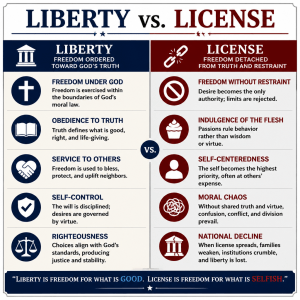
Scripture teaches that freedom is not the absence of restraint, but the right use of freedom under God’s moral order. In Galatians 5:131NIV New International Version Translations, believers are reminded that they were called to be free, yet not to use that freedom to indulge the flesh, but to serve one another humbly in love. In other words, biblical liberty is not a license (permission) to do as we please. Liberty is freedom to obey what is right before God; license is the abuse of freedom in service to self. One leads to ordered righteousness, the other to moral chaos.
Additional Scriptures: John 8:31–36 teaches that true freedom is found in the Son; 1 Peter 2:16 commands believers to live as free people, but not to use freedom as a cover for evil; Proverbs 14:34 reminds us that righteousness exalts a nation; and Titus 2:11–12 teaches that the grace of God trains us to say no to ungodliness and to live self-controlled, upright, and godly lives.
Moral self-government is the idea that individuals and communities can govern their desires, choices, and conduct without constant external control. The freedom the founders valued cannot endure without such self-government, and for the Christian, that self-government must be grounded in the truth and authority of God. A nation remains free only when its citizens are prepared to regulate their desires, submit to what is right, and understand that liberty is not the freedom to do whatever we want, but the responsibility to live under a higher moral law.
In simpler terms, moral self-government involves the daily habits and convictions that enable a people to remain free:
- self-restraint — controlling impulses and appetites
- conscience — knowing right from wrong
- personal responsibility — owning your actions
- discipline — doing what is right even when it is hard
- duty — placing higher obligations above mere personal desire
So instead of asking, “What am I free to do?” it asks, “What is the right thing to do with my freedom?“
The Challenges Ahead
We are called not merely to admire the language of “sacred honor,” but to recover the moral seriousness it demands. If the founding vision of liberty was sustained by public accountability, principled conviction, self-restraint, and a willingness to sacrifice for what is right, then those same realities confront us now. Our nation will not be preserved by sentiment, outrage, or slogans, but by a people willing to live under God’s authority, govern themselves with discipline, and uphold what is true at personal cost. Moving forward calls for a renewal of personal obedience, civic courage, and sacred responsibility before the Lord. May we ask ourselves honestly: Are we governing our lives under God, or surrendering them to appetite, distraction, and fear?
Contemplations
- What truths do you consider sacred enough to defend with courage, sacrifice, and integrity?
- Ideas to Explore: Consider what assumptions or habits might shape how you interpret this issue. Think about how someone from a different background or era might answer the same question.
- In what areas of your life do you confuse liberty with license (permission to do whatever you want)?
- Ideas to Explore: Reflect on whether this situation reveals a deeper principle about human nature or responsibility. Explore how this idea connects to the larger themes of liberty, duty, or moral courage.
- How can you practice greater self-restraint, responsibility, and obedience to God in the year ahead?
- Ideas to Explore: Ask yourself what the long‑term consequences would be if this idea were ignored. Consider whether this question challenges you to rethink what “good citizenship” or “integrity” looks like in daily life.
- What does it look like for you to live with sacred honor before both God and others?
- Ideas to Explore: Think about how this question relates to the tension between personal freedom and the common good. Think about a moment in history — or in your own life — when this principle proved costly but necessary.
- 1NIV New International Version Translations ↩︎