
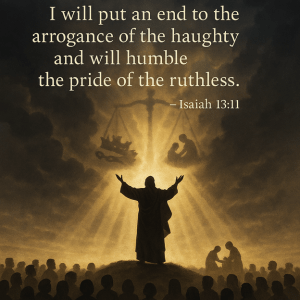
Have you ever witnessed pride or injustice in your community? Isaiah’s ancient words speak directly to these struggles. In his writings, we encounter a profound text that resonates with today’s challenges. Isaiah is the most quoted prophet in the New Testament. In fact, it’s noted that “fully 90% of the New Testament’s 260 chapters quote from Isaiah’s writings“.1https://www.christianity.com/wiki/bible/why-is-isaiah-the-most-quoted-prophet-in-the-bible.html He speaks boldly about themes of justice, accountability, and hope—elements crucial to our world today. Isaiah offers a powerful warning against pride and oppression while reminding us of God’s ultimate sovereignty and justice. His timeless message provides guidance not only on personal integrity but also on our responsibilities in society. Our focus will be on Isaiah 13:11 and exploring the rich insights it holds for our lives. Together, we will uncover how these ancient words from our God can continue to shape our understanding and actions in a contemporary world.
(Isaiah 13:11)2NIV New International Version Translations – “I will punish the world for its evil, the wicked for their sins. I will put an end to the arrogance of the haughty and will humble the pride of the ruthless.”
Isaiah 13:11 is part of a larger prophecy called the “Oracle Against Babylon.” This prophecy, spanning chapters 13 to 23 of Isaiah, shifts the focus from the people of Judah and Israel to the surrounding nations, with Babylon as a key subject. At the time Isaiah delivered these prophecies in the late 8th century BC, Babylon was not yet a significant power; it was under Assyrian control. However, Isaiah envisioned a future in which Babylon would rise to power, become proud and oppressive, and ultimately face divine judgment for its arrogance and wicked deeds.
Isaiah’s ministry spanned the reigns of several kings in Judah, during a period of political instability, international conflict, and spiritual decline. Powerful neighbors threatened the people of Judah, and there was widespread temptation to form alliances with foreign nations like Babylon and Egypt. Isaiah, however, consistently warned against relying on human power and urged people to only trust in God.
Babylon was a constant source of rebellion and unrest for the Assyrians. Its very existence as a powerful cultural and religious center posed a threat to the Assyrian empire. The Babylonian King Merodach-Baladan II sent envoys to King Hezekiah of Judah, likely seeking an anti-Assyrian partnership (Isaiah 39). Isaiah severely criticized Hezekiah for showing them his treasures, prophesying that Babylon itself would one day carry away those treasures and Hezekiah’s descendants into exile.
Isaiah’s words in our featured verse are far more than a warning about ancient Babylon—they stand as a sweeping declaration of divine judgment against every nation and every generation that chooses pride, oppression, and rebellion over humility and justice. With these bold pronouncements, Isaiah calls us to confront the uncomfortable truths about our world and ourselves, urging us to listen closely to the messages that challenge, convict, and ultimately guide us toward a life aligned with God’s purpose.
Isaiah faced a world in which empires constantly emerged and collapsed, often due to violence, arrogance, and idolatry. The people of Judah were at risk of falling into these same destructive patterns. Isaiah’s mission was to urge his fellow citizens to remain faithful, to warn them about the dangers of pride and injustice, and to remind them that God is in control of all nations. God’s command, given through Isaiah, is not limited to ancient Babylon or even to a single country; it is a universal declaration. It underscores that no one is above accountability, and that God’s justice applies to all people and all nations. The verse reminds us that unchecked evil, pride, and oppression will ultimately be confronted and judged.
For those who suffer under injustice or oppression, this verse should offer hope. It assures us that God sees wrongdoing and will not let it go unpunished forever. The promise of divine justice should be of comfort to those who feel powerless in the face of evil. Even today, the principle that leaders and individuals must be and will be held accountable for their actions remains relevant. History shows that empires and individuals who act with arrogance and injustice eventually face consequences. Isaiah’s message is clear:
- Pride leads to downfall.
- Divine justice is universal.
- Hope exists for the oppressed.
Through Isaiah, God provides a moral compass, prompting us to reflect on our actions and attitudes. We are challenged to choose humility and integrity over injustice and pride. Actions have consequences, and justice will ultimately prevail for all humanity—no exceptions. Isaiah speaks with certainty about God’s inevitable judgment, highlighting the seriousness of divine intervention.
In conclusion, the profound insights of Isaiah resonate powerfully within our contemporary struggles. As we navigate the complexities of our lives, we must heed the wisdom of this ancient prophet. Amidst turmoil and uncertainty, true strength lies not in human power, riches, or human promises, but in unwavering faith and humility before God. Let us not allow the distractions of this world to overshadow our trust in divine authority. Instead, let Isaiah’s call to humility inspire us to place our confidence where it truly belongs—into the hands of the one who holds ultimate sovereignty over our lives.
Contemplations
- How does pride manifest in our personal lives and communities today?
- Idea to Explore: Consider examples of pride in modern society—such as leadership, social media, or personal relationships. When left unchecked, pride leads to injustice or division. How should you respond when you see it?
- In what ways does the promise of divine justice offer hope to those facing oppression or injustice?
- Idea to Explore: Think about current events or personal experiences where injustice seems to prevail. How does the assurance of accountability (as described in Isaiah 13) inspire perseverance, advocacy, or comfort for those who feel powerless?
- What responsibilities do we have, individually and collectively, to align our actions with the principles of humility and justice found in Isaiah’s message?
- Idea to Explore: What can we do to promote justice and humility in everyday life—at work, in community service, or within families? Consider how small actions can contribute to broader societal change and reflect the values Isaiah’s prophecy emphasizes.
- 1
- 2NIV New International Version Translations