
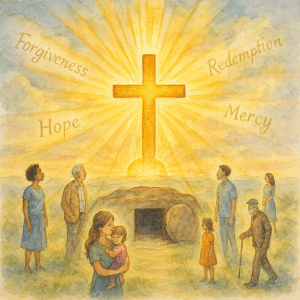
Today is Good Friday. It is worth our time to understand what took place high on that Cross on Golgotha (“the place of the skull”). In Latin, Golgotha is also called Calvary. To begin, let’s look at the Apostle’s Creed, a statement of Christian faith that summarizes our foundational beliefs.
The Apostle’s Creed (traditional version):
I believe in God, the Father almighty, creator of heaven and earth. I believe in Jesus Christ, his only Son, our Lord, who was conceived by the Holy Spirit, born of the Virgin Mary, suffered under Pontius Pilate, was crucified, died, and was buried; he descended into hell; on the third day he rose again from the dead; he ascended into heaven, he is seated at the right hand of God the Father almighty, from there he will come to judge the living and the dead. I believe in the Holy Spirit, the holy catholic Church, the communion of saints, the forgiveness of sins, the resurrection of the body, and the life everlasting. Amen.
This traditional version of the Apostle’s Creed is an ancient statement of Christian faith summarizing foundational beliefs held by many Christian denominations. Its origins date back to the early centuries of Christianity, and it developed as a concise summary of core doctrines for teaching and worship. The Creed is not found verbatim in the Bible but reflects key biblical teachings and was gradually shaped by the early church to unify what we believe in. For this study, we will focus on one statement, “he descended into hell.”
This line that captures our attention comes after Jesus’ crucifixion but before His glorious resurrection. Jesus truly experiences death by descending to the dead, often referred to as “hell” or “Hades.” The Creed emphasizes that Jesus genuinely died, affirming to us His complete humanity. The phrase “He descended into hell” in the Apostle’s Creed highlights this profound moment; it’s not about eternal punishment, but rather, it acknowledges Jesus entering the realm of the dead.
It’s interesting to note that in older English, “hell” referred to a place for those who had departed, rather than solely a place of suffering. This distinction reaffirms that Jesus fully embraced the human experience of death. His journey through death and subsequent resurrection emphasizes the hope and promise of new life. Understanding this connection enriches our faith and deepens our appreciation for the significance of His sacrifice. Isn’t it amazing how this ancient belief still resonates with us today?
William Barclay, a profound theologian, beautifully expresses that the Creed offers us an inspiring “breath-taking glimpse of nothing less than the gospel of a second chance.” How wonderful is that? He goes on to remind us that this doctrine assures us that, whether in this life or the next, every person is presented with the loving truth of God’s grace. This insight sheds light on the vital question of “What happens to the countless individuals who have never encountered Jesus Christ?” Barclay views Christ’s descent into the realm of the dead as a powerful “note of triumph” highlighting the “universality of His Atonement.” His message is clear and uplifting: “Jesus Christ not only faced death; He fully engaged with it, ensuring that His victory reaches every corner of existence.” His compelling interpretation assures us that Christ descended not just as a conqueror but as a loving savior, extending His gracious offer of salvation to those who, during their earthly journey, never had the chance to hear the Gospel. This perspective fills us with hope and underscores the incredible breadth of God’s love and mercy available to all!
When we relate our beliefs to the Incarnation—God becoming human in the person of Jesus Christ—we begin to grasp the enormity of the sacrifice made on Golgotha. God, who has no limits or boundaries, confined Himself to a human form. In doing so, God took upon Himself (in the form of His Son) every sin—past, present, and future—becoming the perfect atoning sacrifice. This act allowed humanity to be fully reconciled with God (Himself). The mystery and miracle of the Trinity unfolded before us.
In 1 Peter 3:191NIV New International Version Translations, we discover a this significant moment in the story of Jesus, where He ventured into the realm of the dead before His glorious resurrection. He descended there as our Savior, sharing the incredible message of good news with the spirits who were awaiting liberation. This moment highlights that Christ’s victory over death isn’t about further suffering—rather, it’s a triumphant affirmation of hope and the fulfillment of ancient prophecies.
Then, on the third day, the Creed celebrates the remarkable truth that Christ rose again from the dead! It’s important to note that the term “again” in this context doesn’t imply that He rose multiple times; rather, it conveys a deeper meaning, suggesting a renewal or return to life. Essentially, “rose again” signifies that Jesus, who lived, died, and then came back to life—He is truly alive once more!
This understanding is beautifully rooted in the language of the Creed, where the Latin term resurgere means to “rise again.” Similarly, the Greek word anastasis, translated as resurrection, literally means “to stand up again.” The Creed powerfully reassures us that Jesus genuinely died and was resurrected, offering profound hope we can cherish throughout our lives. This hope carries us even to the grave, shining brightly as a testament to His everlasting life and for those who accept Christ as their Savior, their own eternal life!
As we reflect on the depth of Christ’s sacrifice on Good Friday, let us not remain at the foot of the Cross, but lift our eyes to the hope that dawns on Easter morning. The story does not end in sorrow or defeat—on the third day, Jesus rose again, conquering death and opening the way to everlasting life for all who believe. The tomb is empty!
This is the heart of our faith: that darkness is overcome by light, despair is replaced by hope, and death is swallowed up in victory. Easter is our invitation to celebrate not only Christ’s resurrection, but also the new life and unshakable hope we have in Him.
Rejoice! Proclaim with confidence that Christ is risen—He is risen indeed! May this truth fill our hearts with joy and our lives with purpose, as we go forth to share the good news and live in the power of His resurrection.
Contemplations
- Barclay emphasized that Christ’s descent into the realm of the dead proves the “universality of His Atonement.” How does this concept of Christ’s victory reaching even the most isolated or previously unreached (in time or geography) influence your view of God’s power and compassion?
- Ideas to Explore: How does this truth change or affirm your understanding of God’s justice and mercy concerning those who lived before Christ or in places where the Gospel has not yet been heard? Does it give you a more profound sense of hope regarding the extent of God’s saving will? If Christ’s authority is absolute over all realms (Heaven, Earth, and the place of the dead), how does knowing this ultimate victory affect your present-day efforts to share the Gospel?
- Barclay described the descent as a “breath-taking glimpse of nothing less than the gospel of a second chance” for the dead. While the primary theological focus is on Christ’s victory, how does this concept of persistent, boundless grace challenge your own tendency to place limits or conditions on God’s forgiveness and love for others in this life?
- Ideas to Explore: Think about a relationship or situation where you might have mentally written someone off as “too far gone” or unforgivable. How does the boundless, persistent nature of Christ’s grace—extended even beyond the grave—encourage you to re-evaluate your own willingness to forgive and extend grace to others today? Apply this boundless grace to your own life. Identify a sin, failure, or doubt that you constantly revisit and struggle to believe is fully forgiven. How does the historical and theological weight of Christ conquering even the most profound darkness (the grave/Hades) give you renewed assurance and hope for your own complete redemption?
- 1NIV New International Version Translations