Inspiration for Today's World

Category: Snapshots (Page 9 of 45)

Why a Church is Worth Living For

Acts 11:1-181NIV New International Version Translations
1 The apostles and the believers throughout Judea heard that the Gentiles also had received the word of God. 2 So when Peter went up to Jerusalem, the circumcised believers criticized him 3 and said, “You went into the house of uncircumcised men and ate with them.” 4 Starting from the beginning, Peter told them the whole story: 5 “I was in the city of Joppa praying, and in a trance I saw a vision. I saw something like a large sheet being let down from heaven by its four corners, and it came down to where I was. 6 I looked into it and saw four-footed animals of the earth, wild beasts, reptiles and birds. 7 Then I heard a voice telling me, ‘Get up, Peter. Kill and eat.’ 8 “I replied, ‘Surely not, Lord! Nothing impure or unclean has ever entered my mouth.’ 9 “The voice spoke from heaven a second time, ‘Do not call anything impure that God has made clean.’ 10 This happened three times, and then it was all pulled up to heaven again. 11 “Right then three men who had been sent to me from Caesarea stopped at the house where I was staying. 12 The Spirit told me to have no hesitation about going with them. These six brothers also went with me, and we entered the man’s house. 13 He told us how he had seen an angel appear in his house and say, ‘Send to Joppa for Simon who is called Peter. 14 He will bring you a message through which you and all your household will be saved.’ 15 “As I began to speak, the Holy Spirit came on them as he had come on us at the beginning. 16 Then I remembered what the Lord had said: ‘John baptized with water, but you will be baptized with the Holy Spirit.’ 17 So if God gave them the same gift he gave us who believed in the Lord Jesus Christ, who was I to think that I could stand in God’s way?” 18 When they heard this, they had no further objections and praised God, saying, “So then, even to Gentiles God has granted repentance that leads to life.”
Background2https://www.christianity.com/bible/commentary.php?com=mhc&b=44&c=11
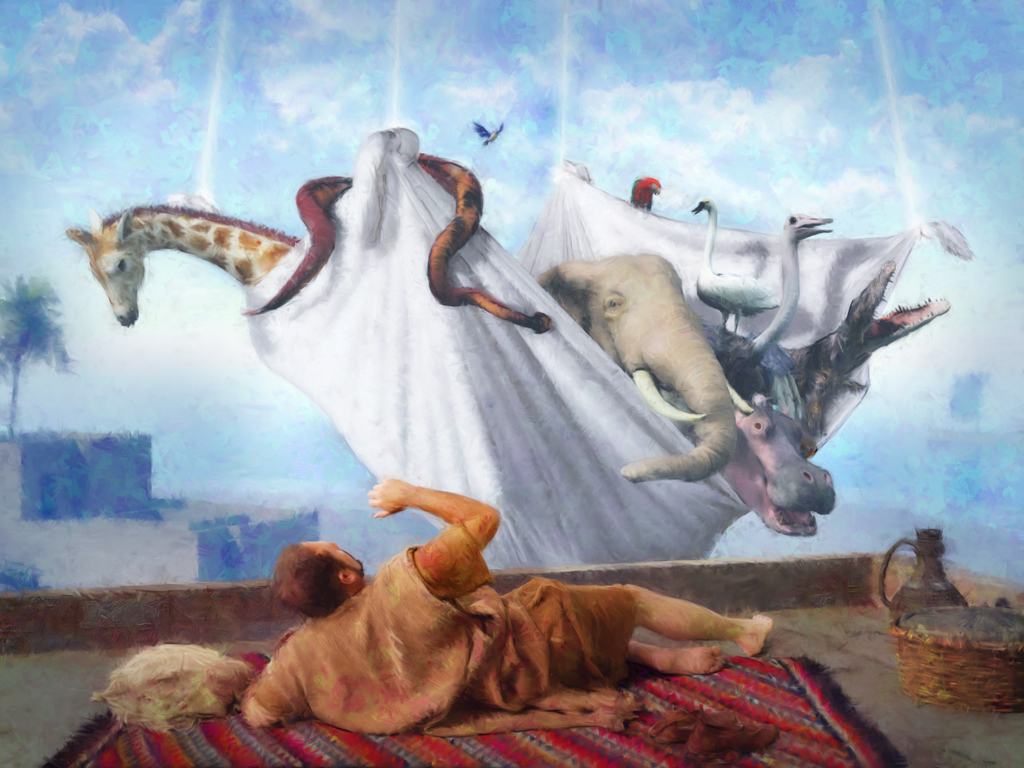
The extent to which Peter was committed to a Jewish church is reflected in Acts 10, which tells us of Cornelius, a devout Gentile. Then it tells us of Peter’s housetop vision where God called him to kill and eat animals which were prohibited under Jewish law. Peter responded, “Not so, Lord; for I have never eaten anything that is common or unclean” (10:14). But God responded, “What God has cleansed, you must not call unclean” (10:15). This vision was followed by God telling Peter to meet with three men, to include Cornelius. Peter said, “You yourselves know how it is an unlawful thing for a man who is a Jew to join himself or come to one of another nation, but God has shown me that I shouldn’t call any man unholy or unclean” (10:28). While Peter was speaking to these Gentiles, the Holy Spirit came upon the Gentiles and they received the gift of the Holy Spirit. So Peter ordered them to be baptized (10:44-48).

This dream of Peters is viewed as his vision and call to action to spread the Gospel of Christ to gentiles too. Peter shows how imperfect the human being is; even when we appear to be godly people, we can still become displeased that others have received God’s grace because they do not meet or match our own definitions and criteria.  Nothing can damage the Church more than to decide to shut out some from our fellowship because they are different from us. We are not asked to accept or permit their sinful behavior (if any)  but only asked to bear with the faith struggles of our bothers and sisters. Instead of taking offence, we should explain our motives, and show the nature of our reasons and beliefs.  Society loves it’s own regulations. However, we should be cautious that they do not go against the heart of our own God. Those who love the Lord will glorify him when they understand that He has given repentance and eternal life to any fellow-sinners. Repentance is God’s gift; not only His to give it to anyone, it is theirs alone to accept.

Peter’s public is his personal experience and his experience of others’ faith. Sharing experience in this case results in the shared glorification of God (11:18). God’s gift for all is not always shared or communicated in high-brow “theologically correct” expressions. Such expressions often do not fit established denominational categories or even come through the typical channels.  What they do is to testify to the fundamentally human nature of the way God breaks on through to people. Good news is not a standardized theological truth to be believed, but an experience of God that draws us into corporate and shared confession and glorification of God.

Items for Discussion

  • What are the subjective decisions that we tend to make when meeting newcomers to our church?
  • Are there physical characteristics that are hard to set aside when meeting newcomers?
  • What makes personal experience and testimonies so effective in sharing our faith to others?
  • What reasons have you heard from others as to why they do not share their faith?


Revelation 21:1-6
1 Then I saw “a new heaven and a new earth,” for the first heaven and the first earth had passed away, and there was no longer any sea. 2 I saw the Holy City, the new Jerusalem, coming down out of heaven from God, prepared as a bride beautifully dressed for her husband. 3 And I heard a loud voice from the throne saying, “Look! God’s dwelling place is now among the people, and he will dwell with them. They will be his people, and God himself will be with them and be their God. 4 ‘He will wipe every tear from their eyes. There will be no more death’ or mourning or crying or pain, for the old order of things has passed away.” 5 He who was seated on the throne said, “I am making everything new!” Then he said, “Write this down, for these words are trustworthy and true.” 6 He said to me: “It is done. I am the Alpha and the Omega, the Beginning and the End. To the thirsty I will give water without cost from the spring of the water of life.

Background

The vision of the city with the gleaming golden streets and pearly gates, where death and tears are no more, has been the dreams of God’s people through the ages. African-American spirituals and gospel songs invoke imagery of this golden holy city and its river of life. Revelation’s holy city promises life and healing, reconciliation and justice.

The promise of newness – a “new heaven and new earth” – gives an image of resurrection and renewal. The first earth and the sea have “passed away”. John’s point certainly is not that the whole cosmos will be annihilated, but the “first earth” that passes away represents the earth as captive to imperial domination and sin. The earth and all things will become “new” just as our bodies will be resurrected, renewed.

New Jerusalem is a profoundly urban vision. “God wills to restore this world to a beauty we can not currently imagine. It is a city, not a desolate place. We are not alone wandering in the cosmos, we are together in fellowship. As faithful believers of Christ,  we are invited to enter as citizens and to “inherit” (21:7) its blessings, as God’s own sons and daughters.

Items for Discussion

  • Where can the earthly church today be like the “New Jerusalem?” In other words, what can we be doing with the world today to give them a greater appreciation of what our next world will bring?
  • What are the most appealing parts of the New Jerusalem to you personally?
  • If you consider the New Jerusalem heaven and it a great place, what would you be willing to do to make sure all you love are their with you?
  • What would you be willing to do to make sure all you dislike and hate are there with you?

Discussion Challenge

  • How can the Christian Church today help people prepare to share their faith with others?

A Content Life (A Mother’s Day Recipe)

Psalm 471NIV New International Version Translations
1 Clap your hands, all you nations; shout to God with cries of joy. 2 For the LORD Most High is awesome, the great King over all the earth. 3 He subdued nations under us, peoples under our feet. 4 He chose our inheritance for us, the pride of Jacob, whom he loved. 5 God has ascended amid shouts of joy, the LORD amid the sounding of trumpets. 6 Sing praises to God, sing praises; sing praises to our King, sing praises. 7 For God is the King of all the earth; sing to him a psalm of praise. 8 God reigns over the nations; God is seated on his holy throne. 9 The nobles of the nations assemble as the people of the God of Abraham, for the kings of the earth belong to God; he is greatly exalted.

Background

We do not know who wrote this psalm or when it was written. What we do know is that something happened that saved the city of Jerusalem. Speculation is that it was when Sennacherib, the king of Assyria, attacked Jerusalem in 701 BC.  God protected the city.  In one night, 185 000 Assyrian soldiers died. We do not know why. It was a strange illness, but we do not know what it was (2 Kings 19:34-36).

The God with whom we have our relationship is a God of awful majesty. The universal and absolute sovereignty of a holy God would be too much for us even imagine if it were not for the sacrifices of His Son, Jesus Christ. While God’s people express confidence and joy and encourage each other through serving Him, it is always the sinner who must repent, submit to God’s authority and accept His Grace. Jesus is to gather the Gentiles as sheep into the fold, not for slaughter, but for preservation, eternal preservation. Jesus has earned our affections and made us a faithful people. The psalm speaks of God giving rest and peace. Now apply this spiritually –  God Himself has undertaken to be the inheritance of His people. This shows itself as true through our faith and willingness to obey His commands. This psalm is the language of every gracious soul: The Lord God is choosing your inheritance for you because He knows what is good for you better than you do.

The psalm speaks of praise as a duty which should be frequent and abundant. But there is a rule given to us: Sing our praises with understanding.  We are called to  understand why and for what reasons we praise God. It is not praise if there is no understanding of God. We should never forget what Christ (who is God) has done for us. There is no bond of membership with God and His Son unless they are the cornerstone of our heart and soul through faith.

Items for Discussion

  • What are the attributes of God that cause you to praise Him?
  • How do we recognize the need to offer God praise and thanks?
  • Where and what do you do to personally seek to improve your understanding of God?
  • This passage was chosen for a Mother’s Day Service – How are the reasons for offering praise to God similar to the reasons of praising a mother?


Philippians 4:4-9
4 Rejoice in the LORD always. I will say it again: Rejoice! 5 Let your gentleness be evident to all. The LORD is near. 6 Do not be anxious about anything, but in every situation, by prayer and petition, with thanksgiving, present your requests to God. 7 And the peace of God, which transcends all understanding, will guard your hearts and your minds in Christ Jesus. 8 Finally, brothers and sisters, whatever is true, whatever is noble, whatever is right, whatever is pure, whatever is lovely, whatever is admirable-if anything is excellent or praiseworthy-think about such things. 9 Whatever you have learned or received or heard from me, or seen in me-put it into practice. And the God of peace will be with you.

Background

Paul is pleading with two women leaders at Philippi who are at odds with each other. We know nothing else about them, or about the “loyal companion” mentioned earlier who Paul asks to help. What we do know is that they were valued fellow missionaries who had shared Paul’s struggles. They provide evidence for the leadership roles of women in Paul’s churches. Paul commands us to rejoice! Again, how surprising this is, coming from a person experiencing the horrors of a Roman prison. The reason is not difficult to find: “The Lord is near.” Paul expects the imminent return of Christ, who will put all things right. But as we have seen throughout the letter, Paul also experiences the nearness of God in Christ, even in his present captivity. So he commands us to rejoice.

Paul tells us to focus our minds on what is true, honorable, just, pure, pleasing, commendable, excellent and worthy of praise. There is the immediate reality of a world in which human beings are constantly at war somewhere, betraying one another, brutally suppressing each other in order to get ahead, and so forth. This was true of the Roman Empire, and it is true today. Every day we hear and see a culture that focuses on what is false, dishonorable, unjust, impure, and shameful. We think that to act hopefully in such a world is unrealistic.

But Paul also sees another reality, and it is the reality that holds the future. That is the reality of God’s redemption, already here and still drawing near. Training our minds to think of this reality, and thereby to act with hope, is a daily mental discipline. For such a discipline, we need to experience the reality of God’s rule in the midst of tangible human relationships. Paul offers his own relationship with the Philippians as just such a tangible experience to the temptation of despair and futile thinking.

Items for Discussion

  • What are your tips for handling the depravity and sadness in the world today?  How do you keep positive?
  • Where do you go to find peace? Where are your places of respite?
  • What is the impact of a Church on your goals? In other words, “the fellowship of other believers?” What do other like-minded people do for you?

Discussion Challenge

  • How would you change our church so that a “new comer,” entering our doors, immediately saw it as a place to find peace?


  • 1
    NIV New International Version Translations

An Attitude of Gratitude

Psalm 1001NIV New International Version Translations
1 Shout for joy to the Lord, all the earth. 2 Worship the Lord with gladness; come before him with joyful songs. 3  Know that the Lord is God. It is he who made us, and we are his; we are his people, the sheep of his pasture. 4 Enter his gates with thanksgiving and his courts with praise; give thanks to him and praise his name. 5 For the Lord is good and his love endures forever; his faithfulness continues through all generations.

Background

This  psalm is a song of praise and should be considered a prophecy,  a prayer, for the coming of that time when all people will know God and worship Him as sheep of His pasture. We are encouraged to worship God and to do it cheerfully. Because we often stray like wandering sheep, God brings us to his fold again and again. For this reason alone, for God’s generous grace,  we have reason to bless His name.

In the matter of praise,  our motives are very important. Each of us must decide who God is to us. The closer and more constant our worship, more inward and serious we are in our worship, the deeper the relationship will be with our God. God gives us the Scriptures of the Old and New Testament, filled with rich promises, for a purpose. It is to strengthen the faith of every weak believer through praise and worship.

Items for Discussion

  • What assists the acts of worship to become joyful?
  • Are these the same things or different that what is necessary to be drawn closer to God?
  • Where should each of us look and find our definition of God?
  • Are there places we should avoid that could mislead us in understanding God?

Luke 17:11-19
11 Now on his way to Jerusalem, Jesus traveled along the border between Samaria and Galilee. 12 As he was going into a village, ten men who had leprosy met him. They stood at a distance 13 and called out in a loud voice, “Jesus, Master, have pity on us!” 14 When he saw them, he said, “Go, show yourselves to the priests.” And as they went, they were cleansed. 15 One of them, when he saw he was healed, came back, praising God in a loud voice. 16 He threw himself at Jesus’ feet and thanked him-and he was a Samaritan. 17 Jesus asked, “Were not all ten cleansed? Where are the other nine? 18 Has no one returned to give praise to God except this foreigner?” 19 Then he said to him, “Rise and go; your faith has made you well.”

Background

Samaria and Galilee border each other, there is no “region between” them, and even if there were, it would be an odd route to take toward Jerusalem. Jesus is on his way to the cross, and the encounters He has along the way show us something about the nature of the kingdom He will establish. This encounter happens in a place where we would expect the tension between ethnic and religious differences to be intense.

We all have “spiritual leprosy.” This should make us very humble whenever we attempt to draw near to Christ. We should expect God to meet us with mercy when we are obedient to Him. At the outset of this story, ten men are stuck in a “no-man’s” land of being socially, religiously, and physically unclean. By the end of the story, all ten are made well. But one has something more. He has seen Jesus, recognized His blessing and rejoiced in it, and changed his course of action and behavior. Just one of those who were healed returned to give thanks.

Because the leper sees what has happened, he is not just healed, but is made whole, restored, drawn back into relationship with God and humanity. In all these ways he has been, if we must choose a single word, saved.  This should be the response of every Christian when God has bestowed His gifts of healing and grace, to be very humble in our thanksgivings, as well as in prayers. Christ noticed the one who distinguished himself was a Samaritan. The others only got the outward cure, the Samaritan alone got the spiritual blessing.

Items for Discussion

  • Are there people in our society today that are stuck in a “no-man’s” land? Who are they? Why are they stuck there?
  • What gifts “from God” do you see people taking for granted?
  • How would you describe a proper thank you?
  • What did the other nine lepers miss out on?

Philippians 1:3-6
3 I thank my God every time I remember you. 4 In all my prayers for all of you, I always pray with joy 5 because of your partnership in the gospel from the first day until now, 6 being confident of this, that he who began a good work in you will carry it on to completion until the day of Christ Jesus.

Background

At Philippi the Paul was treated badly  saw little fruits from his labor, Yet, he remembers Philippi and the people with joy. The Aposlte Paul reminds us that we must always thank our God for the graces and comforts, gifts and usefulness of others, as we are the one’s who receive the benefits and God receives the glory. The work of grace itself will never be perfected till the day of Jesus Christ, the day of his appearance.

Items for Discussion

  • Paul is separating the treatment of a place from those who have helped him. Why is our opinion of a place often tied to how well or successful we have been? Think of a community, a job even a church.
  • What makes the difference in sorting out the joys from the sorrows?

Discussion Challenge

  • What are the top priorities of a congregation in making sure the worship experience and church life are joyful?
  • 1
    NIV New International Version Translations

Jesus is Playing with Us

John 20:19-311NIV New Internationa Version Translations
19 On the evening of that first day of the week, when the disciples were together, with the doors locked for fear of the Jewish leaders, Jesus came and stood among them and said, “Peace be with you!” 20 After he said this, he showed them his hands and side. The disciples were overjoyed when they saw the Lord. 21 Again Jesus said, “Peace be with you! As the Father has sent me, I am sending you.” 22 And with that he breathed on them and said, “Receive the Holy Spirit. 23 If you forgive anyone’s sins, their sins are forgiven; if you do not forgive them, they are not forgiven.”  24 Now Thomas (also known as Didymus ), one of the Twelve, was not with the disciples when Jesus came. 25 So the other disciples told him, “We have seen the Lord!” But he said to them, “Unless I see the nail marks in his hands and put my finger where the nails were, and put my hand into his side, I will not believe.” 26 A week later his disciples were in the house again, and Thomas was with them. Though the doors were locked, Jesus came and stood among them and said, “Peace be with you!” 27 Then he said to Thomas, “Put your finger here; see my hands. Reach out your hand and put it into my side. Stop doubting and believe.” 28 Thomas said to him, “My Lord and my God!” 29 Then Jesus told him, “Because you have seen me, you have believed; blessed are those who have not seen and yet have believed.”  30 Jesus performed many other signs in the presence of his disciples, which are not recorded in this book. 31 But these are written that you may believe that Jesus is the Messiah, the Son of God, and that by believing you may have life in his name.

Background

This is a perfect set of Bible verses for the Sunday after Easter. The story in John’s gospel takes place exactly one week after that first Easter Sunday (John 20:26). We have just celebrated an event where Jesus shows us that there is life after death. He even shows us how to find it. Now is the time, after the story that we must come to terms with our own hidden doubts, and decide if our faith is real enough to believe in Easter.

Along comes one of the disciples, Thomas. We have given him the name “Doubting Thomas” and looked down at his weak faith. Yet, the world is filled with “Doubting Thomas’s. It is easier to find skeptics on the Sunday after Easter than it is to find reassured believers. So when we read that Thomas refuses to believe Jesus has come back from the dead because it is just hearsay, we find ourselves in a similar place, a world  demanding  physical proof that Jesus’s story is true.  “Unless I see the mark of the nails in his hands, and put my finger in the mark of the nails and my hand in his side, I will not believe” (John 20:25). Yes, and why not? If it’s true, why can’t we have proof? We too want to see. We want to touch. We want to be there to remove all doubt from our faith.

Proof is what everyone prefers. Unfortunately, all of today’s people must come to terms with their time and place in history; we are here now and were not there then! God did not ordain it so that we should “be there” no matter how sincerely and prayerfully we wish it. We live in an age of wonders, of satellites that let us communicate around the world instantly. We have self-driving cars (well almost) and science is on the verge of conquering many diseases. We have science now, right?  However, when it comes to resurrection faith, we cannot see it ourselves,

Instead, God has given us the chance to be blessed. “Blessed are the poor,” said Jesus, and yet the least well off among us are wealthy by any realistic historical or global standard. “Blessed are you who hunger,” and yet we are only hungry when we are dieting. “Blessed are the meek,” and yet we can scarcely avoid pride at all that we have achieved.  It will be through the last beatitude that our best shot at the designation “blessed of God” comes to us. Blessed are they who can’t be absolutely sure. Blessed are they who believe the hearsay. Blessed are the eyes of faith that continue in hope despite the frustrations of this world. “Blessed are those who have not seen and yet have come to believe” (John 20:29).

However, the most amazing thing about the Apostle Thomas’s encounter with Jesus is that after three years, he finally really gets it! Jesus is more than just the “Son of Man,” or the “Son of God.” Jesus IS God.

Items for Discussion

  • How to you personally remove doubt in your own mind about something?
  • How is science a two-edged sword when it comes to removing doubt?
  • What is the role of the Holy Spirit in our belief system?
  • What is it about wealth (the opposite of POOR) that hinders one’s faith?


Revelation 1:4-8
4 John, To the seven churches in the province of Asia: Grace and peace to you from him who is, and who was, and who is to come, and from the seven spirits before his throne, 5 and from Jesus Christ, who is the faithful witness, the firstborn from the dead, and the ruler of the kings of the earth. To him who loves us and has freed us from our sins by his blood, 6 and has made us to be a kingdom and priests to serve his God and Father—to him be glory and power for ever and ever! Amen. 7 “Look, he is coming with the clouds,” and “every eye will see him, even those who pierced him”; and all peoples on earth “will mourn because of him.” So shall it be! Amen. 8 “I am the Alpha and the Omega,” says the Lord God, “who is, and who was, and who is to come, the Almighty.”

Background2http://www.workingpreacher.org/preaching.aspx?commentary_id=561

The Apostle John writes “to the seven churches that are in Asia.” Asia refers to the Roman province of that name; today it is western Turkey. Seven is the number of completion. To write to seven churches is to write to all churches. John’s greeting begins in a way similar to Paul’s letter openings: “Grace to you and peace,” and it continues with a three-point formula:

  1. First, the greeting is from “him who is and who was and who is to come,” a statement that echoes Exodus 3:13-14. Thus, the same God who was is also now. God has not retired! This, our God will continue to come.
  2. Second, the greeting is “from the seven spirits who are before his throne” (also in 3:1, 4:5, 5:6). (This is typically explained theologically as the Holy Spirit)
  3. Third, the greeting is from “Jesus Christ, the faithful witness, the firstborn of the dead, and the ruler of the kings of the earth.” Jesus Christ is further identified in three ways.
    1. Faithful witness”: the Greek word for witness also means martyrs.
    2. Jesus has been resurrected, and so He is the firstborn from the dead.
    3. Jesus is now “the ruler of the kings of the earth,”

The rest of verse 5 and all of verse 6 are a doxology (ascribing glory,) to Christ. Jesus is glorified because:

  • He loves us (the way Revelation is often read the love of God in Christ can easily be lost)
  • He freed or released us from our sins by His blood (in Revelation Jesus is always the slaughtered Lamb who died for us)
  • He made us to be a kingdom and priests (that is, he made believers a kingdom, each member of which is a priest to God; these are ancient privileges of Israel; see Exodus 19:6).

Verse 7 provides the first overarching theme of the book: Jesus will return. The first theme is one we automatically associate with Revelation, and John concludes it with a bilingual double-whammy: “So it is to be” (the Greek word yes), and “Amen” (the Hebrew for let it be so).

Verse 8 gives us the second overarching theme: God is God. Perhaps that is not so obvious a theme, but the constant battle in Revelation is between the true God, the God of Israel, the God of Jesus, and the false gods of this world epitomized in the emperor of Rome. In contrast to the false gods, the Lord, the one again “who is and who was and who is to come,” is the Alpha and the Omega.

Alpha, of course, was the first letter of the Greek alphabet; Omega was the last letter. In a sense, God is before the beginning and after the end.  Moreover, this God is the Almighty, the All-Powerful One. It is a title claimed by the emperor-as are Lord and God. “Here,” writes John, “is God. Beside him there is no other.” So is Jesus, the Son of God, existing before the beginning and after the end.

Items for Discussion

  • Who are the gods attracting people today?
  • And what does the true God say to us about them?

Discussion Challenge

  • How can the Christian Church survive in a “doubting world?”

The Best of All Possible News

Isaiah 65:17-251NIV New International Version Translations
17 “See, I will create new heavens and a new earth. The former things will not be remembered, nor will they come to mind. 18 But be glad and rejoice forever in what I will create, for I will create Jerusalem to be a delight and its people a joy. 19 I will rejoice over Jerusalem and take delight in my people; the sound of weeping and of crying will be heard in it no more. 20 “Never again will there be in it an infant who lives but a few days, or an old man who does not live out his years; the one who dies at a hundred will be thought a mere child; the one who fails to reach a hundred will be considered accursed. 21 They will build houses and dwell in them; they will plant vineyards and eat their fruit. 22 No longer will they build houses and others live in them, or plant and others eat. For as the days of a tree, so will be the days of my people; my chosen ones will long enjoy the work of their hands. 23 They will not labor in vain, nor will they bear children doomed to misfortune; for they will be a people blessed by the Lord, they and their descendants with them. 24 Before they call I will answer; while they are still speaking I will hear. 25 The wolf and the lamb will feed together, and the lion will eat straw like the ox, and dust will be the serpent’s food. They will neither harm nor destroy on all my holy mountain,” says the Lord.

Background

Isaiah is asking each of us to look forward to a new heaven and new earth. Our former world, will be the one filled with confusion, sin and miseries of the human race and all of these will no longer be remembered or even happen again. It will be a new world. A “ever more” happy state of the church is described here by a variety of images. Christianity, our beliefs, will be based on a world that has no violence or evil.  In those happy days, all God’s people will enjoy the fruit of their labors. No longer will children be a trouble for their parents, or even suffer trouble themselves. The evil personalities of sinners will be in such contrast, that it will even frighten the sinners to live in perfect harmony with us. Therefore, the church on earth will be full of happiness, just like heaven. This prophecy assures us, the servants of Christ, that as the end time approaches, we will be blessed with the undisturbed enjoyment of all that is needful for our happiness. As workers together with God, we are called to respect God’s authority and obey His commands. Happy days are coming!

The mention of creating “new heavens and a new earth” takes us back to the opening chapters of Genesis where, “In the beginning God created the heavens and the earth” (Genesis 1:1). With each act of creation, God pronounced the creation good, but the introduction of sin in Genesis 3 defiled the good creation—nothing has been the same since. But God is going to redeem the situation by creating “new heavens and a new earth.” This does not mean that he is going to destroy what exists and begin anew from nothing. This is to be a transformation more like the rebirth to which Jesus alludes in his conversation with Nicodemus (John 3).

What’s going to be different in this new world?

  • Weeping will turn to rejoicing
  • An infant that lives a few days translates to a person who lives to be old
  • An old person dying early changes to an old person living beyond a hundred years
  • Build and another inhabits what you built to build and you inhabit
  • Plant and another eats your harvest changes to you plant and eat your own harvest
  • People labor in vain, work itself, changes to let people enjoy the work of their hands
  • Bear children for calamity, having children only to have them suffer, changes to our offspring are blessed by the Lord
  • Unanswered prayers are always answered prayers
  • Violence disappears and we have peace

Items for Discussion

  • When you think about what a perfect world will be like, what visions do you see?
  • What in God’s eternal world are your hopes? Are any different than what Isaiah is foretelling?
  • In the Book of Isaiah’s description, we get a picture of a very physical place – How might this be different than what we call heaven? How is it the same?
  • What is Isaiah’s message to those who believe?
  • What reassurances do you see in these verses for people who are alive today?

Luke 24:1-12
1 On the first day of the week, very early in the morning, the women took the spices they had prepared and went to the tomb. 2 They found the stone rolled away from the tomb, 3 but when they entered, they did not find the body of the Lord Jesus. 4 While they were wondering about this, suddenly two men in clothes that gleamed like lightning stood beside them. 5 In their fright the women bowed down with their faces to the ground, but the men said to them, “Why do you look for the living among the dead? 6 He is not here; he has risen! Remember how he told you, while he was still with you in Galilee: 7 ‘The Son of Man must be delivered over to the hands of sinners, be crucified and on the third day be raised again.’ ” 8 Then they remembered his words. 9 When they came back from the tomb, they told all these things to the Eleven and to all the others. 10 It was Mary Magdalene, Joanna, Mary the mother of James, and the others with them who told this to the apostles. 11 But they did not believe the women, because their words seemed to them like nonsense. 12 Peter, however, got up and ran to the tomb. Bending over, he saw the strips of linen lying by themselves, and he went away, wondering to himself what had happened.

Background

The first thing we see is the affection and respect the women showed to Christ, even after He was dead and buried. We also need to pay attention to their surprise when they found the stone rolled away and the grave empty.  As Christians, we often do the same, worry about the wrong thing. They went looking to find their Master in His grave-clothes; they were not searching for angels in their shining garments. The angels assure them that He is risen from the dead; risen by his own power. These angels from heaven are not bringing a new gospel message. They are simply reminding the women of Christ’s own words, and are attempting to teach them how to apply them to their own lives.

We may wonder why these disciples, who believed Jesus to be the Son of God and the true Messiah, who had been told so often that He must die, and rise again, and then enter into His glory with God, who had seen Him more than once raise the dead, were so surprised and found it so hard to believe now that He raised Himself from the dead. We too make the same mistakes in our faith. It manifests itself from ignorance or forgetfulness of those same words Christ has spoken to both the women and to us. Peter now ran to the grave. Not so long ago, Peter ran from his Master. Peter was amazed. There are many things about God and Christ that are puzzling and perplexing to us. All of this would become so very plain and simple if we made it our life’s pursuit to just understand the words of Christ.

Items for Discussion

  • How would you explain the risen Christ to your best friend?
  • What makes Christ’s words so difficult for people to understand?
  • What reassurances do you see in these verses?

Discussion Challenge

  • Why is it so hard for some to understand that through God’s grace, we are forgiven and through the belief in Christ’s words and example we become eternal?
  • 1
    NIV New International Version Translations

Singing the Same Old Songs

Psalm 118:1-2, 19-291NIV New International Version Translations
1 Give thanks to the Lord, for he is good; his love endures forever. 2 Let Israel say: “His love endures forever.”

19 Open for me the gates of the righteous; I will enter and give thanks to the Lord. 20 This is the gate of the Lord through which the righteous may enter. 21 I will give you thanks, for you answered me; you have become my salvation. 22 The stone the builders rejected has become the cornerstone; 23 the Lord has done this, and it is marvelous in our eyes. 24 The Lord has done it this very day; let us rejoice today and be glad. 25 Lord, save us! Lord, grant us success! 26 Blessed is he who comes in the name of the Lord. From the house of the Lord we bless you. 27 The Lord is God, and he has made his light shine on us. With boughs in hand, join in the festal procession up to the horns of the altar. 28 You are my God, and I will praise you; you are my God, and I will exalt you. 29 Give thanks to the Lord, for he is good; his love endures forever.

Background

David, the psalmist is describing here his own troubles which were similar to those of Christ. Many hated David without a cause just like the hatred against Christ.  David had his bruises and his grief. All of them needed healing. God is sometimes the strength of His people, even when He is not their song. While what we want in life are spiritual delights, many times we just get spiritual support.

Our challenge is to trace all of our comforts back to their source, the everlasting goodness and mercy of God. It is then, in our forward vision that we see our blessing and find abundant cause for joy and praise. Every answer to our prayers is evidence that the Lord is on our side and that we need not fear what any man can do to us. What is our roll in this relationship? To conscientiously do our duty to all and trust in God alone to accept us and bless us. Each of us should set as a goal to live to declare the good works of God and to encourage others to serve God and trust in Him. These were the greatest triumphs of Christ, to assurance each one of us that we will prosper in His hands

Items for Discussion

  • What is the most lasting impact of Palm Sunday on you personally?
  • How do you keep yourself focused on God’s many blessings when things are not going the way you would like them to?
  • What do you think the greatest characteristic of God is?
  • What do you think the greatest characteristic of Christ is?
  • What makes acts of faith when times are hard so much more important to your spiritual growth?


Mark 14:1-11
1 Now the Passover and the Festival of Unleavened Bread were only two days away, and the chief priests and the teachers of the law were scheming to arrest Jesus secretly and kill him. 2 “But not during the festival,” they said, “or the people may riot.” 3 While he was in Bethany, reclining at the table in the home of Simon the Leper, a woman came with an alabaster jar of very expensive perfume, made of pure nard. She broke the jar and poured the perfume on his head. 4 Some of those present were saying indignantly to one another, “Why this waste of perfume? 5 It could have been sold for more than a year’s wages and the money given to the poor.” And they rebuked her harshly. 6 “Leave her alone,” said Jesus. “Why are you bothering her? She has done a beautiful thing to me. 7 The poor you will always have with you, and you can help them any time you want. But you will not always have me. 8 She did what she could. She poured perfume on my body beforehand to prepare for my burial. 9 Truly I tell you, wherever the gospel is preached throughout the world, what she has done will also be told, in memory of her.” 10 Then Judas Iscariot, one of the Twelve, went to the chief priests to betray Jesus to them. 11 They were delighted to hear this and promised to give him money. So he watched for an opportunity to hand him over.

Background

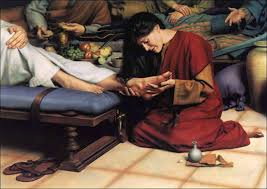
The anointing of Jesus by Mary Magdalene is traditionally depicted with a vessel of ointment. The anointing of Jesus’s feet are events recorded in all four gospels. The account in Matthew 26, Mark 14, and John 12 has as its location the city of Bethany in the south and involves Mary the sister of Martha and Lazarus. Christ poured out His soul unto death for us and the hard question we face is whether there is anything God asks of us  that is too precious for Jesus? Do we give Him the “precious ointment” of our best affections? Do we love Him with all our heart?

The Jewish priests had decided that Jesus should die but they did not know how to make this happen away from the crowds. During each day, large crowds listened while Jesus taught them. So these priests needed to know where Jesus was by night. Usually, nobody would tell them. But some disciples were not happy with Jesus. Among those disciples was Judas (Mark 14:10-11; John 12:3-5).

We know many things about the woman. The Bible tells us who she was (John 12:3). And we know many things about her family (Luke 10:38-42; John 11:1-44). But Mark does not tell us these things. He only tells us how she showed her love for Jesus. She gave something that was both beautiful and expensive. And she gave it all to Jesus. Some disciples thought that Jesus would be angry, they were not rich men and the gift was expensive. They wanted to use the money so that they could help poor people. And they thought that the woman had wasted her gift.

Those disciples knew that poor people needed money but they did not know what God was doing. By her gift, the woman showed that she knew, she was preparing Jesus’ body for His death. That is why it was so right to give this gift. It was right to give an expensive gift because Jesus is the true King. The women would not have the time to give these gifts after his death (Mark 16:1-8).

While a few disciples were not happy, (Mark 14:3-9), only Judas went to the priests. Judas knew that they were against Jesus and decided at moment to be against Jesus too. We do not know if Judas wanted Jesus to die but what we know that Judas liked money (John 12:4) so Judas agreed to lead the priests to Jesus.

Items for Discussion

  • What is your “best gift” that you give to Jesus?
  • How do you know it is your best?
  • Do gifts change over a life time?
  • What do you think the impact is on others, when they see absolute unselfish acts of generosity?

Discussion Challenge

  • Based on this story of Mary in Mark, how would you explain “Lent” to someone? Is it different knowing the story?
  • 1
    NIV New International Version Translations

The 5 Life Attitudes that Begin with the Letter F

Isaiah 43:18-191NIV New International Version Translations
18 “Forget the former things; do not dwell on the past. 19 See, I am doing a new thing! Now it springs up; do you not perceive it? I am making a way in the wilderness and streams in the wasteland.

Background

The Israelites have been delivered out of Egypt. While there were great things God did for them like the crossing of the Red Sea and the destruction of the Egyptian army right behind them, they are captives in Babylon now. Isaiah foretells their deliverance and refers to even greater events. The redemption of sinners by Christ, the conversion of the Gentiles, and the recall of the Jews, are described here. All that is to be done to rescue sinners, and to bring the believer to glory, is little, compared with that wondrous work of love, the redemption of man.

Items for Discussion

  • What do we learn from the past and why is it so important not to forget the past?
  • What happens when we dwell on things that have already happened? Both good things and bad things?
  • How does the past help us get through the present problems of life?
  • Why is the hope in a better future so important to each of us?
  • What do we miss out on if we dwell too much on the present or the future?


John 12:3-5, 7
3 Then Mary took about a pint[a] of pure nard, an expensive perfume; she poured it on Jesus’ feet and wiped his feet with her hair. And the house was filled with the fragrance of the perfume. 4 But one of his disciples, Judas Iscariot, who was later to betray him, objected, 5 “Why wasn’t this perfume sold and the money given to the poor? It was worth a year’s wages.” 

7 “Leave her alone,” Jesus replied. “It was intended that she should save this perfume for the day of my burial.

Philippians 3:4-14
4 though I myself have reasons for such confidence. If someone else thinks they have reasons to put confidence in the flesh, I have more: 5 circumcised on the eighth day, of the people of Israel, of the tribe of Benjamin, a Hebrew of Hebrews; in regard to the law, a Pharisee; 6 as for zeal, persecuting the church; as for righteousness based on the law, faultless. 7 But whatever were gains to me I now consider loss for the sake of Christ. 8 What is more, I consider everything a loss because of the surpassing worth of knowing Christ Jesus my Lord, for whose sake I have lost all things. I consider them garbage, that I may gain Christ 9 and be found in him, not having a righteousness of my own that comes from the law, but that which is through faith in Christ—the righteousness that comes from God on the basis of faith. 10 I want to know Christ—yes, to know the power of his resurrection and participation in his sufferings, becoming like him in his death, 11 and so, somehow, attaining to the resurrection from the dead. 12 Not that I have already obtained all this, or have already arrived at my goal, but I press on to take hold of that for which Christ Jesus took hold of me. 13 Brothers and sisters, I do not consider myself yet to have taken hold of it. But one thing I do: Forgetting what is behind and straining toward what is ahead, 14 I press on toward the goal to win the prize for which God has called me heavenward in Christ Jesus.

Background

Passover is near, and so too is Jesus’ “hour” (see 13:1). He spends time with Mary, Martha, and Lazarus soon after the pivotal scene of Lazarus being brought back to life (11:1-44). That is the “sign” that brings many to believe in Him (11:45; 12:9-11), many to flock to Him (12:17-19), and others to plot his death (11:47-53). When Jesus mentions his burial in 12:7, this confirms that his end is coming. Yet Lazarus’s presence at the table confirms that death does not speak the final word.

Jesus creates a connection between His and His burial in 12:7. Jesus suggests that Mary’s keeping the perfume in her possession and using it on Him now have consequently achieved a greater, more meaningful purpose that she perhaps originally intended, thus announcing the nearness of Jesus’ death and preparing for His burial. The sweet smell of Mary’s perfume counters the stench of Lazarus’s tomb (11:39). Life and death, wholeness and corruption remain in contrast.

Mary’s wiping of Jesus’ feet reveals her as a model disciple, for the washing and wiping of feet  foretells the time when He will wipe the feet of his disciples (13:5). We have already been told (6:70-71) that Judas is “a devil,” but John chooses this point  to reveal him as a thief (compare 13:29). This creates a clear contrast between Judas and Mary. He is false; she is true. He is greedy and self-serving; she is generous devoted.

The whole scene seems to offend Judas. The question is does he regret losing the chance to pilfer from the 300 denarii, or is Mary’s lavish love too disturbing to watch? We can understand the economic and charitable logic beneath Judas’s criticism, but we should also recognize that it resembles a rigorous, unyielding piety that cannot stomach a wild love like Mary’s. Acts of true grace and love regularly get slandered as being deviant behavior.

Now the Apostle Paul tells us that the work of religion is to no purpose or for no benefit, unless our heart is in it. To gain it from it we must worship God in the strength and grace of the Holy Spirit. We are to rejoice in Christ Jesus, not just in mere outward enjoyment. Paul says he had every reason to trust in the flesh as anyone. This is what he counted on while a Pharisee. Now he considers all these things to be a loss, compared with the knowledge of Christ, by faith in His person and salvation. Paul speaks of all worldly enjoyments and outward privileges which sought a place with Christ in his heart. He had suffered the loss of all such privileges to be a Christian. It would be, however, his true knowledge of Christ that changed him. The believer will always prefer Christ, knowing that it is better for us to be without all worldly riches, than without Christ.

Before God, we are guilty. There is a righteousness provided for us in Jesus Christ, and it is a complete and perfect. None can gain benefits from this righteousness if we trust in ourselves. Faith is the appointed means of applying the “saving benefit.” It is by faith in Christ’s blood. We are made to die with Christ, when we die to sin, as he died for sin; and the world has crucified us by the cross of Christ. The apostle Paul was willing to do or to suffer any thing, to obtain glorious resurrection promised to him. This hope and this prospect carried him through all difficulties of his work. He did not hope to attain it through his own merit and righteousness, but through the merit and righteousness of Jesus Christ.

Items for Discussion

  • What smells of your past do you still find pleasurable? Offensive?
  • How were the circumstances of those experiences influencing either your pleasure or displeasures with those smells?
  • Why are some people angered by scenes of extreme love and generosity?
  • Our failures act like an anchor. How can we help people break that chain and free themselves from negative past experiences?
  • Why is it difficult to focus on the future?
  • What are your secrets to finding enough energy to continue the “fight” toward Christ?

Discussion Challenge

  • How do each of the areas below serve to inhibit and/or strengthen our faith in Christ?

1. Foil – Legalism – excessive adherence to law or formula.
2. Face – Faults – taking responsibility for an accident or misfortune.
3. Forget – Failures and Successes – learning from a prior success and failure experience.
4. Focus – Future – existing or occurring at a later time.
5. Fight – Till the Finish Line – to contend against in or as if in battle or physical combat.

  • 1
    NIV New International Version Translations

Where is Your Treasure?

Matthew 6:19-21[NIV New International Version Translations[/mfn]
19 “Do not store up for yourselves treasures on earth, where moths and vermin destroy, and where thieves break in and steal. 20 But store up for yourselves treasures in heaven, where moths and vermin do not destroy, and where thieves do not break in and steal. 21 For where your treasure is, there your heart will be also.

Background

It is believed that Matthew wrote his Gospel while Peter and Paul were preaching at Rome 63 A.D. Matthew was also called Levi, son of Alpheus. He was a publican, or tax-gatherer, under the Romans. Of his actual life and death we know very few facts. Socrates, a writer of the fifth century, says that he went to Ethiopia, after the apostles were scattered abroad from Judea, and died a martyr in a city called Nadebbar. However, how he died is unknown. Matthew wrote especially for the Jews.

In Matthew, chapter 6, one of the main points, if not the main point, is our relationship as Christians to our heavenly Father. In this chapter alone, Jesus mentions the term “Father” 11 times, showing the significance and importance of that relationship (verses: 1, 3, 6, 8, 9, 14, 15, 18, 26, 32). Our relationship to the Father as His children is the most remarkable and incredible relationship. We have been bought with a price, so that we can be called “children of God.” Romans 8:15-17.

Treasures, or wealth, among people in Christ’s day generally consisted in clothes, gold, silver, gems, wine, lands, and oil. The use of the term “treasures” meant an abundance of “anything” that was held to be used for ornament or to add comfort to one’s life. This fact is one reason that the use of the word “moth” is used as a risk to one’s wealth. In our society today, we think at once of gold, and silver, land, and houses even automobiles. When a Hebrew spoke of wealth, he thought first of what would make a “display;” and included, as an essential part, splendid articles of dress. The “moth” would destroy their apparel, the “rust” their silver and gold; thus all their treasure would waste away. The word rendered “rust” signifies anything which “eats into,” and hence, anything which would consume one‘s property, and may very well mean more than the literal term “rust.”

Because the houses in Israel were frequently made of clay hardened in the sun, or of loose stones, it was comparatively easy and not uncommon, for thieves to “dig through” the wall, and carry out their theft. So Matthew is telling us to make our provision for eternal happiness, not worldly pleasure. We are cautioned not to expend our strength and spend our days focused on life here, but to let anxiety be focused on eternity. In Isaiah 55:2, we are reminded that in heaven nothing corrupts; nothing terminates; no enemies plunder or destroy. To have a treasure in heaven is to possess purity in this world so that eternal joy will be ours.

Items for Discussion

  • What is a treasure to you?
  • Is Matthew saying all treasure is bad and not worth storing up?
  • How should today’s Christian balance their treasures with their life? What are your tips?
  • What kind of treasure is Matthew calling on us to store up for our eternal life? List as many things as you can.
  • If we are saved by faith not good works, then why should we even worry about eternal treasures?
  • What eternal treasures do you think about and strive for?

Discussion Challenge

  • The Christian life is one of balance, work, success, generosity, faith and forgiveness. What are the actions and duties of our lives today that grow these attributes in a balanced way?

What Makes a Church Great?

Romans 5:51NIV New International Version Translations
5 And hope does not put us to shame, because God’s love has been poured out into our hearts through the Holy Spirit, who has been given to us.

Background

A wonderful change takes place in the sinner when they becomes a true believer. Whatever the sinners had been, they become different. Because of their faith in Jesus, the sinner makes peace with God. There is no other way we can have peace while under the guilt of sin.  Called justification, our guilt gives way to peace. This is through our Lord Jesus Christ; through Him as the great Peace-maker, the Mediator between God and man.

This is our happy state, a state of grace, something we are not born into. We could not have found it by ourselves but we were led into it, as pardoned offenders by Jesus Himself. This is the foundation upon which we build our hope to see the glory of God, Our hope should excite us, it should provide us patience as we suffer in this world because it is only temporary. Our hope is for a new world, a new order that will not disappoint, because it is sealed with the Holy Spirit as a Spirit of love and Christ’s own blood. Our hope, however, is also for this world now. We should be bold and proclaim our pride in Christ because we are saved. The living Christ is with each of us every day.

Items for Discussion

  • The Apostle Paul calls each Christian to be bold. How would you expect someone to act boldly?
  • Where is it that we still harbor the “shame” of our faith?  Give examples of how we do or do not boldly stand up for Christ.
  • When you walk into a church, how would you expect to visually see their “boldness” stand out and be visible?
  • When you see or hear about someone’s bold pride in their church, how does it make you feel?
  • Where is the line drawn between being bold, having pride and fostering arrogance?


Matthew 23:11-12
11 The greatest among you will be your servant. 12 For those who exalt themselves will be humbled, and those who humble themselves will be exalted.

Background

The kingdom of God is an upside down world, a kingdom where the rules are the opposite of the world’s rules. Can you imagine what your work or home life would be if all of the rules changed?  Confusion is probably a good description and you would want someone to explain the new rules so that you could function.  Here (and elsewhere in this Gospel) Jesus explains the new rules, the rules of  His new kingdom. The new rules are the greatest are the servants and the servants are the greatest.

The emphasis in the verses with regard to roles and humility have to do with the end times. The Grand Reversal will be fulfilled completely when Jesus returns and the kingdom of God is fully revealed. However, we don’t have to wait for the Second Coming to begin life in the kingdom of heaven, a term that is synonymous with God’s kingdom in this Gospel. God’s kingdom is anyplace where God is king. We are part of God’s kingdom if we have made God king in our lives.

This last verse is particularly significant for our Gospel lesson today, because the scribes and Pharisees possessed no humility. Puffed up and pompous, they were like the camel who could not go through the eye of a needle or the rich person who found it difficult to enter the kingdom of God. Jesus calls us not to be like them, but to be humble servants.

Items for Discussion

  • What would the opposite of your role be in a new world order like Jesus is describing? Who is the highest in your world, who is the lowest and how do you think things would go after the switch?
  • How would you define humility in a new world order?
  • What does “exalted mean to you?
  • With respect to the following groups, how would you describe examples of what Jesus wants us to do?
    • Your Family
    • Your work
    • Your neighborhood
    • Your Church
  • Can you think of any other rules that would be opposite in God’s new world from our existing world?

Discussion Challenge

  • Churches are caught in a generational shift. How do you think a church should respond to each generation so that they feel they are “exalted?”
  • Design the perfect church for each and discuss how do reach each group through one single church?
    • The Veterans (also called the Traditionals or GI Generation), born between 1901-1926.
    • Mature/Silents (Korean and Vietnam War generation), born between 1927- 1945
    • The Baby Boomers, born between 1946 and 1964.
    • Generation X, born between 1965 and 1980.
    • The Millennials (also called Generation Y or the Nexters), born between 1980 and 2000.
    • Generation Z (also called Boomlets) born after 2001.
  • Definitions for these groups can be found here https://www.marketingteacher.com/the-six-living-generations-in-america/
  • 1
    NIV New International Version Translations

Knowing Who and Whose We Are

Genesis 15:1-12, 17-181NIV New International Version Translations
1 After this, the word of the Lord came to Abram in a vision: “Do not be afraid, Abram. I am your shield, your very great reward.” 2 But Abram said, “Sovereign Lord, what can you give me since I remain childless and the one who will inherit my estate is Eliezer of Damascus?” 3 And Abram said, “You have given me no children; so a servant in my household will be my heir.” 4 Then the word of the Lord came to him: “This man will not be your heir, but a son who is your own flesh and blood will be your heir.” 5 He took him outside and said, “Look up at the sky and count the stars—if indeed you can count them.” Then he said to him, “So shall your offspring be.” 6 Abram believed the Lord, and he credited it to him as righteousness. 7 He also said to him, “I am the Lord, who brought you out of Ur of the Chaldeans to give you this land to take possession of it.” 8 But Abram said, “Sovereign Lord, how can I know that I will gain possession of it?” 9 So the Lord said to him, “Bring me a heifer, a goat and a ram, each three years old, along with a dove and a young pigeon.” 10 Abram brought all these to him, cut them in two and arranged the halves opposite each other; the birds, however, he did not cut in half. 11 Then birds of prey came down on the carcasses, but Abram drove them away. 12 As the sun was setting, Abram fell into a deep sleep, and a thick and dreadful darkness came over him.

17 When the sun had set and darkness had fallen, a smoking firepot with a blazing torch appeared and passed between the pieces. 18 On that day the Lord made a covenant with Abram and said, “To your descendants I give this land, from the Wadi of Egypt to the great river, the Euphrates—

Background

Chapter 15 of the book of Genesis can be summarized as follows: God encourages Abram. (1) The Divine promise, Abram is justified by faith. (2-6) God promises Canaan to Abram for an inheritance. (7-11) The promise confirmed in a vision. (12-16) The promise confirmed by a sign. (17-21)

We do not have permission to complain about our God, yet God gives us complete freedom to complain to Him and state all of our complaints.  Why? It is a way to ease the burden on our own spirit. It is just like sharing with a faithful friend, to unload those things that bother us the most.  Abram’s complaint is that he had no child. Now that he and his wife are old, it was very probable that Abram would never have any children to inherit his land. He wants a son very badly, to the point that Abram has no comfort in his remaining life.

If one only considers that Abram looked no further than his outward worldly comfort, this complaint was clearly the cause. However, if  we could suppose that after Abram was promised an heir, things changed. Christians go through a similar transition, we have many complaints but God gives us His promise in Christ. What if we go Christless? We should feel like Abram. Our response to our emptiness must be to continue  in prayer, praying with humble submission for God’s will in our lives. Our promise from God is that we will not seek Him in vain.

God gave Abram an express promise of a son. Christians may believe in God with respect to the common concerns of this life and this world. However, it will be our faith that will bring us into the work of Christ. Abram’s belief in God is no different that God’s promise of Christ to us. Our inheritance, our future legacy is to be raised  from the dead (Romans 4:24) and through faith in His sacrifice, obtain forgiveness of our sins.

For Abram’s faith, God provided a clear vision of his future and then confirmed it. God will do the same for us.

Items for Discussion

  • How do you complain to God? About what?
  • What are the attributes of the next generation that we need to pass on to them? Be specific?
  • How do we pass faith on?
  • In what ways does God provide us with a vision and confirmation of His promises?


Luke 13:31-35
31 At that time some Pharisees came to Jesus and said to him, “Leave this place and go somewhere else. Herod wants to kill you.” 32 He replied, “Go tell that fox, ‘I will keep on driving out demons and healing people today and tomorrow, and on the third day I will reach my goal.’ 33 In any case, I must press on today and tomorrow and the next day—for surely no prophet can die outside Jerusalem! 34 “Jerusalem, Jerusalem, you who kill the prophets and stone those sent to you, how often I have longed to gather your children together, as a hen gathers her chicks under her wings, and you were not willing. 35 Look, your house is left to you desolate. I tell you, you will not see me again until you say, ‘Blessed is he who comes in the name of the Lord.’”


Background

It is difficult to evaluate the motives of the Pharisees. We also cannot evaluate whether their warning were sincere or of concerns of a real threat. As in all the Gospels, the Pharisees in Luke are largely antagonistic to Jesus and Jesus to them. There are some exceptions.  In 7:36 and 14:1, for instance, Pharisees invite Jesus into their homes, and in Acts 15:5 we hear that some Pharisees had actually become Christians. On the other hand, their report seems problematic: Luke 9:7-9 and 23:8 suggest Herod’s interest in Jesus was not in killing him, and when given the chance to condemn Jesus during the account of His crucifixion, Herod refuses to do so (23:6-12).

Whatever the purposes of the Pharisees and Herod, Jesus uses the threat to make clear the nature of his upcoming death as a part of his mission. Jesus is going to die in completion of His present ministry. He characterizes this ministry as “casting out demons and performing cures” (verse 32). When Jesus follows this statement about “today and tomorrow” by saying that “on the third day I finish my work,” it is perhaps not apparent from these words alone what He means. Indeed, the reference to “the third day” probably sounds to most readers like a reference to the resurrection. Perhaps the resurrection is meant to be included, but the following verse makes it clear that it is his death that Jesus primarily has in mind: “Yet today, tomorrow, and the next day I must be on my way, because it is impossible for a prophet to be killed outside of Jerusalem” (verse 33).

The important point to note is that Jesus’ death is in continuity with the rest of his ministry — “today,” “tomorrow,” and “the third day” go together. Jesus’ death is not of a fundamentally different character than His ministry while He was alive: They are all about establishing the kingdom of God. Holding together Jesus’ life and death helps us to make better sense of both.

Jesus’ prophetic reflection alternates between denunciation and compassion:

  • He first indicts Jerusalem as “the city that kills the prophets and stones those who are sent to it” (verse 34). The irony is heavy. Jerusalem, after all, is “the place that the Lord your God will choose out of all your tribes as his habitation to put His name there” (Deuteronomy 12:5). That the city of God’s habitation becomes the seat of such violent opposition to God is part of the ironic tragedy of Israel’s own story, including Jesus’ story.
  • Immediately following this indictment we have the compassionate and agonized plea of v. 35b Jesus (“longs to shelter the children of Israel like a mother hen does for her brood.”)
  • Nevertheless, punishment is announced in verse 35: “your house is left to you desolate.” This is probably a reference to the destruction of Jerusalem and the temple (the “house” of God) in A.D. 70 by Titus.

But Jesus ends with a recognition that Jerusalem will, at least for a moment, recognize Him (“I tell you, you will not see me again until you say, ‘Blessed is he who comes in the name of the Lord.”). He refers, of course, to his triumphal entry on Palm Sunday.

Items for Discussion

  • How would you “condemn” our cities today?
  • Who are the prophets of today?
  • Do we “kill” the prophets of today? If so, how? If not, why not?
  • We spend much time trying to understand Christ’s mission. What is ours?
  • If Jesus foretold the complete destruction of Jerusalem for their failure to repent and embrace God, do you think the same thing can happen to us today?

Discussion Challenge

  • What should the Christian Church be doing today to support Christ’s mission and change our “City and its Leaders?”
  • 1
    NIV New International Version Translations
« Older posts Newer posts »

"For it is by grace you have been saved" - Ephesians 2:8-9  

Copyright: © 2001 - 2025 Lostpine

Translate »