Biblical wisdom, historical insight, and personal growth — all in one place

Category: Snapshots (Page 43 of 45)

What Shall I Say?

Isaiah 6:1-81NIV New International Version Translations
1In the year that King Uzziah died, I saw the Lord, high and exalted, seated on a throne; and the train of his robe filled the temple. 2 Above him were seraphim, each with six wings: With two wings they covered their faces, with two they covered their feet, and with two they were flying. 3And they were calling to one another: “Holy, holy, holy is the Lord Almighty; the whole earth is full of his glory.” 4At the sound of their voices the doorposts and thresholds shook and the temple was filled with smoke. 5“Woe to me!” I cried. “I am ruined! For I am a man of unclean lips, and I live among a people of unclean lips, and my eyes have seen the King, the Lord Almighty.” 6Then one of the seraphim flew to me with a live coal in his hand, which he had taken with tongs from the altar. 7With it he touched my mouth and said, “See, this has touched your lips; your guilt is taken away and your sin atoned for.” 8 Then I heard the voice of the Lord saying, “Whom shall I send? And who will go for us?” And I said, “Here am I. Send me!”

hotcoalsBackground

Chapter 6 of Isaiah is about how he gained his commission from God.

Biblical Truth2http://www.easyenglish.info/bible-commentary/isaiah1-9-lbw-nh.htm

Verse 1: Uzziah was king of Judah for over 50 years. But his last years were unhappy (see 2 Chronicles 26:16-21). Human kings must die. But the Lord is King of Heaven. He will never die. In a vision, Isaiah sees something of the Lord’s great glory (magnificent appearance).

Verse 2: Wings cover the faces of the fiery angels, but not their ears, which are ready to hear God’s instructions. Wings also cover the angels’ feet. That seems to mean that the angels will obey God. They will go only where the Lord sends them.

Verse 3: ‘Holy’ stated three times emphasizes God’s absolutely pure nature.

Verse 5: To know now what holiness truly means, causes Isaiah to realize his own wicked nature.

Verses 6-7: But God has work for Isaiah to do. The action of a fiery angel convinces Isaiah that God has forgiven him. So Isaiah is now able to do what God asks.

Verse 8: Isaiah is now fit to answer the call of our God, who is so holy.

Items for Discussion

  • Isaiah was in the presence of God. What can you tell about that experience for Isaiah and maybe for us someday?
  • Isaiah shows that forgiveness is not without fear and pain. How would you use this story if you had a friend that did not believe they could ever be forgiven for something they did in their life?
  • There are beings in heaven so Isaiah’s dream goes. What can you learn about our God through the seraphim?
  • Why would “wishing to serve God,” “being sent,” be a logical response to just having been forgiven for all of your sins?


John 12:27
“Now my soul is troubled, and what shall I say? ‘Father, save me from this hour’? No, it was for this very reason I came to this hour.

Background

In chapter 11, we read about the dishonor done to our Lord Jesus, when the scribes and Pharisees proclaimed him a traitor to their church, and put upon him all the marks of personal humiliation and disgrace they could. It is chapter 12, however, that balances that by giving us an account of the honor done to Christ in spite of what was stated in Chapter 11.

Here are Christ’s honors in Chapter 12:

  1. Mary honored him, by anointing his feet at the supper in Bethany (v. 1-11).
  2. The common people honored him with their acclamations of joy, when he rode in triumph into Jerusalem (v. 12-19).
  3. The Greeks honored him by seeking after him with a longing desire to see him (v. 20-26).
  4. God the Father honored him by a voice from heaven, bearing testimony to him (v. 27-36).
  5. He had honor done to him by the Old Testament prophets, who foretold the infidelity of those that heard the report of him (v. 37-41).
  6. He had honor done to him by some of the chief rulers, whose consciences witnessed for him, though they had not courage to own it (v. 42, v. 43.)
  7. He claimed honor to himself, by asserting his divine mission, and the account he gave of his purpose for coming into the world (v. 44-50).

Biblical Truth

The sin of our souls was the consternation within Christ, when he undertook to redeem and save us, and to make Himself an offering for our sin. Christ was willing to suffer for us, yet prayed to be saved from suffering. We can take from this that prayer against trouble may well a good and honorable human response. But like Christ, we are also to be willing to submit to the will of God. Our Lord Jesus undertook to satisfy God’s injured honor, and He did it by humbling himself.

Items for Discussion

  • What does this verse tell you about Jesus? Name all of the things you can think of?
  • Why do our actions, how we treat and honor those around us, help them with their faith walk?
  • Do you think we have an “honor” problem in society today? Where?
  • What is the risk to society if we are no longer honorable to each other?
  • How do we keep/create honor in ourselves, in others?

Discussion Challenge

  • How does the Church today remain honorable?

Do You Truly Love Me?

1 Samuel 15:34-16:131NIV New International Version Translations
15:34 Then Samuel left for Ramah, but Saul went up to his home in Gibeah of Saul. 35 Until the day Samuel died, he did not go to see Saul again, though Samuel mourned for him. And the Lord regretted that he had made Saul king over Israel. 16:1 The Lord said to Samuel, “How long will you mourn for Saul, since I have rejected him as king over Israel? Fill your horn with oil and be on your way; I am sending you to Jesse of Bethlehem. I have chosen one of his sons to be king.” 2 But Samuel said, “How can I go? If Saul hears about it, he will kill me.” The Lord said, “Take a heifer with you and say, ‘I have come to sacrifice to the Lord.’ 3 Invite Jesse to the sacrifice, and I will show you what to do. You are to anoint for me the one I indicate.” 4 Samuel did what the Lord said. When he arrived at Bethlehem, the elders of the town trembled when they met him. They asked, “Do you come in peace?” 5 Samuel replied, “Yes, in peace; I have come to sacrifice to the Lord. Consecrate yourselves and come to the sacrifice with me.” Then he consecrated Jesse and his sons and invited them to the sacrifice. 6 When they arrived, Samuel saw Eliab and thought, “Surely the Lord’s anointed stands here before the Lord.” 7 But the Lord said to Samuel, “Do not consider his appearance or his height, for I have rejected him. The Lord does not look at the things people look at. People look at the outward appearance, but the Lord looks at the heart.” 8 Then Jesse called Abinadab and had him pass in front of Samuel. But Samuel said, “The Lord has not chosen this one either.” 9 Jesse then had Shammah pass by, but Samuel said, “Nor has the Lord chosen this one.” 10 Jesse had seven of his sons pass before Samuel, but Samuel said to him, “The Lord has not chosen these.” 11 So he asked Jesse, “Are these all the sons you have?” “There is still the youngest,” Jesse answered. “He is tending the sheep.” Samuel said, “Send for him; we will not sit down until he arrives.” 12 So he sent for him and had him brought in. He was glowing with health and had a fine appearance and handsome features. Then the Lord said, “Rise and anoint him; this is the one.” 13 So Samuel took the horn of oil and anointed him in the presence of his brothers, and from that day on the Spirit of the Lord came powerfully upon David. Samuel then went to Ramah.
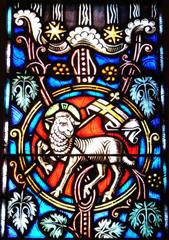
stainglassBackground

The books of 1 and 2 Samuel were, at one time, one book written in Hebrew. During its translation into the Greek language, Samuel was divided into two parts. The name of the book comes from the first important person in this book, Samuel the prophet. Samuel did not write it, however. He died before the end of it. We do not know who wrote the book. The author lived after King Solomon had died in about 930 BC (930 years Before Christ). After Solomon died, the country of Israel divided into two countries, Israel and Judah. The country of Judah included the tribes of Judah and Benjamin (see 1 Kings 12:1-24). In 1 and 2 Samuel the author often refers to Judah as a country.

In those days, the kings and leaders employed writers. They wrote about the events in their country. The prophets also wrote accounts of events. 2 Samuel 1:18; 1 Kings 11:41; 14:19, 29; 1 Chronicles 27:24; 29:29 all refer to these writers and their books. The writer of 1 and 2 Samuel probably got most of his information from these accounts.

The book of 1 Samuel records a major change from the time of the judges to Israel’s first king. The judges had led the Israelites for about 350 years after the death of Joshua. Samuel was the last of the judges. He was also a prophet and a priest. Samuel anointed Saul, the first king of Israel. But Saul did not obey God. So, God chose another king, David, who would obey him. 1 Samuel ends with the death of Saul. The book of 2 Samuel records the life of David as king.

Biblical Truth2http://www.easyenglish.info/bible-commentary/1sam-lbw.htm

Saul did not want Samuel to leave him. Saul said that he wanted to worship the Lord. But Saul really wanted Samuel to give him honor. Saul wanted the people to think that nothing had changed. Samuel changed his decision the second time that Saul asked. He went back with Saul. Saul worshipped the Lord. But Samuel did the job that Saul should have done. He killed Agag. Agag thought that he would not have to die. But Samuel punished Agag because he had killed so many people. After this, Samuel left Saul. They lived only 10 miles apart. Samuel never went to visit Saul again because God had refused him as king. Samuel was as sad about Saul as if he had died. And the Lord was sad about the first king of Israel too. Saul continued to rule Israel until he died many years later. But from this day, Saul had many problems. And he was not a good leader.

The Lord did not allow Samuel to be sad about Saul for a long time. God had now chosen a new king. Jesse was the grandson of Ruth and Boaz (Ruth 4:17-22). Samuel went from his home in Ramah to Jesse’s town of Bethlehem. The road went past Gibeah where Saul lived. Saul knew that God would choose a new king to replace him. Samuel was afraid that Saul would be jealous about the new king. And Saul might be angry enough to kill Samuel. So the Lord told Samuel to give a sacrifice to him. Samuel could then tell people the truth. But he did not tell them the main reason for his visit. Samuel trusted God and obeyed him.

The leaders of Bethlehem were afraid of Samuel because he was a prophet. He spoke words from God. He went to towns as a judge (7:15-17). But this was a peaceful visit. They had to separate themselves from things that made them not holy. (Leviticus explains what these things were.) Then they washed and put clean clothes on. This showed that they had made themselves holy. (In Exodus 19 the Israelites had to consecrate themselves before God gave Moses the 10 laws.)

Verse 7 shows us that God does not behave like us. God sees what people are like inside, in their spirit (1 Kings 8:39; Psalm 139; Luke 16:15; John 2:25). He knows about each person’s character. He knows whether they will trust and obey him. This is most important to God. Samuel thought that God would choose Eliab because he was handsome and tall. People like handsome men. And the Israelite army would look good with a tall strong king as leader. But Saul was tall and handsome (9:1-2) and yet he was not a good king.

Samuel, listened to God. God said that he had chosen one of Jesse’s sons. But God did not choose any of the sons who walked past Samuel. Jesse had not invited his youngest son to the sacrifice. Perhaps Jesse thought that he was too young to come. But Samuel had to see Jesse’s youngest son David. He looked handsome, but God saw that he had a good spirit too. Samuel obeyed God. He anointed David with oil. David’s brothers saw this. But we do not know if anyone else from Bethlehem was there. The Spirit of the Lord came on David that day. The Hebrew word means that the Spirit ‘rushed’ on David with power. In Acts 2:1-4, the Holy Spirit sounded like strong wind as he came from heaven. In the Old Testament the Spirit of the Lord (the Holy Spirit) came on people for a particular job. The Spirit also left people when they did not obey God. But the Spirit of the Lord did not leave David.

Samuel went back to his home at Ramah. He had completed the task that God gave to him. The writer mentions Samuel only once more (at the end of chapter 19) before his death in 25:1. The account of David continues in the rest of 1 Samuel. It goes through all of 2 Samuel and finishes with David’s death in 1 Kings 2:10. David was a shepherd. David looked after his father’s sheep. David wrote Psalm 23. He described God as a shepherd. This is picture language for how God cared for David. Jesus said ‘I am the good shepherd’ (John 10:11-16). Ezekiel 34 and 1 Peter 5:1-4 call leaders ‘shepherds’ and God’s people ‘sheep’. David understood how God wanted him to lead the Israelites.

Items for Discussion

  • If we were given the task to choose someone from a group of people, what criteria would you use?
  • Since we are unable to see into the hearts of people like God, what kind of criteria might we use to gain insights on one’s faithfulness to God?
  • What was it about David’s life that prepared him so well for being the King God wanted for Israel?
  • What are the characteristics of a shepherd?


John 21:15-17
15 When they had finished eating, Jesus said to Simon Peter, “Simon son of John, do you love me more than these?” “Yes, Lord,” he said, “you know that I love you.” Jesus said, “Feed my lambs.” 16 Again Jesus said, “Simon son of John, do you love me?” He answered, “Yes, Lord, you know that I love you.” Jesus said, “Take care of my sheep.” 17 The third time he said to him, “Simon son of John, do you love me?” Peter was hurt because Jesus asked him the third time, “Do you love me?” He said, “Lord, you know all things; you know that I love you.” Jesus said, “Feed my sheep.

Background

We are given insight into Simon Peter, who was John’s partner in the fishing business. Simon Peter also a disciple of Jesus (Luke 5:1-11). Simon Peter, James and John were Jesus’ special friends, usually together and witness to much of what Jesus did. They were the only disciples with Jesus when he raised Jairus’ daughter from death (Mark 5:37). On another occasion, Jesus took Simon Peter, James and John up a mountain. There, they saw him as he talked with Moses and Elijah. They heard God’s voice. God said that Jesus was his Son. And they must listen to Jesus (Mark 9:2-12). And on the night before Jesus died, John and Simon Peter made the arrangements for the Passover meal (Luke 22:8). So John, the Gospel’s writer and Peter knew Jesus very well.

Biblical Truth

After breakfast, Jesus walked away from the other disciples (verse 20). He took Simon Peter with him. Jesus wanted to talk to Peter in private. In this conversation, Jesus called Peter by his original name: ‘Simon’.
Outside the High Priest’s house, Peter had said three times that he did not know Jesus. So, three times, Jesus asked Peter if he (Peter) loved him (Jesus). Jesus did this because of several reasons. He wanted Peter to know that he (Jesus) had forgiven him. Also Jesus wanted Peter to say aloud that he loved Jesus. This was the opposite of what Peter had said outside the High Priest’s house. Jesus was giving Peter the opportunity to declare that he (Peter) was Jesus’ loyal follower. But Jesus did more than just forgive Peter. Jesus gave Peter a very important job. This showed that Jesus trusted Peter. Even after what Peter had done, Jesus still trusted Peter.

The ‘lambs’ and the ‘sheep’ that Jesus referred to meant his followers. Jesus had called himself ‘the good shepherd’ (John 10:11). He told Peter to look after his followers. Peter obeyed this command. Soon after this, he became a leader of the disciples and of the church in Jerusalem. Peter said that he loved Jesus. Then Peter obeyed Jesus to show that he really meant this. If we really love Jesus, we will obey him, too.

Jesus used two different Greek words for the word that we translate as ‘love’ in this passage. In verses 15 and 16, Jesus used a form of the word ‘agape’. This refers to love that is completely unselfish. It means to love without a thought about our own desires. It means to love without a desire to receive any reward. ‘Agape’ describes the kind of love that God has for us. ‘Agape’ is the word that John used in John 3:16.

But the three times that Peter answered Jesus, he (Peter) used the Greek word ‘phileo’. This refers to the kind of love that friends have. It means to care for somebody. It is a weaker kind of love than ‘agape’. Perhaps Peter felt that he was not yet ready to declare that kind of ‘agape’ love for Jesus. Once, Peter had said that he would die on behalf of Jesus (John 14:37-38). Perhaps Peter was remembering how, instead, he had lied to protect himself. In verse 17, Jesus used the word ‘phileo’, too. Perhaps he was saying, ‘Are you even my friend?’ Perhaps that was what upset Peter.

But Peter knew that Jesus did not really have to ask these questions. Jesus already knew how Peter felt. Jesus knows how we feel, too. He knows how much we love him. But still he wants us to tell him. Perhaps we feel that our love for him is too weak. We can never love him as much as he loves us. If we ask, he will increase our love for him. But we must spend more time with him. We must worship him, alone and with other Christians. We must learn more about him from the Bible. We must pray often. Then we will realize that our love for him is increasing. We will know him more. Our love for him will increase every day of our lives, if we let this happen.

Items for Discussion

  • Why is Jesus the perfect shepherd?
  • Why was it so important to Jesus to make sure that Peter knew he was forgiven?
  • Jesus uses “agape” to describe the love he wants from Peter but Peter responds with “phileo” love. Why is it so important to understand the difference?
  • How does love grow between people?
  • How is the love Jesus calls for that of a shepherd and why will the love of a “friend” fall short?
  • How can we use these Biblical stories to help us when we are asked to choose people as friends, partners, leaders, etc.?

Discussion Challenge

  • What should the role of today’s Christian Church be in teaching people how to love each other?

Stormy Weather

1 Samuel 17:33-18:51NIV New International Version Translations
17:33 Saul replied, “You are not able to go out against this Philistine and fight him; you are only a young man, and he has been a warrior from his youth.” 34 But David said to Saul, “Your servant has been keeping his father’s sheep. When a lion or a bear came and carried off a sheep from the flock, 35 I went after it, struck it and rescued the sheep from its mouth. When it turned on me, I seized it by its hair, struck it and killed it. 36 Your servant has killed both the lion and the bear; this uncircumcised Philistine will be like one of them, because he has defied the armies of the living God. 37 The Lord who rescued me from the paw of the lion and the paw of the bear will rescue me from the hand of this Philistine.” Saul said to David, “Go, and the Lord be with you.” 38 Then Saul dressed David in his own tunic. He put a coat of armor on him and a bronze helmet on his head. 39 David fastened on his sword over the tunic and tried walking around, because he was not used to them. “I cannot go in these,” he said to Saul, “because I am not used to them.” So he took them off. 40 Then he took his staff in his hand, chose five smooth stones from the stream, put them in the pouch of his shepherd’s bag and, with his sling in his hand, approached the Philistine. 41 Meanwhile, the Philistine, with his shield bearer in front of him, kept coming closer to David. 42 He looked David over and saw that he was little more than a boy, glowing with health and handsome, and he despised him. 43 He said to David, “Am I a dog that you come at me with sticks?” And the Philistine cursed David by his gods. 44 “Come here,” he said, “and I’ll give your flesh to the birds and the wild animals!” 45 David said to the Philistine, “You come against me with sword and spear and javelin, but I come against you in the name of the Lord Almighty, the God of the armies of Israel, whom you have defied. 46 This day the Lord will deliver you into my hands, and I’ll strike you down and cut off your head. This very day I will give the carcasses of the Philistine army to the birds and the wild animals, and the whole world will know that there is a God in Israel. 47 All those gathered here will know that it is not by sword or spear that the Lord saves; for the battle is the Lord’s, and he will give all of you into our hands.” 48 As the Philistine moved closer to attack him, David ran quickly toward the battle line to meet him. 49 Reaching into his bag and taking out a stone, he slung it and struck the Philistine on the forehead. The stone sank into his forehead, and he fell face down on the ground. 50 So David triumphed over the Philistine with a sling and a stone; without a sword in his hand he struck down the Philistine and killed him. 51 David ran and stood over him. He took hold of the Philistine’s sword and drew it from the sheath. After he killed him, he cut off his head with the sword. When the Philistines saw that their hero was dead, they turned and ran. 52 Then the men of Israel and Judah surged forward with a shout and pursued the Philistines to the entrance of Gath and to the gates of Ekron. Their dead were strewn along the Shaaraim road to Gath and Ekron. 53 When the Israelites returned from chasing the Philistines, they plundered their camp. 54 David took the Philistine’s head and brought it to Jerusalem; he put the Philistine’s weapons in his own tent. 55 As Saul watched David going out to meet the Philistine, he said to Abner, commander of the army, “Abner, whose son is that young man?” Abner replied, “As surely as you live, Your Majesty, I don’t know.” 56 The king said, “Find out whose son this young man is.” 57 As soon as David returned from killing the Philistine, Abner took him and brought him before Saul, with David still holding the Philistine’s head. 58 “Whose son are you, young man?” Saul asked him. David said, “I am the son of your servant Jesse of Bethlehem.” 18:1 After David had finished talking with Saul, Jonathan became one in spirit with David, and he loved him as himself. 2 From that day Saul kept David with him and did not let him return home to his family. 3 And Jonathan made a covenant with David because he loved him as himself. 4 Jonathan took off the robe he was wearing and gave it to David, along with his tunic, and even his sword, his bow and his belt. 5 Whatever mission Saul sent him on, David was so successful that Saul gave him a high rank in the army. This pleased all the troops, and Saul’s officers as well.

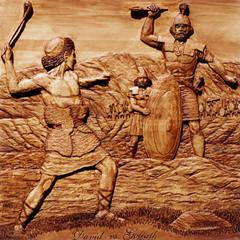
davidgoliathBackground

The book 1 of Samuel ends with one of the most amazing stories of God’s power and grace. From a simple shepherd, David kills a monster of a man, Goliath with a simple slingshot and stone. From this time forward, Saul would fear David as God continued to prepare David to be King.

Biblical Truth2http://www.christnotes.org/commentary.php?com=mhc&b=9&c=17

A shepherd boy, comes the same morning from his job of keeping sheep, and has more courage than all the mighty men of Israel. Thus God often sends good words to his Israel, and does great things for them, by way of the weak and foolish things of the world. As he had answered his brother’s passion with meekness, so David answered Saul’s fear with faith. When David kept sheep, he proved himself a very competent shepherd. This reminds us of Christ, the good Shepherd, who not only ventured, but laid down his life for the sheep. Our experience ought to encourage us to trust in God, and be bold in the way of our Christian duty. God that has delivered us, does and will continue to do so. David gained permission from his job to fight the Philistine. Not being used to such armor as Saul put upon him, he was not satisfied to go in that manner. David desired that all would know victory was from the Lord and that it might more plainly appear he fought and conquered in faith. Victory would be from God who works by the feeblest and most despised means and instruments, like a simple shepherd boy. It did not matter how luxurious Saul’s coat or how strong his armor. David needed only faith, prayer, truth, and righteousness; the whole armor of God, and the same mind that would come in Christ

The security and presumption of fools destroy themselves. Nothing can excel the humility, faith, and piety which appear in David’s words. He expressed his assured expectation of success; he gloried in his enemy’s mean appearance and weapons, that the victory might be ascribed to the Lord alone.

See how frail and uncertain life is, even when a man thinks himself best fortified; how quickly, how easily, and by how small a matter, the passage may be opened for life to go out, and death to enter! Let not the strong man glory in his strength, nor the armed man in his armor. God resists the proud, and pours contempt on those who defy him and his people. No one ever hardened his heart against God and prospered. The history is recorded, that all may exert themselves for the honor of God, and the support of his cause, with bold and unshaken reliance on him. Even today, there is one conflict in which all the followers of Christ must be engaged; one enemy, more formidable than Goliath, still challenges the armies of Israel. But “resist Satan, and he will flee from you.” Go forward into battle with the faith of David, and the powers of darkness cannot stand against you. But how often is the Christian foiled through a heart of unbelief!

The friendship of David and Jonathan was the effect of Divine grace, which produces in true believers one heart and one soul, and causes them to love each other. This union of souls is from partaking in the Spirit of Christ. Where God unites hearts, carnal matters are too weak to separate them. Those who love Christ as their own souls, will be willing to join themselves to him in an everlasting covenant. It was certainly a great proof of the power of God’s grace in David, that he was able to bear all this respect and honor, remaining humble.

Items for Discussion

  • This story might be retitled, “God Wins!” – Why are people today so reluctant to reach out and accept God’s victories over their own efforts and skills?
  • Who are the Goliaths of our times?
  • If you had to compare Saul and David, how did they differ in their approach to the enemy?
  • How would you rate today’s leaders, in our country, in our businesses, in our families? More like Saul, more like David?


Matthew 8:23-27
23 Then he got into the boat and his disciples followed him. 24 Suddenly a furious storm came up on the lake, so that the waves swept over the boat. But Jesus was sleeping. 25 The disciples went and woke him, saying, “Lord, save us! We’re going to drown!” 26 He replied, “You of little faith, why are you so afraid?” Then he got up and rebuked the winds and the waves, and it was completely calm. 27 The men were amazed and asked, “What kind of man is this? Even the winds and the waves obey him!”

Background

Matthew, the Apostle, has just finished giving us examples of the Lord’s preaching, now us a specimen of our now moves to give some instances of the miracles Jesus brought to our world. Matthew’s purpose well might be to prove Christ a Teacher coming from God, and the great Healer for a diseased world. In verses 23 to 27, we see Christ’s power to even control the wind and weather.

Biblical Truth

Jesus and his disciples got into the boat and they started to go across Lake Galilee. They were part of the way across the lake when there came a fierce storm. The lake is about 700 feet (215 metres) below sea level. Winds sweep down through the valleys that lead to the lake. And these winds often cause sudden storms. This time the wind was so powerful that it caused the waves to crash against the boat. Water began to fill the boat. It seemed likely that the boat would sink. Some of these disciples were skilled sailors. But they could do nothing to save themselves and they were afraid. Jesus was asleep in the back of the boat. So, the disciples woke Jesus. In despair, they cried to Jesus to save them.

Jesus asked the disciples why they were afraid. They ought to have had more faith. Faith removes fear, and fear opposes faith. Faith is a practical trust in God. They should have trusted God to protect them. Jesus had already shown his power over demons and diseases. Now he showed his authority over the forces of the natural world. He stood up and he spoke to the wind and the waves. The wind and the waves obeyed him and they became calm.
The disciples knew that Jesus was someone special. But this display of power made them afraid. It astonished them. They wondered what kind of man Jesus was. Jesus had power over the wind and the waves. In the Psalms, God has the power to control the wind and the waves (see Psalm 107:23-32). Jesus showed that he had this same power. This event was evidence that Jesus was the Christ.

Items for Discussion

  • What can you discern about Christ from his miracle in calming the storm?
  • How do fear and faith interact when someone is afraid?
  • How can we tell in advance which one will win, fear or faith?
  • How might this story be similar to David’s story, when God used a simple slingshot to down a nation’s enemy?
  • If we were like Saul and not David, what might the story of the storm and the boat sound like?
  • What point is Matthew trying to make with regard to facing overwhelming “Storms” within one’s life?

Discussion Challenge

  • How do we assure ourselves that our faith is stronger than our fears?

Time is of the Essence

Isaiah 13:6-91NIV New International Version Translations
6 Wail, for the day of the Lord is near; it will come like destruction from the Almighty. 7 Because of this, all hands will go limp, every heart will melt with fear. 8 Terror will seize them, pain and anguish will grip them; they will writhe like a woman in labor. They will look aghast at each other, their faces aflame. 9 See, the day of the Lord is coming—a cruel day, with wrath and fierce anger—to make the land desolate and destroy the sinners within it.

thiefBackground

The threats within God’s word press heavily upon the wicked, and are a heavy burden, too heavy for them to bear. The persons brought together to lay Babylon waste, are called God’s sanctified or appointed ones; designed for this service, and made able to do it. They are called God’s mighty ones, because they had their might from God, and were now to use it for him. They come from afar. God can make those a scourge and ruin to his enemies, who are farthest off, and therefore least dreaded.

We have here the terrible desolation of Babylon by the Medes and Persians. Those who in the day of their peace were proud, and haughty, and terrible, are quite dispirited when trouble comes. Their faces shall be scorched with the flame. All comfort and hope shall fail. The stars of heaven shall not give their light, the sun shall be darkened. Such expressions are often employed by the prophets, to describe the convulsions of governments. God will visit them for their iniquity, particularly the sin of pride, which brings men to their knees. There will be a general scene of horror.

Biblical Truth2http://www.christnotes.org/commentary.php?com=mhc&b=23&c=13

‘The day is coming.’ On that day, people will see clearly what God is doing. His powerful deeds will impress everyone. The date is God’s secret but on that day, God will punish proud people. The message is simple, frightening and to the point. No one, that is no one no matter where they are on earth will be spared God’s judgment.

Items for Discussion

  • What does overwhelming fear feel like?
  • What is God’s covenant with His people?
  • In order to guide His people to Himself, to God, what do you think God would be willing to do?
  • History tells us that God often punishes its people for their sins. Is there punishment today such as was in the Old Testament?
  • Can you think of examples when horror brought people closer to God?
  • Why do you think it takes horrible events to make people both fear and desire God?


1 Thessalonians 5:1-11
1 Now, brothers and sisters, about times and dates we do not need to write to you, 2 for you know very well that the day of the Lord will come like a thief in the night. 3 While people are saying, “Peace and safety,” destruction will come on them suddenly, as labor pains on a pregnant woman, and they will not escape. 4 But you, brothers and sisters, are not in darkness so that this day should surprise you like a thief. 5 You are all children of the light and children of the day. We do not belong to the night or to the darkness. 6 So then, let us not be like others, who are asleep, but let us be awake and sober. 7 For those who sleep, sleep at night, and those who get drunk, get drunk at night. 8 But since we belong to the day, let us be sober, putting on faith and love as a breastplate, and the hope of salvation as a helmet. 9 For God did not appoint us to suffer wrath but to receive salvation through our Lord Jesus Christ. 10 He died for us so that, whether we are awake or asleep, we may live together with him. 11 Therefore encourage one another and build each other up, just as in fact you are doing.

Background3http://www.easyenglish.info/bible-commentary/1thess-lbw.htm

This letter is from Paul, Silas and Timothy. From these three, the apostle Paul was the main author. We do not know how much of the letter Silas and Timothy wrote. But all three of them were in agreement with what the letter contains. It may be the earliest of the letters of Paul that we have. Paul and his friends wrote it between AD 50 and AD 53. That is about 20 years after Jesus died and rose again to life. Paul was on his second main journey in which he spread the good news about Jesus. He and his friends were in the city of Corinth when they wrote the letter. We can be sure about this, and about the date, from the letter and the book of the Acts for these reasons:

  1. Paul had to leave Thessalonica and he went to the city of Beroea. From there, he went to the city of Athens (Acts 17). From Athens, he went to Corinth (Acts 18:1). Silas and Timothy arrived from Macedonia and were with Paul in Corinth (Acts 18:1-5). Then Paul sent Timothy back to Thessalonica to see what was happening with that church (1 Thessalonians 3:5). They wrote this first letter soon after Timothy had come back to join Paul and Silas in Corinth (1 Thessalonians 3:6).
  2. Silas and Timothy were with Paul when they wrote the letter (1 Thessalonians 1:1). Silas was only with Paul on his second main journey. So, we know that they wrote the letter during that journey.
  3. The ruler in Corinth was a man called Gallio. The Jews there, who were against Paul, brought him in front of Gallio (Acts 18:12-17). They accused him of breaking the law. Gallio was the ruler for one or two years, and that was between AD 51 and AD 53. As Paul was in Corinth for about 18 months, the date of the letter must have been in the period AD 50 to AD 54.

The purpose of the letter was to inform the church in Thessalonica over issues that Timothy saw while on a trip there. He came back to Corinth with news about the church at Thessalonica. He told Paul and Silas that the church was strong but that there was much persecution. Some people were saying bad things about Paul and his friends. These people claimed that Paul’s intentions were false. Then the Christians had many questions and were in need of more teaching. So the purposes of the letter included:

  1. To express the joy that the writers felt and to give thanks to God for the good news that Timothy brought.
  2. To tell the Thessalonians how much they loved them. And to tell them that they cared about them. The writers wanted to encourage them as they tried to live for the Lord Jesus.
  3. To answer the false things that the Jews and other people had said about Paul and his friends. These people said that Paul had come to make a profit from those who believed his message. They said that the message was not from God, but that Paul had made it up. They said that the fact that Paul had not come back showed that he did not really care about the Christians.
  4. There were questions about Christians who had died. They wanted to know what would happen to those Christians when Jesus came to earth again. The authors wrote about this (1 Thessalonians 4:13-18) and taught some more about the return of the Lord Jesus (1 Thessalonians 5:1-11).
  5. To teach that those who trust in God must not be guilty in matters to do with sex (1 Thessalonians 4:4-8). Such sins were common in the city in which they lived.

Biblical Truth4http://www.easyenglish.info/bible-commentary/1thess-lbw.htm

Verse 1: The writers had answered the worries about those who had died. Now they turn to a new subject. This is the question of when Jesus will come again. It seems that some of the Christians had expected Jesus to come soon. But he had not come yet. There was no need to write to them to tell them that the Lord will come. They knew that. There was no need to tell them that the time of his coming is secret. But they did need instruction about what will happen when he does come back.

Verse 2: They knew about the day of the Lord and of his return, because Paul and his friends had taught them about it. But when that day would be, no one could know. This day is not a single day, as we understand it. Rather it is the day of the Lord, which covers many events.

Verse 3: The beginning of the day of the Lord will come as a surprise. Those who do not believe in Jesus will not be ready for that day. They will think that they are safe. It will be a time when at last there seems to be peace on the earth. But, at that moment, when they feel safe and at peace, ruin will come to them from the Lord. The dawn of that day will be sudden, just like the pains of a woman who is having a baby (Isaiah 13:8-9). There will be no warning and they will not be expecting it. They will not be able to avoid the anger of God. There will be no escape for them.

Verse 4: Those who do not believe in Jesus are like people living in the dark. They cannot see when the danger comes towards them. So, the coming of the Lord will surprise and shock them. Like a thief, it will come when they do not expect it. But, those who believe in Jesus are not living in the dark. The day of the Lord should not come as a surprise to them. They should be expecting it and they should be ready for the Lord to come.

Verse 5: In contrast to those who do not believe in the Lord Jesus, Paul describes all the Christians at Thessalonica as children of the light. Light represents life and also goodness. So children of the light are those who have God’s life. And they try to do good. Some of them may be weak or doubting in their faith. The writers encourage them by saying that they are all children of the light and of the day. When it is night, we cannot see where we are going. We cannot see what is coming to us. Those who do not believe in the Lord Jesus are like people who walk in the night. All who believe in the Lord Jesus are ‘children of the day’. They are people who do not belong to night and darkness. They can see where they walk. And they can be ready for what is coming.

Verse 6: Because they are children of the day, they should not be asleep. They should be awake to all that the apostles taught them. They know the truth and how they ought to live. Those who do not believe in the Lord Jesus do not know these things. So they are not aware of them. They are like those who are asleep.
Christians know what is right. And they are responsible for what they do. Those who have drunk too much wine lose control of their actions. Those who believe in the Lord Jesus must never be like that. They must always be in control of themselves. They must be ready for the day when the Lord shall come.

Verse 7: To explain what he means in verse 6, Paul states the normal pattern of life. People usually go to bed and sleep at night. Those who drink strong drink to excess often do so at night. Because Christians are not ‘children of the night’, they should keep awake. And they should not lose control as those who drink too much do. They are not talking about the sleep that the body needs. But they use that to show that Christians must be awake to the things of God. Those who drink to excess are not in full control of themselves. Those who believe in the Lord Jesus should always be ready for him to come.

Verse 8: Those who belong to the day are those who believe in the Lord Jesus. The word ‘day’ here represents the new kind of life that comes by means of faith in the Lord. They have this new life with the Lord Jesus. And that should cause them to be careful how they live. It is the reason why they must be in control of themselves.

Verse 9: God chose all those who have come to believe in the Lord Jesus. He chose them so that they would escape his anger when he judges the people of the world. He chose them to benefit from what the Lord Jesus has done. The Lord Jesus has suffered the anger of God for all that they have done wrong. So, as they accept this by believing in the Lord Jesus, they are free from God’s anger. The Lord Jesus has saved them from that anger and from the judgement of God. But more than that, God will raise them up to live again after they have died. So, they will live again with the Lord Jesus and with God.

Verse 10: Here is how Jesus Christ obtained our salvation for us. He died for us. He died the death that should have been ours because of our sin. God judged all our sins and Jesus took the punishment for us. So, he will save all those who accept that Jesus died for them and trust him. He will save them from the anger of God.

Verse 11: All who believe in the Lord Jesus have his promise. The promise is that, when he comes, they will live with him. So, they can encourage each other as they speak about these things. They can help those who have doubts and fears. They can help them by showing them that the Lord accepts them. The writers want them to help each other to be strong and certain in what they believe. They need to help each other to know God better and to love him more. They were doing this already but they should go on doing it.

Items for Discussion

  • How much time do we have to prepare for God’s arrival?
  • Why is no one in a hurry or paying attention is seems?
  • Drunkenness, and maybe today, drugs, are common. They must have been common in Jesus’ time too. What is their risk?
  • What comfort do you draw from verse 9?
  • Do you believe that God lets us use what we love for His kingdom? If so, why, if not why not?
  • Do you believe that God is directing us to just do what He wants for His kingdom? If so, why, if not why not?

Discussion Challenge

  • Why is verse 11 so important to the Christian Church?


And The Walls Came Tumbling Down

Joshua 6:1-51NIV New International Version Translations
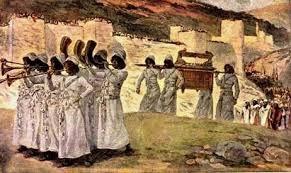
1 Now the gates of Jericho were securely barred because of the Israelites. No one went out and no one came in. 2 Then the Lord said to Joshua, “See, I have delivered Jericho into your hands, along with its king and its fighting men. 3 March around the city once with all the armed men. Do this for six days. 4 Have seven priests carry trumpets of rams’ horns in front of the ark. On the seventh day, march around the city seven times, with the priests blowing the trumpets. 5 When you hear them sound a long blast on the trumpets, have the whole army give a loud shout; then the wall of the city will collapse and the army will go up, everyone straight in.”

joshuaBackground

Joshua is best known as Moses’ second in command who takes over and leads the Israelites into the Promised Land after Moses’ death. Joshua is considered one of the Bible’s greatest military leaders for leading the seven-year conquest of the Promised Land, and is often held up as a model for leadership and a source of practical application on how to be an effective leader. Joshua is a figure in the Torah, being one of the spies for Israel (Num 13–14) and identified in several passages as Moses’ assistant. He is the central character in the Hebrew Bible’s Book of Joshua. According to the books Exodus, Numbers and Joshua, he became the leader of the Israelite tribes after the death of Moses.

As a military leader, Joshua would be considered one of the greatest generals in human history. The Lord had promised sure victory and delivered it in convincing fashion. The only exception is in the battle of Ai (Joshua 7). There are several things to note about this incident. Israel broke faith with God in regards to the “devoted things” (Joshua 7:1). God had commanded the Israelites to devote everything to destruction (Joshua 6:17), and Achan had kept some of the loot from the battle of Jericho for himself. Because of this, God judged them by not giving them the victory at Ai. Another thing to note is that there is no explicit command by God to go against Ai. The purpose of putting these two battle stories side by side is show that when God sets the program and agenda, victory follows, but when man sets the program and agenda, failure ensues. Jericho was the Lord’s battle; Ai was not. God redeemed the situation and eventually gave them the victory, but not until after the object lesson was given.

Further evidence of Joshua’s leadership qualities can be seen in his rock-solid faith in God. When the Israelites were on the edge of the Promised Land in Numbers 13, God commanded Moses to send out twelve people to spy out the land, one from each of the tribes of Israel. Upon their return, ten reported that the land, while bounteous as the Lord had promised, was occupied by strong and fierce warriors dwelling in large, fortified cities. Furthermore, the Nephilim (giants from the Israelites’ perspective) were in the land. However, Joshua and Caleb were the only two who urged the people to take the land (Numbers 14:7-10). Here we see one thing that sets Joshua (and Caleb) apart from the rest of the Israelites—they believed in the promises of God. They were not intimidated by the size of the warriors or the strength of the cities. Rather, they knew their God and remembered how He had dealt with Egypt, the most powerful nation on the earth at that time. If God could take care of the mighty Egyptian army, He could certainly take care of the various Canaanite tribes. God rewarded Joshua’s and Caleb’s faith by exempting them from the entire generation of Israelites that would perish in the wilderness.

Biblical Truth

The residents of Jericho resolved that Israel would not be its master. It shut itself up, in other words, strongly fortified both by stone and nature. But they were foolish, and their hearts hardened to their own destruction; the miserable case of all that strengthen themselves against the Almighty. God resolved that Israel would be its master, and it would happen quickly. No warlike preparations were to be made. By the uncommon method of besieging the city, the Lord honored the Ark of the Covenant, as the symbol of His presence, and showed that all the victories were from Him. The faith and patience of the people were proved and increased.

Items for Discussion

  • Why would someone believe that they could defend themselves from God?
  • Are there cases in history that people have been able to hide from God’s reach?
  • What are the elements of this story that strengthen your belief and faith in God?
  • Walls were basically stacked stones. There is no mention of any force besides the shouts of men and the walls came down. How do you think the enemy felt? How do you think the Israelites felt?


Luke 14:15-24
15 When one of those at the table with him heard this, he said to Jesus, “Blessed is the one who will eat at the feast in the kingdom of God.” 16 Jesus replied: “A certain man was preparing a great banquet and invited many guests. 17 At the time of the banquet he sent his servant to tell those who had been invited, ‘Come, for everything is now ready.’ 18 “But they all alike began to make excuses. The first said, ‘I have just bought a field, and I must go and see it. Please excuse me.’ 19 “Another said, ‘I have just bought five yoke of oxen, and I’m on my way to try them out. Please excuse me.’ 20 “Still another said, ‘I just got married, so I can’t come.’ 21 “The servant came back and reported this to his master. Then the owner of the house became angry and ordered his servant, ‘Go out quickly into the streets and alleys of the town and bring in the poor, the crippled, the blind and the lame.’ 22 “‘Sir,’ the servant said, ‘what you ordered has been done, but there is still room.’ 23 “Then the master told his servant, ‘Go out to the roads and country lanes and compel them to come in, so that my house will be full. 24 I tell you, not one of those who were invited will get a taste of my banquet.’”.

Background

Luke, the author of the third Gospel and the book of Acts, should be of special interest to us for several reasons. He was the only Gentile who wrote any of the books of the Bible. He is one of us. Furthermore, he was the only scientist among the writers. We do not know much about Luke’s background or his medical training. He was called “the beloved physician” by Paul (Colossians 4:14), and undoubtedly one reason for his ongoing association with Paul was the latter’s need for frequent medical care.

It is his medical background that places close to science. As far as Luke’s two Bible books are concerned, there is little in either book that utilizes scientific or medical facts or principles. He does refer to the infant Jesus being circumcised on the eighth day (Luke 2:21), and he is the only one of the four Gospel writers who does.

He is also recognized as a great historian, with his excellent accounts of the key events of the most important era in the history of the world. He also was undoubtedly a devoted Christian, a truth especially demonstrated by his unselfish service and companionship to the apostle Paul. Finally, he was probably the first Christian apologist, zealously concerned to defend and establish the absolute truth of the gospel of Christ.

Biblical Truth2http://www.easyenglish.info/bible-commentary/luke9-19-im-lbw.htm

Jesus had spoken of the future when God will raise people from death. The Jews were familiar with the idea of a grand dinner in God’s kingdom. They believed that the good people of the past would rise from death. And these good people would be guests at that dinner. Also as Jews, they expected to be guests with them at the dinner. Jesus would explain to him that many people are too busy to accept God’s invitation. Jesus told them a story about a man who invited many people to a great supper. None of the people whom he had invited had refused the invitation. The host expected them all to come. It took a long time to prepare for the great supper. When the supper was ready, the host sent his servant to fetch the guests. But they would not come to the supper.

It was the custom in some places to expect a second invitation. It may be that the servant took the second invitation to the guests. And they refused the second invitation. To refuse in this way was an insult to the host. The guests made excuses. The first one had bought a field.

  • The excuse: He needed to look at it before he bought it. The field, of course, would still be there after the meal. Therefore, it was not necessary to view it at that time. It could wait until after the supper. It is plain that, really, this man did not want to come to the supper.
  • The excuse: Another man had bought some oxen. He should have been satisfied with them before he bought them. Now they were his oxen and he could test them at any time. It could wait until after the supper. But he too did not want to go to the supper.
  • The excuse: Another man had just married a wife. A marriage is not a sudden affair. He should have known about it before he received the invitation to the supper. The invitation to these suppers would be to men only. He would have to leave his new wife at home while he went to the supper. The wives of the other guests would have to stay at home. As an excuse, he said that he could not go to the supper. If he had wanted to, he could have gone.

All three of these men knew about the supper before the servant came. All three made weak excuses as their reasons not to go to the supper.

The servant told his master what had happened. His master was angry. The guests that he had invited had insulted him. But he would not allow those excuses to spoil his supper. If the original guests would not come, he would invite other guests. He sent his servant to the poorer parts of the town. He told him to bring in poor people from there. He included those people who were sick or blind. And he included those people who could not walk.

The servant did what his master told him. But he did not bring in enough guests to satisfy his master. So, the master sent the servant to search wider and to urge people to come in. The servant went to the roads and paths outside the town. There he would find people who had no homes. Even these people, the servant must urge to come to the supper. Even if the first guests came, the master would not allow them to come in. There would be no further chance for them. They had missed their opportunity.

Jesus told this story to show God’s desire to have a right relationship with people. The supper means a place in God’s kingdom. He sent the prophets to invite his people to come in. But very many of them would not accept that invitation. Now in Jesus, there is the invitation for all to come in. He sends Christians to bring in people from all nations. They must bring all types of people. No person is beyond the reach of God. The good news of Jesus is for all people. God will receive all who come to him. But when people refuse God’s invitation, that invitation may not remain open to them.

Items for Discussion

  • What is an invitation?
  • In today’s world, who are the invited?
  • Who would be those who would fit the description of the uninvited?
  • What is the banquet?
  • Why do humans make so many excuses?

Discussion Challenge

  • How does today’s church help people understand the value of the invitation they have been given?

Despots and Dictators

2 Samuel 11:1-151NIV New International Version Translations
1 In the spring, at the time when kings go off to war, David sent Joab out with the king’s men and the whole Israelite army. They destroyed the Ammonites and besieged Rabbah. But David remained in Jerusalem. 2 One evening David got up from his bed and walked around on the roof of the palace. From the roof he saw a woman bathing. The woman was very beautiful, 3 and David sent someone to find out about her. The man said, “She is Bathsheba, the daughter of Eliam and the wife of Uriah the Hittite.” 4 Then David sent messengers to get her. She came to him, and he slept with her. (Now she was purifying herself from her monthly uncleanness.) Then she went back home. 5 The woman conceived and sent word to David, saying, “I am pregnant.” 6 So David sent this word to Joab: “Send me Uriah the Hittite.” And Joab sent him to David. 7 When Uriah came to him, David asked him how Joab was, how the soldiers were and how the war was going. 8 Then David said to Uriah, “Go down to your house and wash your feet.” So Uriah left the palace, and a gift from the king was sent after him. 9 But Uriah slept at the entrance to the palace with all his master’s servants and did not go down to his house. 10 David was told, “Uriah did not go home.” So he asked Uriah, “Haven’t you just come from a military campaign? Why didn’t you go home?” 11 Uriah said to David, “The ark and Israel and Judah are staying in tents, and my commander Joab and my lord’s men are camped in the open country. How could I go to my house to eat and drink and make love to my wife? As surely as you live, I will not do such a thing!” 12 Then David said to him, “Stay here one more day, and tomorrow I will send you back.” So Uriah remained in Jerusalem that day and the next. 13 At David’s invitation, he ate and drank with him, and David made him drunk. But in the evening Uriah went out to sleep on his mat among his master’s servants; he did not go home. 14 In the morning David wrote a letter to Joab and sent it with Uriah. 15 In it he wrote, “Put Uriah out in front where the fighting is fiercest. Then withdraw from him so he will be struck down and die.”

RomanTileBackground2https://www.biblegateway.com/resources/matthew-henry/2Sam.11.1-2Sam.11.27

What David said of the mournful report of Saul’s death may more fitly be applied to the sad story of this chapter, the adultery and murder David was guilty of.—“Tell it not in Gath, publish it not in the streets of Ashkelon.” We wish we could draw a veil over it, and that it might never be known, might never be said, that David did such things as are here recorded of him. But it cannot, it must not, be concealed. The scripture is faithful in relating the faults even of those whom it most applauds, which is an instance of the sincerity of the author, and evidence that it was not written to serve any party: and even such stories as these “were written for our learning,” that “he that thinks he stands may take heed lest he fall,” and that others’ harms (faults and punishments) may be our warnings. Many, no doubt, have been emboldened to sin, and hardened in it, by this story, and to them it is a “savior of death unto death;” but many have by it been awakened to a holy jealousy over themselves, and constant watchfulness against sin, and to them it is a “savior of life unto life.” Those are very great sins, and greatly aggravated, which here we find David guilty of.

  • He committed adultery with Bathsheba, the wife of Uriah, 2 Sam. 11:1-5.
  • He endeavored to father a child and then pass the blame onto Uriah, 2 Sam. 11:6-13.
  • When that project failed, he plotted the death of Uriah by the sword of the children of Ammon, and made it happen, 2 Sam. 11:14-25.
  • He married Bathsheba, 2 Sam. 11:26, 27.

Is this really David? Is this the man after God’s own heart? How is his behavior changed, worse than it was before Ahimelech, the king prior to David? How has this light before God become dim! Let those that read this story, understand what the best of men can become when God leaves them to themselves.

Biblical Truth3http://www.easyenglish.info/bible-commentary/2samuel-lbw.htm

Kings preferred not to fight wars in the winter when was wet and often cold. The roads and the land became muddy. The soldiers could not move from one area to another. People would not be able to supply the soldiers with food and the other things that they needed. In chapter 10, the Israelites had already fought the Ammonites. David wanted to defeat them completely and take their capital city. Sometimes David led the army himself (10:17). At other times, he sent Joab out to lead the army (10:7). In this battle, David had sent Joab.

Israel is a hot country after the winter. People used to get up early in the morning to do their work. They stopped in the afternoon when it became too hot. Then they went to bed. They slept until it was cooler. David’s palace had a flat roof. In the evening, it was cooler on the roof than inside the palace. There were many houses in Jerusalem. Some of them had a private garden. There would be a wall round the garden. Bathsheba probably had a bath in her private garden. People would not be able to see her. But David saw her because he was up high on his roof. He saw that she was beautiful. He had a strong desire for her.

Uriah came from the Hittite nation. This nation had become very strong and it had defeated many other nations. The Hittites ruled many nations on the east side of Israel for over 400 years. Then in the end, other nations defeated the Hittite nation. This happened about 200 years before David became king. But Hittite people still lived in many different countries. Uriah lived in Jerusalem. He was one of David’s best soldiers (23:39).

David knew God’s laws and knew that adultery was wrong. But he did not obey God’s law. David saw Bathsheba but he should not have watched her. This resulted in him having a wrong desire for her. Jesus said that such behavior is adultery too (Matthew 5:27-28). Bathsheba’s father and husband were both in David’s group of 30 brave men (23:34; 23:39). David discovered that Bathsheba was married. He should have left her alone. Instead, he used his power as king to get her. David sinned. Bathsheba could not obey both God and David. Perhaps she was afraid to refuse the king’s command. Verse 4 suggests that Bathsheba went to David only once.

A young woman bleeds each month when she is not expecting a baby. The Jewish law says that a woman is not ‘clean’ (or ‘pure’) when she bleeds. This does not mean that she is physically dirty. But she cannot go to religious events, the ceremonies of the Jewish religion. She has to make herself pure when she stops bleeding (Leviticus 15:19-24; 15:28-30). Bathsheba was not expecting a baby before David had sex with her. Verse 4 proves this. Uriah was off fighting in the war and not at his home. Therefore, Bathsheba was expecting David’s baby.

Adultery is a serious sin. In the Old Testament, God said that the guilty man and woman should die (Leviticus 20:10). So, David had a problem. Bathsheba’s baby did not belong to Uriah. David wanted Uriah to go home to his wife. Later, everyone would believe that Bathsheba was expecting her husband’s baby. David pretended that he wanted to hear about the war and the soldiers. In verse 8, David’s gift showed that he was pleased with Uriah. ‘Wash your feet’ probably meant ‘have a rest and enjoy yourself at home’. But Uriah would not go home. He was not an Israelite but he was loyal to the Lord. Deuteronomy 23:9-11 may show that men should not have sex during a war. (See also 1 Samuel 21:4-5.) Uriah obeyed this rule even when he was away from the battle. Uriah had a duty to the other soldiers. He was not selfish. He would not enjoy himself while the other men were in the war. He had a good character and high moral standards. He was an honest man. Uriah’s good behavior is very different from David’s bad behavior.

David realized that Uriah would not change his decision. So, David used his power in the wrong way again. Usually it is an honor to eat and drink with the king. But David did not care about Uriah. David just wanted Uriah to go home and have sex with his wife. This would have solved David’s problem. People often cannot control their behavior when they drink too much alcohol. But Uriah still would not go home. The next day, David decided that Uriah had to die, in spite of Uriah’s innocence. This was murder. Uriah did not know what David wrote to Joab. But Uriah had to carry the letter that led to his own death. Joab did not know the facts. But he had to obey David. Uriah died in the battle. And other soldiers died too.

Items for Discussion

  1. Are there special risks with regard to sin that leaders face? What are they?
  2. Why do you think we are given so much “graphic” detail on David’s sin?
  3. What is it that you have learned about sin through David’s personal failures?
  4. Did God grant any special privileges to David that were not available to anyone else? What can you conclude about our God?
  5. How can one’s experience with sin help others?


Acts 12:19b-23
19b Then Herod went from Judea to Caesarea and stayed there. 20 He had been quarreling with the people of Tyre and Sidon; they now joined together and sought an audience with him. After securing the support of Blastus, a trusted personal servant of the king, they asked for peace, because they depended on the king’s country for their food supply. 21 On the appointed day Herod, wearing his royal robes, sat on his throne and delivered a public address to the people. 22 They shouted, “This is the voice of a god, not of a man.” 23 Immediately, because Herod did not give praise to God, an angel of the Lord struck him down, and he was eaten by worms and died.

Background

Citizens of today’s nation-states are not unlike those of Roman times. People often succumb to an almost religious reverence for the power of the state. Theophilus and his peers lived under regimes where homage to the emperor was not only a civic duty but a welcome way of expressing appreciation for the “safety net” the emperor had provided. But the demand for this total loyalty would turn into total opposition when that same state would face Christian citizens who confess, “Jesus is Lord!”

The narrative of Herod’s opposition and demise can help Christians face political opposition with discerning confidence. The state (government) cannot stop the church in its mission.

Biblical Truth

When Herod left Jerusalem, he went to Caesarea. Tyre and Sidon were ports by the Mediterranean Sea, close to Caesarea, which was also a port. Perhaps the traders in Tyre and Sidon took trade away from Caesarea. Perhaps that is why Herod was angry with Tyre’s people and Sidon’s people. However, we do not know exactly why Herod argued with them. But the people from Tyre and Sidon wanted to make peace with Herod. Wheat grew in Galilee and those people needed this wheat for food. Herod was ruling over Galilee. So, they persuaded Blastus, Herod’s official, to help them.

Herod and the people from Tyre and Sidon wanted to be friends again. They wanted to do this in public. Perhaps Herod was trying to be popular again. So, they chose a day when they would meet. It was probably a special day, like the Emperor’s birthday. The Jewish writer Josephus also wrote an account of this occasion. He described the clothes that Herod wore. Someone had made them from silver cloth. They shone in the sun. For that reason, the people shouted that Herod was a god. Josephus wrote that Herod did not stop them. Josephus also described Herod’s death.

Items for Discussion

  • Is government, the state as Matthew Henry calls it, at war with Christians?
  • In what ways do leaders of today make the same subtle claims that they are “God?”
  • What is the role of a Christian when we encounter a “Herod?”
  • Why is the old adage “Power corrupts, absolute power corrupts absolutely” true?

Discussion Challenge

  • How do we equip our church to survive in a world that is against us? Discuss the following strategies:
    • Capitulation – embrace changing world views
    • Discernment – teach each other to recognize God’s ways
    • Stay quiet, out of sight – don’t rock the boat but be faithful
    • Activism – Share the Gospel, share Christ, even at our own expense
    • Ignore the issue – God is in charge, He will fix everything

All Things Being Equal

2 Samuel 11:26-12:131NIV New International Version Translations
26 When Uriah’s wife heard that her husband was dead, she mourned for him. 27 After the time of mourning was over, David had her brought to his house, and she became his wife and bore him a son. But the thing David had done displeased the Lord.

1 The Lord sent Nathan to David. When he came to him, he said, “There were two men in a certain town, one rich and the other poor. 2 The rich man had a very large number of sheep and cattle, 3 but the poor man had nothing except one little ewe lamb he had bought. He raised it, and it grew up with him and his children. It shared his food, drank from his cup and even slept in his arms. It was like a daughter to him. 4 “Now a traveler came to the rich man, but the rich man refrained from taking one of his own sheep or cattle to prepare a meal for the traveler who had come to him. Instead, he took the ewe lamb that belonged to the poor man and prepared it for the one who had come to him.” 5 David burned with anger against the man and said to Nathan, “As surely as the Lord lives, the man who did this must die! 6 He must pay for that lamb four times over, because he did such a thing and had no pity.” 7 Then Nathan said to David, “You are the man! This is what the Lord, the God of Israel, says: ‘I anointed you king over Israel, and I delivered you from the hand of Saul. 8 I gave your master’s house to you, and your master’s wives into your arms. I gave you all Israel and Judah. And if all this had been too little, I would have given you even more. 9 Why did you despise the word of the Lord by doing what is evil in his eyes? You struck down Uriah the Hittite with the sword and took his wife to be your own. You killed him with the sword of the Ammonites. 10 Now, therefore, the sword will never depart from your house, because you despised me and took the wife of Uriah the Hittite to be your own.’ 11 “This is what the Lord says: ‘Out of your own household I am going to bring calamity on you. Before your very eyes I will take your wives and give them to one who is close to you, and he will sleep with your wives in broad daylight. 12 You did it in secret, but I will do this thing in broad daylight before all Israel.’” 13 Then David said to Nathan, “I have sinned against the Lord.” Nathan replied, “The Lord has taken away your sin. You are not going to die.

onelambBackground

Like David, we often forget to count the costs of our sins, but it is Nathan’s confrontation of David that requires us to carefully consider powerful story in a broader way. It is a story that reflects in particular on the sins of the powerful and the grief those in power can leave through their sinful actions. And so God sends the prophet, Nathan to David (12:1). Nathan enters to shake David out of what looks like a power-drunken stupor, but Nathan’s method is sophisticated. He does not confront David directly. Instead, he tells the parable about the rich man who takes the poor man’s beloved lamb. David is so self-righteous and self-assured that his anger kindles against this man (12:5). David’s responds like a man accustomed to pronouncing judgments. David says that the man deserves to die “because he had no pity” (12:6).

Nathan’s timing is perfect. When David arrogantly slips into his role as judge, Nathan delivers the judgment: “You are the man” (12:7). God’s investment in David has been so great and God’s disappointment so deep that Nathan’s lecture even ends with the typical parental question: “Why?” (12:9). “Why did you do it, David?” “Why have you despised the word of the Lord?” God is taking David’s failure personally and He is not a parent who will be satisfied with a guilty expression and a sincere apology. In verse 10, God explains what David’s punishment will be. There will be a sword over David’s house, his family, and his dynasty for all time. The unconditional covenant, extended by God in Chapter 7, has not been revoked, but now there is the curse to accompany it.

Now the amazing thing about David is that he recognizes his depravity. He does not try to explain. He does not protest the judgment. He says simply, “I have sinned against the Lord.” Perhaps David realizes, not only that he has done something evil, but that as the anointed one of the Lord, there is no such thing as a strictly personal action or a personal sin. David has public role as God’s anointed king and David’s sin reflects upon God.

Biblical Truth2http://www.christnotes.org/commentary.php?com=mhc&b=10&c=12

David is not upset with the loss of his men. He is quite happy with the results. But what David had done displeased the Lord. The whole matter of Uriah as it is called, the adultery, falsehood, murder, and this marriage at last, it was all displeasing to the Lord. He had pleased himself, but displeased God. God sees and hates sin in his own people. However, nearer any are to God in their profession the more displeasing to him their sins are; for in them there is more ingratitude, treachery, and reproach, than in the sins of others.

God does let his people suffer in sin. By this parable Nathan drew out from David a sentence against himself. There is great need in the recognition of one’s own sins. In this story God was faithful. God says in plain terms, you are my man but I hate your sin! Wherever God finds sin, He will not let it go unpunished. David says not a word to excuse himself or make light of his sin, but freely owns it. When David said, I have sinned, and Nathan perceived that he was a true penitent, he assured him his sin was forgiven. Nathan confirms, you will not die: that is, not die eternally, or be forever separated from God, as you could have been, if you had not repented. It is important for us to remember, however, that for one momentary gratification of a vile lust, David had to endure many days and years of extreme distress.

Items for Discussion

  • Why do you think that Nathan was so effective with King David?
  • What does it take for a person to recognize their own sins?
  • God clearly showed that there are consequences to sin. Are consequences necessary for repentance to be effective? Explain your opinion on either why it is or why it is not.
  • Do you have a “Nathan” in your life?
  • What emotions angered David in verse 5? Can we be saved without it?


Luke 8:1-33http://www.biblestudytools.com/commentaries/matthew-henry-concise/luke/8.html
1 After this, Jesus traveled about from one town and village to another, proclaiming the good news of the kingdom of God. The Twelve were with him, 2 and also some women who had been cured of evil spirits and diseases: Mary (called Magdalene) from whom seven demons had come out; 3 Joanna the wife of Chuza, the manager of Herod’s household; Susanna; and many others. These women were helping to support them out of their own means.

Background

This evangelist is generally supposed to have been a physician, and a companion of the apostle Paul. The style of his writings, and his acquaintance with the Jewish rites and usages, sufficiently show that he was a Jew, while his knowledge of the Greek language and his name and speak of his Gentile origin. Luke is first mentioned (Acts 16:10-11), as with Paul at Troas, where he attended to him to Jerusalem, and was with him in his voyage, and in his imprisonment at Rome. This Gospel appears to be designed to supersede many defective and unauthentic narratives in circulation at that time, and to give a genuine and inspired account of the life, miracles, and doctrines of our Lord, learned from those who heard and witnessed Jesus’ teaching and miracles.

Biblical Truth

We are here told what Christ made the constant business of his life, teaching the gospel. Tidings of the kingdom of God are glad tidings, and what Christ came to bring. Certain women attended upon him who ministered to him from their substance. It showed the mean condition to which the Saviour humbled himself, that he needed their kindness, and his great humility, that he accepted it. Though rich, yet for our sakes he became poor.

Items for Discussion

  • What can you learn about the role of women in Christ’s time?
  • How would you characterize Christ’s relationship with women?
  • In many of today’s interpretations of women’s roles in a church or denomination, what inconsistencies do you see being propagated today that were not part of Christ’s church?
  • What conclusions can you draw from the comment that women were supporting Christ out of their own means?

Discussion Challenge

  • To help our friends, families, neighbors and workers to understand that while God may evoke consequences on sinful behavior, God has taken away the consequence of eternal separation from Him through His Son, Jesus Christ.

Overcoming Trouble

Ecclesiastes 3:11-151NIV New International Version Translations
11 He has made everything beautiful in its time. He has also set eternity in the human heart; yet no one can fathom what God has done from beginning to end. 12 I know that there is nothing better for people than to be happy and to do good while they live. 13 That each of them may eat and drink, and find satisfaction in all their toil—this is the gift of God. 14 I know that everything God does will endure forever; nothing can be added to it and nothing taken from it. God does it so that people will fear him. 15 Whatever is has already been, and what will be has been before; and God will call the past to account.

eyeofgodBackground2https://www.biblegateway.com/resources/matthew-henry/Eccl.3.1-Eccl.3.22

In earlier chapters and verses, Solomon has shown the vanity of studies, pleasures, and business, and made it to appear that happiness is not to be found in the schools of the learned, or in the gardens of Epicurus, then proceeds, in this chapter, to further prove his point:

  • That we should be cheerfully content with, and make use of, what God has given us.
  • The changeability of all human affairs, Eccl. 3:1-10.
  • The unchangeability of God’s divine advice concerning human affairs and our inability to search for more knowledge on God’s advice, Eccl. 3:11-15.
  • The vanity of worldly honor and power, which are used and abused for the support of oppression and persecution. In spite of the purpose of man’s justice, there is still wickedness, Eccl. 3:16.

For those who may be proud oppressors of others, and to point out their own vanity, Solomon reminds them:

  • That they will be called to account for it in the other world, Eccl. 3:17.
  • That their condition, in reference to this world is no better than that of the beasts, Eccl. 3:18-21. And therefore Solomon concludes that the purpose of our wisdom should be to make use of what power we have for our own comfort, and not to oppress others with it.

Biblical Truth3https://www.biblegateway.com/resources/matthew-henry/Eccl.3.11-Eccl.3.15

We have seen what changes there are in the world, and must not expect to find the world better for us than it has been to others. Now here Solomon shows the hand of God in all those changes; it is God that has made every creature to be what it is for us, and therefore we must have our eye always upon God.

  1. We must make the best of that which is, and must believe it best for the present, and accommodate ourselves to it. Then everything shall appear to have been done in the most proper time and it will be the wonder of eternity, Deut. 32:4; Ezek. 1:18.
  2. We must wait with patience for the full discovery of that which to us seems intricate and perplexed, acknowledging that we cannot find out the work that God makes from the beginning to the end, and therefore must judge nothing before the time.
  3. We must be pleased with our lot in this world, and cheerfully acquiesce in the will of God concerning us, and accommodate ourselves to it.
  4. We must be entirely satisfied in all the disposals of God’s divine Providence, both as to our personal and public concerns, and bring our minds to them, because God, in all, performs the thing that He has appointed for us, acts according to the counsel of His will.
  5. We must study to find God’s end in all his providences, which is in general to make us religious. God does all that men should fear before him, to convince them that there is a God above them that has a sovereign dominion over them, at whose disposal they are and all their ways, and in whose hands their times are and all events concerning them, and that therefore they ought to have their eyes ever towards Him, to worship and adore Him, to acknowledge Him in all their ways, to be careful in everything so as to please Him, and afraid of offending Him in anything.
  6. Whatever changes we see or feel in this world, we must acknowledge the inviolable steadiness of God’s government. The sun rises and sets, the moon increases and decreases, and yet both are where they were, and their revolutions are in the same method from the beginning according to the ordinances of heaven; so it is with the events of Providence (Eccl. 3:15): That which has been is now.

Items for Discussion

  • When you stare up at the universe, what conclusions do you draw?
  • Why is it so preposterous to conclude that humans are the highest form of intelligent life in the universe?
  • Read verse 15 – How would you summarize this verse?
  • Solomon seems to be saying that God’s Providence has been ordained from the beginnings of time, like the universe. What interpretation should we take away from these words?
  • So when there is something that is most troubling, what is Solomon telling us?


John 16:29-334http://www.biblestudytools.com/commentaries/matthew-henry-concise/luke/8.html
29 Then Jesus’ disciples said, “Now you are speaking clearly and without figures of speech. 30 Now we can see that you know all things and that you do not even need to have anyone ask you questions. This makes us believe that you came from God.” 31 “Do you now believe?” Jesus replied. 32 “A time is coming and in fact has come when you will be scattered, each to your own home. You will leave me all alone. Yet I am not alone, for my Father is with me. 33 “I have told you these things, so that in me you may have peace. In this world you will have trouble. But take heart! I have overcome the world.”

Background

These verses probably could be called the “Good News-Bad News” verses. Good news, you will have joy. The bad news, you will suffer in this world. Keep in mind that as you read John’s gospel, he already lived with Jesus for about three years. John knew that Jesus was a real man. Also John had seen the miracles that Jesus did. John watched Jesus die on a cross. And John had also seen Jesus after he (Jesus) had become alive again. John knew that Jesus had defeated death. And John had seen Jesus rise up to heaven. So John knew that Jesus was a real man. But Jesus was and is also God’s Son. John is writing this story to prove this.

Biblical Truth5http://www.easyenglish.info/bible-commentary/john-ma-lbw.htm

Jesus had used many “figures of speech” (parables) when he was talking to his disciples. At the time when he was speaking, they did not understand the meaning. But after his resurrection, and when the Holy Spirit came, they understood. Already, at this time, they were beginning to understand. They believed that Jesus knew everything. He knew what people were thinking. And he knew what they were like inside their hearts. They had seen that Jesus had God’s power in him. So they believed that he had come from God. But when the Holy Spirit came, their faith would really increase much, much more.

Jesus had warned them that he had to die. He had told them that they would feel grief but also told them that after a short period of time, they would see him again. Then they would be joyful. He knew that, in just a few hours, he would be arrested. His disciples would run away in fear. They would leave their master and would hide themselves. It would seem that he would have to suffer alone. But actually, he was not alone because the Father (God) was still with him.

That night, Jesus had talked to the disciples about many things. He had both warned them and encouraged them. He made his disciples some wonderful promises. Yes, they would have trouble, but they would only be alone for a short time. Then Jesus would return to them. Afterwards he would return to the Father, so that the Holy Spirit would live in them. The Holy Spirit would be with them always, wherever they went.

These wonderful promises are for all Christians. We will have troubles in this world, too. But Jesus has defeated the devil. And Jesus has defeated everything that is evil. He has defeated even death. We do not need to be afraid about anything. We can have this peace in our hearts always, no matter what happens to us.

Items for Discussion

  • We are told that all of the faithful will be joyful in this world too. Why?
  • Based on what John is sharing with us about Christ, what are the reasons we should believe we will have joy along with our hardships?
  • When severe hardships are upon us, what would you expect a Christian to do?
  • Many people attempt to avoid hardships: what are their distractions? Why is this a bad idea?
  • What should the goals of Christian fellowship be when faced with Joy? – With hardships?

Discussion Challenge

  • How does Solomon’s advice relate to Christ’s message here?

To Make Whole

Proverbs 1:20-231NIV New International Version Translations
20 Out in the open wisdom calls aloud, she raises her voice in the public square; 21 on top of the wall she cries out, at the city gate she makes her speech: 22 “How long will you who are simple love your simple ways? How long will mockers delight in mockery and fools hate knowledge? 23 Repent at my rebuke! Then I will pour out my thoughts to you, I will make known to you my teachings.

PieChartBackground

Proverbs are seen as the wisdom of King Solomon, the person with the most wisdom that has ever lived. They are not rules but practical, God-inspired guidelines for life. He ruled the nation of Israel for 40 years, bringing peace and wealth to the nation. Solomon’s workmen built palaces, and the great temple. During his reign, the people of Israel learned arts, sciences and music.

When he was young, Solomon obeyed God. He asked God for wisdom, and God gave it to him (1 Kings 3:9, 12). Other rulers, including the queen of Sheba, visited Solomon (1 Kings 10:1-13). She asked him many questions. His answers showed great knowledge of many subjects. He taught about plants, animals and fish. Solomon learned much and wrote 3000 proverbs (1 Kings 4:29-34). Solomon also wrote Ecclesiastes and the Song of Solomon.

Biblical Truth

In this part of Proverb 1, we hear from a woman called Wisdom. The woman in our proverb is upset, and she is angry. This is why she shouts. Her children are not obeying her. They refuse her advice. She walks through the streets and she complains to everyone. She even goes to the city gate, the place in ancient times where you could find the judges. She wants to obtain a judgment against her children. They are simple, evil and foolish (verse 22).

Items for Discussion

  • When children do not behave (listen to the parents rules), what does society tell us we should do?
  • What happens when bad behavior is ignored?
  • Why would God be remiss if He did not hold bad behavior to account?
  • In our society today, what constitutes bad behavior in God’s eyes?
  • Can you think of any examples where ignoring bad behavior (of people, companies, countries, etc.) has been an effective strategy for seeking change and compliance to society’s norms and God’s Laws?


Matthew 4:23; 9:35
4:23 Jesus went throughout Galilee, teaching in their synagogues, proclaiming the good news of the kingdom, and healing every disease and sickness among the people. 9:35 Jesus went through all the towns and villages, teaching in their synagogues, proclaiming the good news of the kingdom and healing every disease and sickness.

Background

Matthew, who was a tax collector before his conversion, was considered a Jewish Christian, writing especially for the Jews. It is believed that Matthew collected those teaching of Jesus that He taught in the Hebrew language along with most of Jesus’ other teachings. Matthew did not write first. He had the benefit of Mark’s Gospel. The Christian church placed Matthew’s book first in the Bible because Matthew often refers to the Old Testament and, therefore, believed it to be a bridge between the Old and New Testament writings.

Biblical Truth

Jews typically met at synagogues so it was a logical place for Jesus to go to teach. It is here, from chapter 4 to chapter 9 that we see the details of Jesus’ ministry. Matthew repeats the words in 9:35 that he wrote in Matthew 4:23. From the end of chapter 4 to the end of chapter 9. The news that Jesus could heal people spread quickly. And people with all kinds of illness came long distances to get His help, even from foreign countries. Many other people came just to listen to him. They wanted to see Him heal people. And they wanted to hear what He was teaching.

Items for Discussion

  • Can you summarize what Jesus’ ministry was about?
  • How would you describe responsible behavior in God’s kingdom?
  • If Jesus was teaching us about what His father, God, wants from each of us, what do you think God’s response will be if we do not listen?
  • How do we learn what God wants us to do (how to behave)?

Discussion Challenge

  • We have a responsibility in the Church to teach Christ’s teachings – How can each member help in that goal?
  • 1
    NIV New International Version Translations

Of Gadgets and Glitches

Exodus 15:19-201NIV New International Version Translations
19 When Pharaoh’s horses, chariots and horsemen went into the sea, the Lord brought the waters of the sea back over them, but the Israelites walked through the sea on dry ground. 20 Then Miriam the prophet, Aaron’s sister, took a timbrel in her hand, and all the women followed her, with timbrels and dancing.

gadgetsgimmicsBackground

The Book of Exodus, chapter 15 gives us a holy song, the most ancient we know of. It is a song, to the honor of God, to exalt his name, and celebrate his praise, and his only. It is a song not in the least to magnify any man, is it to magnify only God only. So as we look at our two verses our joy will come through God’s the final destruction of the enemies of the church.

God is doing wonders, things out of the common course of nature; wondrous to those in whose favor He has acted, who are also unworthy, so much so that they had no reason to expect them. There were wonders of power and wonders of grace; and God was to be humbly adored.

Biblical Truth

The account that tells about Moses as a baby does not name Moses’ sister. But she was a responsible girl when the princess rescued Moses from the river (Exodus 2:7). When Moses was at Pharaoh’s court, they probably referred to her as Aaron’s sister. Miriam said that she had spoken God’s message too (Numbers 12:2). The timbrel is a small drum, a ‘tambourine’. It was the women who usually sang and danced when the Israelites were happy. On this day, they gave honor to that special occasion because God had defeated their enemies, and delivered them safely across the Red Sea.

Items for Discussion

  • Why would the defeat of an enemy through the course of nature be so much more impactful to the people of Israel?
  • How many different providential events can you think of that would have impacted the ability of the Israelites to look back and see their enemy’s destruction?
  • Can any of them be credited to luck or circumstances?
  • How do we celebrate today when given an example of God’s power and grace?
  • Why do you think that something as dramatic as their physical salvation by God did not permanently alter the Israelites attitudes about their God?


Ephesians 1:22-23
22 And God placed all things under his feet and appointed him to be head over everything for the church, 23 which is his body, the fullness of him who fills everything in every way.

Background

The apostle Paul wrote this letter when he was in a prison in Rome, about 61 years after the birth of Christ. Ephesus was a busy port and the center of much trade. The temple of the goddess (female god) Diana (or Artemis) was there. The business people sold models of Diana’s temple but Paul’s preaching affected their trade and caused confusion and trouble in the city (Acts 19:23-41).

Paul wrote the letter to encourage the personal faith of the Christians. It gives teaching, prayers and great praises to God. It is about God’s Son, Jesus Christ. He came to our world in order to put right all the things that had gone wrong. Paul makes clear that Christ is the head of the church and will work out His purposes in and by the church.

Chapter one is about unity. There is no unity in a world without Christ. One person is against another person. Nations fight each other. Jews and Gentiles are against each other. There is a battle between evil and good. There is a battle between God and Satan. Because most people in the world do not know Christ, we do not have unity. Unity must begin inside the church. Then it should be for all people everywhere. Then it should be with everything that God has made. This unity is for the entire world and for all ages.

Biblical Truth2http://www.easyenglish.info/bible-commentary/eph-lbw.htm

Originally, God told man to rule over all things. When Adam sinned, people lost the power to rule. Christ now rules over everything but he gives us back that power we lost. How, you might ask?

There are two powers that men cannot control. One power is death and the other power is Satan. Jesus Christ won the battle over both. He did this by his death and resurrection. He can rescue us from both death and Satan. God raised Jesus from dead, yes, but God also raised him to new life where there is no more death. This new life lasts for eternity. Afterwards, God gave Christ dominion over every power that exists. Jesus rules in heaven as king. He rules over all people. He rules over all nations. He rules over all spirits, both good and evil.

The church is the body of Christ. The church consists of his people (Christians). Most importantly, Jesus is the head of His church. And what is our job? The job of the church is to explain Jesus to the world. To do this, the church needs to be fully empowered by the Holy Spirit. We don’t need gadgets or gimmicks. They only break. The underlying power of Christ is the only way to overcome those things mankind cannot do, death and evil.

Items for Discussion

  • Is there anything God can do to prove to mankind that He exists?
  • Is there anything that man can do to prove that God does not exist?
  • So what are the plausible explanations as to why people believe in God?
  • If the only role of the Church is to spread the message of Christ, what has the Church done right and where has the Church gone wrong?

Discussion Challenge

  • If the Church is the body of Christ, how do you make it more effective in its service to Christ?
« Older posts Newer posts »

"For it is by grace you have been saved" - Ephesians 2:8-9  

Copyright: © 2001 - 2025 Lostpine

Translate »