Biblical wisdom, historical insight, and personal growth — all in one place

Category: Snapshots (Page 32 of 45)

You are Witnesses of these Things

Psalm 151NIV New International Version Translations
1 LORD, who may dwell in your sanctuary? Who may live on your holy hill? 2 He whose walk is blameless and who does what is righteous, who speaks the truth from his heart 3 and has no slander on his tongue, who does his neighbor no wrong and casts no slur2Slur, a term of disparagement on his fellowman, 4 who despises a vile man but honors those who fear the LORD, who keeps his oath even when it hurts, 5 who lends his money without usury and does not accept a bribe against the innocent. He who does these things will never be shaken.

Background3http://www.godrules.net/library/clarke/clarkepsa15.htm

Adam Clarke Commentary: The important question answered is: Who is a proper member of the Church militant? (the church here on earth) and who shall finally join the Church triumphant? (the final church we call heaven) Ver. 1 contains the question; ver. 2-5, the answer.

David4http://www.easyenglish.info/psalms/psalm015-taw.htm had a house in Jerusalem for the LORD. It was a tent made from goat skins. Holy means very, very good, and only God is holy. David called his tent the house of the LORD. David thought that God lived in it. God is holy, so David said this made the hill of Zion holy too. People who loved the LORD came to his house. They asked, “Who can come into the house of the LORD?” The answer is in verses 2-5. It was probably said by a priest of the LORD. Psalm 15 says the same things today. If we want to live with the LORD we must obey verses 2-5. Because God loves us he will give us help. If we do not obey a rule we must tell God that we are sorry. He will forgive us. This means that he will give our sins to Jesus. Jesus will take them away, and give us help to keep to His rules.

Biblical Truths5http://www.easyenglish.info/psalms/psalm015-taw.htm

The doing-words or verbs in Psalm 15:2 are different from those in Psalm 15:3-5. The words in verse 2 tell us what believers are like on the inside and only God sees inside us. Verses 3-5 tell us what believers are like on the outside. This is what everyone sees. There is no temple today, it was destroyed about 2,000 years ago. Jesus will tell his friends that he will make them another house. It will be in heaven. As Christians, we believe that Psalm 15 is telling us about that house in heaven.

Items for Discussion

  • So what is the answer for getting to heaven? Make a list from verses 2 through 5
  • How is mankind doing against the criteria for entry?
  • Is it possible to be successful and do what is required?
  • What can a person do to change their heart?
  • How do you see the “Grace of God” and mankind’s requirement to be blameless, righteous, and truthful in working together to get us to heaven?


Luke 24:41-48
41 And while they still did not believe it because of joy and amazement, he asked them, “Do you have anything here to eat?” 42 They gave him a piece of broiled fish, 43 and he took it and ate it in their presence. 44 He said to them, “This is what I told you while I was still with you: Everything must be fulfilled that is written about me in the Law of Moses, the Prophets and the Psalms.” 45 Then he opened their minds so they could understand the Scriptures. 46 He told them, “This is what is written: The Christ will suffer and rise from the dead on the third day, 47and repentance and forgiveness of sins will be preached in his name to all nations, beginning at Jerusalem. 48You are witnesses of these things.

Background

The Apostle Luke had specific reasons for writing his Gospel. We are lucky because he tells us in his opening verses why he wrote it:

  • v1 Many people have tried to write about what God has done among us. v2 They obtained their information from witnesses. They saw what happened and preached the gospel. v3 I have studied all these facts with great care from the beginning. So, I decided, most noble Theophilus, to give you an exact account of events, in their proper order. v4 This is so that you may know the truth about what you have heard.

As Luke points out, our system of fairness, law, and order is fully dependent upon relying upon witnesses6Witness: To see or know by personal presence and perception; to be present; to testify or to give evidence to. 6(The American College Dictionary – 1948) to tell us the truth, to reassure us that what happened really did happen. The verses today will be exactly that, the Apostles witnessed the life, death, and resurrection of Christ. Luke is giving us his sworn testimony. And that is how the Christian Church has grown from a few to many, one witness at a time sharing their life, death, and resurrection into a new life, one Christ-filled and destined for David’s eternal temple we call Heaven.

Bible Truths

Verses 41-43 They still could not believe that he was real. So Jesus asked for some food. He did not need it for himself, but it gave them extra proof.

Verses 44-45 Jesus may have taught them that evening or on another occasion. He said that the three parts of the Hebrew Old Testament all taught about him. He said that their words had come true. Psalms are in the third part, called ‘The Writings’. The Scriptures said this: The Messiah must suffer before he rose to life again three days later.

Verses 47-48 Jesus said that they must take his message of good news to all nations. They would have his authority. They must tell people to turn to God. Then God will forgive their sins. The disciples’ work must begin in Jerusalem. There, they would give the good news that they knew was true.

Items for Discussion

  • What is the importance of firsthand knowledge?
  • Could our society function without the concept of witnesses?
  • There can be good witnesses and bad witnesses. How can you tell them apart?
  • Why is the sharing of one’s faith so important to the spread of the Gospel’s message of Good News?
  • Why do people believe you when you share?

Discussion Challenge

  • How can a church embolden its members to share their faith?

Do You Want The Faith Of Christ To Grow?

Isaiah 5:1-71NIV New International Version Translations
1I will sing for the one I love a song about his vineyard: My loved one had a vineyard on a fertile hillside. 2He dug it up and cleared it of stones and planted it with the choicest vines. He built a watchtower in it and cut out a winepress as well. Then he looked for a crop of good grapes, but it yielded only bad fruit. 3″Now you dwellers in Jerusalem and men of Judah, judge between me and my vineyard. 4What more could have been done for my vineyard than I have done for it? When I looked for good grapes, why did it yield only bad? 5Now I will tell you what I am going to do to my vineyard: I will take away its hedge, and it will be destroyed; I will break down its wall, and it will be trampled. 6I will make it a wasteland, neither pruned nor cultivated, and briers and thorns will grow there. I will command the clouds not to rain on it.” 7The vineyard of the LORD Almighty is the house of Israel, and the men of Judah are the garden of his delight. And he looked for justice, but saw bloodshed; for righteousness, but heard cries of distress.

clip_image150Background2http://en.wikipedia.org/wiki/Book_of_Isaiah

Isaiah prophesied during the reigns of Uzziah (or Azariah), Jotham, Ahaz, and Hezekiah (1:1), the kings of Judah. Uzziah reigned fifty-two years in the middle of the 8th century BC, and Isaiah must have begun his career a few years before Uzziah’s death, probably in the 740s BC. He lived till the fourteenth year of Hezekiah (who died 698 BC), and may have been contemporary for some years with Manasseh. Thus Isaiah may have prophesied for the long period of at least forty-four years.

In early youth Isaiah may have been moved by the invasion of Israel by the Assyrian monarch Tiglath-Pileser III (2 Kings 15:19); and again, twenty years later, when he had already entered on his office, by the invasion of Tiglath-Pileser and his career of conquest. Ahaz, king of Judah, at this crisis refused to co-operate with the kings of Israel and Syria in opposition to the Assyrians, and was on that account attacked and defeated by Rezin of Damascus and Pekah of Israel (2 Kings 16:5; 2 Chronicles 28:5-6). Ahaz, thus humbled, sided with Assyria, and sought the aid of Tiglath-Pileser against Israel and Syria. The consequence was that Rezin and Pekah were conquered and many of the people carried captive to Assyria (2 Kings 15:29, 16:9; 1 Chronicles 5:26).

The last years of Hezekiah’s reign were peaceful (2 Chr 32:23-29). Isaiah probably lived to its close, and possibly into the reign of Manasseh, but the time and manner of his death are not specified in either the Bible or recorded history. There is a tradition (reported in both the Martyrdom of Isaiah and the Lives of the Prophets) that he suffered martyrdom by Manasseh due to pagan reaction.

Biblical Truths3http://www.christnotes.org/commentary.php?com=mhc&b=23&c=5

Christ is God’s beloved Son, and our beloved Saviors. The care of the Lord over the church of Israel, is described by the management of a vineyard. The advantages of our situation will be brought into the account another day. He planted it with the choicest vines; gave them a most excellent law, instituted proper ordinances. The temple was a tower, where God gave tokens of his presence. He set up his altar, to which the sacrifices should be brought; all the means of grace are denoted thereby. God expects fruit from those that enjoy privileges. Good purposes and good beginnings are good things, but not enough; there must be vineyard fruit; thoughts and affections, words and actions, agreeable to the Spirit. It brought forth bad fruit. Wild grapes are the fruits of the corrupt nature. Where grace does not work, corruption will. But the wickedness of those that profess religion, and enjoy the means of grace, must be upon the sinners themselves. They shall no longer be a peculiar people. When errors and vice go without check or control, the vineyard is unpruned; then it will soon be grown over with thorns. This is often shown in the departure of God’s Spirit from those who have long striven against him, and the removal of his gospel from places which have long been a reproach to it. The explanation is given. It is sad with a soul, when, instead of the grapes of humility, meekness, love, patience, and contempt of the world, for which God looks, there are the wild grapes of pride, passion, discontent, and malice, and contempt of God; instead of the grapes of praying and praising, the wild grapes of cursing and swearing. Let us bring forth fruit with patience, that in the end we may obtain everlasting life.

Items for Discussion

  • What would be the modern day equivalent to a vineyard?
  • What parallels can you draw between the story in Isaiah and other things found to be non-productive in our society?
  • What was God looking for in His people?
  • Where does the world fall short today?
  • If we were Isaiah today, what should we be saying to the world around us?
  • Of the sins in Isaiah’s time, can you find examples in today’s world that are the same?

For further ideas see my story on My First Home


Luke 12:49-56
49″I have come to bring fire on the earth, and how I wish it were already kindled! 50But I have a baptism to undergo, and how distressed I am until it is completed! 51 Do you think I came to bring peace on earth? No, I tell you, but division. 52 From now on there will be five in one family divided against each other, three against two and two against three. 53 They will be divided, father against son and son against father, mother against daughter and daughter against mother, mother-in-law against daughter-in-law and daughter-in-law against mother-in-law.” 54He said to the crowd: “When you see a cloud rising in the west, immediately you say, ‘It’s going to rain,’ and it does. 55And when the south wind blows, you say, ‘It’s going to be hot,’ and it is. 56 Hypocrites! You know how to interpret the appearance of the earth and the sky. How is it that you don’t know how to interpret this present time?

Background4http://www.easyenglish.info/bible-commentary/luke-lbw.htm

Luke wrote two books of the New Testament (NT). Luke’s Gospel tells the story of the life and work of Jesus. Luke’s second book, Acts, continues the story after Jesus went back to heaven. The two books amount to a quarter of the NT. This is even more than Paul wrote.

Luke was a doctor (Colossians 4:14). He was often Paul’s companion in his travels. The book of Acts contains passages in which the author includes himself as a companion of Paul (‘we’ in Acts 16:10-17; 20:5-21:18; 27:1-28:16).

uke shared Paul’s work (Philemon, verse 24). He was a loyal friend. In prison, Paul says, ‘only Luke is with me’ (2 Timothy 4:11).

Luke was a Gentile and came from Antioch.

Bible Truths5http://www.easyenglish.info/bible-commentary/luke-lbw.htm

Verse 49 – Jesus had come to bring God’s judgment. It was like fire that destroys things that have no value. This judgment would take place at the cross, where God would judge people’s sin. Jesus came to rescue people from sin. He wished that his work had already begun.

Verse 50 – He referred to his death as a ‘baptism’. The word baptism sometimes means suffering. (Look at Mark 10:39.) Jesus knew that he would suffer and die. He felt great strain as he thought about it. He wanted it to happen soon.

Verses 51-53 – Jesus did bring peace. He made people at peace with God. However, his message also divided people. Some people accepted his message. Other people refused to obey him. This would even divide some families. Jesus used words like those in Micah 7:6. He said that in one family there would be three people on his side and two people against him. Or it would be the other way round. A father will decide one way, a son another way. Mother and daughter will not agree. In a family, people must be loyal to Jesus first. Their family must take the second place.

Verse 54 – Jesus said that people could understand the weather. They saw the evidence that it would change. Sometimes the clouds came from the Mediterranean Sea. Then they knew that it would rain.

Verse 55 – The south wind from the desert would bring extremely hot weather.

Verse 56 – They were hypocrites. They knew how to judge the evidence of future weather. But they refused to understand the ‘signs’ that Jesus was talking about. The Greek word for ‘time’ here is ‘kairos’, which means ‘the right time’. People were not deciding to follow Jesus while they had the opportunity.

Items for Discussion

  • What are the commonalities between Jesus’ death and a baptism?
  • Jesus talks about a lack of discernment in people – How is discernment learned?
  • How does the Gospel’s message divide people?
  • If Christ came to make people choose, then where are the places the modern Christian church can offer these lessons?
  • Where are the places the modern Christian church fails?

Discussion Challenge

  • What is the role of each Christian in promoting “the choice” that Christ brought to mankind? 

Come Saturday Morning

Isaiah 58:9b-141NIV New International Version Translations
9b”If you do away with the yoke of oppression, with the pointing finger and malicious talk, 10 and if you spend yourselves in behalf of the hungry and satisfy the needs of the oppressed, then your light will rise in the darkness, and your night will become like the noonday. 11The LORD will guide you always; he will satisfy your needs in a sun-scorched land and will strengthen your frame. You will be like a well-watered garden, like a spring whose waters never fail. 12 Your people will rebuild the ancient ruins and will raise up the age-old foundations; you will be called Repairer of Broken Walls, Restorer of Streets with Dwellings. 13″If you keep your feet from breaking the Sabbath and from doing as you please on my holy day, if you call the Sabbath a delight and the LORD’s holy day honorable, and if you honor it by not going your own way and not doing as you please or speaking idle words, 14 then you will find your joy in the LORD, and I will cause you to ride on the heights of the land and to feast on the inheritance of your father Jacob.” The mouth of the LORD has spoken.

clip_image151Background2http://www.ccel.org/ccel/henry/mhc4.Is.lix.html

The prophet Isaiah, in chapter 58, has his commission and charge renewed to reprove the sinners in Zion, particularly the hypocrites, to show them their transgressions, ver. 1. It is intended for admonition and warning to all hypocrites, and is not to be confined to those of any one age. Some refer it primarily to those at that time when Isaiah prophesied. Others to the captives in Babylon, the wicked among them, to whom the prophet had declared there was no peace. Against the terror of that word they thought to shelter themselves with their external performances, particularly their fastings, which they kept up in Babylon, and for some time after their return to their own land. The prophet therefore here shows them that their devotions would not entitle them to peace while their conversations were not at all of a piece with them. Others think it is principally intended against the hypocrisy of the Jews, especially the Pharisees before and in our Saviors’ time: they boasted of their fastings, but Christ (as the prophet here) showed them their transgressions (Matt. 23.), much the same with those they are here charged with. Observe, I. The plausible profession of religion which they made, ver. 2. II. The boasts they made of that profession, and the blame they laid upon God for taking no more notice of it, ver. 3. III. The sins they are charged with, which spoiled the acceptableness of their fasts, ver. 4, 5. IV. Instructions given them how to keep fasts aright, ver. 6, 7. V. Precious promises made to those who do so keep fasts, ver. 8-12. VI. The like precious promises made to those that sanctify Sabbaths aright, ver. 13, 14.

Biblical Truths3http://www.easyenglish.info/bible-commentary/isaiah58-66-lbw-nh.htm

Verses 6-10 To take care of poor and weak people in society is to practise self-denial. This what the Lord calls a true fast.

  • The Lord approves of those who take care of other people in this way. They will find that the Lord takes care of them (see Luke 6:38).
  • Among his other benefits, the Lord will protect and guide. This is what he did in ancient times, by cloud and fire in the desert (see Exodus 13:21; see also Isaiah 9:2 and 60:1-3).

Verse 10 Light is at its brightest at midday.

Verse 11 In a dry land like Israel, water is essential for life. It is not just essential for people. It is essential for everything that is alive. Without water, all die.

  • Here ‘water’ is also a picture word for the Lord’s free gifts. He provides all that is good and necessary for human life (see John 4:14).
  • ‘Plenty of water’ means a supply that never ends.

Verse 12 The ‘ancient properties’ were buildings that the Babylonians had knocked down a century earlier. The people had never repaired them, although Cyrus had given the order to do so (see Isaiah 45:13).

  • To erect a building, people did not clear the ground first, as today. They simply knocked down the old property. Then they built the new building on top of the piles of rocks and stones of the old building. Because people did this,
  • Today great mounds (huge piles) mark the position of ancient towns. We call them ‘tells’. It would take many centuries to dig up the ‘tells’ of a large city like Babylon!

Verse 14 To ‘ride high in the land’ means ‘your happy life will attract favourable attention’.

  • The Lord promised to supply all that his people need (see Deuteronomy 32:13-14).

Items for Discussion

  • Isaiah calls people back to God. Look at the following questions to guide discussion:
    • How are the times of Isaiah similar to those of today?
    • How are the times different?
  • What is God willing to do for people who follow His precepts?
  • Can you think of people in today’s news who are doing what Isaiah is warning about?
  • Are there people today that are following Isaiah’s advice?
  • Do we honor the call in verse 13 today? Why or why not?


Luke 13:10-17
10On a Sabbath Jesus was teaching in one of the synagogues, 11and a woman was there who had been crippled by a spirit for eighteen years. She was bent over and could not straighten up at all. 12 When Jesus saw her, he called her forward and said to her, “Woman, you are set free from your infirmity.” 13 Then he put his hands on her, and immediately she straightened up and praised God. 14 Indignant because Jesus had healed on the Sabbath, the synagogue ruler said to the people, “There are six days for work. So come and be healed on those days, not on the Sabbath.” 15The Lord answered him, “You hypocrites! Doesn’t each of you on the Sabbath untie his ox or donkey from the stall and lead it out to give it water? 16Then should not this woman, a daughter of Abraham, whom Satan has kept bound for eighteen long years, be set free on the Sabbath day from what bound her?” 17When he said this, all his opponents were humiliated, but the people were delighted with all the wonderful things he was doing.

Background4http://www.christnotes.org/commentary.php?com=mhc&b=42&c=13

Christ exhorts to repentance from the case of the Galileans and others. (1-5) Parable of the barren fig-tree. (6-9) The infirm woman strengthened. (10-17) The parables of the mustard seed, and leaven. (18-22) Exhortation to enter at the strait gate. (23-30) Christ’s reproof to Herod, and to the people of Jerusalem. (31-35)

Chapter 13:10-17 – Our Lord Jesus attended upon public worship on the Sabbaths. Even bodily infirmities, unless very grievous, should not keep us from public worship on Sabbath days. This woman came to Christ to be taught, and to get good to her soul, and then he relieved her bodily infirmity. This cure represents the work of Christ’s grace upon the soul. And when crooked souls are made straight, they will show it by glorifying God. Christ knew that this ruler had a real enmity to him and to his gospel, and that he did but cloak it with a pretended zeal for the Sabbath day; he really would not have them be healed any day; but if Jesus speaks the word, and puts forth his healing power, sinners are set free. This deliverance is often wrought on the Lord’s day; and whatever labor tends to put men in the way of receiving the blessing, agrees with the design of that day.

Bible Truths5http://www.easyenglish.info/bible-commentary/luke-lbw.htm

Verse 12 ‘Woman’ was a polite way of speaking. Jesus used the word when he spoke to his mother (John 2:4).

Verse 14 Many people opposed Jesus because he did not keep their Sabbath traditions. This incident is another example of this. The official may also have been angry that Jesus had taken no notice of his authority. He did not have the courage to speak directly to Jesus himself. Instead, he protested to the people in the synagogue.

Verses 15-16 Some people agreed with the attitude of the official. Jesus called them ‘hypocrites’. They would free their animals on the Sabbath. But they were not willing for him to free a person. God rescued the Israelites so that they were not slaves any more (Deuteronomy 5:13-15). Jesus linked this to the law about the Sabbath.

Satan had kept the woman in a ‘prison’. Jesus gave the woman her freedom. By that action Jesus was destroying the work of Satan.

Items for Discussion

  • How does Jesus’ teachings about the Sabbath differ from those in Isaiah?
  • Is there anything that society does today that does not honor the Sabbath?
  • What criteria would you use for determining whether you did something on the Sabbath or not?
  • What are the risks of making the Sabbath just like any other day of the week?
  • What are the benefits to us for setting aside one specific day a week as God asked us to do? (Look at the first verse in our Isaiah Scripture for ideas)
  • If you had to describe a perfect Sabbath, one that you enjoyed and you were sure God approved of, what would it look like?

Discussion Challenge

  • What role does each of us have in creating the perfect Sabbath for both God and our family, friends and community?

When We Meet To Worship – Sing Wholeheartedly

1 Chronicles 16:9-231NIV New International Version Translations
9 Sing to him, sing praise to him; tell of all his wonderful acts. 10 Glory in his holy name; let the hearts of those who seek the LORD rejoice. 11 Look to the LORD and his strength; seek his face always. 12 Remember the wonders he has done, his miracles, and the judgments he pronounced, 13O descendants of Israel his servant, O sons of Jacob, his chosen ones. 14He is the LORD our God; his judgments are in all the earth. 15He remembers his covenant forever, the word he commanded, for a thousand generations, 16the covenant he made with Abraham, the oath he swore to Isaac. 17 He confirmed it to Jacob as a decree, to Israel as an everlasting covenant: 18″To you I will give the land of Canaan as the portion you will inherit.” 19 When they were but few in number, few indeed, and strangers in it, 20 they wandered from nation to nation, from one kingdom to another. 21He allowed no man to oppress them; for their sake he rebuked kings: 22″Do not touch my anointed ones; do my prophets no harm.” 23 Sing to the LORD, all the earth; proclaim his salvation day after day.

clip_image152Background2http://www.abu.nb.ca/ecm/Chr10b.htm

In the Hebrew Bible the books of 1 and 2 Chronicles were united as one book called ‘The words of the days’. But most scholars agree that originally 1 and 2 Chronicles was part of Ezra and Nehemiah and these four books comprised one writing.

1 and 2 Chronicles tells the long and detailed history of Israel, and in so doing the author has relied on many different writings. Much of the content of 1 and 2 Chronicles were taken from Samuel and Kings. It is also evident that the Chronicler relied on several other Old Testament writers like Judges, Ruth, Psalms, Isaiah, Jeremiah and Zechariah. There is even mention of several other sources being used in the book. Mention is made of, The book of the Chronicles of the Kings of Israel or Judah 1 Chronicles 27:24, the book of the annals of king David, of Samuel the seer, the records of Nathan the prophet and the records of Gad the seer, 1 Chronicles 29:29 to mention a few.

Apart from the genealogies found in the first nine chapters of first Chronicles this book deals with the forty year life and reign of King David. The Chronicler seeks to maintain the covenant continuity with the Messiah. God’s promises of a Messiah from David’s seed are remembered again as Israel’s hope.

Biblical Truths3http://www.christnotes.org/commentary.php?com=mhc&b=13&c=16

Let God be glorified in our praises. Let others be edified and taught, that strangers to him may be led to adore him. Let us ourselves triumph and trust in God. Those that give glory to God’s name are allowed to glory in it. Let the everlasting covenant be the great matter of our joy his people of old, be remembered by us with thankfulness to him. Show forth from day to day his salvation, his promised salvation by Christ. We have reason to celebrate that from day to day; for we daily receive the benefit, and it is a subject that can never be exhausted. In the midst of praises, we must not forget to pray for the servants of God in distress.

Items for Discussion

  • Is worship the ultimate priority for the church, the reason man was created, the reason regenerate man was redeemed, and in the end, the culmination of man’s history? Please discuss your viewpoints
    • How is worship a celebration of God, His works and His character?
    • Services should lift our worship perspective up to the level of God, and not down to the level of mankind.
    • Worship should be full of joyful energy and expression in our music and praise. The music we use must be musically uplifting as well as textually edifying.
    • Music should show newness and creativity and engender the sense of awe and wonder that God deserves.
    • Our worship should include enthusiastic singing and music accompanied by instruments, voice and JOY!
  • Why does stale, dead music not promote healthy worship?
  • Should worship be offered solely for God’s enjoyment and pleasure?
  • Could corporate worship be conducted and be offensive to weaker believers? How?


Ephesians 5:19-20
19 Speak to one another with psalms, hymns and spiritual songs. Sing and make music in your heart to the Lord, 20always giving thanks to God the Father for everything, in the name of our Lord Jesus Christ.

Background

Paul founded the Ephesian church during his third missionary journey (Acts 18) between 49-51 A.D. Ephesus was the fourth largest city in the Roman empire. Home of a temple to the fertility goddess, worship to her was the city’s largest source of income. Along with this idol worship, prostitution and other religious practices were prevalent throughout the city.

The letter was written during Paul’s Roman imprisonment (Eph.3:1; 4:1; 6:20), very close to the end of his life. The other letters written by Paul during this period are Colossians, Philippians, and Philemon. Many of the phrases and themes of Ephesians are also found in Colossians. Both letters were carried by Paul’s associate Tychicus (Col.4:7; Eph.6:21).

Bible Truths4http://www.easyenglish.info/bible-commentary/eph-lbw.htm

Verse 19 Paul tells Christians what should happen when they meet together. They should be glad and they should praise God. They should sing and so encourage each other. Joy comes from inside us as does music. It may be silent and we may be singing only to the Lord. Christians have always sung to God. Every new movement of the Holy Spirit brings new songs of joy.

Verse 20 Paul tells Christians always to give thanks to God the Father. This can be by songs or in any other way. To complain is a sin. In the Old Testament, it was one of the sins of the Israelites. It does not please God. Believers who are filled with the Holy Spirit should not complain. They should always give thanks to God for everything. There is only one way to obey this instruction: that is to have a complete faith in God. We do not praise God for evil things. We praise him for the benefit that he will cause from them.

All this comes from ‘God the Father’. But it is ‘in the name of Jesus Christ, our Lord’. This is because every good thing comes by him. Again, we see here our Three in One God. God fills us with the Holy Spirit. We then give thanks to God the Father. We do it in the name of our Lord Jesus Christ.

Items for Discussion

  • How would you describe music that is appropriate for worship?
  • Has this description changed over time?
  • In what way does music draw one’s heart closer to God?
  • How can music interfere with worship?
  • How is music a form of communication? To you and to God?
  • What is gained and lost by worshiping with traditional hymns and organ?
  • What is gained and lost by worshiping with contemporary instruments and songs?
  • How do you think the new emerging technologies like video and the Internet will impact the worship experience in the future?

Discussion Challenge

  • How does a church keep pace with the changes in society with regard to motivation of the Spirit without compromising the worship itself?

When We Meet To Worship – Pray Fervently

Isaiah 56:5-8 1NIV New International Version Translations
5to them I will give within my temple and its walls a memorial and a name better than sons and daughters; I will give them an everlasting name that will not be cut off. 6And foreigners who bind themselves to the LORD to serve him, to love the name of the LORD, and to worship him, all who keep the Sabbath without desecrating it and who hold fast to my covenant-these I will bring to my holy mountain and give them joy in my house of prayer. Their burnt offerings and sacrifices will be accepted on my altar; for my house will be called a house of prayer for all nations.” 8The Sovereign LORD declares—he who gathers the exiles of Israel: “I will gather still others to them besides those already gathered.”

clip_image154 (1)Background

The Lord tells us his expectations of duty from us. Be honest and just in all dealings. Also strictly observe the Sabbath day. To have the blessing of God upon employments all the week, make conscience of keeping the Sabbath holy. Have nothing to do with sin. Blessed is the man that keeps his hand from all things displeasing to God and hurtful to his own soul. Those who, through the Spirit, wait for the hope of righteousness by faith, will be found walking in ways of holy obedience.

Biblical Truths2http://www.christnotes.org/commentary.php?b=23&c=56&com=mhc

Unbelief often suggests things to discourage believers, against which God has expressly guarded. Spiritual blessings are unspeakably better than having sons and daughters; for children are a care, and may prove a grief and shame, but the blessings we partake of in God’s house, are comforts which cannot be made bitter. Those who love the Lord truly, will serve him faithfully, and then his commandments are not grievous. Three things are promised. Assistance: I will not only bid them welcome, but incline them to come. Acceptance and comfort: though they came mourning to the house of prayer, they shall go away rejoicing. They shall find ease by casting their cares and burdens upon God. Many a sorrowful spirit has been made joyful in the house of prayer. The Gentiles shall be one body with the Jews, that, as Christ says, John 10:16, there may be one fold and one Shepherd. Thanks be to God that none are separated from him except by willful sin and unbelief; and if we come to him, we shall be accepted through the sacrifice of our great High Priest.

Items for Discussion

  • What are the elements of worship that bring you joy?
  • Have you ever left a worship service feeling defeated – if so, what was it about the service that left you feeling that way?
  • How would you describe a perfect worship service?
  • Isaiah’s words clearly state that we are to be one body under one Shepherd. Why do you think that there is so much disagreement among the churches?
  • How is it that people of widely differing tastes and even opinions can come together in one common worship experience?
  • How has worship changed over the generations of Christians?
  • Where do you see the changes coming for the next generations?


Ephesians 6:18-20
18 And pray in the Spirit on all occasions with all kinds of prayers and requests. With this in mind, be alert and always keep on praying for all the saints. 19 Pray also for me, that whenever I open my mouth, words may be given me so that I will fearlessly make known the mystery of the gospel, 20for which I am an ambassador in chains. Pray that I may declare it fearlessly, as I should.

Background3http://www.studylight.org/com/bnn/view.cgi?book=eph&chapter=6

Chapter 6 of Ephesians is comprised of the following subjects:

  1. An exhortation to children to obey their parents, with a promise of the blessing that would follow from obedience, Ephesians 6:1-3.
  2. An exhortation to fathers to manifest such a character that children could properly obey them, and to train them up in a proper manner, Ephesians 6:4.
  3. The duty of servants, Ephesians 6:6-8.
  4. (The duty of masters towards their servants, Ephesians 6:9.
  5. An exhortation to put on the whole armor of God, with a description of the Christian soldier, and of the Christian panoply, Ephesians 6:10-17.
  6. The duty of prayer, and especially of prayer for the apostle himself, that he might be enabled to speak with boldness in the cause of his Master, Ephesians 6:18-20.
  7. In the conclusion, Ephesians 6:21-24, he informs them that if they wished to make any inquiries about his condition, Tychicus, who conveyed this letter, could acquaint them with his circumstances; and then closes the epistle with the usual benedictions.

Bible Truths

Verse 18. Pray on all occasions. It would be well for the soldier who goes forth to battle to pray–to pray for victory; or to pray that he may be prepared for death, should he fall. But soldiers do not often feel the necessity of this. To the Christian soldier, however, it is indispensable. Prayer crowns all lawful efforts with success, and gives a victory when nothing else would. No matter how complete the armor; no matter how skilled we maybe in the science of war; no matter how courageous we may be, we may be certain that without prayer we shall be defeated. God alone can give the victory; and when the Christian soldier goes forth armed completely for the spiritual conflict, if he looks to God by prayer, he may be sure of a triumph. This prayer is not to be intermitted. It is to be always. In every temptation and spiritual conflict we are to pray.

With all kinds of prayers and requests. With all kinds of prayer; prayer in the closet, the family, the social meeting, the great assembly; prayer at the usual hours, prayer when we are specially tempted, and when we feel just like praying, prayer in the form of supplication for ourselves, and in the form of intercession for others. This is, after all, the great weapon of our spiritual armor, and by this we may hope to prevail.

“Restraining prayer, we cease to fight; Prayer makes the Christian armor bright; And Satan trembles when he sees the meanest saint upon his knees.”

In the Spirit. By the aid of the Holy Spirit; or perhaps it may mean that it is not to be prayer of form merely, but when the spirit and the heart accompany it. The former idea seems, however, to be the correct one.

Be alert. Watching for opportunities to pray; watching for the spirit of prayer; watching against all those things which would hinder prayer.

  1. With this in mind. Never becoming discouraged and disheartened.
  2. And Pray for All the Saints, for all Christians. We should do this because
  3. they are our brethren–though they may have a different skin, language, or name.
  4. like us, they have hearts prone to evil, and need, with us, the grace of God.
  5. nothing tends so much to make us love others, and to forget their faults, as to pray for them.
  6. the condition of the church is always such that it greatly needs the grace of God. Many Christians have backslidden; many are cold or lukewarm; many are in error; many are conformed to the world; and we should pray that they may become more holy, and may devote themselves more to God.
  7. each day many a Christian is subjected to some peculiar temptation or trial, and though he may be unknown to us, yet our prayers may benefit him.
  8. each day and each night many Christians die. We may reflect each night as we lie down to rest, that while we sleep some Christians are kept awake by the prospect of death, and are now passing through the dark valley; and each morning we may reflect that today some Christian will die, and we should remember them before God.
  9. we shall soon die, and it will be a comfort to us if we can remember then that we have often prayed for dying saints, and if we may feel that they are praying for us.

Verse 19. And for me. Paul was then a prisoner at Rome. He specially needed the prayers of Christians,

  1. that he might be sustained in his afflictions; and
  2. that he might be able to manifest the spirit which he ought, and to do good as he had opportunity. Learn hence that we should pray for the prisoner, the captive, the man in chains, the slave. There are in this land constantly not far from ten thousand prisoners–husbands, fathers, sons, brothers; or wives, mothers, daughters. True, they are the children of crime, but they are also the children of sorrow; and in either case, or both, they need our prayers. There are in this land not far from three millions of slaves–and they need our prayers. They are the children of misfortune and of many wrongs; they are sunk in ignorance and want and woe; they are subjected to trials, and exposed to temptations to the lowest vices. But many of them, we trust, love the Redeemer; and whether they do or do not, they need an interest in the prayers of Christians.

That words may be given to me. Paul, though a prisoner, was permitted to preach the gospel.

I will fearlessly make known. He was in Rome. He was almost alone, he was surrounded by multitudes of the wicked. He was exposed to death. Yet he desired to speak boldly in the name of the Lord Jesus, and to invite sinners to repentance. A Christian in chains, and surrounded by the wicked, may speak boldly, and may have hope of success–for Paul was not an unsuccessful preacher ever when a captive at Rome.

The mystery of the Gospel.

Verse 20. For which I am an ambassador in chains. In confinement. There is something peculiarly touching in this. He was an ambassador sent to proclaim peace to a lost world. But he was now in chains. An ambassador is a sacred character. No greater affront can be given to a nation than to put its ambassadors to death, or even to throw them into prison. But Paul says here that the unusual spectacle was witnessed of an ambassador seized, bound, confined, imprisoned; an ambassador who ought to have the privileges conceded to all such men, and to be permitted to go everywhere publishing the terms of mercy and salvation.

I declare it fearlessly. Openly, plainly, without fear.

As I should. Whether in bonds or at large. Paul felt that the gospel ought always to be spoken with plainness, and without the fear of man. It is remarkable that he did not ask them to pray that he might be released. Why he did not we do not know; but perhaps the desire of release did not He so near his heart as the duty of speaking the gospel with boldness. It may be of much more importance that we perform our duty aright when we axe afflicted, or are in trouble, than that we should be released.

Items for Discussion

  • How many attributes of prayer can you find in these verses?
  • What about the Apostle Paul’s character can you discern from these verses?
  • If we are to be witnesses, why is prayer such an important component in the sharing of one’s faith?
  • What would life, your life or the world at large be like without prayer?
  • What would life, your life or the world at large be like with more prayer?

Discussion Challenge

  • How do we help those around us to pray as the Apostle Paul is asking us to pray? 

I Have Fought The Good Fight

Joel 2:23-27 1NIV New International Version Translations
23 Be glad, O people of Zion, rejoice in the LORD your God, for he has given you the autumn rains in righteousness. He sends you abundant showers, both autumn and spring rains, as before. 24The threshing floors will be filled with grain; the vats will overflow with new wine and oil. 25″I will repay you for the years the locusts have eaten—the great locust and the young locust, the other locusts and the locust swarm—my great army that I sent among you. 26 You will have plenty to eat, until you are full, and you will praise the name of the LORD your God, who has worked wonders for you; never again will my people be shamed. 27 Then you will know that I am in Israel, that I am the LORD your God, and that there is no other; never again will my people be shamed.

clip_image155Background

The Book of Joel is part of the Hebrew Bible. Joel is part of a group of twelve prophetic books known as the Minor Prophets or simply as The Twelve; the distinction ‘minor’ indicates the short length of the text in relation to the book may be broken down into the following sections:

  1. Lament over a great locust plague and a severe drought (1:1–2:17) The effects of these events on agriculture, farmers, and on the supply of agricultural offerings for the Jerusalem temple, interspersed with a call to national lament. (1:1–20)
  2. A more apocalyptic passage comparing the locusts to an army, and revealing that they are God’s army. (2:1–11)
  3. A call to national repentance in the face of God’s judgment. (2:12–17)
  4. Promise of future blessings (2:18–32) Banishment of the locusts and restoration of agricultural productivity as a divine response to national penitence. (2:18–27)
  5. Future prophetic gifts to all God’s people, and the safety of God’s people in the face of cosmic cataclysm. (2:28–32)
  6. Coming judgment on God’s (Israel’s) enemies and the vindication of Israel. (3:1–21)tion to the larger prophetic texts known as the “Major Prophets”.

Biblical Truths2http://www.christnotes.org/commentary.php?b=29&c=2&com=mhc

The priests and rulers are to appoint a solemn fast. The sinner’s supplication is, Spare us, good Lord. God is ready to help his people; and he waits to be gracious. They prayed that God would spare them, and he answered them. His promises are real answers to the prayers of faith; with him saying and doing are not two things. Some understand these promises figuratively, as pointing to gospel grace, and as fulfilled in the abundant comforts treasured up for believers in the covenant of grace.

Items for Discussion

  • What are the “harvests,” the blessings that Joel and the people of Israel attributed to God?
  • What are the “harvests,” the blessings that you attribute directly to God?
  • Are these different in today’s world?
  • What is it about our world today that makes it so hard to give credit to God?
  • Exactly what does God want from us?
  • How is this different in today’s world?
  • Do you believe that blessings flow more or less after suffering?
  • In what way do life’s difficulties help us with our relationship with God?


2 Timothy 4:6-8
6 For I am already being poured out like a drink offering, and the time has come for my departure. 7I have fought the good fight, I have finished the race, I have kept the faith. 8 Now there is in store for me the crown of righteousness, which the Lord, the righteous Judge, will award to me on that day—and not only to me, but also to all who have longed for his appearing.

Background3http://www.christnotes.org/commentary.php?com=mhc&b=55&c=4

The apostle solemnly charges Timothy to be diligent, though many will not bear sound doctrine. (1-5) Enforces the charge from his own martyrdom, then at hand. (6-8) Desires him to come speedily. (9-13) He cautions, and complains of such as had deserted him; and expresses his faith as to his own preservation to the heavenly kingdom. (14-18) Friendly greetings and his usual blessing. (19-22).

Bible Truths

The blood of the martyrs, though not a sacrifice of atonement, yet was a sacrifice of acknowledgment to the grace of God and his truth. Death to a good man, is his release from the imprisonment of this world, and his departure to the enjoyments of another world. As a Christian, and a minister, Paul had kept the faith, kept the doctrines of the gospel. What comfort will it afford, to be able to speak in this manner toward the end of our days! The crown of believers is a crown of righteousness, purchased by the righteousness of Christ. Believers have it not at present, yet it is sure, for it is laid up for them. The believer, amidst poverty, pain, sickness, and the agonies of death, may rejoice; but if the duties of a man’s place and station are neglected, his evidence of interest in Christ will be darkened, and uncertainty and distress may be expected to cloud and harass his last hours.

Items for Discussion

  • How does the Apostle Paul describe the struggles of his life?
  • In what ways do pain and suffering help us prepare for God?
  • What are the difficulties in building and maintaining a strong faith when life is easy?
  • How is Paul describing death? What constraints has he placed within his description?
  • What do you think the fears of death are like for a “bad” person? Are they greater than those of a good person?
  • What warning does Paul give about neglecting our faith?

Discussion Challenge

  • How do fellow believers help others in distress so that their faith and hope is strengthened?

Who are the saints?

Psalm 1461NIV New International Version Translations
1 Praise the LORD. Sing to the LORD a new song, his praise in the assembly of his faithful people. 2Let Israel rejoice in their Maker; let the people of Zion be glad in their King. 3Let them praise his name with dancing and make music to him with timbrel and harp. 4For the LORD takes delight in his people; he crowns the humble with victory. 5Let his faithful people rejoice in this honor and sing for joy on their beds. 6 May the praise of God be in their mouths and a double-edged sword in their hands, 7 to inflict vengeance on the nations and punishment on the peoples, 8to bind their kings with fetters, their nobles with shackles of iron, 9 to carry out the sentence written against them—this is the glory of all his faithful people. Praise the LORD.

clip_image156Background2http://www.easyenglish.info/psalms/psalm149-taw.htm

We do not know who wrote this psalm or when it was written. Perhaps it was before a war, or after a war which God’s people, the Jews, won. Some think that Psalm 149 is not only about a war that the Jews fought, or even a Christian war. It also makes us look at when Jesus will come back to the earth. This is called “eschatology”. It is the study of what happens at the end of the world. That is when God will have vengeance on his enemies. God has often used some people to punish others. But at the end of time, this is what the Bible tells us. God will use his people to give him help!

Some translations of Psalm 149 also use the word “saints”. They use it in verses 1, 5 and 9 where we have “his people”. The Hebrew word for “his people” or “saints” is “chesidim”. It really means “people that have accepted God’s kind love”.

Biblical Truths

Verse 1: The word “hallelujah” means “praise the LORD”. “Praise” means “tell someone that they are very great”. “LORD” is a special name for God. It is his covenant name. A covenant is when two people (or groups of people) agree. Here, God agrees to love and give help to his people. They agree to love and obey God. “His people” is “chesidim” in Hebrew. It is the people that have accepted God’s kind love. Some translate it “saints”, some translate it “God’s people”.

Verse 3: The harp and the tambourine make music.

Verse 5: We are not sure what the word “beds” means here. It may be something that people knelt on when they prayed.

Verse 6: Here, the sword has two sharp edges. This separates the sword from common uses. It was to defend one’s self.

Verse 8: The chains of iron were something to tie people up with so people could not get away.

Verse 9: God decided many centuries ago what to do to his enemies. At the end of time, it will happen.

Items for Discussion

  • How do you feel about the notion that God permits war and even uses war to punish His enemies?
  • Since there has never been a time without war, do you think it is realistic to believe there can be peace?
  • What type of peace do you think God can bring about for His world?
  • Do you believe that God will separate people, His people and others that He will punish or destroy?
  • Does this Psalm support those who believe that we have a benevolent God and that all will be saved? Why or Why not?
  • Who are the saints?


Luke 6:20-31
20 Looking at his disciples, he said: “Blessed are you who are poor, for yours is the kingdom of God. 21 Blessed are you who hunger now, for you will be satisfied. Blessed are you who weep now, for you will laugh. 22 Blessed are you when people hate you, when they exclude you and insult you and reject your name as evil, because of the Son of Man. 23“Rejoice in that day and leap for joy, because great is your reward in heaven. For that is how their ancestors treated the prophets. 24“But woe to you who are rich, for you have already received your comfort. 25 Woe to you who are well fed now, for you will go hungry. Woe to you who laugh now, for you will mourn and weep. 26 Woe to you when everyone speaks well of you, for that is how their ancestors treated the false prophets. 27“But to you who are listening I say: Love your enemies, do good to those who hate you, 28 bless those who curse you, pray for those who mistreat you. 29 If someone slaps you on one cheek, turn to them the other also. If someone takes your coat, do not withhold your shirt from them. 30 Give to everyone who asks you, and if anyone takes what belongs to you, do not demand it back. 31 Do to others as you would have them do to you.

Background3http://www.easyenglish.info/bible-commentary/luke-lbw.htm

Luke wrote two books of the New Testament (NT). Luke’s Gospel tells the story of the life and work of Jesus. Luke’s second book, Acts, continues the story after Jesus went back to heaven. The two books amount to a quarter of the NT. This is even more than Paul wrote. Luke was a doctor (Colossians 4:14). He was often Paul’s companion in his travels. The book of Acts contains passages in which the author includes himself as a companion of Paul (‘we’ in Acts 16:10-17; 20:5-21:18; 27:1-28:16). Luke shared Paul’s work (Philemon, verse 24). He was a loyal friend. In prison, Paul says, ‘only Luke is with me’ (2 Timothy 4:11). Luke was a Gentile. He came from Antioch, which was an important town in Syria.

Bible Truths4http://www.ccel.org/ccel/henry/mhc5.Luke.vii.html

In this chapter we have Christ’s exposition of the moral law, which he came not to destroy, but to fulfill, and to fill up, by his gospel. Here is a proof of the lawfulness of works of necessity and mercy on the Sabbath day, the former in vindication of his disciples’ plucking the ears of corn, the latter in vindication of himself healing the withered hand on that day, ver. 1-11. His retirement for secret prayer, ver. 12. His calling his twelve apostles, ver. 13-16. His curing the multitudes of those under various diseases who made their application to him, ver. 17-19. And our verses for this lesson, the sermon that he preached to his disciples and the multitude, instructing them in their duty both to God and man, ver. 20-49.

Verse 20 Poor people have so little in this world. But they can know God’s secret. God’s kingdom belongs to them! Jesus said that the kingdom is theirs. It is theirs, not only in the future, but here and now. They can know God’s rule in their lives. He will guide them. He will care for them.

Verse 21 God will bless those who are hungry now. They will have plenty to eat. God will supply everything that they need. God will bless those who are sad now. They will be able to laugh again. They see that many people and organizations in the world are wicked and unjust. They will be full of joy when they see that goodness overcomes evil.

Verse 22 Jesus spoke about the future when he warned his disciples. But his words were already coming true. The Pharisees hated Jesus and were plotting to kill him. They shut a blind man out of the synagogue. Jesus had healed him so that he could see (John 9:20-34).

Verse 23 ‘Their ancestors’ means the ancestors of people like the Pharisees. They had hated and insulted the prophets. People will hate and insult the disciples. This is the evidence that they are being loyal to Jesus.
In verses 21-23, all these blessings are very different from the way in which the world thinks of happiness.

Next come 4 ‘woes’ which are the opposite of the 4 blessings. ‘Woe to you!’ is an expression of regret, meaning ‘How miserable for you!’ It is also a warning that God’s judgment is to come.

Verse 24 Rich people have a comfortable life. These people think only about what they own. They do not think about what follows this life. They may enjoy their present life, but they have nothing else to come (1 Timothy 6:7).

Verse 25 Some people only think about what they own and enjoy in this world. But they will never find true satisfaction. When this life ends, they are going to cry (Isaiah 65:13-14).

Verse 26 People will be miserable if they just live to be popular with other people. In Old Testament days many people praised the false prophets. These false prophets pretended that their messages came from God. But their messages were not true. They had invented them. There will still be false prophets in the future (2 Peter 2:1).

Verse 27 The Jews knew God’s commandment to love their neighbors (Leviticus 18:18). Their teachers had added the words ‘and hate your enemy’. But those words are not in the Bible. Instead, Jesus said that they must love their enemies. He was not asking them to like their enemies. This love was not like the natural emotion that they had towards their own family. Christian love means that you act for the benefit of the other person. It may be difficult, but God will help us. It is not a matter of the emotions, but we should do what God wants.

Verse 28 If someone hits you, you probably want to hit them back, perhaps twice as hard. This is a natural way to behave. The people who follow Jesus should behave in a different way. They must not do something evil to the person who does something evil to them.

Verses 29-30 Jesus did not mean that all Christians must give everything away and become very poor. But Christians must act with love. They must be generous to other people and not be selfish about their possessions.

Verse 31 Jesus gave this rule for the whole of life. There were many examples of the negative attitude, ‘Do not do to other people what you do not like’ (Tobit 4:15). But Jesus said that those who follow him must be active and do good things. ‘Do to other people what you would want them to do to you’.

Items for Discussion

  • Who are the saints?
  • How does this image of Christ’s chosen fit with how the world might define a “saint?”
  • Is Jesus too hard on those who seem to have it easy?
  • What do you see that a saint must do to receive God’s blessings?
  • Is there anything that the wealthy and well off can do to receive God’s blessings?
  • Are their differences between the definition of saints in our Psalm and Jesus’ definition? If so, what are they?

Discussion Challenge

  • How should those who have treat those who do not have?


Food For Thought – Food For Life

Exodus 16:1-81NIV New International Version Translations
1 The whole Israelite community set out from Elim and came to the Desert of Sin, which is between Elim and Sinai, on the fifteenth day of the second month after they had come out of Egypt. 2 In the desert the whole community grumbled against Moses and Aaron. 3 The Israelites said to them, “If only we had died by the LORD’s hand in Egypt! There we sat around pots of meat and ate all the food we wanted, but you have brought us out into this desert to starve this entire assembly to death.” 4 Then the LORD said to Moses, “I will rain down bread from heaven for you. The people are to go out each day and gather enough for that day. In this way I will test them and see whether they will follow my instructions. 5 On the sixth day they are to prepare what they bring in, and that is to be twice as much as they gather on the other days.” 6 So Moses and Aaron said to all the Israelites, “In the evening you will know that it was the LORD who brought you out of Egypt, 7 and in the morning you will see the glory of the LORD, because he has heard your grumbling against him. Who are we, that you should grumble against us?” 8 Moses also said, “You will know that it was the LORD when he gives you meat to eat in the evening and all the bread you want in the morning, because he has heard your grumbling against him. Who are we? You are not grumbling against us, but against the LORD.”

clip_image157Background2http://en.wikipedia.org/wiki/Manna

In the description in the Book of Exodus, manna is described as being available six mornings a week, after the dew had evaporated. It is described in the Book of Numbers as arriving with the dew during the night; Exodus adds that manna was comparable to hoarfrost in size (ice crystals) similarly had to be collected before it was melted by the heat of the sun, and was white like coriander seed in color. Numbers describes it as having the appearance of bdellium (an aromatic gum like myrrh that is exuded from a tree), adding that the Israelites ground it and pounded it into cakes, which were then baked, resulting in something that tasted like cakes baked with oil. Exodus states that raw manna tasted like wafers that had been made with honey.

The Israelites were instructed to eat only the manna they had gathered for each day. Leftovers or manna stored up for the following day “bred worms and stank”: the exception being the day before Shabbat (Preparation Day), when twice the amount of manna was gathered, which did not spoil overnight; because, Exodus 16:23-24 [states] “This is what the LORD commanded: ‘Tomorrow is to be a day of rest, a holy Sabbath to the LORD. So bake what you want to bake and boil what you want to boil. Save whatever is left and keep it until morning.’ ” 24 So they saved it until morning, as Moses commanded, and it did not stink or get maggots in it.” Concisely, baked and or boiled manna kept overnight; that is, baked and or boiled manna “did not [spoil,] stink or get maggots in it” overnight.

Biblical Truths3http://www.christnotes.org/commentary.php?com=mhc&b=2&c=16

The provisions of Israel, brought from Egypt, were spent by the middle of the second month, and they murmured. It is no new thing for the greatest kindness to be basely represented as the greatest injuries. They so far undervalue their deliverance, that they wished they had died in Egypt; and by the hand of the Lord, that is, by the plagues which cut off the Egyptians. We cannot suppose they had plenty in Egypt, nor could they fear dying for want in the wilderness, while they had flocks and herds: none talk more absurdly than murmurers. When we begin to fret, we ought to consider, that God hears all our murmurings. God promises a speedy and constant supply. He tried whether they would trust him, and rest satisfied with the bread of the day in its day. Thus he tried if they would serve him, and it appeared how ungrateful they were. When God plagued the Egyptians, it was to make them know he was their Lord; when he provided for the Israelites, it was to make them know he was their God.

Items for Discussion

  • How are the difficulties of the Israelites who were wondering in the desert similar to those our society might be experiencing today?
  • Why is it human nature to complain about circumstances (murmuring)?
  • Exactly what was God trying to do for the Israelites?
  • In what way does God do similar things for us today?
  • Is there such a thing as modern day manna?
  • God is asking us to depend on Him and trust Him for our very basic needs and existence – Is this harder or easier to do today? Why or why not?


John 6:25-35
25 When they found him on the other side of the lake, they asked him, “Rabbi, when did you get here?” 26 Jesus answered, “Very truly I tell you, you are looking for me, not because you saw the signs I performed but because you ate the loaves and had your fill. 27 Do not work for food that spoils, but for food that endures to eternal life, which the Son of Man will give you. For on him God the Father has placed his seal of approval.” 28 Then they asked him, “What must we do to do the works God requires?” 29 Jesus answered, “The work of God is this: to believe in the one he has sent.” 30 So they asked him, “What sign then will you give that we may see it and believe you? What will you do? 31 Our ancestors ate the manna in the wilderness; as it is written: ‘He gave them bread from heaven to eat.’” 32 Jesus said to them, “Very truly I tell you, it is not Moses who has given you the bread from heaven, but it is my Father who gives you the true bread from heaven. 33 For the bread of God is the bread that comes down from heaven and gives life to the world.” 34 “Sir,” they said, “always give us this bread.” 35 Then Jesus declared, “I am the bread of life. Whoever comes to me will never go hungry, and whoever believes in me will never be thirsty.

Background4http://www.allaboutjesuschrist.org/gospel-of-john.htm

The Gospel of John is one of four gospels in the Holy Bible and is the fourth book in chronological order presented in the New Testament. The Gospel of John is a unique perspective of the life of Jesus Christ. It varies from the other three gospels of Matthew, Mark and Luke (also known as the synoptic gospels), by focusing more on spiritual themes rather than historical events. The author of this gospel was the disciple John, one of the twelve disciples that followed Jesus Christ during His earthly ministry. The author identifies himself in the last chapter of the gospel: “This is the disciple which testifies of these things, and wrote these things: and we know that his testimony is true.” (John 21:24). John was also known as “the disciple whom Jesus loved” (see John 13:23, 19:26, and 21:7.). Perhaps this explains the uniqueness of John’s record of the life of Jesus. The book is filled with firsthand accounts of experiences with Jesus Christ that occurred during Christ’s 33 years of life on earth. Scholars generally accept that the Gospel of John was written between 50 and 85 A.D.

Bible Truths5http://www.easyenglish.info/bible-commentary/john-ma-lbw.htm

Verses 25-27 The people found Jesus on the other side of the lake. And they wanted to know how he had travelled there so quickly.

But Jesus did not reply to their question. Instead, he told them that they were concentrating on the wrong things. They had seen him feed over 5000 people with only a small amount of food. This was a wonderful miracle. But they did not understand the real meaning of the miracle. They saw only that Jesus had satisfied their physical hunger. They were concentrating only on the things of earth, not on the things of heaven.

Food is essential for our bodies. We need food to remain alive and healthy. But we are more than just bodies. We have spirits, too. And even as we have physical hunger, we have spiritual hunger, too. When we are hungry for physical food, we feel empty inside our bodies. But also we can feel empty inside our hearts and our spirits. This is spiritual hunger. Only God can satisfy it, because he created this spiritual hunger in us. This hunger is the desire to know him and to love him. It is hunger (desire) for the life that only he can give to us by means of his Son, Jesus.

Some people do not know why they feel empty inside their hearts and their spirits. And other people are not even aware that they feel empty inside their hearts and their spirits. They feel strong desires, but they do not know how to satisfy these desires. They may buy more possessions because they want to achieve this. Or they may work hard and look after their families. Or they may do activities that they enjoy. Or perhaps they do activities that they consider important. But still they cannot satisfy their desires. They want to live a life that pleases God. But their problem is that they do not know how. And they may not even realise that this is their problem.

Physical things can never satisfy spiritual hunger. Physical things do not last. So Jesus told the people that they should desire to find eternal life, instead. He told them that he could give eternal life to them. That was why God had sent him to the earth.

We receive eternal life when we believe in Jesus as our Lord and Saviour. Then we can start to live a life that pleases God. This is how God intended us to live. When our lives please God, we are content, too. We realise that our lives have a special purpose. This satisfies all the desires in our hearts and our spirits. And this satisfaction lasts. We can be content always, whatever our circumstances.

It is not enough just to read or to talk about eternal life. We have to receive it ourselves to know how wonderful it is.

Verses 28-29 Immediately, the Jews thought that to get eternal life they had to follow rules. Their religion had many rules already. So they were expecting Jesus to give them rules to obey. Then they could earn eternal life for themselves.

But we can never earn eternal life. We can never be good or holy enough for God. Eternal life is God’s gift to us. We must do just one thing to receive it. We must believe in God’s Son, Jesus. We must have faith in him. When we have faith, we become God’s friend. We know that he loves us. We know that he wants to forgive us. Faith is not a set of rules. But when we have faith in Jesus, we want to obey him. Because he loves us, we want to love other people. We want him to guide us so that we do good things. We want him to control every part of our lives.

Verses 30-31 Jesus had told them that God had sent him. He had God’s authority. They had to believe in him to have eternal life. These were very impressive statements! Jesus did not use the word ‘Messiah’ here. But really Jesus was saying that he was the Messiah. The Jews realised this. So they asked for proof.

They were thinking still about how he had fed them all with the bread and the fish. They connected this with the manna that their ancestors, the Israelites, ate in the desert. Manna was a special food that appeared on the ground at night (Numbers 11:9). It was white and it tasted good. When other food became available, the manna did not continue to appear (Joshua 5:12). The Israelites knew that the manna appeared by means of a miracle. And the Jewish teachers believed that the Messiah would cause manna to fall from heaven again. They considered that manna was God’s bread for them (Psalm 78:24; Exodus 16:15). Jesus had fed over 5000 people when he gave them real bread. Now the people wanted him to produce manna from nothing.

Verses 32-34 Firstly, Jesus reminded them that ‘he’ in this Scripture (see verse 31) referred to God, not to Moses. Again, Jesus referred to God as ‘my Father’. But the manna did not last. And it satisfied only their physical hunger. It was just a symbol of the real bread from heaven. The real bread from heaven gives life to people and it satisfies their spiritual hunger. But the real bread from heaven is not physical food. Instead, the ‘real bread from heaven’ means God’s Son, Jesus.

Verse 35 In John’s Gospel, Jesus made 7 important statements about himself. Each of these statements explained something about his nature and why he had come to the earth. The statements began with the words ‘I am’. This phrase had another important meaning, because ‘I am’ was also the name for God. God had told Moses that ‘I am’ was God’s name (Exodus 3:14). This name means that God has always existed. He will always exist. So Jesus used the words ‘I am’ on purpose in these statements. He wanted people to understand, by means of these words, that he is God. This is the first of these ‘I am’ statements.

Jesus is ‘the bread that gives life’. Bread is the most important daily food in many parts of the world. It gives energy and strength to our bodies. It helps us to stay alive. But Jesus does more than this on our behalf. He gives to us the life that comes only from God. God made us for himself. We can be really happy only when we know him as our friend and our Father. Jesus makes this possible. When we receive Jesus as our Lord and Saviour, we can know God as our friend and our Father. He satisfies our desire (spiritual hunger and thirst) for love.

Items for Discussion

  • Have we lost something today in understanding the Bible because we don’t depend on bread as a key food anymore?
  • What are the other changes that have occurred in society that make it harder to understand our Bible?
  • What kind of “life” is Jesus talking about when He says, “the bread of life?”
  • How would you compare bread (from its place in society during Christ’s times) to faith in our times? Where are they similar and/or dissimilar?
  • We know what drives the physical hunger of a human. What drives the spiritual hunger?
  • What are the things a person can do to satisfy their spiritual hunger?
  • What dangers come from a constant hunger that is not satisfied?

Discussion Challenge

  • How do we help others see their role as feeders of the flock? 
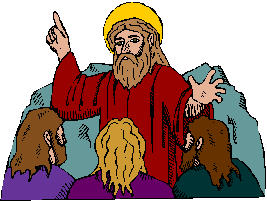
The Forerunner

Isaiah 11:1-101 NIV New International Version Translations
1A shoot will come up from the stump of Jesse; from his roots a Branch will bear fruit. 2 The Spirit of the LORD will rest on him—the Spirit of wisdom and of understanding, the Spirit of counsel and of might, the Spirit of the knowledge and fear of the LORD—3 and he will delight in the fear of the LORD. He will not judge by what he sees with his eyes, or decide by what he hears with his ears; 4but with righteousness he will judge the needy, with justice he will give decisions for the poor of the earth. He will strike the earth with the rod of his mouth; with the breath of his lips he will slay the wicked. 5 Righteousness will be his belt and faithfulness the sash around his waist. 6 the wolf will live with the lamb, the leopard will lie down with the goat, the calf and the lion and the yearling together; and a little child will lead them. 7The cow will feed with the bear, their young will lie down together, and the lion will eat straw like the ox. 8The infant will play near the cobra’s den, the young child will put its hand into the viper’s nest. 9 They will neither harm nor destroy on all my holy mountain, for the earth will be filled with the knowledge of the LORD as the waters cover the sea. 10In that day the Root of Jesse will stand as a banner for the peoples; the nations will rally to him, and his resting place will be glorious.

clip_image158Background2http://www.aboutbibleprophecy.com/isaiah.htm

Isaiah the prophet lived in Jerusalem about 2700 years ago, during the time in which the Assyrian Empire conquered the northern part of the Jewish homeland. The book of Isaiah contains many prophecies that are interpreted by Christians as being about the Messiah Jesus Christ. Today, we can see with our own eyes that many of Isaiah’s prophecies have found fulfillment with the worldwide dispersion of Jews, the worldwide persecution of Jews, the recent worldwide migration of Jews back to Israel during the past century, the recent re-establishment and restoration of Israel, and the worldwide impact that Jews have had on the world.

Below is a partial listing of Isaiah’s prophecies, based on the copyrighted commentaries of George Konig and Ray Konig, authors of the book, 100 Prophecies.

Verse
Prophecy

Isaiah 7:14

Isaiah 9:6-7

Isaiah 13:19

Isaiah 14:23

Isaiah 35:4-6

Isaiah 40:1-5,9

Isaiah 45:1

Isaiah 49:6

Isaiah 49:13-17

Isaiah 50:6

Isaiah 53:1-3

Isaiah 53:4-6

Isaiah 53:7

Isaiah 53:9

Isaiah 53:12

Biblical Truths3http://www.easyenglish.info/bible-commentary/isaiah10-20-lbw-nh.htm

Verse 1: One of Jesse’s sons was David, who followed Saul as king of Israel. David overcame all of Israel’s enemies. He established national worship. And he prepared for the construction of the Temple in Jerusalem (see 1 Chronicles chapters 11 to 29).

  • Son of David’ was a title of the Messiah that the people in Judah and Israel were expecting.

Verse 2: David did many great things for his people. But his own life was not perfect (see 2 Samuel chapters 11 to 12).

  • God’s Spirit will provide the king that is coming with special gifts (skills) and qualities. Other national leaders can only pretend to possess such qualities.

Verses 6-8: The Messiah’s arrival will bring about perfect harmony (peace and calm) in all life. This includes the animals, especially those animals that are natural enemies. No person or animal will be afraid of another.

Verse 10: Foreign nations will want to know more about Israel’s Messiah.

Items for Discussion

  • What are some of the ways people attempt to foretell the future?
  • How is having wisdom and knowledge on a subject different than being able to foretell events?
  • What makes Isaiah special as a futurist – That is, able to foretell the future?
  • Why should we care that Christ’s life was foretold to us in the Old Testament?
  • Why would God want to tell the people of Israel about the future? Why not surprise them?
  • What does this scripture tell us about the character of our God?


Matthew 3:1-12
1In those days John the Baptist came, preaching in the wilderness of Judea 2 and saying, “Repent, for the kingdom of heaven has come near.” 3 This is he who was spoken of through the prophet Isaiah: “A voice of one calling in the wilderness, ‘Prepare the way for the Lord, make straight paths for him.’” 4 John’s clothes were made of camel’s hair, and he had a leather belt around his waist. His food was locusts and wild honey. 5 People went out to him from Jerusalem and all Judea and the whole region of the Jordan. 6 Confessing their sins, they were baptized by him in the Jordan River. 7But when he saw many of the Pharisees and Sadducees coming to where he was baptizing, he said to them: “You brood of vipers! Who warned you to flee from the coming wrath? 8 Produce fruit in keeping with repentance. 9And do not think you can say to yourselves, ‘We have Abraham as our father.’ I tell you that out of these stones God can raise up children for Abraham. 10The ax is already at the root of the trees, and every tree that does not produce good fruit will be cut down and thrown into the fire. 11“I baptize you with water for repentance. But after me comes one who is more powerful than I, whose sandals I am not worthy to carry. He will baptize you with the Holy Spirit and fire. 12 His winnowing fork is in his hand, and he will clear his threshing floor, gathering his wheat into the barn and burning up the chaff with unquenchable fire.”

Background

The opening twelve verses of this chapter present us with the character of John the Baptist before Jesus appears on the scene to be baptized by him (Matthew 3:13). As such, it gives us an illustration of the type of person he was and of the type of ministry that he imparted to Israel.

Facts about John the Baptist4http://www.answers.com/topic/john-the-baptist Note: There are discrepencies with regard to the birth date of John the Baptist

Born: 5 B.C.

Birthplace: Judea

Died: c. 33 A.D. (beheading)

Best Known As: The man who “prepared the way” for Jesus of Nazareth

John the Baptist is a key figure in the Biblical stories of Jesus. According to the Gospels, John’s role was to announce the coming of Jesus: in John 1:23 he tells interrogators, “I am the voice of one crying out in the wilderness, ‘Make straight the way of the Lord.'” According to Matthew 3:4, he wore clothing made of camel’s hair and ate locusts and wild honey, and baptized people in the river Jordan. (It was after being baptized by John that Jesus was led to the wilderness to be tempted by the devil.) John later was executed by the ruler Herod; as told in Matthew chapter 14, Herod granted the demand of Salome to “give me the head of John the Baptist here on a platter.”

John the Baptist is a different person from the apostle John, for whom the Gospel of John is named… In speaking of Jesus, John said: “I have baptized you with water, but he will baptize you with the holy spirit”… According to Luke, John was the son of Zechariah (or Zachary) and his wife Elizabeth, a relative of Jesus’ mother Mary, and was born roughly six months before Jesus.

Biblical Truths5http://www.easyenglish.info/bible-commentary/matthew-lbw.htm

Verse 1 ‘In those days’. Matthew does not tell us exactly when John began his work. But Luke tells us the names of all the rulers at that time (Luke 3:1-2). It was about 30 years after Jesus was born. Judea’s wild country was the desert area on the west side of the Dead Sea. John may have stayed in the desert with the Essenes. They were a group of Jews who lived a very strict life together. They lived at Qumran, which was by the Dead Sea. Nobody had given the people a message from God for about four hundred years. Then John suddenly arrived in the desert.

Verse 2 John said that people must turn from their sins. They must prepare themselves for God to rule as he does in heaven. The Jews greatly respected God and his name. They would not use God’s name. Instead, they used the word ‘heaven’. God rules in heaven. But now God wants to rule in a person’s life. It is not a political idea. People should obey Jesus the king. Then they can become citizens of where God rules.

Verse 3 John made Isaiah’s words (Isaiah 40:3) come true. All four gospels agree with that. In those days, people had to repair a road before a king travelled on it. John was like someone who gave orders to the people. He described himself as ‘a voice that is calling out in the desert’ (John 1:23). He was telling people to prepare for the Messiah.

Verse 4 John had made rough clothes from camel’s hair. They were like the clothes that God’s servant Elijah wore long ago (2 Kings 1:8). The Jews believed that Elijah would return. Then he would announce that the Messiah was coming (Malachi 4:5). John’s food was simple. He ate a kind of insect that flies. These insects can cause trouble for farmers. They are called ‘locusts’. The Jewish law allows people to eat these insects (Leviticus 11:22-23).

Verses 5-6 Sometimes people who were not Jews wanted to become Jews. Then they asked for baptism. They did not usually baptize people who were Jews already. But John baptized Jews in water. They had confessed their sins and they wanted to obey God. Water cleans a person’s body. In a similar way, baptism shows that a person is ‘clean’ from their sins. They would then be ready to meet the Messiah.

Verse 7 The Pharisees were Jews who wanted to obey God’s Law. There were many good Pharisees. One was called Gamaliel (Acts 5:33-39). But there were also many proud Pharisees. They believed that they were the only people who obeyed God’s law. But they destroyed what the law really meant. Through the years, the official writers (called ‘scribes’) had introduced hundreds of extra rules. The Pharisees said that people must also obey all those extra rules.

  • The Sadducees came from the families of priests. They were wealthy. They wanted to keep their political power. So they opposed any religious ideas that might make them lose their authority.
    John called the Pharisees and the Sadducees ‘a family of poisonous snakes’. Later, Jesus used the same words about the Pharisees (Matthew 12:34; 23:33). They were dangerous. They were like poisonous snakes. John said that they were like snakes that were trying to escape from a fire in a forest. He meant that God was angry with them. They were trying to escape from him.

Verses 8-9 A person’s actions show whether they have sincerely changed their way of life. The Jews believed that Abraham’s actions were good enough for himself and for all his children and their families always. So Jews thought that they were safe after they died. But John said that that was not enough. A person may have Abraham as his ancestor but each person must change his own actions.

Verse 10 A farmer cuts down trees that do not produce good fruit. He throws them into the fire. God is like a farmer. He will punish those people who do not live in the right way.

Verse 11 John knew that he was preparing the way for someone. That person was much greater than he himself was, John said. Only a slave carried other people’s shoes. John said that he was not good enough to do even this humble task for the Messiah. John baptized people with water. This showed that people desired to be free from sin. The Messiah would give the Holy Spirit. The Jews had looked forward to the time when the Spirit would come. ‘It shall happen that I will pour out my Spirit on everyone’, God’s servant had said long ago (Joel 2:28). The Spirit teaches people how to live in the true way. The Spirit also gives people the power to live in the right way. Fire is very powerful. Fire can also destroy. Therefore, it is picture language for God’s judgment.

Verse 12 At harvest-time, people used a tool like a large fork to throw dry plants into the air. The grain fell to the ground, and the wind blew the rest away. The farmer stored the grain. Then he burned the part of the plant that he could not use. In this picture, John showed that the Messiah would separate people. The people who believed him would be like the grain. They would be his people. But some people did not accept the Messiah. They were like the part of the plant that the farmer burned. God would judge them.

Items for Discussion

  • Obviously, John the Baptist was a unique person, maybe even a strange person – What were the benefits of sending someone who was very different to tell people about Christ’s coming?
  • How is John the Baptist similar to a wedding invitation?
  • What would the benefits be to God by announcing Christ instead of just having Him appear in society one day?
  • What was John the Baptist’s message about Christ to the people?
  • What was John the Baptist’s message to the religious leaders?
  • John the Baptist calls those who do not believe, chaff – something to be blown away – is this fair (why or why not)?
  • What is the “fruit” that a Christian must produce in order not to become chaff?

Discussion Challenge

  • How does the Body of Christ, the Church, produce more fruit within its fields?


Receptive to God’s Will

Isaiah 7:10-161 NIV New International Version Translations
10 Again the LORD spoke to Ahaz, 11 “Ask the LORD your God for a sign, whether in the deepest depths or in the highest heights.” 12 But Ahaz said, “I will not ask; I will not put the LORD to the test.” 13 Then Isaiah said, “Hear now, you house of David! Is it not enough to try the patience of humans? Will you try the patience of my God also? 14 Therefore the Lord himself will give you a sign: The virgin will conceive and give birth to a son, and will call him Immanuel. 15 He will be eating curds and honey when he knows enough to reject the wrong and choose the right, 16 for before the boy knows enough to reject the wrong and choose the right, the land of the two kings you dread will be laid waste.

clip_image159Background

In Isaiah 7:14, the prophet Isaiah is addressing the “house of David,” meaning the family and descendants of King David. He speaks of a virgin being pregnant with a child, and giving birth to the child. Isaiah says this in the context of it being a sign from God. He also says that the child would be referred to as “Immanuel,” which means, “God with us.” We look to the New Testament books of Matthew and Luke to record details involving the birth of Jesus, who was born about 700 years after the time of Isaiah, saying that he was born of the virgin Mary and is the Son of God. Because he is the Son of God, Jesus literally can be referred to as “God with us.”

Biblical Truths2http://www.christnotes.org/commentary.php?com=mhc&b=23&c=7

Secret disaffection to God is often disguised with the color of respect to him; and those who are resolved that they will not trust God, yet pretend they will not tempt him. The prophet reproved Ahaz and his court, for the little value they had for Divine revelation. Nothing is more grievous to God than distrust, but the unbelief of man shall not make the promise of God of no effect; the Lord himself shall give a sign. How great so ever your distress and danger, of you the Messiah is to be born, and you cannot be destroyed while that blessing is in you. It shall be brought to pass in a glorious manner; and the strongest consolations in time of trouble are derived from Christ, our relation to him, our interest in him, our expectations of him and from him. He would grow up like other children, by the use of the diet of those countries; but he would, unlike other children, uniformly refuse the evil and choose the good. And although his birth would be by the power of the Holy Ghost, yet he should not be fed with angels’ food. Then follows a sign of the speedy destruction of the princes, now a terror to Judah. “Before this child,” so it may be read; “this child which I have now in my arms,” (Shear-jashub, the prophet’s own son, verse 3,) shall be three or four years older, these enemies’ forces shall be forsaken of both their kings. The prophecy is so solemn, the sign is so marked, as given by God himself after Ahaz rejected the offer, that it must have raised hopes far beyond what the present occasion suggested. And, if the prospect of the coming of the Divine Savior was a never-failing support to the hopes of ancient believers, what cause have we to be thankful that the Word was made flesh! May we trust in and love Him, and copy his example.

Items for Discussion

  • How do people “Secretly” hide their true beliefs with respect to God?
  • When and where is this most to occur in our society?
  • What do we miss from the Advent Season and Christmas when we fail to believe in our Savior’s birth?
  • Isaiah is focusing on the humanity of our Savior – He will eat ordinary foods. How does the food we eat define our very character?
  • Is it important to believe in the “Virgin” birth? How does this “belief” help us with our relationship with God?
  • Isaiah is pointing out to the king that he is trying the “patience” of our God – How do people to that today, especially over the Christmas season?


Matthew 1:18-25
18 This is how the birth of Jesus the Messiah came about: His mother Mary was pledged to be married to Joseph, but before they came together, she was found to be pregnant through the Holy Spirit. 19 Because Joseph her husband was faithful to the law, and yet did not want to expose her to public disgrace, he had in mind to divorce her quietly. 20 But after he had considered this, an angel of the Lord appeared to him in a dream and said, “Joseph son of David, do not be afraid to take Mary home as your wife, because what is conceived in her is from the Holy Spirit. 21 She will give birth to a son, and you are to give him the name Jesus, because he will save his people from their sins.” 22 All this took place to fulfill what the Lord had said through the prophet: 23 “The virgin will conceive and give birth to a son, and they will call him Immanuel (which means “God with us”). 24 When Joseph woke up, he did what the angel of the Lord had commanded him and took Mary home as his wife. 25 But he did not consummate their marriage until she gave birth to a son. And he gave him the name Jesus.

Background3http://www.ccel.org/ccel/henry/mhc5.Matt.ii.html

Matthew begins with the account of Christ’s parentage and birth, the ancestors from whom he descended, and the manner of his entry into the world, to help us understand that he was indeed the Messiah promised, for it was foretold that he should be the son of David, and should be born of a virgin. His pedigree from Abraham in forty-two generations, three fourteens, ver. 1-17 An account of the circumstances of his birth, so far as was requisite to show that he was born of a virgin, ver. 18-25

The Genealogy of Christ.
  1. The book of the generation of Jesus Christ, the son of David, the son of Abraham.
  2. Abraham begat Isaac; and Isaac begat Jacob; and Jacob begat Judas and his brethren;
  3. And Judas begat Phares and Zara of Thamar; and Phares begat Esrom; and Esrom begat Aram;
  4. And Aram begat Aminadab; and Aminadab begat Naasson; and Naasson begat Salmon;
  5. And Salmon begat Booz of Rachab; and Booz begat Obed of Ruth; and Obed begat Jesse;
  6. And Jesse begat David the king; and David the king begat Solomon of her that had been the wife of Urias;
  7. And Solomon begat Roboam; and Roboam begat Abia; and Abia begat Asa;
  8. And Asa begat Josaphat; and Josaphat begat Joram; and Joram begat Ozias;
  9. And Ozias begat Joatham; and Joatham begat Achaz; and Achaz begat Ezekias;
  10. And Ezekias begat Manasses; and Manasses begat Amon; and Amon begat Josias;
  11. And Josias begat Jechonias and his brethren, about the time they were carried away to Babylon;
  12. And after they were brought to Babylon, Jechonias begat Salathiel; and Salathiel begat Zorobabel;
  13. And Zorobabel begat Abiud; and Abiud begat Eliakim; and Eliakim begat Azor;
  14. And Azor begat Sadoc; and Sadoc begat Achim; and Achim begat Eliud;
  15. And Eliud begat Eleazar; and Eleazar begat Matthan;
  16. And Matthan begat Jacob;
  17. And Jacob begat Joseph the husband of Mary, of whom was born Jesus, who is called Christ.

So all the generations from Abraham to David are fourteen generations and from David until the carrying away into Babylon are fourteen generations; and from the carrying away into Babylon unto Christ are fourteen generations.

Biblical Truths4http://www.easyenglish.info/bible-commentary/matthew-lbw.htm

Verses 18-19 Joseph and Mary had promised to marry each other. But Joseph thought that Mary had not been loyal to him. They were Jews. And the only way for Jews to break this promise was to divorce each other. But Joseph was kind. He planned to protect her from public gossip. He wanted to divorce her in private. He himself would risk public gossip.

Verses 20-21 Matthew and Luke agree that Mary had the child ‘by the power of the Holy Spirit’ (Luke 1:35; Matthew 1:20). God showed the truth to Joseph in a dream. ‘Jesus’ is the same as the Old Testament name ‘Joshua’. The name means ‘the Lord saves’.

Verses 22-23 ‘Immanuel’ means ‘God is with us’. God’s servant Isaiah lived about 700 years before Jesus. He gave the name ‘Immanuel’ to the son of a young woman. Isaiah wanted to encourage the king and the people to trust God. God would protect them from their enemies (Isaiah 7:14). Isaiah’s words came true in an even more wonderful way when Jesus came into the world. The whole gospel describes how Jesus was ‘God with us’. Everything that he said and did showed the power of God. And he showed how much God loves people.

Verses 24-25 Joseph believed the Lord’s messenger and he obeyed God’s message.

Items for Discussion

  • How far back can you trace your genealogy?
  • What is the significance that Jesus’ genealogy can be traced back directly to David?
  • What can we tell about the character of Joseph?
  • How do you think Joseph’s character influenced Jesus’ upbringing?
  • How does someone’s genealogy help us with our opinions about them?
  • How does it help the person to know their genealogy?

Discussion Challenge

  • Why is it important focus on Christ’s humanity during this holy season and accept Him as Scripture defines Him?
« Older posts Newer posts »

"For it is by grace you have been saved" - Ephesians 2:8-9  

Copyright: © 2001 - 2025 Lostpine

Translate »