Biblical wisdom, historical insight, and personal growth — all in one place

Category: Snapshots (Page 30 of 45)

Who’s Shout is Heard Round the World?

Psalm 81NIV New International Version Translations
1 O LORD, our Lord, how majestic is your name in all the earth! You have set your glory above the heavens. 2 From the lips of children and infants you have ordained praise because of your enemies, to silence the foe and the avenger. 3 When I consider your heavens, the work of your fingers, the moon and the stars, which you have set in place, 4 what is man that you are mindful of him, the son of man that you care for him? 5 You made him a little lower than the heavenly beings and crowned him with glory and honor. 6 You made him ruler over the works of your hands; you put everything under his feet: 7 all flocks and herds, and the beasts of the field, 8 the birds of the air, and the fish of the sea, all that swim the paths of the seas. 9 O LORD, our Lord, how majestic is your name in all the earth!

clip_image128 (1)Background2http://www.easyenglish.info/psalms/psalm008-taw.htm

When he was young David kept sheep. He was with his sheep on the hills at night. The sheep were safe with him. David saw the moon and the stars in the sky. God made them all. God was strong and powerful. But God had enemies. These enemies fought God. They also hurt the people of God. David felt very small when he looked at what God had made. David felt that he was not important. But David also knew that God would make people strong. As Paul wrote to the Christians in Corinth, ‘God said, My power works best when you are weak’. (2 Corinthians 12:9) Later David wrote Psalm 8. Perhaps it was when he lived in Gath. Gath was a Philistine city. It was 30 kilometres west of Bethlehem. David came from Bethlehem. In the psalm David remembered:

  • the sheep, the hills and the wild animals
  • the moon and stars at night

David also remembered that he felt very small. David put all that he felt into Psalm 8. Perhaps he used music from Gath.

The New Testament of the Bible tells us that David was a prophet. A prophet speaks for God. He also says what will happen in the future. In Psalm 8 David said that God would visit the earth. He came as Jesus.

Biblical Truths3Matthew Henry – http://www.christnotes.org/commentary.php?com=mhc&b=19&c=8

Verses 1-2: The psalmist seeks to give unto God the glory due to his name. How bright this glory shines even in this lower world! He is ours, for he made us, protects us, and takes special care of us. The birth, life, preaching, miracles, suffering, death, resurrection, and ascension of Jesus are known through the world. No name is so universal, no power and influence so generally felt, as those of the Saviour of mankind. But how much brighter it shines in the upper world! We, on this earth, only hear God’s excellent name, and praise that; the angels and blessed spirits above, see his glory, and praise that; yet he is exalted far above even their blessing and praise. Sometimes the grace of God appears wonderfully in young children. Sometimes the power of God brings to pass great things in his church, by very weak and unlikely instruments, that the excellency of the power might the more evidently appear to be of God, and not of man. This he does, because of his enemies, that he may put them to silence.

Verses 3-9: We are to consider the heavens, that man thus may be directed to set his affections on things above. What is man, so mean a creature, that he should be thus honored! so sinful a creature, that he should be thus favored! Man has sovereign dominion over the inferior creatures, under God, and is appointed their lord. This refers to Christ. In Hebrews 2:6-8, the apostle, to prove the sovereign dominion of Christ, shows he is that Man, that Son of man, here spoken of, whom God has made to have dominion over the works of his hands. The greatest favor ever showed to the human race, and the greatest honor ever put upon human nature, were exemplified in the Lord Jesus. With good reason does the psalmist conclude as he began, Lord, how excellent is thy name in all the earth, which has been honored with the presence of the Redeemer, and is still enlightened by his gospel, and governed by his wisdom and power! What words can reach his praises, who has a right to our obedience as our Redeemer?

Items for Discussion

  • David shows us that early experiences in life can affect our view of God. What were your experiences that helped frame your belief and mental picture of God?
  • In what ways can experiences serve to be a negative influence?
  • Why were David’s experiences positive?
  • What do you think David learned from sheep?
  • What have you learned from observing the heavens?
  • Of the places you have lived, which ones were the most influential on your faith? Why?


Hebrews 2:10-12
10 And by that will we have been sanctified through the offering of the body of Jesus Christ once for all. 11 And every priest stands daily at his service, offering repeatedly the same sacrifices, which can never take away sins. 12 But when Christ had offered for all time a single sacrifice for sins, he sat down at the right hand of God,

Background4http://www.easyenglish.info/bible-commentary/hebrews-lbw.htm

The author of this book does not tell us his name. There is nothing in the book to say who wrote it. For centuries the church thought that the author was the apostle Paul. But Paul always begins his letters with his name. The way that the author uses Greek words is unlike the way Paul uses them. The first readers were probably Christian Jews. The author did not write for all Jews. He wrote to a group, whom he knew well, that had become Christian. The book shows that they were not strong in their belief. They were in danger of going back to their old religion. The writer argues from the Old Testament to keep them trusting in Jesus.

From early times the church believed that the readers lived in Jerusalem. The title, the letter to the Hebrews, could show that they were Jews in Israel who spoke Hebrew. Many Jews who did not live in Israel spoke Greek. Another suggestion is that the readers lived in Rome. There is in fact so little evidence in the book itself that we have to say that we do not know where the readers were living.

A bishop of Rome named Clement knew this letter and used it in his own writing. He wrote in about AD 96. The author of the letter to the Hebrews wrote his letter before then. From what is in the book we could argue that the Jews were still carrying on the temple ceremonies in Jerusalem. We know that the Romans destroyed the temple in AD 70. If the date of writing was later, the author would have noted that event. So the date of the letter was probably before AD 70. (The ceremonies that he speaks about did not take place in fact from the temple. They refer to the special tent that was in use before the Jews built the temple).

These Christian Jews had to make a choice. They could not continue in Judaism and be Christians. They must decide which way to go. It was either to go back to being Jews or to go on to be Christians. It seems that their nation had now turned against Christians. They could not now go to the temple as the Jews would not let them. The writer tries to show his readers that the right choice was to continue to trust in Jesus. That was much better than all the ceremonies of their former religion, which Jesus had replaced.

The way the author has written the book is not like any other book in the New Testament. We call it a letter, but it does not start like one. It does finish like a letter, but the author does not give us his name. The writer knows the readers and is eager to see them again (13:19, 23). He thinks well of them (6:9), but they should by now have been able to teach (5:12). He knows all about their past and their needs. The way he writes is almost like a speech or a lesson. He cares about his friends and wants to advise them in the choices they have to make.

Biblical Truths5http://www.easyenglish.info/bible-commentary/hebrews-lbw.htm

Verse 10 – God made all things. He made all things for himself. In other parts of the Bible it says that Jesus made all things and all things are for his pleasure. There is no problem here. God the Father and God the Son are both God. Together they made the heavens and the earth. It is only in Jesus that all things find their purpose. In order to make us clean from sin there had to be a sacrifice. It was right that Jesus should come to earth and become one of us. He was then able to suffer on behalf of us all. He died a terrible death on the cross of wood. This death was not for any sins that he himself had done, for he was perfect. That is, he was all that God intended him to be. When he died, he accepted all our sins. Because of this he can give to us a new life. He is able to bring many sons and daughters to be with God in heaven. We become God’s sons and daughters when we trust in Jesus and in his work for us. By his death for us, Jesus was able to make us clean from sin. Now we can go to be with God.

Verse 11 – Jesus makes us holy when we trust in him. He brings us into the family of God and makes us his sons and daughters. All who trust in Jesus receive a new birth from the Spirit. In this way they have the same Father as Jesus and the same life. Jesus is so great, yet he is happy to call the weakest Christian brother or sister. He is the firstborn of many brothers and sisters. He is the firstborn from the dead and all who trust in him will also rise from the dead.

Verse 12 – Jesus calls us his brothers and sisters. In the Old Testament the Messiah says that he will tell the name of God to his brothers and sisters (Psalm 22:22). To the Hebrews the ‘name’ meant more than just a name. It meant the whole person. Jesus is the Messiah and he showed men and women the nature of God. As a human among humans Jesus praised God. He praised God with them in the temple of the Jews in Jerusalem and their other holy buildings. Now as we praise God, Jesus in spirit is there with us. He promised that when two or three of those who follow him meet together, he too will be there (Matthew 18:20).

Items for Discussion

  • Verse 10 may be the most important verse ever to a Christian – Why should we take so much comfort in what it says?
  • It is easy to agree with verse 11, humans are imperfect and limited – Why do so many fight accepting Christ’s offer of forgiveness?
  • Comparing the idea that on April 19, 1775, a single gun shot was to be called the “shot heard round the world,” how is Christ’s message of complete and total forgiveness resonate as the “shout heard round the world?”

Discussion Challenge

  • How does a church help its members accept Christ’s forgiveness?

Who Is Able?

Psalm 91:9-161NIV New International Version Translations
9 If you make the Most High your dwelling—even the LORD, who is my refuge- 10 then no harm will befall you, no disaster will come near your tent. 11 For he will command his angels concerning you to guard you in all your ways; 12 they will lift you up in their hands, so that you will not strike your foot against a stone. 13 You will tread upon the lion and the cobra; you will trample the great lion and the serpent. 14 “Because he loves me,” says the LORD, “I will rescue him; I will protect him, for he acknowledges my name. 15 He will call upon me, and I will answer him; I will be with him in trouble, I will deliver him and honor him. 16 With long life will I satisfy him and show him my salvation.”

img129Background2http://www.easyenglish.info/psalms/psalm091-taw.htm

There is nothing in Psalm 91 that tells us who wrote it or when. It may be “words that Moses prayed”, as Psalm 90. The two psalms do have the same feeling. Jesus knew this psalm. He repeated words from it when his enemy (Satan) tried to tempt him. “Tempt” means “try to make someone do what they should not do”. The story is in Matthew 4:11.

Biblical Truths3Matthew Henry – http://www.christnotes.org/commentary.php?com=mhc&b=19&c=91

Whatever happens, nothing shall hurt the believer; though trouble and affliction befall, it shall come, not for his hurt, but for good, though for the present it be not joyous but grievous. Those who rightly know God, will set their love upon him. They by prayer constantly call upon him. His promise is, that he will in due time deliver the believer out of trouble, and in the mean time be with him in trouble. The Lord will manage all his worldly concerns, and preserve his life on earth, so long as it shall be good for him. For encouragement in this he looks unto Jesus. He shall live long enough; till he has done the work he was sent into this world for, and is ready for heaven. Who would wish to live a day longer than God has some work to do, either by him or upon him? A man may die young, yet be satisfied with living. But a wicked man is not satisfied even with long life. At length the believer’s conflict ends; he has done for ever with trouble, sin, and temptation.

Items for Discussion

  • How does the old adage, “love is blind” describe the relationship with God that the psalmist is describing in 91?
  • From this psalm, what early warning signs can we see that might indicate we are not “blindly faithful to God?”
  • What type of satisfaction is the psalmist describing?
  • How would you translate verse 9 to a child?
  • When you think about being protected by angels, what imagery goes through your mind?


Mark 10:35-45
35 Then James and John, the sons of Zebedee, came to him. “Teacher,” they said, “we want you to do for us whatever we ask.” 36 “What do you want me to do for you?” he asked. 37 They replied, “Let one of us sit at your right and the other at your left in your glory.” 38 “You don’t know what you are asking,” Jesus said. “Can you drink the cup I drink or be baptized with the baptism I am baptized with?” 39 “We can,” they answered. Jesus said to them, “You will drink the cup I drink and be baptized with the baptism I am baptized with, 40 but to sit at my right or left is not for me to grant. These places belong to those for whom they have been prepared.” 41 When the ten heard about this, they became indignant with James and John. 42 Jesus called them together and said, “You know that those who are regarded as rulers of the Gentiles lord it over them, and their high officials exercise authority over them. 43 Not so with you. Instead, whoever wants to become great among you must be your servant, 44 and whoever wants to be first must be slave of all. 45 For even the Son of Man did not come to be served, but to serve, and to give his life as a ransom for many.”

Background4http://www.americanbible.org/absport/news/item.php?id=92

There are several characteristics that make the Gospel of Mark unique. Too often, these special characteristics are overlooked because Mark is read in light of the other synoptic gospels (Matthew and Luke), or John, or even the letters of Paul.

  • Although still debated by some, the consensus among the majority of biblical scholars is that the Gospel of Mark was the first of the canonical Gospels to appear. Consequently, it served as a source for the authors of Matthew and Luke when they wrote their Gospels. Moreover, although the Gospel of Mark was probably not the first Christian text to be labeled as “gospel,” it is likely the first gospel to utilize a narrative structure (versus, for example, a “sayings” gospel).
  • The author of Mark places sharp emphasis on the humanity of Jesus. This is best seen perhaps with respect to Jesus’ suffering. In fact, the suffering of Jesus is the key to understanding Jesus’ true identity as the Messiah, Son of God, and Son of Man (see e.g., 8:31-33; ; and 10:33-34, et al.).
  • In Mark, faith is a gift of God; characters in the narrative either have it or they don’t. Furthermore, miracles do not lead to faith (compare the Gospel According to John), but rather, faith is required in order that miracles can take place (see e.g., 6:1-6).
  • Many readers of Mark have recognized for a long time the negative manner in which Mark portrays the disciples (including the authors of Matthew and Luke who “corrected” Mark’s treatment in various ways). The disciples in Mark come across as dimwitted, misguided, and selfish, rather than as Jesus’ privileged associates and great apostles of the church. There are a number of ways to interpret this. For instance, perhaps Mark meant to depict them as “fallible followers” and thus give his readers hope when they struggle to understand and follow Jesus. On the other hand, the author of Mark may well have had an axe to grind with the leaders of the church in his day.
  • Readers of Mark have also noticed Jesus’ frequent commands to silence and his efforts to hide his identity. This motif has often been referred to as the “Messianic secret.” Whether it is a historical representation or a literary construction of the author is a matter of debate. Regardless of which position one takes, however, the theme poses interesting challenges for interpretation. One important outcome of the Messianic secret in Mark is that it allows for a provocative use of irony on the part of the author. Since the reader does, in fact, know who Jesus really is, she/he can immediately grasp the ironic twist when, for instance, Jesus is identified on the cross as the “King of the Jews.”

Biblical Truths5http://www.americanbible.org/absport/news/item.php?id=92

The disciples wanted honor and power

Jesus and his disciples were now approaching Jerusalem. Two apostles, James and John, who were brothers, asked Jesus a question:

When Jesus began to rule his kingdom, could they sit one on each side of him, as an honor? James and John thought that a kingdom would begin on earth immediately. [The kingdom that Jesus spoke about is God’s kingdom. Everyone who loves God belongs to his kingdom. But God’s kingdom is not yet complete.] The apostles wanted power for themselves. It was like a request for an important job in government.

There is some evidence that these brothers may have been cousins of Jesus. So they asked Jesus to keep important jobs in the family. This happens often in the world today. Notice what the request means. They wanted great honor and power for themselves. They did not ask to be servants in the kingdom. They did not ask Jesus to use them. They asked for honor and power.

The other disciples’ reaction

The other apostles were very angry. They also wanted these jobs! The apostles all had selfish ambitions. They thought, ‘What is there for me in all this?’ This was a struggle for power. So, they asked, ‘Who would be greatest?’ (See Matthew 18:1-3, Matthew 19:27-30, especially verse 27.)

The brothers did not really understand their request. Jesus told them this. They did not understand until after the resurrection who Jesus really was. Jesus is God. Also, Jesus would suffer very much before he could rule in his kingdom. The brothers did not understand this. Jesus spoke about it. He asked the brothers if they could suffer with him. The brothers bravely declared that they could! Jesus then replied:

Mark 10:39, 40  ‘You will drink the cup that I drink. You can have the same baptism as I have. But I do not choose who sits at my right or left. God chooses the people who will receive these honors.
Power in God’s kingdom

Jesus then made another statement. This shows that the Kingdom of God is far better than any kingdom on earth.

Mark 10:42-44 Jesus called the disciples together. He said, ‘You know this. The rulers of the Gentiles [Gentiles are people who are not Jews] have great power. Their important officials give many orders to people. You must not behave like that. Whoever wants to become great among you must be your servant. Whoever wants to be important must be a slave of all.’

In kingdoms on earth, power is usually a bad thing. There are many beautiful great houses in my country. The people who built them were often very poor. Rich people forced them to work very hard, without much payment. We can still see that this happens today, across the world. It happens when some people have power over other people. We even see this problem in the church. In the Bible, the apostles had wrong ambitions, until Jesus died on the cross. This is not what Christ teaches. He teaches that in the Kingdom of God our ambition should be to serve other people. We should not try to become the person who gives orders. Our ambition should not be to rule other people. Our ambition should be to help them to know God. This would bless them, and help them to serve other people. (Of course, we should still have leaders. But the leaders should be servants of other people. They should help other people.)
Jesus came to serve

Lastly, Jesus made one other statement. This showed how he himself had come to serve.

Mark 10:45 For even the Son of Man [Jesus] did not come so that other people would serve him. He came to serve other people. He came to die, and to rescue people from the results of their sin.
Here is something wonderful. Jesus is the son of God, and his home is with God, in heaven. But he left his home in heaven. He came into this world, which he had made. He was born in our world, and he had a humble birth. His family was poor. His birth was in a shed for animals. He did not come to rule over us, like a proud man. He came to serve. He came to cure sick and blind people. He came to tell people the good news from God. But especially, he came ‘to give his life’. Here is another wonderful thing. He came not so much to live, but to die. He came ‘to die, to rescue people from the results of their sin’. He came to die on the cross for our sins, so that God might forgive us. Then God can give us eternal life.

John 3:16 ‘For God loved the world so much that he gave his one and only Son. Whoever believes in him shall not die, but shall have eternal life.’

Christian leadership

This is the kind of leadership which Jesus shows us. He wants us to have leaders like that. And he wants us to be leaders like that. These ideas are very different from the ideas that the apostles had! Let us remember that Jesus taught this lesson to apostles. He was not teaching other people. He wanted his disciples to be humble. Jesus patiently repeated the lesson several times before he died on the cross. How much Christian people need to learn this lesson! There are many jobs which somebody must do. We need to be ready to do some of them. We need to be ready to serve other people, and not merely to give orders. If it is best for the church, we need to be ready to give up our Christian job. To help the church, we need to be ready to do something else. If we all lived as real Christians, we would live like Jesus. He did not come to order other people about, but to serve them. He lived his life for other people. He even died for other people.

Items for Discussion

  • How do you reconcile your thoughts around what your role may be in the Christian Church?
  • Who in your mind is a great leader?
  • Can you think of a great leader that you have personally known as a friend?
  • In a church that you were a member of?
  • So of the great leaders you have known, why were they great?
  • Is it bad to want honor and power?
  • When does wanting honor and power cross the line and become a deterrent to your faith walk?

Discussion Challenge

  • In a society created on the adoration of honor and power, how to you raise children so they have the proper sense of Christian Leadership that Christ was talking about?

Your Lips Say Yes

Psalm 1271NIV New International Version Translations
1 Unless the LORD builds the house, its builders labor in vain. Unless the LORD watches over the city, the watchmen stand guard in vain. 2 In vain you rise early and stay up late, toiling for food to eat—for he grants sleep to those he loves. 3 Sons are a heritage from the LORD, children a reward from him. 4 Like arrows in the hands of a warrior are sons born in one’s youth. 5 blessed is the man whose quiver is full of them. They will not be put to shame.

img-130Background2http://www.easyenglish.info/psalms/psalm127-taw.htm

Psalm 127 tells people to remember that it was God who saved their city from enemies. God had given them everything that was valuable to them: *safety, houses, food, children and *peace. It was God who let them work hard to build houses. It was God who let them do the other things in the psalm.

Biblical Truths3Matthew Henry – http://www.christnotes.org/commentary.php?b=19&c=127&com=mhc

Let us always look to God’s providence. In all the affairs and business of a family we must depend upon his blessing.

  1. For raising a family. If God be not acknowledged, we have no reason to expect his blessing; and the best-laid plans fail, unless he crowns them with success.
  2. For the safety of a family or a city. Except the Lord keep the city, the watchmen, though they neither slumber nor sleep, wake but in vain; mischief may break out, which even early discoveries may not be able to prevent.
  3. For enriching a family. Some are so eager upon the world, that they are continually full of care, which makes their comforts bitter, and their lives a burden.

All this is to get money; but all in vain, except God prosper them: while those who love the Lord, using due diligence in their lawful callings, and casting all their care upon him, have needful success, without uneasiness or vexation. Our care must be to keep ourselves in the love of God; then we may be easy, whether we have little or much of this world. But we must use the proper means very diligently. Children are God’s gifts, a heritage, and a reward; and are to be accounted blessings, and not burdens: he who sends mouths, will send meat, if we trust in him. They are a great support and defense to a family. Children who are young, may be directed aright to the mark, God’s glory, and the service of their generation; but when they are gone into the world, they are arrows out of the hand, it is too late to direct them then. But these arrows in the hand too often prove arrows in the heart, a grief to godly parents. Yet, if trained according to God’s word, they generally prove the best defense in declining years, remembering their obligations to their parents, and taking care of them in old age. All earthly comforts are uncertain, but the Lord will assuredly comfort and bless those who serve him; and those who seek the conversion of sinners, will find that their spiritual children are their joy and crown in the day of Jesus Christ.

Items for Discussion

  • What is divine providence?
  • Where in history have you seen divine providence at work?
  • What is the point of the psalmist in verse 2?
  • Why is the analogy of arrows and a quiver so appropriate for describing children?
  • How does this psalm serve to summarize the essence of a person’s faith?


Matthew 21:28:32
28 “What do you think? There was a man who had two sons. He went to the first and said, ‘Son, go and work today in the vineyard.’ 29 ” ‘I will not,’ he answered, but later he changed his mind and went. 30 “Then the father went to the other son and said the same thing. He answered, ‘I will, sir,’ but he did not go. 31 “Which of the two did what his father wanted?” “The first,” they answered. Jesus said to them, “I tell you the truth, the tax collectors and the prostitutes are entering the kingdom of God ahead of you. 32 For John came to you to show you the way of righteousness, and you did not believe him, but the tax collectors and the prostitutes did. And even after you saw this, you did not repent and believe him.

Background4http://www.rc.net/wcc/readings/matintro.htm

Jesus chose one of the unlikeliest of men to be his apostle, Matthew the much hated tax-collector who worked for the Roman empire (Matthew 9:9). Unlike most of the other apostles who were skillful fishermen, Matthew was skilled with the pen and with giving an account of facts and figures. Papias, one of the earliest Church historians, records that “Matthew collected the sayings of Jesus in the Hebrew tongue.” Matthew the evangelist wrote some 1068 verses. While the evangelist Mark wrote some 661 verses which focus on the “events” of Jesus’ life and ministry, Matthew focuses on the substance of Jesus’ teaching. When did Matthew write his gospel? Sometime in the last quarter of the first century, likely between 85 and 105 AD.

Matthew was responsible for the first collection or handbook on the teaching of Jesus. His account of Jesus’ teaching is arranged in five sections which focus on the kingdom of God: (1) the Sermon on the Mount or the Law of the Kingdom comprise chapters 5-7; (2) his missionary instructions to his disciples on the duties of the leaders of the kingdom in chapter 10; (3) the Parables of the Kingdom in chapter 13; (4) the themes of “greatness” and “forgiveness” in the kingdom in chapter 18; and (5) the “coming of the King” in chapters 24-25.

Matthew’s gospel is placed first in the canon of the New Testament, not because it was written first, some of Paul’s letter’s and the Gospel of Mark were written before, but because it is a bridge between the Old and New Testament. The main point and argument of Matthew’s 28 chapters is to convince the Jews that Jesus is their Messiah King, the Anointed One, the Christ, the Son of God and founder of the kingdom of God. Matthew’s account uses the word “kingdom” 50 times, and the “kingdom of heaven” 32 times.

Matthew’s account emphasizes Jesus’ kingly rule and divine authority. Jesus says to Peter, “I will give you the keys of the kingdom of heaven, and whatever you bind on earth shall be bound in heaven, and whatever you loose on earth shall be loosed in heaven” (Matthew 16:19). Jesus’ last words to his apostles also speak about his kingly authority over all: “All authority in heaven and on earth has been given to me. Go therefore and make disciples of all nations.. teaching them to observe all that I have commanded you; and lo, I am with you always…” (Matthew 28:18-19) Matthew uses the word “all” four times in this passage alone. Matthew also shows Jesus’ authority over nature by his miracles, his authority over sin by forgiving sins, and his authority over death by his resurrection.

The Gospel of the Jews

Matthew writes as a Jew to his fellow Jews to present to them the evidence for Jesus’ claim to be the King of the Jews. He quotes extensively from the Old Testament prophets to show how Jesus fulfilled all that was spoken about the Messiah who would come to establish the reign [or kingdom] of God. He frequently writes, “as it is written in the prophet…” or “this was done to fulfill what was spoken by the prophets…” Nine times Matthew refers to Jesus as the “son of David”. The prophets had foretold that the Messiah would be a direct descent of David. Matthew’s gospel begins with the genealogy of Jesus, tracing him back to David, King of Israel, and then to Abraham, the first Jew. Matthew traces Jesus’ lineage through Joseph, his foster father, rather than through Mary, his biological mother [as Luke’s account does]. Matthew, the observant Jew, notes that according to Jewish genealogy, the father’s lineage counted legally for royalty.

Biblical Truths

The three parables in 21:28-22:14 together respond to the Jewish leaders, critiquing them harshly. Ancient Mediterranean culture demanded that sons honor and obey their parents, especially when they still lived on the father’s estate. The parable’s point is obvious enough in Matthew’s context: the repentant (3:2) son does the father’s will (7:21; 12:50); the unrepentant son is unfruitful (3:8), claiming to do but not doing (23:3). Thus the latter stands for Israel’s religious leaders, in contrast to the humble who heed John and Jesus. The issue is not that the tax collectors and the prostitutes were good (compare 9:9; 18:17; cf. 19:17); it is that the religious and political elite were worse, being treasonous (22:5-10). Jesus provides a question after a parable (as in Is 5:3-4; Mt 21:40).

The interpretation of this parable follows naturally after 21:23-27: Jesus and John represent the same source of moral authority, and those who rejected John’s way of righteousness showed the hypocrisy of their own claims to be God’s servants. The repentance of more openly sinful people did not provoke them to jealousy for their own spiritual status (compare Rom 11:14).

Items for Discussion

  • How does this parable enter the modern church of today – how are its members like the two sons?
  • If we were to conduct a “self-audit” of our lives, upon what criteria is Jesus establishing his kingdom?
  • Has Jesus placed any value upon the son who’s intent is to serve but does not?
  • To what degree has Jesus devalued the work of the second son who is a reluctant worker?
  • What does Jesus do with sin in this parable?
  • What does this parable say about the modern parable “do as I say, not as I do?”
  • What is the impact of our church’s failure to “do what it says” on those who are observing us?

Discussion Challenge

  • By what criteria should a church measure its impact upon this world and the community of believers?

As Easy As ONE, TWO, THREE

Micah 6:1-81NIV New International Version Translations
1 Listen to what the LORD says: “Stand up, plead your case before the mountains; let the hills hear what you have to say. 2 Hear, O mountains, the LORD’s accusation; listen, you everlasting foundations of the earth. For the LORD has a case against his people; he is lodging a charge against Israel. 3 “My people, what have I done to you? How have I burdened you? Answer me. 4 I brought you up out of Egypt and redeemed you from the land of slavery. I sent Moses to lead you, also Aaron and Miriam. 5 My people, remember what Balak king of Moab counseled and what Balaam son of Beor answered. Remember your journey from Shittim to Gilgal, that you may know the righteous acts of the LORD.” 6 With what shall I come before the LORD and bow down before the exalted God? Shall I come before him with burnt offerings, with calves a year old? 7 Will the LORD be pleased with thousands of rams, with ten thousand rivers of oil? Shall I offer my firstborn for my transgression, the fruit of my body for the sin of my soul? 8 He has showed you, O man, what is good. And what does the LORD require of you? To act justly and to love mercy and to walk humbly with your God.

img-131Background

Micah lived about 2750 years ago, in about 750 BC, during the time of Isaiah. Micah spoke of how Israel and Judah would be punished for hypocritical worship, injustice and immorality. He also spoke of redemption. He also foretold, in detail, the destruction and plowing of Jerusalem, which took place about 1900 years ago, in 135 AD.

Biblical Truths2http://www.easyenglish.info/bible-commentary/micah-lbw.htm

Verses 1-2
This is the preparation for the case in court. God tells Micah to stand up. It is God who is actually making this protest, not Micah. Micah is speaking on behalf of God. Micah calls the mountains to be God’s witnesses. Verse 2 tells the reason why the LORD is accusing the people in Israel. This is the reason: Israel is not obeying God’s covenant.

Verse 3
In order to start his defence, the LORD asks two questions. First, he asks, ‘Have I done anything wrong to you?’ He tries to prove that he has not done anything wrong. The second question is ‘How have I made life too hard for you?’ The people in Israel think that they have a good explanation. They think that God’s actions have not helped them. They have worshipped him. They have sacrificed (killed) animals to give honour to him. They have thought about what things would satisfy him. And they have done those things. But God has not accepted any efforts that they have made. So they think that they have a good reason to complain. But the truth is that Israel has done wrong things. So God has the right to complain.

The next question also shows that God loves the people. ‘How have I made life too hard for you?’ He may also be saying, ‘You do not speak to me. You do not think about me. You have become tired of me.’ Probably they do not answer him. So he shouts at them, ‘Answer me!’

Verse 4
God’s people have not answered him. So again he accuses them. But God speaks with great love for his people. His speech is full of kindness and truth. God’s purpose is to bring his people, the nation called Israel, back to himself. He wants them to remember his covenant with them. God wants his people to obey their part of the agreement. He speaks to them about two main subjects.

Verse 5
Secondly, God reminds them about his other wonderful deeds. These were acts that he did with great power. They happened when Israel was still a weak nation. God protected the people from evil political leaders.

God is also reminding the people about a journey from Shittim (Numbers 22:1; Joshua 2:1; 3:1). They knew that many wonderful events had happened to them then. God had already rescued his people from Egypt. Then he helped them on the journey from Shittim to Gilgal.

Verses 6-7
God has reminded his people about his wonderful acts in the past. Micah speaks on behalf of God’s people. He recognises that they do not obey God any longer. God’s people need to understand this. They need to start obeying God again. They need to stop living as they do now. They need to start again in a new way.

That wrong way to think is like business. It is like a contract, an agreement that people make in business. It has rules and regulations. Yes, God has made a covenant with his people. But it is not about business and money. It is about one person’s relationship to another person. It is about each person’s relationship to God.

That wrong way was not what God wanted. This was the instruction that God gave to Israel. ‘Listen, people in Israel. The LORD is our God. The LORD our God is one LORD. You must love the LORD your God. You must love him with all your heart. You must love him with all your soul (the inner part of a person which can contact God). You must love him with all your strength’ (Deuteronomy 6:4-5).

Verse 8
God ordered Israel’s people to agree to his covenant. So the people must do this. They must practise the deeds that are in the covenant. They must believe in God. They way that they live should express their belief in him.

This is how God’s covenant requires people to live:

  1. You must do to your neighbour (to other people) what is fair and right. Israel’s leaders had taken things that belonged to the people. They had killed people. Their desire was to get as much as possible for themselves. And the rulers did not punish those that did these crimes (Micah 2:1-2; 3:1-3, 5-7, 9-11).
  2. You must love kindness. Some people are weaker than you are. Some people are poorer than you are. You should be kind to them. You should help them. You should do that because you want to do it. You should be happy to do it.
  3. You must walk (live) humbly with your God. It means that moral behaviour is more important than the rules and traditions of religion. Only when we walk humbly with our God can we practise the first two things.

Items for Discussion

  • Why is God’s covenant and its requirements so effective when it is applied in a society?
  • What kind of justice is God requiring of each person?
  • Why is loving mercy or being merciful so important to a Christian life?
  • In what ways does humility improve our ability to hear God?

Mark 12:28-34
28 One of the teachers of the law came and heard them debating. Noticing that Jesus had given them a good answer, he asked him, “Of all the commandments, which is the most important?” 29 “The most important one,” answered Jesus, “is this: ‘Hear, O Israel, the Lord our God, the Lord is one.] 30 Love the Lord your God with all your heart and with all your soul and with all your mind and with all your strength.'[b] 31 The second is this: ‘Love your neighbor as yourself.'[c]There is no commandment greater than these.” 32 “Well said, teacher,” the man replied. “You are right in saying that God is one and there is no other but him. 33 To love him with all your heart, with all your understanding and with all your strength, and to love your neighbor as yourself is more important than all burnt offerings and sacrifices.” 34 When Jesus saw that he had answered wisely, he said to him, “You are not far from the kingdom of God.” And from then on no one dared ask him any more questions.

Background3http://www.americanbible.org/absport/news/item.php?id=92

Why was Mark written?

  • The author of Mark likely wrote this Gospel for a community of Christians who was experiencing persecution and suffering (see e.g., 4:16-17; 8:34-38; 9:42-48; 10:17-31, 38-39; and 13:9-13). The Christology of the Gospel According to Mark is corrective insofar as it aims to demonstrate the necessity of Jesus’ suffering, as well as that of the community itself. “Jesus is presented as a paradigm of the way in which his disciples, including the Markan audience, should endure suffering” (Marcus, 29). Whereas so many people of the period were anticipating a powerful and victorious warrior-Messiah who would overthrow the Roman Empire, Mark presents Jesus as the Son of God whose destiny it was to suffer the fate of the Son of Man, i.e., to die. However, Jesus suffers innocently and is therefore vindicated by God. Likewise, although believers suffer unfairly at the hands of their oppressors, God will vindicate them as well.

Biblical Truths4http://www.christnotes.org/commentary.php?com=mhc&b=41&c=12

Those who sincerely desire to be taught their duty, Christ will guide in judgment, and teach his way. He tells the scribe that the great commandment, which indeed includes all, is, that of loving God with all our hearts. Wherever this is the ruling principle in the soul, there is a disposition to every other duty. Loving God with all our heart, will engage us to everything by which he will be pleased. The sacrifices only represented the atonements for men’s transgressions of the moral law; they were of no power except as they expressed repentance and faith in the promised Savior, and as they led to moral obedience. And because we have not thus loved God and man, but the very reverse, therefore we are condemned sinners; we need repentance, and we need mercy. Christ approved what the scribe said, and encouraged him. He stood fair for further advance; for this knowledge of the law leads to conviction of sin, to repentance, to discovery of our need of mercy, and understanding the way of justification by Christ.

Items for Discussion

  • How would you describe loving something “with all your mind, heart, soul and strength?
  • Where is this behavior most prevalent in our society today?
  • Why is it so difficult to apply this to our neighbors?
  • Where do churches struggle with Christ’s most important commandment?

Discussion Challenge

  • Name three things each of us can do to honor God by following this commandment?

When Do We Put Christmas Back In the Attic?

Psalm 161NIV New International Version Translations
1 Keep me safe, O God, for in you I take refuge. 2 I said to the LORD, “You are my Lord; apart from you I have no good thing.” 3 As for the saints who are in the land, they are the glorious ones in whom is all my delight. 4 The sorrows of those will increase who run after other gods. I will not pour out their libations of blood or take up their names on my lips. 5 LORD, you have assigned me my portion and my cup; you have made my lot secure. 6 The boundary lines have fallen for me in pleasant places; surely I have a delightful inheritance. 7 I will praise the LORD, who counsels me; even at night my heart instructs me. 8 I have set the LORD always before me. Because he is at my right hand, I will not be shaken. 9 Therefore my heart is glad and my tongue rejoices; my body also will rest secure, 10 because you will not abandon me to the grave (the PIT), nor will you let your Holy One see decay. 11 You have made known to me the path of life; you will fill me with joy in your presence, with eternal pleasures at your right hand.

image-132Background2http://www.easyenglish.info/psalms/psalm016-taw.htm

Saul was trying to kill David. David ran away to the woods, the hills and the fields. He hid there from Saul. 400 men went with David. Saul had 3000 soldiers. Saul was king of Israel. One night Saul and all his men slept. David came near in the night and took some things from Saul. David did not kill Saul. In the morning David told Saul, “It was easy to kill you but I did not. What have I done wrong? You sent me away from my own country. You told me to find other gods. Why?” It was probably at this time that David wrote Psalm 16. It has two ideas in it:

  1. The inheritance of David. Your inheritance is what your parents give you when they die. David says Saul made him go away from his own country. The inheritance of David was there. But David had a better inheritance. The LORD was his inheritance.
  2. The God of David. Saul told David to find other gods. But David already had the best God that there was. David had the only God. He had no need to make a change.

Biblical Truths3http://www.easyenglish.info/psalms/psalm016-taw.htm

The psalm is entitled a “miktam of David.”

Verses 1 – 4: “Secret” is “miktam” in Hebrew. “Secret” is only one of the things that it may mean. Another is “gold”. Some Christians call Psalm 16 the “golden psalm”. “Golden” means “like gold”. In Psalm 16 it is the secret that is of great value. It is the secret of living for ever. First we live on earth. When we die we live with God in heaven. The secret is to believe in the one true God. David found this secret. It is of more value than gold. David tells us that there are 2 groups of people:

  1. the saints on earth. These are the people of the LORD, or the righteous. The righteous are people that God sees as clean. They are not his enemies. Saints is a word that the New Testament uses for Christians. The New Testament is part of the Bible. It tells us about Jesus and the Church.
  2. people that run after other gods. “Run after” is the Hebrew way of saying “go and serve”. These are the enemies of God. Christians call them ‘unbelievers’ because they do not believe in the one true God. Jesus came to show us the one true God. What does “gifts of blood” mean in verse 4? In the time of David they killed animals and sometimes children for their false gods. David called these “gifts of blood”.

Verses 5 – 6: “my part” is “my inheritance” in Hebrew. An inheritance is what a father gives (or leaves) to his children when he dies. In the time of David it was probably land or animals. Saul made David go away. So, David had no inheritance. This part of the psalm tells us that David had a better inheritance than land or animals. God himself was David’s inheritance.

Verses 7-11 tell us what this meant to David. What does “lines” mean in verse 6? The lines measured the land into pieces. People then knew where their piece of land was. In ( ) is another way of translating this part.

Verses 7 – 11: There are 5 parts in the inheritance that David received from the LORD:

  • David will have the LORD for a teacher
  • Nobody will move David away from what he believes
  • David will always be safe and happy
  • David will not go to Sheol
  • David will live with the LORD now and when David dies

Where is the Pit? The Pit is a part of Sheol, a place noted in Hebrew theology where very bad people go when they die. This is what the Jews believed. You never came back from the Pit. In Psalm 16:10 we read about “the holy one”. Who was the holy one? In the psalm it was David. But for Christians the psalms mean more than they do for the Jews. Saints Peter and Paul thought that it meant Jesus.

Items for Discussion

  • How does the modern world miss David’s point, especially at Christmas?
  • Where do the modern Christian’s miss David’s point?
  • What determines something’s value?
  • Why do you think so many people place so little value on knowing Christ?
  • How do you keep the spirit of true Christmas alive – in other words, what are your traditions that foster your family’s understanding of the true meaning of Christmas?

Matthew 28:16-20
16 Then the eleven disciples went to Galilee, to the mountain where Jesus had told them to go. 17 When they saw him, they worshiped him; but some doubted. 18 Then Jesus came to them and said, “All authority in heaven and on earth has been given to me. 19 Therefore go and make disciples of all nations, baptizing them in the name of the Father and of the Son and of the Holy Spirit, 20 and teaching them to obey everything I have commanded you. And surely I am with you always, to the very end of the age.”

Philippians 4:4-5
4 Rejoice in the Lord always. I will say it again: Rejoice! 5 Let your gentleness be evident to all. The Lord is near.

John 15:11-17
11 I have told you this so that my joy may be in you and that your joy may be complete. 12 My command is this: Love each other as I have loved you. 13 Greater love has no one than this: to lay down one’s life for one’s friends. 14 You are my friends if you do what I command. 15 I no longer call you servants, because servants do not know their master’s business. Instead, I have called you friends, for everything that I learned from my Father I have made known to you. 16 You did not choose me, but I chose you and appointed you so that you might go and bear fruit—fruit that will last—and so that whatever you ask in my name the Father will give you. 17 This is my command: Love each other.

Background

This lesson is being given on the Sunday proceeding Christmas. What is it about Christmas that brings so many to church on that one day but yet the next day, become engaged in other priorities. These verses were chosen to focus our minds on what the answer to that question may be.

Biblical Truths4http://www.easyenglish.info/bible-commentary/john-ma-lbw.htm

Matthew 28:16-20
Verse 16 Jesus had called his first disciples in Galilee district. Now it was the place where he gave his last instructions to them. He had promised to go to Galilee ahead of his disciples (Matthew 26:32). The angel and Jesus had both repeated this message (Matthew 28:7, 10).

Verse 17 It is not clear who doubted him. There may have been more than the 11 disciples present. Some people could not believe that Jesus was really alive again after his death.

Verses 18-20 Matthew records how Jesus had shown his authority. He showed it by all that he did. And he showed it by all that he taught. Jesus has universal authority. So therefore he can order his disciples to obey him. Jesus’ authority is more powerful than that of any ruler or official in this world. So his disciples serve a powerful master. His instructions were clear.

  1. His disciples had to go to ‘the people in all nations’. Jesus meant that both Jews and other people should hear the gospel. Jesus had trained his disciples. He had told them that all of the people in the world would hear the gospel message (Matthew 24:14).
  2. The book called Acts tells us about the first Christians. From the very beginning, Christians baptised people. And Peter declared that baptism was a sign. It showed that people trusted Jesus (Acts 2:38). It showed that God had forgiven people. Water washes people’s bodies clean. In a similar way, baptism shows other people that new disciples are ‘clean’ from their sins. Jesus said that they should use God’s complete name during the baptism. Believers trust that God is their Father. They believe that Jesus has saved them. They know that the Holy Spirit will give them power. With the Holy Spirit they can live a new life.
  3.  ‘Teach them to obey everything that I have told you’, Jesus said. The disciples needed to teach new Christians how to behave as believers. They had to think about new things. Jews may have learned from the Old Testament. But they needed to understand completely what the Law meant. Gentiles used to behave badly. So they had to learn how to behave in a different way. Matthew wrote in five sections what Jesus had taught. And new disciples would be able to learn from this. Many of them came from places where nobody knew the truth about God. Later Paul wrote his letters because it was necessary to teach these people.
  4. Jesus had given his disciples an enormous task. He had warned them that people would hate them. People would oppose them. But he did not want them to be afraid. So he promised that he would be with them always. Then they could obey his commands. He will be with his disciples every single day. When the ‘end of the world’ comes, they will have finished their work for him.

Philippians 4:4-5
Verse 4 To rejoice is the attitude of Paul (Philippians 1:1-4; 2:7; 2:18; 3:1). He tells the Christians at Philippi to rejoice. Whatever their circumstances, Paul and his friends can have joy, because the Lord Jesus is always near them.
Verse 5 Christians should behave towards other people with mercy, patience and understanding love.

‘The Lord is near’ might mean:

  • The Lord is always close to them.
  • The Lord knows everything that a Christian does.
  • The Lord is coming again soon.

These words encourage Christians to remember the love with which God deals with them. They hope that God will deal with them with sympathy. So they should be gentle towards other people who make mistakes.

Verse 6 ‘The Lord is near’ might also introduce the words ‘Do not worry about anything’. These words will remind Christians that the Lord is always with them. And they will meet him when he returns. Christians should pray about everything. They should pray:

  • that God will forgive them for the past
  • about what they need now, both for the body and for the spirit
  • for God to guide them in the future.

‘God’s love desires what is best for us. His wisdom knows what is best. His power can cause what is best for us to happen.’ Every prayer should include thanks. We should be grateful that God wants to listen. We should believe that he will give us the best answer.

John 15:11-17
Verses 9-11 There is only one way to be really happy. We must remain in a close relationship with Jesus at all times. Jesus was joyful always because he was united with God the Father. He knew that his Father loved him completely. Jesus loved his disciples as much as his Father loved him. And Jesus loves all his genuine followers in this special way. We can know his wonderful love all the time if we remain in a close relationship with him.

But Jesus emphasised that we must obey his commands. Then we will be happy inside our hearts, whether good or bad things happen. When we know Jesus’ love daily, our happiness does not depend on our situation. It depends on him. He will never leave us. And he will always love us.

Verses 12-13 Jesus loves us completely. When we know this, we want to love other people. Jesus loves us so much that he died to save us. He said that, like him, we too should love other people. So, we should do whatever we can in order to help other people. We do not need always to do great things in order to show our love. For example, we might simply listen to other people. And that shows more love than if we always talk about ourselves. Or, we might help other people even when we have our own problems. We might spend time with other people when we would prefer to do something else. Or we might just do more things on behalf of other people than they would expect.

Verses 14-15 Jesus was the disciples’ master and their Lord. Therefore, he had the right to call them his slaves. But slaves do not know their master’s affairs. Instead, Jesus told them the Father’s plans. And Jesus called them his friends. Jesus is our Lord and our master, too. He is God’s Son. He caused everything to exist. He has the right to call us his slaves, too. He could demand that we obey him. Slaves do not have a choice. They must obey their master. But Jesus gives us the choice to obey him or not. He does not want us to obey him because we are afraid of him. He wants us to obey him because we love him.

Verse 16 Jesus’ disciples made a decision to follow him. But they could make that decision only because he chose them. He has chosen us, too. If he had not chosen us first, we could not choose to follow him.
He has chosen us to work for him. He has chosen us to bring glory to God by what we do. God’s Son has chosen each one of us to achieve good things for him. We are important to him.

Verse 17 Sometimes, people hate us just because we are Christians. They may insult us because of our faith in Jesus. It is very important that Christians encourage each other. We must love each other at all times. Even if we do not always agree, we must always love each other.

Items for Discussion

  • When you think about Christmas and Jesus, what comes to into your mind?
  • Where does a one day holiday fall short when it comes to celebrating Christ’s birth?
  • How do we keep Christmas alive all year long, 365 days long?
  • Why is the world so contrary to the principles of gentleness and love that are in our New Testament verses?
  • What examples can you think of in Christ’s life where he was divisive in nature, self-focused, interested in more power and willing to do be influenced by special interests?
  • As a Christian, when we see such contrary behavior to Christ’s life, how should we respond?

Discussion Challenge

  • What part of Christmas will you NOT put back in the attic until next year?

He Knew He Was Right

Psalm 291NIV New International Version Translations
1 Ascribe to the LORD, O mighty ones, ascribe to the LORD glory and strength.2 Ascribe to the LORD the glory due his name; worship the LORD in the splendor of his holiness. 3 The voice of the LORD is over the waters; the God of glory thunders, the LORD thunders over the mighty waters. 4 The voice of the LORD is powerful; the voice of the LORD is majestic. 5 The voice of the LORD breaks the cedars; the LORD breaks in pieces the cedars of Lebanon. 6 He makes Lebanon skip like a calf, Sirion2Mount Hermon like a young wild ox. 7 The voice of the LORD strikes with flashes of lightning. 8 The voice of the LORD shakes the desert; the LORD shakes the Desert of Kadesh. 9 The voice of the LORD twists the oaks and strips the forests bare. And in his temple all cry, “Glory!” 10 The LORD sits enthroned over the flood; the LORD is enthroned as King forever. 11 The LORD gives strength to his people; the LORD blesses his people with peace.

img133Background3http://www.easyenglish.info/psalms/psalm029-taw.htm

David saw a great storm. Perhaps he was hiding from it. He saw the rain and heard the wind. He saw the lightning (fire in the sky) and heard the thunder (noise in the sky). The storm came from the Mediterranean Sea to the mountains of Lebanon. It went from there to Sirion, then down the river Jordan to Kadesh. The great storm made David think about God. He wrote Psalm 29 in 3 parts:

Psalm 29:1-2: David tells everyone in heaven to say that God is very great

Psalm 29:3-9: David describes the storm with the thunder as the voice of God

Psalm 29:10-11:David says that the people of the LORD will be safe even in a great storm.

Biblical Truths4http://www.easyenglish.info/psalms/psalm029-taw.htm

Verse 1: The sons of God are probably the angels. Angels live in heaven with God.

Verse 2: Our translation says that the LORD is beautiful and holy. It is possible that the Hebrew means that the angels in heaven are wearing beautiful clothes.

Verse 3: The waters is another word for the sea, probably the Mediterranean Sea.

Verse 5: Lebanon was famous for cedar trees. They were very big trees. Solomon (a son of David) used cedar wood from Lebanon when he built the temple in Jerusalem.

Verse 6: Lebanon and Sirion mean the mountains in these places. In the storm David thought that they were moving around. Perhaps there was an earthquake. In an earthquake the ground moves.

Verse 9: We are not sure how to translate “blows strongly on the trees”. Some people say it is better to translate it “makes the animals have their babies”. The storm was so bad that the animals were afraid. The ones that were going to have baby animals had them early. The temple here means heaven. Everyone means the sons of God that are in verse 1

Verse 10: We have spelled Flood with a capital f. This is because it means one special flood. It happened in the time of Noah. Water covered the whole earth. Everybody died except Noah and his family. We know that David meant this Flood because he used the special word that describes the Flood in Genesis. Nobody else uses it in the whole Bible.

Verse 11: After the storm there was peace. Peace is a gift that God gives to his people. Peace means no loud noises or fighting round us. The peace of God means that there is nothing bad inside us. We are happy deep inside us.

Items for Discussion

  • Describe a time you were in a storm – What did you do and how did you feel?
  • What are the worst parts of a storm?
  • Why do people feel so helpless in a bad storm?
  • What were your reactions after the storm ended?
  • Why is it that people are drawn closer to God in a storm?
  • Would the world be a better place if there were no storms?
  • In what way is God present in the aftermath of a bad storm?


Luke 3:15-17; 21-22
15 The people were waiting expectantly and were all wondering in their hearts if John might possibly be the Christ. 16 John answered them all, “I baptize you with water. But one more powerful than I will come, the thongs of whose sandals I am not worthy to untie. He will baptize you with the Holy Spirit and with fire. 17 His winnowing fork is in his hand to clear his threshing floor and to gather the wheat into his barn, but he will burn up the chaff with unquenchable fire.”

21 When all the people were being baptized, Jesus was baptized too. And as he was praying, heaven was opened 22 and the Holy Spirit descended on him in bodily form like a dove. And a voice came from heaven: “You are my Son, whom I love; with you I am well pleased.”

Background

The role of John the Baptist was to announce the coming of Jesus: in John 1:23 he tells interrogators, “I am the voice of one crying out in the wilderness, ‘Make straight the way of the Lord.'” According to Matthew 3:4, he wore clothing made of camel’s hair and ate locusts and wild honey, and baptized people in the river Jordan. (It was after being baptized by John that Jesus was led to the wilderness to be tempted by the devil.) John later was executed by the ruler Herod; as told in Matthew chapter 14, Herod granted the demand of Salome to “give me the head of John the Baptist here on a platter.”

John the Baptist is a different person from the apostle John, for whom the Gospel of John is named… In speaking of Jesus, John said: “I have baptized you with water, but he will baptize you with the holy spirit”… According to Luke, John was the son of Zechariah (or Zachary) and his wife Elizabeth, a relative of Jesus’ mother Mary, and was born roughly six months before Jesus. Born: 5 B.C.

Birthplace: Judea

Died: c. 33 A.D. (beheading)

Best Known As: The man who “prepared the way” for Jesus of Nazareth

Biblical Truths5Barnes Notes http://www.studylight.org/com/bnn/view.cgi?book=lu&chapter=003

Verse 15. In expectation. Expecting the Messiah. Marg. suspense. That is, they were not certain whether John was not himself the Messiah. They confidently expected his appearing, and their minds were in suspense, or they were in a state of doubt whether he had not already come, and whether John was not the Messiah.

Mused in their hearts of John. Thought of his character, his preaching, and his success, and anxiously inquired whether he did not do the things which were expected of the Messiah.

Verse 21. Jesus being baptized; or, Jesus having been baptized. This took place after the baptism, and not during its administration, Matthew 3:16.

Praying. This circumstance is omitted by the other evangelists; and it shows,

  • 1st. That Jesus was in the habit of prayer.
  • 2nd. That it is proper to offer up special prayer at the administration of the ordinances of religion.
  • 3rd. That it is possible to pray in the midst of a great multitude, yet in secret. The prayer consisted, doubtless, in lifting up the heart silently to God. So we may do it anywhere–about our daily toil–in the midst of multitudes, and thus may pray always.

Verse 22. In a bodily shape. This was a real visible appearance, and was doubtless seen by the people. The dove is an emblem of purity and harmlessness, and the form of the dove was assumed on this occasion to signify, probably, that the spirit with which Jesus would be endowed would be one of purity and innocence. The Holy Spirit, when he assumes a visible form, assumes that which will be emblematic of the thing to be represented. Thus he assumed the form of tongues, to signify the miraculous powers of language with which the apostles would be endowed; the appearance of fire, to denote their power, Acts 2:3.

Items for Discussion

  • Why do you think God sent a messenger ahead to conduct baptisms?
  • What significance do you find in the event of Jesus’ baptism?
  • How does the life John the Baptist chose, one of extreme austerity, compare with today’s “messengers” of the Gospel?
  • Can you see any benefits in either lifestyle?
  • How can you tell when someone brings you a message, that it is from God?

Discussion Challenge

  • In what way does the Church today carry on John the Baptist’s role as messenger? 

The First Objections

Jeremiah 1:4-101NIV New International Version Translations
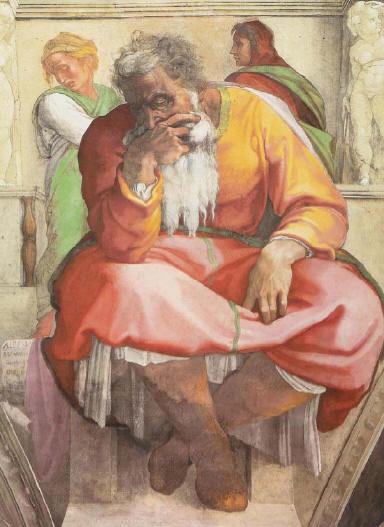
4 The word of the LORD came to me, saying, 5 “Before I formed you in the womb Jeremiah in the Sistine Chapel knew] you, before you were born I set you apart; I appointed you as a prophet to the nations.” 6 “Ah, Sovereign LORD,” I said, “I do not know how to speak; I am only a child.” 7But the LORD said to me, “Do not say, ‘I am only a child.’ You must go to everyone I send you to and say whatever I command you. 8 Do not be afraid of them, for I am with you and will rescue you,” declares the LORD. 9 Then the LORD reached out his hand and touched my mouth and said to me, “Now, I have put my words in your mouth. 10 See, today I appoint you over nations and kingdoms to uproot and tear down, to destroy and overthrow, to build and to plant.”

image_134Background2http://en.wikipedia.org/wiki/Jeremiah

Jeremiah is one of the prophets of the Hebrew Bible. His writings are put together in the Book of Jeremiah and traditionally, authorship of the Book of Lamentations is ascribed to him. God appointed Jeremiah to confront Judah and Jerusalem for the worship of idols and other violations of the covenant described in Deuteronomy. According to Jeremiah, the LORD declared that the covenant was broken and that God would bring upon Israel and Judah the curses of the covenant. Jeremiah’s job was to explain the reason for the impending disaster (destruction by the Babylonian army and captivity), “And when your people say, ‘Why has the LORD our God done all these things to us?’ you shall say to them, ‘As you have forsaken me and served foreign gods in your land, so you shall serve foreigners in a land that is not yours.'” The LORD said to Jeremiah:

God’s personal prediction to Jeremiah, “Attack you they will, overcome you they can’t,” was fulfilled many times in the Biblical narrative as Jeremiah warned of destruction of those who continued to refuse repentance and accept more moderate consequences. In return for his adherence to God’s disciplines and speaking God’s words, Jeremiah was attacked by his own brothers, beaten and put into the stocks by a priest and false prophet, imprisoned by the king, threatened with death, thrown into a cistern by Judah’s officials, and opposed by a false prophet. Yet God was faithful to rescue Jeremiah from his enemies. For example, when his prophecies regarding the destruction of Judah and Jerusalem were fulfilled by Nebuchadnezzar’s army in 586 BC, Nebuchadnezzar ordered that Jeremiah be freed from prison and treated well.

Biblical Truths3http://www.godrules.net/library/clarke/clarkejer1.htm

Verse 4. The word of the Lord came unto me] Then I first felt the inspiring influence of the Divine Spirit, not only revealing to me the subjects which he would have me to declare to the people, but also the words which I should use in these declarations.

Verse 5. Before I formed thee] I had destined thee to the prophetic office before thou wert born: I had formed my plan, and appointed thee to be my envoy to his people. St. Paul speaks of his own call to preach the Gospel to the Gentiles in similar terms, Galatians i. 15, 16.

Verse 6. I cannot speak] Being very young, and wholly inexperienced, I am utterly incapable of conceiving aright, or of clothing these Divine subjects in suitable language. Those who are really called of God to the sacred ministry are such as have been brought to a deep acquaintance with themselves, feel their own ignorance, and know their own weakness. They know also the awful responsibility that attaches to the work; and nothing but the authority of God can induce such to undertake it. They whom God never called run, because of worldly honor and emolument: the others hear the call with fear and trembling, and can go only in the strength of Jehovah.

“How ready is the man to go, Whom God hath never sent! How timorous, diffident, and slow, God’s chosen instrument!”

Verse 7. Whatsoever I command thee] It is my words and message, not thine own, that thou shall deliver. I shall teach thee; therefore thy youth and inexperience can be no hinderance.

Verse 8. Be not afraid of their faces] That is, the Jews, whom he knew would persecute him because of the message which he brought. To be fore-warned is to be half armed. He knew what he was to expect from the disobedient and the rebellious, and must now be prepared to meet it.

Verse 10. I have-set thee over the nations] God represents his messengers the prophets as doing what he commanded them to declare should be done. In this sense they rooted up, pulled down, and destroyed-declared God’s judgments, they builder up and planted-declared the promises of his mercy. Thus God says to Isaiah, chap. vi. 10: “Make the heart of this people fat-and shut their eyes.” Show them that they are stupid and blind; and that, because they have shut their eyes and hardened their hearts, God will in his judgments leave them to their hardness and darkness.

Items for Discussion

  • Where you ever given a job that seems overwhelming? One that you did not believe you could handle? What did you do and how did you feel?
  • What is the assurance that God gives Jeremiah? Did this mean he would have a life of easy and peace?
  • How do you think that Jeremiah’s confidence was bolstered by God’s assurances?
  • How can you experience a life of peace when you follow God’s commands?
  • Why is listening to God often hard on a person?
  • Can you follow God without suffering discomfort? Or another way to put it, if you were completely pain free, in want of nothing and comfortable, could you follow God?


Luke 4:21-30
21 and he began by saying to them, “Today this scripture is fulfilled in your hearing.” 22 All spoke well of him and were amazed at the gracious words that came from his lips. “Isn’t this Joseph’s son?” they asked. 23 Jesus said to them, “Surely you will quote this proverb to me: ‘Physician, heal yourself! Do here in your hometown what we have heard that you did in Capernaum.’ ” 24 “I tell you the truth,” he continued, “no prophet is accepted in his hometown. 25I assure you that there were many widows in Israel in Elijah’s time, when the sky was shut for three and a half years and there was a severe famine throughout the land. 26 Yet Elijah was not sent to any of them, but to a widow in Zarephath in the region of Sidon. 27 And there were many in Israel with leprosy in the time of Elisha the prophet, yet not one of them was cleansed—only Naaman the Syrian.” 28 All the people in the synagogue were furious when they heard this. 29 They got up, drove him out of the town, and took him to the brow of the hill on which the town was built, in order to throw him down the cliff. 30 But he walked right through the crowd and went on his way.

Background

Luke wrote two books of the New Testament (NT). Luke’s Gospel tells the story of the life and work of Jesus. Luke’s second book, Acts, continues the story after Jesus went back to heaven. The two books amount to a quarter of the NT. This is even more than Paul wrote.

Luke was a doctor (Colossians 4:14). He was often Paul’s companion in his travels. The book of Acts contains passages in which the author includes himself as a companion of Paul (‘we’ in Acts 16:10-17; 20:5-21:18; 27:1-28:16).

Luke shared Paul’s work (Philemon, verse 24). He was a loyal friend. In prison, Paul says, ‘only Luke is with me’ (2 Timothy 4:11).

Luke was a Gentile. He came from Antioch, which was an important town in Syria.

Biblical Truths4http://www.easyenglish.info/bible-commentary/luke-lbw.htm

Verses 22-23 The Jews in Nazareth thought that they knew everything about Jesus. They had seen him grow up. They knew his family. He had been a carpenter (he made wooden objects). They could not believe that he was the Messiah. In the same way, we may not give honour to someone who is very familiar to us. Jesus knew that they wanted him to prove that he was speaking the truth. They wanted Jesus to do something wonderful for them. This demand was like the devil’s third test in the desert.

Verses 25-27 In the past, Jews had not believed the prophets Elijah and Elisha. In the same way Jesus was saying that the Jews of his day would not accept their Messiah.

Verse 28 The idea that Gentiles were better than Jews made the Jews in the synagogue extremely angry. They wanted to kill Jesus.

Verse 29 The Jews intended to push him over a steep hill. If he did not die when he fell, they would throw stones at him.

Verse 30 Jesus remained calm. He walked away through the angry crowd. He never returned to Nazareth. The people there had had their chance.

Items for Discussion

  • In what way does familiarity interfere with one’s assessment of a situation?
  • When a child of yours or one you know becomes an educated adult, why is it difficult to see them differently?
  • How much of the image of a person comes from our own desires of who we want them to be?
  • Jesus says that Gentiles could see who He was easier than the Jew, why was this so?
  • How can people avoid the “trap of familiarity” and see people as they are and for who they are?

Discussion Challenge

  • Familiarity is both good and bad. How can the good points be built upon and the bad points avoided within a congregation of people?

Temptations

Deuteronomy 26:1-111NIV New International Version Translations
1 When you have entered the land the LORD your God is giving you as an inheritance and have taken possession of it and settled in it, 2 take some of the firstfruits of all that you produce from the soil of the land the LORD your God is giving you and put them in a basket. Then go to the place the LORD your God will choose as a dwelling for his Name 3 and say to the priest in office at the time, “I declare today to the LORD your God that I have come to the land the LORD swore to our forefathers to give us.” 4 The priest shall take the basket from your hands and set it down in front of the altar of the LORD your God. 5 Then you shall declare before the LORD your God: “My father was a wandering Aramean, and he went down into Egypt with a few people and lived there and became a great nation, powerful and numerous. 6 But the Egyptians mistreated us and made us suffer, putting us to hard labor. 7 Then we cried out to the LORD, the God of our fathers, and the LORD heard our voice and saw our misery, toil and oppression. 8 So the LORD brought us out of Egypt with a mighty hand and an outstretched arm, with great terror and with miraculous signs and wonders. 9 He brought us to this place and gave us this land, a land flowing with milk and honey; 10 and now I bring the firstfruits of the soil that you, O LORD, have given me.” Place the basket before the LORD your God and bow down before him. 11 And you and the Levites and the aliens among you shall rejoice in all the good things the LORD your God has given to you and your household.

img135Background2http://en.wikipedia.org/wiki/Book_of_Deuteronomy

Deuteronomy (Greek: Deuteronomion, “second law”) or Devarim (Hebrew: literally “things” or “words”) is the fifth book of the Hebrew Bible, and the fifth of five books of the Jewish Torah or Pentateuch.

A large part of the book consists of three sermons delivered by Moses reviewing the previous forty years of wandering in the wilderness, and the future entering into the Promised Land. Its central element is a detailed law-code by which the Israelites are to live within the Promised Land. Theologically the book constitutes the renewing of the covenant between Yahweh, the Jewish God, and the “Children of Israel.”

Conservative Bible scholars are united in their conviction that Moses wrote this book. Much of modern critical scholarship, while agreeing that Deuteronomy contains a core of material from ancient Mosaic traditions or writing, dates the book several centuries after Moses time, to the late 7th century BC. This latter view sees Deuteronomy as a product of the religious reforms carried out under king Josiah, with later additions from the period after the fall of Judah to the Babylonian empire in 586 BC.

Bible Truths3http://bible.cc/deuteronomy/26-1.htm

When God has made good his promises to us, he expects we should own it to the honor of his faithfulness. And our creature comforts are doubly sweet, when we see them flowing from the fountain of the promise. The person who offered his first-fruits, must remember and own the mean origin of that nation, of which he was a member. A Syrian ready to perish was my father. Jacob is here called a Syrian. Their nation in its infancy sojourned in Egypt as strangers, they served there as slaves. They were a poor, despised, oppressed people in Egypt; and though become rich and great, had no reason to be proud, secure, or forgetful of God. He must thankfully acknowledge God’s great goodness to Israel. The comfort we have in our own enjoyments, should lead us to be thankful for our share in public peace and plenty; and with present mercies we should bless the Lord for the former mercies we remember, and the further mercies we expect and hope for. He must offer his basket of first-fruits. Whatever good thing God gives us, it is his will that we make the most comfortable use we can of it, tracing the streams to the Fountain of all consolation.

Items for Discussion

  • What does the concept of firstfruits mean to you?
  • Why would God want us to give of the firstfruits?
  • What is the difference between giving from abundance versus tithing?
  • Why does God want us to give anything to Him, He surely doesn’t need us? (Hint: read Genesis 3)


Luke 4:1-13
1 Jesus, full of the Holy Spirit, returned from the Jordan and was led by the Spirit in the desert, 2 where for forty days he was tempted by the devil. He ate nothing during those days, and at the end of them he was hungry. 3 The devil said to him, “If you are the Son of God, tell this stone to become bread.” 4 Jesus answered, “It is written: ‘Man does not live on bread alone.” 5 The devil led him up to a high place and showed him in an instant all the kingdoms of the world. 6 And he said to him, “I will give you all their authority and splendor, for it has been given to me, and I can give it to anyone I want to. 7 So if you worship me, it will all be yours.” 8 Jesus answered, “It is written: ‘Worship the Lord your God and serve him only.” 9 The devil led him to Jerusalem and had him stand on the highest point of the temple. “If you are the Son of God,” he said, “throw yourself down from here. 10 For it is written: “‘He will command his angels concerning you to guard you carefully; 11 they will lift you up in their hands, so that you will not strike your foot against a stone.” 12 Jesus answered, “It says: ‘Do not put the Lord your God to the test.” 13 When the devil had finished all this tempting, he left him until an opportune time.

Background4http://www.easyenglish.info/bible-commentary/luke-lbw.htm

Luke wrote two books of the New Testament (NT). Luke’s Gospel tells the story of the life and work of Jesus. Luke’s second book, Acts, continues the story after Jesus went back to heaven. The two books amount to a quarter of the NT. This is even more than Paul wrote.

Luke was a doctor (Colossians 4:14). He was often Paul’s companion in his travels. The book of Acts contains passages in which the author includes himself as a companion of Paul (‘we’ in Acts 16:10-17; 20:5-21:18; 27:1-28:16).

Luke shared Paul’s work (Philemon, verse 24). He was a loyal friend. In prison, Paul says, ‘only Luke is with me’ (2 Timothy 4:11).

Luke was a Gentile. He came from Antioch, which was an important town in Syria.

Biblical Truths5http://www.christnotes.org/commentary.php?b=42&c=4&com=mhc Matthew Henry Concise Commentary

Christ’s being led into the wilderness gave an advantage to the tempter; for there he was alone, none were with him by whose prayers and advice he might be helped in the hour of temptation. He who knew his own strength might give Satan advantage; but we may not, who know our own weakness. Being in all things made like unto his brethren, Jesus would, like the other children of God, live in dependence upon the Divine Providence and promise. The word of God is our sword, and faith in that word is our shield. God has many ways of providing for his people, and therefore is at all times to be depended upon in the way of duty. All Satan’s promises are deceitful; and if he is permitted to have any influence in disposing of the kingdoms of the world and the glory of them, he uses them as baits to ensnare men to destruction. We should reject at once and with abhorrence, every opportunity of sinful gain or advancement, as a price offered for our souls; we should seek riches, honors, and happiness in the worship and service of God only. Christ will not worship Satan; nor, when he has the kingdoms of the world delivered to him by his Father, will he suffer any remains of the worship of the devil to continue in them. Satan also tempted Jesus to be his own murderer, by unfitting confidence in his Father’s protection, such as he had no warrant for. Let not any abuse of Scripture by Satan or by men abate our esteem, or cause us to abandon its use; but let us study it still, seek to know it, and seek our defense from it in all kinds of assaults. Let this word dwell richly in us, for it is our life. Our victorious Redeemer conquered, not for himself only, but for us also. The devil ended all the temptation. Christ let him try all his force, and defeated him. Satan saw it was to no purpose to attack Christ, who had nothing in him for his fiery darts to fasten upon. And if we resist the devil, he will flee from us. Yet he departed but till the season when he was again to be let loose upon Jesus, not as a tempter, to draw him to sin, and so to strike at his head, at which he now aimed and was wholly defeated in; but as a persecutor, to bring Christ to suffer, and so to bruise his heel, which it was told him, he should have to do, and would do, though it would be the breaking of his own head, Genesis 3:15. Though Satan depart for a season, we shall never be out of his reach till removed from this present evil world.

Items for Discussion

  • What did you learn about Christ in this story concerning Satan?
  • How did Satan attempt to convince Christ to sin-what was Satan’s modus operandi-his strategy?
  • How did Christ defend Himself against Satan?
  • Can a human who is not God, defend him/herself from Satan?
  • What are your “tricks of the trade” for handling temptation?
  • In what way does the Old Testament verses about sacrifice and firstfruits relate to this story about Jesus and temptation?

Discussion Challenge

  • In what ways can a church equip its congregation to be more effective when it comes to handling temptation?

Are You A Person Of Sacrifice?

Psalm 271NIV New International Version Translations
1 The LORD is my light and my salvation—whom shall I fear? The LORD is the stronghold of my life—of whom shall I be afraid? 2 When evil men advance against me to devour my flesh, when my enemies and my foes attack me, they will stumble and fall. 3 Though an army besiege me, my heart will not fear; though war break out against me, even then will I be confident. 4 One thing I ask of the LORD, this is what I seek: that I may dwell in the house of the LORD all the days of my life, to gaze upon the beauty of the LORD and to seek him in his temple. 5 For in the day of trouble he will keep me safe in his dwelling; he will hide me in the shelter of his tabernacle and set me high upon a rock. 6 Then my head will be exalted above the enemies who surround me; at his tabernacle will I sacrifice with shouts of joy; I will sing and make music to the LORD. 7 Hear my voice when I call, O LORD; be merciful to me and answer me. 8 My heart says of you, “Seek his face!” Your face, LORD, I will seek. 9 Do not hide your face from me, do not turn your servant away in anger; you have been my helper. Do not reject me or forsake me, O God my Savior. 10 Though my father and mother forsake me, the LORD will receive me. 11 Teach me your way, O LORD; lead me in a straight path because of my oppressors. 12 Do not turn me over to the desire of my foes, for false witnesses rise up against me, breathing out violence. 13 I am still confident of this: I will see the goodness of the LORD in the land of the living. 14 Wait for the LORD; be strong and take heart and wait for the LORD.

clip_image136Background2http://www.easyenglish.info/psalms/psalm027-taw.htm

We do not know when David wrote Psalm 27. Some Christians believe that he wrote it in 2 parts. He wrote verses 1 – 6 when life was good. God was answering all his prayers. Perhaps it was after he had killed Goliath. (See Psalm 27:2). He wrote verses 7-12 when life was difficult He thought that God was hiding from him. Perhaps it was when Saul was fighting him. (See Psalm 27:12). He wrote verses 13-14 when he put the 2 parts together. Other Christians believe that David wrote it all at the same time. In the past God had been good to him. Why was God not good to him now? He would still believe in God and wait for his help. In Psalm 27 we learn that for David life had its ups and downs. The ups were the good times. The downs were the difficult times. This happens to us also. When life is difficult we must remember the good times. When we think that God has forgotten us, we must remember the times when he did not forget us. We must be like David in Psalm 27:14. We must wait for the Lord. One day he will give us help. If we believe this, it will make us strong.

Bible Truths3http://bible.cc/deuteronomy/26-1.htm

Verses 1 – 3: “The Lord is my light” means many things. One is that he shows us what to do in life. “The LORD is my hiding place” means that when trouble comes the LORD will be with us in it. He will give us help to live through it, he will not leave us by ourselves. Verse 2 says that David thought that bad men (like animals) wanted to eat him. But these bad men fell down and they did not hurt David. Perhaps David remembered Goliath. Goliath said that he would feed David’s body to the wild animals and birds. But David killed Goliath. David believed that because God gave him help in the past he will in the future. The same is true for us. Every time God gives us help we are more sure that he will give us help in the future.

Verses 4 – 6: Here are 4 words for where the LORD lives: house, palace, hiding place and tent. They are not 4 different places. They all describe where God is. For David it was either the tent with the ark in it, or heaven. The ark was where the Jews kept special things that made them think of God. Heaven is where God lives. If we are Christians then God lives in us. We are the house of God.

Verses 7 – 9: Here the psalm changes. In verses 1-6 life was good for David. Now life is difficult. David thinks that God has forgotten him. David prays to God, “Answer me”. He thinks that he hears a voice inside him that says, “Look for my face”. So David continues to pray. He says, “You gave me help in the past ~ do not forget me now”.

Verses 10 – 12: Verse 10 tells us that David is sure that God will answer him one day. Even if his parents forget him, God will never forget him. In verses 11-12 David tells us that he has many enemies that want to hurt him. Some, as Cush in Psalm 7, tell lies about him. Lies are words that are not true. So David prays for a straight path. This means one that is safe.

Verses 13 – 14: This starts with something very strange. Verse 13 has no beginning. In Hebrew it is ” . . . . . if I had not believed to see the goodness the LORD is in the land of the living”. This is not a mistake, as some people think. It means that everyone that reads the psalm can put their own words in. What would happen to you if you did not believe in the Lord? But because you do believe in the Lord you are ready to wait for his answers. You may wait a long time, but be brave and strong. One day, God will answer you, if you believe in him.

Items for Discussion

  • How was your confidence built with respect to your faith in God?
  • While miracles are hard to forget, most of us do not see them every day. So how do you notice God in your everyday life?
  • If David was confident in God’s protection, why do you think he was equally so fearful of his enemies?
  • David used his psalms to remember his feelings toward God – what do you do or use to remember yours?
  • How can adults help youth gain confidence that God is going to protect them?


Luke 13:31-35
31 At that time some Pharisees came to Jesus and said to him, “Leave this place and go somewhere else. Herod wants to kill you.” 32 He replied, “Go tell that fox, ‘I will drive out demons and heal people today and tomorrow, and on the third day I will reach my goal.’ 33 In any case, I must keep going today and tomorrow and the next day—for surely no prophet can die outside Jerusalem! 34 “O Jerusalem, Jerusalem, you who kill the prophets and stone those sent to you, how often I have longed to gather your children together, as a hen gathers her chicks under her wings, but you were not willing! 35 Look, your house is left to you desolate. I tell you, you will not see me again until you say, ‘Blessed is he who comes in the name of the Lord.'”

Background4http://www.biography.com/articles/St-Luke-9388807

Luke is first mentioned in the letters of the Apostle Paul as the latter’s “coworker” and as the “beloved physician.” The former designation is the more significant one, for it identifies him as one of a professional cadre of itinerant Christian “workers,” many of whom were teachers and preachers. His medical skills, like Paul’s tent making, may have contributed to his livelihood; but his principal occupation was the advancement of the Christian mission.

Luke is credited with being the author of the third Gospel and the Acts of the Apostles. He excludes himself from those who were eyewitnesses of Christ’s ministry. His participation in the Pauline mission, however, is indicated by the use of the first person in the “we” sections of Acts. They reveal that Luke shared in instructing persons in the Christian message and possibly in performing miraculous healings.

The “we” sections are analogous in style to travel reports found elsewhere in writings of the Greco-Roman period. They place the author with Paul during his initial mission into Greece—i.e., as far as Philippi, in Macedonia. It is there that Luke later rejoins Paul and accompanies him on his final journey to Jerusalem. After Paul’s arrest in that city and during his extended detention in nearby Caesarea, Luke may have spent considerable time in Palestine working with the apostle as the occasion allowed and gathering materials for his future two-volume literary work, the Gospel and the Acts. In any case, two years later he appears with Paul on his prison voyage from Caesarea to Rome and again, according to the Second Letter of Paul to Timothy 4:11, at the time of the apostle’s martyrdom in the imperial city.

Biblical Truths5http://www.easyenglish.info/bible-commentary/luke-lbw.htm

Verse 31 These Pharisees may have acted as sincere friends. But they probably tried to move Jesus out of Galilee for their own reasons. They had more power to change public opinion in Judea. Therefore, they were willing to warn Jesus about Herod, a person whom they hated. Herod Antipas was the ruler of Galilee and Perea. Perhaps he was still anxious because he had agreed to John the Baptist’s death. He did not want to be responsible for another murder. Jesus was popular. So, Herod may have been worried about political activity that would disturb the peace. Therefore, he thought that he should warn Jesus. This would make him leave that region.

Verse 32 The Jews believed that they could not trust a fox. It was an animal that was always destroying things. Foxes were of little worth. Jesus compared Herod to this animal. Jesus continued his work. He forced out demons and healed people. But soon he would finish this work.

Verse 33 He ‘must’ go to Jerusalem but not because of Herod’s wish. God planned that Jesus would go there. It would be when God wanted. It would not be when Herod wanted. Jerusalem was a ‘holy’ city because the Temple was there. But they had often killed prophets there. Jesus was a prophet too.

Verse 34 ‘I often’ shows that Jesus went to Jerusalem more times than Matthew, Mark, Luke and John record. Jesus said that the people of Jerusalem had refused to obey God’s servants. They even killed them.

Verse 35 Jews refused to obey God. So, God stopped protecting their city. As in the time of Jeremiah (Jeremiah 7:4), the Jews believed that their city would always be safe. The Temple was there. So, they thought that an enemy would never defeat Jerusalem. But Jesus’ words came true. In AD 70, the Romans completely destroyed Jerusalem.

Jesus used words from Psalm 118:26. People greeted one another with these words when they came to Jerusalem. People greeted Jesus with these words on the Sunday before the first Easter (Luke 19:38). Here Jesus also refers to when he will return to earth. On that day people will have to recognise him as Messiah.

Items for Discussion

  • The Pharisees are using an old technique, fear, to get Jesus out of their area. How is fear used in our modern society today?
  • Why would a fox be used as an example for Herod?
  • Who are the fox’s of today?
  • How did the Israelites lose the protection of God over their city?
  • Read verse 35: is Jesus being too harsh or unreasonable with the Pharisees?
  • What is the sacrifice that a person makes when they rely on God for their protection?

Discussion Challenge

  • How can a simple church help its community to recognize the risk of losing God’s protection?

Change of Heart

Isaiah 55:1-91NIV New International Version Translations
1 “Come, all you who are thirsty, come to the waters; and you who have no money, come, buy and eat! Come, buy wine and milk without money and without cost. 2 Why spend money on what is not bread, and your labor on what does not satisfy? Listen, listen to me, and eat what is good, and your soul will delight in the richest of fare. 3 Give ear and come to me; hear me, that your soul may live. I will make an everlasting covenant with you, my faithful love promised to David. 4 See, I have made him a witness to the peoples, a leader and commander of the peoples. 5 Surely you will summon nations you know not, and nations that do not know you will hasten to you, because of the LORD your God, the Holy One of Israel, for he has endowed you with splendor.” 6 Seek the LORD while he may be found; call on him while he is near. 7 Let the wicked forsake his way and the evil man his thoughts. Let him turn to the LORD, and he will have mercy on him, and to our God, for he will freely pardon. 8 “For my thoughts are not your thoughts, neither are your ways my ways,” declares the LORD. 9 “As the heavens are higher than the earth, so are my ways higher than your ways and my thoughts than your thoughts.

clip_image137Background

In 742 B.C. Isaiah was called to be a prophet. He had a vision of the heavenly throne room where an angel purified his lips with a burning coal. He lived in Judah in the vicinity of Jerusalem where he condemned social injustice. He was married and had sons to whom he gave symbolic names: Shear-jashub meant “a remnant shall return” and Maher-shalal-hash-baz meant “the spoil speeds, the prey hastens.” These names anticipated that the Assyrians would conquer Syria and Israel but that God would preserve at least a remnant of Judah. Isaiah lived during the time when the Assyrians expanded their empire. The Syrians and the northern kingdom tried to pressure the southern kingdom of Judah to help them resist the Assyrians. As a sign of God’s faithfulness, Isaiah promised that a child would be born who would be called “Immanuel,” which means “God with us.” Isaiah told people not to fight because God would protect them. Isaiah’s advice was heeded by Hezekiah, who was king late in Isaiah’s life. The Assyrians did conquer the northern kingdom and besieged Jerusalem but did not capture it. An outbreak of disease forced the Assyrians to depart. Isaiah’s life and message are recounted in the book of Isaiah.

Bible Truths2http://www.ccel.org/ccel/henry/mhc4.Is.lvi.html Matthew Henry Commentaries

As we had much of Christ in the 53rd chapter, and much of the church of Christ in the 54th chapter, so in this chapter we have much of the covenant of grace made with us in Christ. The “sure mercies of David,” which are promised here (ver. 3), are applied by the apostle to the benefits which flow to us from the resurrection of Christ (Acts xiii. 34), which may serve as a key to this chapter; not but that it was intended for the comfort of the people of God that lived then, especially of the captives in Babylon, and others of the dispersed of Israel; but unto us was this gospel preached as well as unto them, and much more clearly and fully in the New Testament. Here is, I. A free and gracious invitation to all to come and take the benefit of gospel grace, ver. 1. II. Pressing arguments to enforce this invitation, ver. 2-4. III. A promise of the success of this invitation among the Gentiles, ver. 5. IV. An exhortation to repentance and reformation, with great encouragement given to hope for pardon thereupon, ver. 6-9. V. The ratification of all this, with the certain efficacy of the word of God, ver. 10, 11. And a particular instance of the accomplishment of it in the return of the Jews out of their captivity, which was intended for a sign of the accomplishment of all these other promises.

Items for Discussion

  • God is asking people to change – Why don’t people change?
  • What makes people change?
  • God proposes that worldly food and purchases are not satisfying – How does society argue against God?
  • Read verse six – Can you interpret this as saying that God may not always respond to someone’s call for Him? Explain: consider this question, Is there a time that it becomes too late to be saved?
  • Besides calling out for God, what does He expect us to do?
  • How does forgiveness support God’s instructions to us?


Luke 13:1-9
1 Now there were some present at that time who told Jesus about the Galileans whose blood Pilate had mixed with their sacrifices. 2 Jesus answered, “Do you think that these Galileans were worse sinners than all the other Galileans because they suffered this way? 3 I tell you, no! But unless you repent, you too will all perish. 4 Or those eighteen who died when the tower in Siloam fell on them—do you think they were more guilty than all the others living in Jerusalem? 5 I tell you, no! But unless you repent, you too will all perish.” 6 Then he told this parable: “A man had a fig tree, planted in his vineyard, and he went to look for fruit on it, but did not find any. 7 So he said to the man who took care of the vineyard, ‘For three years now I’ve been coming to look for fruit on this fig tree and haven’t found any. Cut it down! Why should it use up the soil?’ 8 ” ‘Sir,’ the man replied, ‘leave it alone for one more year, and I’ll dig around it and fertilize it. 9 If it bears fruit next year, fine! If not, then cut it down.’ “

Background3http://orthodoxwiki.org/Apostle_Luke

The Apostle Luke, was of Greek origin born in the Hellenistic city of Antioch, and was extremely educated. His studies included Greek philosophy, medicine, and art in his youth. He was also a professional physician. Luke came to Jerusalem where he came to believe in the Lord. He and Cleopas met the resurrected Lord on the road to Emmaus (Luke 24).

After Pentecost, Luke returned to Antioch and worked with the Apostle Paul, traveling with him to Rome, and converting Jews and pagans to the Christian Faith. “Luke, the beloved physician, … greets you,” writes the Apostle Paul to the Colossians (Colossians 4:14). At the request of Christians, Luke wrote his Gospel in the first century. According to some accounts this took place around 60 A.D., and according to others around 80 A.D. After Paul’s martyrdom, Luke preached the Gospel throughout Italy, Dalmatia, Macedonia, and other regions. He painted icons of the Most-holy Theotokos—not just one, but three—as well as icons of the Holy Apostles Peter and Paul. For this reason, the Apostle Luke is considered the founder of Christian iconography. In his old age, he visited Libya and Upper Egypt; from Egypt he returned to Greece, where he continued to preach and convert many with great zeal despite his age.
In addition to his Gospel, Luke wrote the Acts of the Apostles and dedicated each of these works to Theophilus, the governor of Achaia. Luke was 84 years old when he was tortured him for the sake of Christ and hanged him from an olive tree in the town of Thebes, in Beothia of Greece.

Biblical Truths4http://www.easyenglish.info/bible-commentary/luke-lbw.htm

Two incidents and a parable all teach that people need to turn to God. They must do this so that they avoid punishment.

Verse 1 Pilate was the Roman who governed Judea. He was always afraid that Jewish crowds would disturb the peace. ‘Galileans’ are people who came from the area near Lake Galilee.

Verse 2 The Jews often thought that people suffered because they had sinned (John 9:2). Jesus had just spoken about judgement. The people may also have thought of what Jesus had said. Therefore, they were wondering if these Galileans were especially wicked. Some people from Galilee were offering their sacrifice in the Temple. Pilate did not want anyone to cause trouble against the Romans. He ordered his soldiers to stop such people. The soldiers killed the Galileans. Their own blood mixed with the blood of their animal offerings.

Verses 4-5 The building may have been part of Pilate’s plan to improve the water supply to Jerusalem. This was necessary, but the Jews were very angry. Pilate took some money from the Temple to pay for it. These men may have been working on the water system. Some people hated Pilate’s plan. They thought that people should not work on it. The workers should not have accepted money which came from the Temple as their wages. They died when the building fell down. Therefore, people thought that God had punished them. Jesus denied that they were guiltier than anyone else in Jerusalem. But their deaths were a warning. People needed to turn to God.

Verse 6 A vineyard was picture language for the nation of Israel. Isaiah spoke of the care that God had given to his vineyard. But its fruit was no good. The people were wicked. Therefore God would destroy the vineyard (Isaiah 5:1-7).

Verse 7 In Jesus’ parable, the fig tree was in good soil in the vineyard. But it had failed to produce fruit after three years. Jesus had been expecting the Jews to accept his message for the past three years. The fig tree disappointed its owner in the story. In the same way, the Jews had disappointed Jesus.

Verses 8-9 The extra year in the story suggests that God gives people every chance to repent. But there comes a time when there are no more opportunities. If the Jews did not change their behaviour, God would destroy their nation. He was like the vineyard owner, who would cut down the fig tree.

The Jews would not obey God. Jesus knew that this would lead to trouble with the Romans. The Romans destroyed the Jewish nation in AD 70.

Items for Discussion

  • What can we deduce from the story of the fig tree about the following:
    • God’s expectations for His people
    • God’s patience with His people
  • Jerusalem was destroyed by the Roman General Titus by a siege. People were starved and driven into cannibalism. All this happened because their leaders failed to listen. Can you parallel this story with modern events that were similar?
  • How should these lessons of history affect people today?
  • While we have a patient and forgiving God, what is the bottom line to God’s expectations for His people?
  • Can people change? Can old dogs be taught new tricks?
  • How do people change? What must they do?

Discussion Challenge

  • How can a Christian community help those around them, other Christians, non-Christians, people of other beliefs and faiths change so that their lives are more pleasing to God?
« Older posts Newer posts »

"For it is by grace you have been saved" - Ephesians 2:8-9  

Copyright: © 2001 - 2025 Lostpine

Translate »