Biblical wisdom, historical insight, and personal growth — all in one place

Category: Snapshots (Page 27 of 45)

Family Affair ~ The Prodigal Son

Psalm 130:3-51NIV New International Version Translations
3 If you, O LORD, kept a record of sins, O Lord, who could stand? 4 But with you there is forgiveness; therefore you are feared. 5 I wait for the LORD, my soul waits, and in his word I put my hope.
clip_image011Background2http://www.apostolic.net/biblicalstudies/psalm130.htm

Psalm 130 is an unnamed psalm in the Hebrew psalter composed by a penitential Israelite. Unlike some Psalms that indicate some historical situation from which they were composed, Psalm 130 has no such superscription. We are not given any hint as to the historical situation prompting the psalmist’s composition. One internal clue as to the dating of this psalm may be found in the author’s mention of “Israel.” This term is used 63 times in 40 different psalms. All psalms except 71, 89, 98-99, 105-106, 114,2 115, 118, 121, 125, 128-130, 135, 136,3 147-149 are attributed to David, Solomon, or Asaph, all of whom lived during the time of the united kingdom known as “Israel.” The majority of Psalms that make mention of Israel, then, are prior to the divided monarchy. The psalmist may have lived during this time. It could also be the case, however, that the psalmist composed it during the time of the divided monarch, before the destruction of the nation of Israel in 722 BC by Assyria. The date may never be known with any certainty, and it is not particularly relevant for a proper interpretation of the psalm.
It is difficult to determine the cultural background of the psalm without knowing the historical background, including the identity of the author and the date of composition. The most that can be said is that an Israelite probably composed this psalm sometime between 1000 BC to 722 BC. As an Israelite living during this time his culture would reflect the Mosaic Law. As a Semitic individual he would have viewed society holistically, not individually. This would explain why he exhorts Israel to wait until the Lord redeems Israel as a nation from their sins (130:8).

Most scholars classify this psalm as an individual lament: 1. God is addressed with a cry for help; 2. A poetic description of the crisis is given; 3. An affirmation of trust is given; 4. A series of petitions are made; 5. An additional argument is given to appeal to God’s concern, a confession is made, or a protest of innocence is given; 6. Vows of praise are made if the Lord answers the prayer; 7. The psalmist gives an assurance of having his prayer heard and expresses confidence that the Lord will respond. Verses 1-2 clearly call on the Lord for help. Verse 3 expresses the psalmist’s crisis-he is in need of forgiveness. Verses 4-6 form a long expression of trust in the Lord. After this the psalm does not follow the flow of a typical individual lament psalm. There is no further petitions, an appeal to God’s concern, or a vow of praise. We only find an exhortation to the nation of Israel and a final affirmation of trust; nevertheless, the psalm exhibits the characteristics of the individual lament more so than any other psalm-type.

Biblical Truths

Verse 3 – The second line answers the question posed in the first. The statement is a rhetorical device, not intended to be answered. The psalmist realizes that if the Lord were to keep track of sins, no one would be able to stand before Him.

“keep a record” is a metaphor. It comes from the Hebrew shamar, meaning “store up.” The root idea of this word is “to exercise great care over” something. In this case God is exercising great care to store up man’s sin. He is compared to an accountant who would store up each sin on a ledger. The idea of God storing up sins is not limited to this psalm. It is also found in such passages as Deuteronomy 32:34; I Kings 17:8; Job 7:20; Hosea 13:12.

“Stand” is a also a metaphor. The idea is to stand before God as though God is on the judgment seat. To be able to stand before God is indicative of righteousness and justification. The idea here is that if God were to keep track of all our sins we would never be able to stand justified before Him. Our sins would incriminate us, humiliating us before the king. There is no one righteous, able to say he has clean hands before God. If God were to reward us according to our works, our judgment would be immeasurable. Thank God for His wonderful grace and mercy that forgives us of our sins!

Verse 4 – It is a simple purpose clause, indicating why the Lord is willing to forgive. While we know from other parts of Scripture that the Lord forgives us because He loves us and has chosen us, here we find a slightly different reason. The Lord is willing to forgive because it brings Him “honor.” Many translations render this as “feared,” but to the modern ear this often connotes “to be scared of.” This is not the meaning of the Hebrew. The fear spoken of here is reverential fear, or awe of God. It is paying Him the respect that is due Him. When the Lord forgives our sins it produces in us a gratitude and awe of the Almighty, causing our loyal respect for His willingness to erase our debt of sin.

Verse 5 – Where we have an instance of repetition wherein the psalmist repeats the fact he was waiting for the Lord. First he indicated that he waited for God, and then further indicated that his soul waited. In the second line “soul” is substituted for “I” and there is no mention of the object of wait; i.e. God.

The psalmist declared that his “soul” waited on God. This is an example of a synecdoche wherein one word is related to another word, though unexpressed, in the same genus. Soul, nephesh, is frequently used in the Hebrew Scriptures to indicate the whole person, not just the immaterial portion of man (Leviticus 7:18, 20; Psalm 86:14, et al). God’s “word” also seems to a reference to His pronouncement of righteousness as judge.

This verse is a beautiful confession of the psalmist’s faith. While he cried to the Lord for forgiveness, his cry was a cry of faith. He knew the Lord would show him mercy, but did not know exactly when. He would wait for the Lord’s word confirming the extension of His mercy.

It seems that the psalmist had more in mind than forgiveness of sin because one does not have to wait for the Lord’s forgiveness. It is likely that the psalmist’s sins had caused some temporal difficulties for him that he wished to be delivered from. While the Lord had forgiven him his sin, the Lord had not delivered him from the temporal effects of his sins.

Items for Discussion

  • When do you think about God’s forgiveness?
  • Why is it so hard for humans not to keep a record of the wrongs committed against them?
  • Why are hope and forgiveness so tied together so closely?
  • Can any relationship between two people survive without forgiveness? Why or why not?
  • The psalmist is in awe of God. When are you in awe of God?


Luke 15:20-27
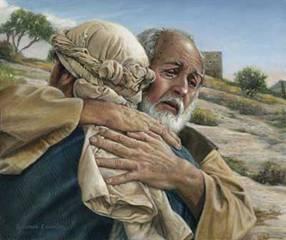
20 So he got up and went to his father. “But while he was still a long way off, his father saw him and was filled with compassion for him; he ran to his son, threw his arms around him and kissed him. 21 “The son said to him, ‘Father, I have sinned against heaven and against you. I am no longer worthy to be called your son.’ 22 “But the father said to his servants, ‘Quick! Bring the best robe and put it on him. Put a ring on his finger and sandals on his feet. 23 Bring the fattened calf and kill it. Let’s have a feast and celebrate. 24 For this son of mine was dead and is alive again; he was lost and is found.’ So they began to celebrate. 25 “Meanwhile, the older son was in the field. When he came near the house, he heard music and dancing. 26 So he called one of the servants and asked him what was going on. 27 ‘your brother has come,’ he replied, ‘and your father has killed the fattened calf because he has him back safe and sound.’

Background

Luke was a doctor and it is only logical that medical matters should be stressed. (Luke 4:38; 7:15; 8:55; 14:2; 18:15; 22:50) Luke was not a Jew and directed his message to Greeks, as a Gentile speaking to Gentiles. He writes in an orderly fashion giving careful attention to historical details. Luke stresses events which point to Christ’s humanity and uses the phrase the Son of Man rather than the term Son of God. He places more space and emphasis on the birth of Christ than any other writer. There is a special emphasis on individuals and prayer, the sick, women, poverty and wealth. The compassion of the Son of Man is displayed everywhere.

Biblical Truths and Theology3Barnes Notes: http://www.studylight.org/com/bnn/view.cgi?book=lu&chapter=015

Verse 20. He arose, and came. Was coming. But here is no indication of haste. He did not run, but came driven by his wants, and, as we may suppose, filled with shame, and even with some doubts whether his father would receive him.

A great way off. This is a beautiful description–the image of his father’s happening to see him clad in rags, poor, and emaciated, and yet he recognized his son, and all the feelings of a father prompted him to go and embrace him.

Had compassion. Pitied him. Saw his condition–his poverty and his wretched appearance–and was moved with compassion and love.

And ran. This is opposed to the manner in which the son came. The beauty of the picture is greatly heightened by these circumstances. The son came slowly– the father ran. The love and joy of the old man were so great that he hastened to meet him and welcome him to his home.

Fell on his neck. Threw his arms around his neck and embraced him.

And kissed him. This was a sign at once of affection and reconciliation. This must at once have dissipated every doubt of the son about the willingness of his father to forgive and receive him. A kiss is a sign of affection, 1 Samuel 10:1; Genesis 29:13. This is evidently designed to denote the readiness of God to pity and pardon returning sinners. In this verse of inimitable beauty is contained the point of the parable, which was uttered by the Savior to vindicate his own conduct in receiving sinners kindly. Who could blame this father for thus receiving his repenting son? Not even a Pharisee could blame him; and our Savior thus showed them, so that they could not resist it, that God received returning sinners, and that it was right for him also to receive them and treat them with attention.

Verse 21. No Barnes text on this verse.

Verse 22. The best robe. The son was probably in rags. The joy of the father is expressed by clothing him in the best raiment, that he might appear well. The robe here mentioned is probably the outer garment; and the father told them to put on him the best one that was in the house–one reserved for festival occasions. See Genesis 27:15.

A ring on his hand. To wear a ring on the hand was one mark of wealth and dignity. The rich and those in office commonly wore them. Comp. James 2:2. To give a ring was a mark of favor, or of affection, or of conferring office. Comp. Genesis 41:42; Esther 8:2. Here it was expressive of the favor and affection of the father.

Shoes on his feet. Servants, probably, did not usually wear shoes. The son returned, doubtless, without shoes–a condition very unlike that in which he was when he left home. When, therefore, the father commanded them to put shoes on him, it expressed his wish that he should not be treated as a servant, but as a son. The word shoes here, however, means no more than sandals, such as were commonly worn. And the meaning of all these images is the same– that God will treat those who return to him with kindness and affection. These images should not be attempted to be spiritualized. They are beautifully thrown in to fill up the narrative, and to express with more force the general truth that God will treat returning penitents with mercy and with love. To dress up the son in this manner was a proof of the father’s affection. So God will bestow on sinners the marks of his confidence and regard.

Verse 23. Be merry. Literally, “eating, let us rejoice.” The word merry does not quite express the meaning of the Greek. Merriment denotes a light, playful, jovial mirth. The Greek denotes simply joy–let us be happy, or joyful.

Verse 24. Was dead. This is capable of two significations:

  1. I supposed that he was dead, but I know now that he is alive.
  2. He was dead to virtue–he was sunk in pleasure and vice. The word is not infrequently thus used. See 1 Timothy 5:6; Matthew 8:22; Romans 6:13. Hence to be restored to virtue is said to be restored to life, Romans 6:13; Revelation 3:1; Ephesians 2:1. It is probable that this latter is the meaning here. See Luke 15:31.
  3. Was lost. Had wandered away from home, and we knew not where he was.

Verse 25. In the field. At work. This eldest son is designed to represent the Pharisees who had found fault with the Savior. Their conduct is likened to that of this envious and unnatural brother.

Music and dancing. Dancing was not uncommon among the Hebrews, and was used on various occasions. Thus Miriam celebrated the deliverance of the children of Israel from Egypt in dances as well as songs, Exodus 15:20. David danced before the ark, 2 Samuel 6:14. It was common at Jewish feasts (Judges 21:19-21) and in public triumphs (Judges 11:34), and at all seasons of mirth and rejoicings, Psalms 30:11; Jeremiah 31:4,13. It was also used in religious services by the idolaters (Exodus 32:19), and also by the Jews, at times, in their religious services, Psalms 149:3; 150:4. In this case it was an expression of rejoicing. Our Lord expresses no opinion about its propriety. He simply states the fact, nor was there occasion for comment on it. His mentioning it cannot be pleaded for its lawfulness or propriety, any more than his mentioning the vice of the younger son, or the wickedness of the Pharisees, can be pleaded to justify their conduct. It is an expressive image, used in accordance with the known customs of the country, to express joy. It is farther to be remarked, that if the example of persons in Scripture be pleaded for dancing, it can be only for just such dances as they practiced –for sacred or triumphal occasions.

Verses 26-28. Safe and sound. In health.


Items for Discussion

  • How did you feel when you had though you lost something of great value and then later, much later, found it?
  • How would you compare the prodigal son’s demeanor with that of his fathers?
  • How the father’s actions were much like that of God’s or Christ’s when we compare other stories in our Scriptures?
  • Who have you related to the most in the sermon series, the prodigal son, the older brother or the father?

Discussion Challenge

  • How do we, as the body of Christ’s church, live this parable?

Walking in Unity

Psalm 17:1-71NIV New International Version Translations
1 Hear, O LORD, my righteous plea; listen to my cry. Give ear to my prayer—it does not rise from deceitful lips. 2 May my vindication come from you; may your eyes see what is right. 3 Though you probe my heart and examine me at night, though you test me, you will find nothing; I have resolved that my mouth will not sin. 4 As for the deeds of men—by the word of your lips I have kept myself from the ways of the violent. 5 My steps have held to your paths; my feet have not slipped. 6 I call on you, O God, for you will answer me; give ear to me and hear my prayer. 7 Show the wonder of your great love, you who save by your right hand those who take refuge in you from their foes.

clip_image10Background2http://www.easyenglish.info/psalms/psalm017-taw.htm

Somebody wanted to kill David. It was probably King Saul. He was like a hungry lion. (verse 2) Here are some words from 1 Samuel 23:25-26. ‘Saul chased David in the wild country near Maon. David ran away. David was afraid of Saul. Saul and his soldiers were all round David. They were ready to kill him’. What happened next? A message came to Saul. It said, ‘We need you to fight the Philistines. Come and give us help’. So Saul left David and went away. God answered the words that David prayed. They are probably in Psalm 17.

Biblical Truths

Verses 1 – 5: David asks God to look at the secrets of his heart. These are things that people cannot see. Only God can see them. David says, “test me” at night.

Verses 6 – 8: Here are some wonderful Bible words. “Great love” is “chesed” in Hebrew. It means that God loves us and is kind to us. We are the “apple of God’s eye”. This means that people that hurt us also hurt God. We are special to God. Also, as a bird hides baby birds under its wing, so God hides us! We hide under his wings, like baby birds. The right hand of God here means what God does on earth.

Items for Discussion

  • What is different about a prayer at night?
  • When you are the most fearful, what is different about your prayers?
  • Since God knows even the moaning of our hearts, why is it important that we still pray?
  • What does walking with God mean to you?


Ephesians 4:1-16
1 As a prisoner for the Lord, then, I urge you to live a life worthy of the calling you have received. 2 Be completely humble and gentle; be patient, bearing with one another in love. 3 Make every effort to keep the unity of the Spirit through the bond of peace. 4 There is one body and one Spirit—just as you were called to one hope when you were called—5 one Lord, one faith, one baptism; 6 one God and Father of all, who is over all and through all and in all. 7 But to each one of us grace has been given as Christ apportioned it. 8 This is why it says: “When he ascended on high, he led captives in his train and gave gifts to men.” 9 (What does “he ascended” mean except that he also descended to the lower, earthly regions? 10 He who descended is the very one who ascended higher than all the heavens, in order to fill the whole universe.) 11 It was he who gave some to be apostles, some to be prophets, some to be evangelists, and some to be pastors and teachers, 12 to prepare God’s people for works of service, so that the body of Christ may be built up 13 until we all reach unity in the faith and in the knowledge of the Son of God and become mature, attaining to the whole measure of the fullness of Christ. 14 Then we will no longer be infants, tossed back and forth by the waves, and blown here and there by every wind of teaching and by the cunning and craftiness of men in their deceitful scheming. 15 Instead, speaking the truth in love, we will in all things grow up into him who is the Head, that is, Christ. 16 From him the whole body, joined and held together by every supporting ligament, grows and builds itself up in love, as each part does its work.

Background

The Book of Ephesians is in the Bible’s New Testament. Paul wrote this letter to the church at Ephesus, which he had led for over two years (Acts 19:10).

When Paul wrote the Book of Ephesians, Paul was in prison. But the letter is not a sad letter. Paul was excited about God’s good gifts (Ephesians 1:3). Paul was pleased that the Christians in Ephesus continued to serve God. Paul wanted to encourage them. And he told them about his prayers for them (Ephesians 1:15-22, Ephesians 3:14-21).

Paul reminded the Christians in Ephesus that previously they were enemies of God. But God sent Jesus to die for them. Because of Jesus’ death, they became friends of God (Ephesians 2:11-22). So, they should live lives that please God (Ephesians 4:17-32, Ephesians 5). And, they should trust God more. God had appointed teachers to help the Christians. And the Christians would learn to be more like Jesus. Troubles would come, so they needed God’s protection (Ephesians 6:10-18).

Biblical Truths

Verse 4:1 – I am in prison because I belong to the Lord. And God chose you to be his people. I tell you now to live the way God’s people should live.

Verse 4:2 – Always be humble and gentle. Be patient and accept each other with love.

Verse 4:3 – You are joined together with peace through the Spirit. F28 Do all you can to continue together in this way. Let peace hold you together.

Verse 4:4 – There is one body and one Spirit. And God called you to have one hope.

Verse 4:5 – There is one Lord, one faith, and one baptism. F29

Verse 4:6 – There is one God and Father of everything. He rules everything. He is everywhere and in everything.

Verse 4:7 – Christ gave each one of us a special gift. Each person received what Christ wanted to give that person.

Verse 4:8 – That is why it says {in the Scriptures F30 }, “He went up high into the sky; he took prisoners with him, and he gave gifts to people.” R1

Verse 4:9 – When it says, “He went up,” what does it mean? It means that he first came down low to earth.

Verse 4:10 – So Jesus came down, and he is the same One who went up. He went up above all the sky. Christ did that to fill everything with himself.

Verse 4:11 – And that same Christ gave gifts to people–he made some people to be apostles, F31 some people to be prophets, F32 some people to go and tell the Good News, F33 and some people to have the work of caring for and teaching God’s people.

Verse 4:12 – Christ gave those gifts to prepare God’s holy people F34 for the work of serving. He gave those gifts to make the body of Christ stronger.

Verse 4:13 – {This work must continue} until we are all joined together in the same faith and in the same knowledge about the Son of God. We must become like a mature (perfect) person–we must grow until we become like Christ and have all his perfection.

Verse 4:14 – Then we will not still be babies. We will not be people who change like a ship that the waves carry one way and then another. We will not be influenced (changed) by every new teaching we hear from people who try to fool us. Those people make plans and try any kind of trick to fool people into following the wrong way.

Verse 4:15 – No! We will speak the truth with love. We will grow to be like Christ in every way. Christ is the head {and we are the body}.

Verse 4:16 – The whole body depends on Christ. And all the parts of the body are joined and held together. Each part of the body does its own work. And this makes the whole body grow and be strong with love.

Items for Discussion

  • Upon what basis should Christians be united?
  • Or in what things should Christians have unity?
  • Are there legitimate basis for not being united with other Christians?
  • In what things should Christians have diversity?
  • Does every Christian have a purpose in the body of Christ?
  • Considering the roles of apostles, prophets, evangelists, pastors and teachers, how does the church benefit from each of these and how would it be detrimental if any of these were lacking?
  • What are signs of immaturity within the body of believers?

Discussion Challenge

  • How does the church identify each person’s Spiritual Gifts and help them maximize them?


Don’t Let The Sun Go Down

Jonah 1:1-3a, 4, 11-12, 15, 17; 2:10; 3:1-5, 10; 4:1, 5-7, 91NIV New International Version Translation
1 The word of the LORD came to Jonah son of Amittai: 2 “Go to the great city of Nineveh and preach against it, because its wickedness has come up before me.” 3 But Jonah ran away from the LORD and headed for Tarshish. He went down to Joppa, where he found a ship bound for that port. … 4 Then the LORD sent a great wind on the sea, and such a violent storm arose that the ship threatened to break up. … 11 The sea was getting rougher and rougher. So they asked him, “What should we do to you to make the sea calm down for us?” 12 “Pick me up and throw me into the sea,” he replied, “and it will become calm. I know that it is my fault that this great storm has come upon you.” … 15 Then they took Jonah and threw him overboard, and the raging sea grew calm. … 17 But the LORD provided a great fish to swallow Jonah, and Jonah was inside the fish three days and three nights. 10 And the LORD commanded the fish, and it vomited Jonah onto dry land. … 1 Then the word of the LORD came to Jonah a second time: 2 “Go to the great city of Nineveh and proclaim to it the message I give you.” … 3 Jonah obeyed the word of the LORD and went to Nineveh. Now Nineveh was a very important city—a visit required three days. 4 On the first day, Jonah started into the city. He proclaimed: “Forty more days and Nineveh will be overturned.” 5 The Ninevites believed God. They declared a fast, and all of them, from the greatest to the least, put on sackcloth. … 10 When God saw what they did and how they turned from their evil ways, he had compassion and did not bring upon them the destruction he had threatened. … 1 But Jonah was greatly displeased and became angry. ‘’’ 5 Jonah went out and sat down at a place east of the city. There he made himself a shelter, sat in its shade and waited to see what would happen to the city. 6 Then the LORD God provided a vine and made it grow up over Jonah to give shade for his head to ease his discomfort, and Jonah was very happy about the vine. 7 But at dawn the next day God provided a worm, which chewed the vine so that it withered. … 9 But God said to Jonah, “Do you have a right to be angry about the vine?” “I do,” he said. “I am angry enough to die.”

clip_image009Background and Biblical Truths2Notes taken from http://www.easyenglish.info/

The book does not say who wrote it. It is unlikely that Jonah was the author. This is because the story is not very favourable towards Jonah. No writer in the Bible tells such a bad story about himself.

Jonah was a prophet in the land of Israel about 800-750 BC. During this time, an important event happened to Israel. Israel shared its northern border with Syria. When the army of Syria defeated the army of Israel in war, it took some of Israel’s land. Then the army of the country of Assyria defeated Syria in war, which made Syria weak. Then Jeroboam (king of Israel 793-753 BC) was able to get his land back. Jonah had said that God would cause this to happen (2 Kings 14:25).

However, when the people of Israel won battles against their enemies, they became proud of their power. The people forgot the special relationship that Israel had with God. They thought that God might be angry with other nations, but not angry with Israel. Israel was God’s special people!

It was at this time that the Lord sent Jonah to the city of Nineveh. (Nineveh was the capital of the land of Assyria, a powerful and cruel enemy of other countries.) God wanted Jonah to warn the people of Nineveh. He was going to punish them soon, because of their evil lives. But God cared even for the Assyrian people in Nineveh. This means that God cares for everybody. Jonah expected God to punish the bad people of Nineveh, not to be kind to them. God shows Jonah that his thoughts are wrong. The people of Israel should care for everyone and everything that God has made.

Items for Discussion

  • Do you take stories like Jonah literally or figuratively?
  • In what way did Jonah refuse to listen to God?
  • Can you find a parallel in the New Testament for the “Three Days?”
  • What parallel can you find with the action of throwing Jonah into the sea and the sea becoming calm?
  • Based on this story, what would you expect God to do when Christians do not listen to God?


Ephesians 4:17-32
17 So I tell you this, and insist on it in the Lord, that you must no longer live as the Gentiles do, in the futility of their thinking. 18 They are darkened in their understanding and separated from the life of God because of the ignorance that is in them due to the hardening of their hearts. 19 Having lost all sensitivity, they have given themselves over to sensuality so as to indulge in every kind of impurity, with a continual lust for more. 20 You, however, did not come to know Christ that way. 21 Surely you heard of him and were taught in him in accordance with the truth that is in Jesus. 22 You were taught, with regard to your former way of life, to put off your old self, which is being corrupted by its deceitful desires; 23 to be made new in the attitude of your minds; 24 and to put on the new self, created to be like God in true righteousness and holiness. 25 Therefore each of you must put off falsehood and speak truthfully to his neighbor, for we are all members of one body. 26 “In your anger do not sin”: Do not let the sun go down while you are still angry, 27 and do not give the devil a foothold. 28 He who has been stealing must steal no longer, but must work, doing something useful with his own hands, that he may have something to share with those in need. 29 Do not let any unwholesome talk come out of your mouths, but only what is helpful for building others up according to their needs, that it may benefit those who listen. 30 And do not grieve the Holy Spirit of God, with whom you were sealed for the day of redemption. 31 Get rid of all bitterness, rage and anger, brawling and slander, along with every form of malice. 32 Be kind and compassionate to one another, forgiving each other, just as in Christ God forgave you.

Background and Biblical Truths

The Book of Ephesians is in the Bible’s New Testament. Paul wrote this letter to the church at Ephesus, which he had led for over two years (Acts 19:10).

When Paul wrote the Book of Ephesians, Paul was in prison. But the letter is not a sad letter. Paul was excited about God’s good gifts (Ephesians 1:3). Paul was pleased that the Christians in Ephesus continued to serve God. Paul wanted to encourage them. And he told them about his prayers for them (Ephesians 1:15-22, Ephesians 3:14-21).

Paul reminded the Christians in Ephesus that previously they were enemies of God. But God sent Jesus to die for them. Because of Jesus’ death, they became friends of God (Ephesians 2:11-22). So, they should live lives that please God (Ephesians 4:17-32, Ephesians 5). And, they should trust God more. God had appointed teachers to help the Christians. And the Christians would learn to be more like Jesus. Troubles would come, so they needed God’s protection (Ephesians 6:10-18).

In these verses, Paul describes how these people lived before they became Christians. The new Christians should have now stopped living that kind of life. But all round them are those who still live in a bad way. These people do not know God. Paul writes to those who are Gentiles. But now, by the grace of God, they are different from the other Gentiles. They are no longer without God in the world. They are no longer without hope (see 2:12). They share the promises that God made to the Jews.

Verses 17-18 Paul writes about the Gentiles. ‘Their minds are confused. They are like blind men, who can see nothing.’ There is no real wisdom in their minds. Paul is now speaking very seriously. He wants the new Christians to be careful. He wants them to listen to what he is saying. ‘I say this in the name of the Lord’, he says. He describes the kind of life that they used to live. They lived like that before they became Christians. It was the very worst kind of life that you can think of. It was very evil. That is how it was in Greece and Rome then. And it is like that in our world today.

Items for Discussion

  • Look at verse 31, what are the five things that a Christian must stop doing?
  • Why is each of the five bad for our relationship with God?
  • Verse 18 has been used to describe the “unforgivable sin.” If there is such a sin, what would you say it is?
  • Why is Christ so important to understanding how to live?
  • What is the danger to have one’s heart darkened to the truth? What do you think that really is?

Discussion Challenge

  • While the story of Jonah may sound like a child’s fairy tale, why is it important to every Christian to understand the message of this story?

The Stranger

Psalm 37:1-111NIV New International Version Translations
1 Do not fret because of evil men or be envious of those who do wrong; 2 for like the grass they will soon wither, like green plants they will soon die away. 3 Trust in the LORD and do good; dwell in the land and enjoy safe pasture. 4 Delight yourself in the LORD and he will give you the desires of your heart. 5 Commit your way to the LORD; trust in him and he will do this: 6 He will make your righteousness shine like the dawn, the justice of your cause like the noonday sun. 7 Be still before the LORD and wait patiently for him; do not fret when men succeed in their ways, when they carry out their wicked schemes. 8 Refrain from anger and turn from wrath; do not fret—it leads only to evil. 9 For evil men will be cut off, but those who hope in the LORD will inherit the land. 10 A little while, and the wicked will be no more; though you look for them, they will not be found. 11 But the meek will inherit the land and enjoy great peace.

clip_image008Background2Matthew Henry Commentaries: http://www.ccel.org/ccel/henry/mhc3.Ps.xxxviii.html

This psalm is a sermon, and an excellent useful sermon it is, calculated not (as most of the psalms) for our devotion, but for our conversation; there is nothing in it of prayer or praise, but it is all instruction; it is “Maschil—a teaching psalm;” it is an exposition of some of the hardest chapters in the book of Providence, the advancement of the wicked and the disgrace of the righteous, a solution of the difficulties that arise thereupon, and an exhortation to conduct ourselves as becomes us under such dark dispensations. The work of the prophets (and David was one) was to explain the law. Now the law of Moses had promised temporal blessings to the obedient, and denounced temporal miseries against the disobedient, which principally referred to the body of the people, the nation as a nation; for, when they came to be applied to particular persons, many instances occurred of sinners in prosperity and saints in adversity; to reconcile those instances with the word that God had spoken is the scope of the prophet in this psalm.

Biblical Truths

  • He forbids us to fret at the prosperity of the wicked in their wicked ways, ver. 1, 7, 8.
  • He gives very good reasons why we should not fret at it.
    • Because of the scandalous character of the wicked (ver. 12, 14, 21, 32) notwithstanding their prosperity, and the honorable character of the righteous, ver. 21, 26, 30, 31.
    • Because of the destruction and ruin which the wicked are nigh to (ver. 2, 9, 10, 20, 35, 36, 38) and the salvation and protection which the righteous are sure of from all the malicious designs of the wicked, ver. 13, 15, 17, 28, 33, 39, 40.
    • Because of the particular mercy God has in store for all good people and the favor he shows them, ver. 11, 16, 18, 19, 22-25, 28, 29, 37.
  • He prescribes very good remedies against this sin of envying the prosperity of the wicked and great encouragement to use those remedies, ver. 3-6, 27, 34. In singing this psalm we must teach and admonish one another rightly to understand the providence of God and to accommodate ourselves to it, at all times carefully to do our duty and then patiently to leave the event with God and to believe that, how black so ever things may look for the present, it shall be “well with those that fear God, that fear before him.”

Items for Discussion

  • What are the ways you personally see evil seemingly succeed each day?
  • How does that make you feel?
  • What comfort should we receive when we read this psalm?
  • God makes suggestions in handling the wicked – what are they?
  • When you read the last verse, how does this remind you of Christ?


Philippians 4:4-9
4 Rejoice in the Lord always. I will say it again: Rejoice! 5 Let your gentleness be evident to all. The Lord is near. 6 Do not be anxious about anything, but in everything, by prayer and petition, with thanksgiving, present your requests to God. 7 And the peace of God, which transcends all understanding, will guard your hearts and your minds in Christ Jesus. 8 Finally, brothers, whatever is true, whatever is noble, whatever is right, whatever is pure, whatever is lovely, whatever is admirable—if anything is excellent or praiseworthy—think about such things. 9 Whatever you have learned or received or heard from me, or seen in me—put it into practice. And the God of peace will be with you.

Background

Philippians has been called the Epistle of Joy. The verb occurs at 1:18; 2:17,18,28; 3:1; 4:4,10. The noun occurs at 1:4,25; 2:2,29; 4:1, for a total of twelve. But it is a particular kind of joy. Paul speaks of joy in the fact of death. He speaks of joy over the spiritual progress of the Philippians. He even calls them his joy and crown.

The joy of a Christian is like that of his Lord of Whom it is said that because of the joy that lay before Him He endured the cross and despised the shame thereof (Hebrews 12:2). Jesus once said that whenever people revile, persecute and say all kinds of evil things against them falsely for Jesus’ sake, they should rejoice and exult because their reward in heaven is great. It’s not wrong to rejoice over a new car, the success of one’s children, one’s relationship to spouse, etc. God is not a God of sorrow. He loves to give Christians these bonuses. But there is a joy greater than that. Of that Paul speaks in this text.

Biblical Truths

Philippians 4:4 (NIV) Rejoice in the Lord always. I will say it again: Rejoice!

This is an example of the third use of the Law. God tells us what we are to do. The prepositional phrase “in the Lord” occurs nine times in this Epistle (1:14; 2:19,24,29; 3:1; 4:1,2,4,10). Each phrase gets its precise meaning from the context. Here, in verse 4, it amounts to: “Because Jesus is your Savior.”

Note that they are told to rejoice at all times. Rejoicing in the Lord is to be a way of life for the Christian. And so important is this concept to Paul that he says: “I’ll say it again ‘Rejoice.'” Compare 3:1 where this same expression occurs. There Paul says that he doesn’t mind saying it over and over again.

This verse implies that Christians easily become downhearted. Very likely the Philippian Christians felt down because their beloved pastor was now in prison. But Paul tells them to rejoice nonetheless. It’s like Paul and Silas in prison in Philippi (Acts 16) when, instead of sitting around and moping, they were praying and singing hymns to God.

Items for Discussion

  • Where does your joy come from?
  • When you meet someone who is joyful, are you suspicious, open, warm, loving – in other words, how do you feel when you are around someone who is joyful?
  • How does thinking about something affect how we act?
  • What do you personally do when you want to change yourself to something better?
  • Don’t Christians experience evil thoughts? Don’t Christians experience seasons of confusion and distress? How can Paul say what he says in verse 7?
  • What does the final verse of this New Testament Scripture tell us about how we impact others?

Discussion Challenge

  • Where does the joy in our church come from?

Finding the Gifts the Spirit Gives You

Psalm 1141NIV New International Version Translations
1 When Israel came out of Egypt, the house of Jacob from a people of foreign tongue, 2 Judah became God’s sanctuary, Israel his dominion. 3 The sea looked and fled, the Jordan turned back; 4 the mountains skipped like rams, the hills like lambs. 5 Why was it, O sea, that you fled, O Jordan, that you turned back, 6 you mountains, that you skipped like rams, you hills, like lambs? 7 Tremble, O earth, at the presence of the Lord, at the presence of the God of Jacob, 8 who turned the rock into a pool, the hard rock into springs of water.

clip_image007Background2http://www.easyenglish.info/psalms/psalm114-taw.htm

This is the second “Egyptian hallel”. Hallel is a Jewish prayer—a verbatim recitation from Psalms 113-118, which is used for praise and thanksgiving that is recited by observant Jews on Jewish holidays. We are not sure who the psalmist was. They are not sure when he wrote it but know why he wrote it. It was to tell people what God did when he led his people from Egypt. There they were slaves, but now they were free.

Maybe he wrote the psalm when the Jews went into their “Promised Land”. This was the country that God promised to Abraham. The north part they called Israel, the south part Judah. Today these places are Palestine and Israel. Today, Israel is the south part that was Judah 2500 years ago! This easily confuses us! Or perhaps the psalmist wrote it before or when Assyria beat the north part called Israel. Assyria took the people of Israel away. They put other people in their place. These other people became the Samaritans.

We need to know what verse 2 means. Then we can give the psalm a date. If Judah and Israel are countries, then it means the psalmist wrote it between 950 and 650 B.C. If Judah and Israel are the people, then the date could be earlier because this also is another name for the Jewish people.

Biblical Truths

What happened when the people of Israel left Egypt? Several things happened:

  • God led them to the Promised Land, (verse 2).
  • God led them through the Red Sea, which became dry for them, (verse 3).
  • God led them over the River Jordan. It also became dry for them, (verse 3).
  • Mountains and hills like Sinai seemed to jump like animals, (verse 4).
  • God gave them water from the rocks in dry places, (verse 8).

Verse 1. The “strange language” was Egyptian. The Jews spoke Hebrew and wrote their psalms in Hebrew. Here “Israel” means the people, not the place.

Verse 2. “*LORD” is a special name for God. It is the covenant name. A covenant is when two people (or groups of people) agree. Here God agrees to love and send help to his people; the people agree to love and obey God. The covenant started when God led his people from Egypt to the Promised Land. Some Bible students translate verse 2 in a different way: The people of Judah worshipped (the LORD). The people of Israel made him their king. This makes the verse about the covenant, not about the land. The people worshipped (or loved and were the servants of) the LORD. The LORD was their king. He gave them help and he was their leader. Both translations teach us something about God.

Verse 3. The sea was the Red Sea. It is between Egypt and the Promised Land. Exodus 14:10-22 tells us what happened. A dry path appeared in the sea! The *psalmist says that the waters ran away (or fled) from God. This is poetry, or a special way to use words. The same thing happened to the River Jordan. The story is in Joshua 3:7-17. “Turned back” means that the water “stopped going”.

Verse 4. Here rams are male sheep, and lambs are young sheep. The hills and mountains jumped like animals when the LORD was near. Again, this is poetry. Maybe the psalmist means the earthquake in Exodus 19:18-20. An earthquake is when the ground moves.

Verses 5 and 6 ask, “Why did the sea become dry? Why did the River Jordan stop? Why was there an earthquake?” The answer is in verses 7 and 8.

Verses 7 and 8 God is near. So, the earth is like a man who is afraid. Here God is “the Lord”. This is not the same Hebrew word as LORD. Lord is a word that means “master”, (someone that you must obey). He is so powerful that he can make water come from a dry rock! The story is in Exodus 17:1-7. In verse 7, Jacob means either:

  • all God’s people, or
  • Jacob himself, who worshipped God.

Items for Discussion

  • When you think about God, what goes through your mind?
  • Do you see God as mostly someone to fear or a benefactor?
  • What miracles do you regularly celebrate that full credit goes to God?How can we help our children create a relationship with God that is based on a view of God being overly generous to His people?


1 Corinthians 12:1, 4-26
1 Now about spiritual gifts, brothers, I do not want you to be ignorant. …. 4 There are different kinds of gifts, but the same Spirit. 5 There are different kinds of service, but the same Lord. 6 There are different kinds of working, but the same God works all of them in all men. 7 Now to each one the manifestation of the Spirit is given for the common good. 8 To one there is given through the Spirit the message of wisdom, to another the message of knowledge by means of the same Spirit, 9 to another faith by the same Spirit, to another gifts of healing by that one Spirit, 10 to another miraculous powers, to another prophecy, to another distinguishing between spirits, to another speaking in different kinds of tongues, and to still another the interpretation of tongues. 11 All these are the work of one and the same Spirit, and he gives them to each one, just as he determines. 12 The body is a unit, though it is made up of many parts; and though all its parts are many, they form one body. So it is with Christ. 13 For we were all baptized by one Spirit into one body—whether Jews or Greeks, slave or free—and we were all given the one Spirit to drink. 14 Now the body is not made up of one part but of many. 15 If the foot should say, “Because I am not a hand, I do not belong to the body,” it would not for that reason cease to be part of the body. 16 And if the ear should say, “Because I am not an eye, I do not belong to the body,” it would not for that reason cease to be part of the body. 17 If the whole body were an eye, where would the sense of hearing be? If the whole body were an ear, where would the sense of smell be? 18 But in fact God has arranged the parts in the body, every one of them, just as he wanted them to be. 19I f they were all one part, where would the body be? 20 As it is, there are many parts, but one body. 21 The eye cannot say to the hand, “I don’t need you!” And the head cannot say to the feet, “I don’t need you!” 22 On the contrary, those parts of the body that seem to be weaker are indispensable, 23 and the parts that we think are less honorable we treat with special honor. And the parts that are unpresentable are treated with special modesty, 24 while our presentable parts need no special treatment. But God has combined the members of the body and has given greater honor to the parts that lacked it, 25 so that there should be no division in the body, but that its parts should have equal concern for each other. 26If one part suffers, every part suffers with it; if one part is honored, every part rejoices with it.

Background3http://en.wikipedia.org/wiki/1_Corinthians

Paul wrote this letter to correct what he saw as erroneous views in the Corinthian church. Several sources informed Paul of conflicts within the church at Corinth: Apollos (Acts 19:1), a letter from the Corinthians, the “household of Chloe,” and finally Stephanas and his two friends who had visited Paul (1:11; 16:17). Paul then wrote this letter to the Corinthians, urging uniformity of belief (“that ye all speak the same thing and that there be no divisions among you,” 1:10) and expounding Christian doctrine. Titus and a brother whose name is not given were probably the bearers of the letter to the church at Corinth 2 Corinthians 2:13; 8:6, 16–18).

In general, divisions within the church at Corinth seem to be a problem, and Paul makes it a point to mention these conflicts in the beginning. Specifically, pagan roots still hold sway within their community. Paul wants to bring them back to his doctrines, stating that God has given him the opportunity to be a “skilled master builder” to lay the foundation and let others build upon it (1 Cor 3:10). The letter acts as a warning to get things back on track or God will punish them.

Biblical Truths4http://theberean.org/index.cfm/fuseaction/Home.showBerean/BereanID/1385/1-Corinthians-12-4-26.htm

In verses 4-11, Paul shows that each person God places in the body receives gifts for the benefit of the entire body. In verses 14-20, he explains that diversity in the body is necessary because, if the entire body was just one part, it could not function. The diversity in this context is in terms of gifts, not doctrine, nationality, sex, or race. Diversity enables the body to be much more effective, efficient, and versatile in performing its intended purpose. Each person has a specific function necessary to the whole.

In verses 21-25, Paul makes a veiled warning that we need to guard against both pride in our abilities and its opposite—equally vain—that we have nothing to give. We become useful members when we choose to set aside these vanities and begin doing what we should.

Verse 18, combined with verses 22-26, teaches us that God Himself has organized the body. We need to understand that the greatest Authority in all of creation has specifically placed us within it and given us gifts. If the body is to function as He has purposed, each part must recognize his individual dependence upon and concern for the whole. In addition, each must understand what the body is designed to accomplish. It is the responsibility of each part to subordinate himself to God to produce the unity that will enable the whole body to do its work.

God expresses these concerns for the body because He wants it to function efficiently and effectively in unity. Therefore, what happens to one part, or what one part does, affects the whole. What we do does indeed make a difference because we are individual parts of a living, spiritual organism. Our actions will produce an increase of good or evil, efficiency or inefficiency in the use of spiritual resources, effectiveness or ineffectiveness of our witness, and growth or backsliding in the grace and the knowledge of Jesus Christ.

Items for Discussion

  • Why is diversity of gifts so important to an organization’s success?
  • Why is unity so important to an organization’s success?
  • If an organization must be diverse and at the same time, must be unified, how should it act to accomplish this?
  • What is the difference between a Spiritual Gift and a talent or skill?
  • Is one better than another?
  • What are the ways that people find their Spiritual Gifts?

Discussion Challenge

  • Please take time this week and discover what gift God has given you to share with others.

Extending The Gifts The Spirit Gives You

Psalm 78:1-4; 12-161NIV New International Version Translations
1 O my people, hear my teaching; listen to the words of my mouth. 2 I will open my mouth in parables, I will utter hidden things, things from of old—3 what we have heard and known, what our fathers have told us. 4 We will not hide them from their children; we will tell the next generation the praiseworthy deeds of the LORD, his power, and the wonders he has done. …. 12 He did miracles in the sight of their fathers in the land of Egypt, in the region of Zoan. 13 He divided the sea and led them through; he made the water stand firm like a wall. 14 He guided them with the cloud by day and with light from the fire all night. 15 He split the rocks in the desert and gave them water as abundant as the seas; 16 he brought streams out of a rocky crag and made water flow down like rivers.

clip_image006Background

We do not know who wrote the psalm. Maybe it was Isaiah after the fall of Ephraim, 720 years before Jesus was born. Ephraim was the name of the largest group of families in Israel. The whole psalm is a story, the story (history) of God’s people until the time of King David. It tells us that God was good to his people, but they were not good to him. They did not obey him. That is the problem in verse 2. We could translate it as “question” or “secret” or “puzzle”. It is something that we want an answer to. It is still true today. We still ask, “Why do people not obey God, when he is so good to them?” After the first 8 verses, above, verses 9 – 72 are in 6 parts. Each part tells a bit of the story.

Biblical Truths

Verses 12 – 13 He led them from Egypt to a country that would be theirs. To do this he made a road through the sea. The water was like a wall on both sides of them. This was a miracle because only God can make a road through a sea. God did this, but his people still did not obey his laws or keep the covenant.

Verse 14 He showed them the way through the desert. He did this with a special cloud in the day and the light of a fire in the sky at night. Again, they did not keep the covenant!

Verses 15 – 16 It was dry in the desert, and they had nothing to drink. They thought that they would die, but God gave them water. But even then “they continued to sin against him and fought against the Most High”, verse 17. We “sin” when we do not obey God.

Items for Discussion

  • How could we live in a nation where 80 percent or more of the people say they believe in God but yet crime is everywhere, fraud permeates our financial institutions and government, the right to have an abortion defines society and corrupt politicians continue to be re-elected?
  • We teach our children the stories of Moses but as adults, do we still believe in the stories of Moses?
  • Can we believe in God if we do not believe in those stories?
  • What is the link between our belief in miracles and our belief in God?
  • What are the characteristics of God that we learn from this Psalm?


Hebrews 6:10-12
10 God is not unjust; he will not forget your work and the love you have shown him as you have helped his people and continue to help them. 11 We want each of you to show this same diligence to the very end, in order to make your hope sure. 12 We do not want you to become lazy, but to imitate those who through faith and patience inherit what has been promised.

Background2http://en.wikipedia.org/wiki/Book_of_Hebrews

Most scholars today believe the document was written to prevent apostasy. (Apostasy is the abandonment of a political or religious belief.) Some have interpreted apostasy to mean a number of different things, such as a group of Christians in one sect leaving for another more conservative sect, one in which the author disapproves. Some have seen apostasy as a move from the Christian assembly to pagan ritual. In light of a possibly Jewish-Christian audience, the apostasy in this sense may be in regard to Jewish-Christians leaving the Christian assembly to return to the synagogue. In light of Pauline doctrine, the epistle dissuades non-Jewish Christians from feeling a need to convert to Judaism. Therefore the author writes, “Let us hold fast to our confession” (4:14).

The Bible’s Epistle to the Hebrews affirms special creation. It affirms that God by His Son, Jesus Christ, made the worlds. “God…hath in these last days spoken unto us by his Son…by whom also he made the worlds” (1:1-2). The epistle also states that the worlds themselves do not provide the evidence of how God formed them. “Through faith we understand that the worlds were framed by the Word of God, so that things which are seen were not made of things which do appear” ((Hebrews 11:3).

Biblical Truths3http://bible.crosswalk.com/Commentaries/WesleysExplanatoryNotes/wes.cgi?book=heb&chapter=006

This is direct text from John Wesley’s notes/commentary on Hebrews. John Wesley was an Anglican clergyman, evangelist, and co founder of Methodism. The 15th child of a former nonconformist minister, he graduated from Oxford University and became a priest in the Church of England in 1728. From 1729 he participated in a religious study group in Oxford organized by his brother Charles (1707-1788), its members being dubbed the “Methodists” for their emphasis on methodical study and devotion.

John Wesley became a Christian at the age of 35. Before his conversion, he had done missionary work among the American Indians as an Anglican minister. He was forced to leave the Anglican Church (the Church of England) and spent the rest of his life preaching in the fields and on the streets and wherever he was able to. He was up each morning before 5:00 for prayer and Bible study, and often rode on horseback 15 to 20 miles a day, preaching four or five times daily. During his lifetime, Wesley traveled 250,000 miles, preaching a total of 42,000 sermons. He died at the age of 88 and preached up to the very month in which he died. His commentary is a window into the soul of someone fully dedicated to God and totally reliant on the Holy Spirit.

Verse 6:10 – For – Ye give plain proof of your faith and love, which the righteous God will surely reward.

Verse 6:11 – But we desire you may show the same diligence unto the end – And therefore we thus speak. To the full assurance of hope – Which you cannot expect, if you abate your diligence. The full assurance of faith relates to present pardon; the full assurance of hope, to future glory. The former is the highest degree of divine evidence that God is reconciled to me in the Son of his love; the latter is the same degree of divine evidence (wrought in the soul by the same immediate inspiration of the Holy Ghost) of persevering grace, and of eternal glory. So much, and no more, as faith every moment “beholds with open face,” so much does hope see to all eternity But this assurance of faith and hope is not an opinion, not a bare construction of scripture, but is given immediately by the power of the Holy Ghost; and what none can have for another, but for himself only.

Verse 6:12 – Inherited the promises – The promised rest; paradise.

Items for Discussion

  • If God is not unjust, why are we always surprised when our judgment does not prevail?
  • What is “hope that is sure?”
  • What would such hope do for a person?
  • What are the characteristics of a person who is using their Spiritual Gifts? Some points to think about are:
    • Can everyone see a person’s gifts?
    • Can gifts mature and become more useful or visible over time?
    • How are Spiritual Gifts extended so they are more useful to God?

Discussion Challenge

  • What is the roll of the church in helping Spiritual Gifts mature?

Lord – Make Us Rich

Psalm 651NIV New International Version Translations
1 Praise awaits you, O God, in Zion; to you our vows will be fulfilled. 2 O you who hear prayer, to you all men will come. 3 When we were overwhelmed by sins, you forgave our transgressions. 4 Blessed are those you choose and bring near to live in your courts! We are filled with the good things of your house, of your holy temple. 5 You answer us with awesome deeds of righteousness, O God our Savior, the hope of all the ends of the earth and of the farthest seas, 6 who formed the mountains by your power, having armed yourself with strength, 7 who stilled the roaring of the seas, the roaring of their waves, and the turmoil of the nations. 8 Those living far away fear your wonders; where morning dawns and evening fades you call forth songs of joy. 9 You care for the land and water it; you enrich it abundantly. The streams of God are filled with water to provide the people with grain, for so you have ordained it. 10 You drench its furrows and level its ridges; you soften it with showers and bless its crops. 11 You crown the year with your bounty, and your carts overflow with abundance. 12 The grasslands of the desert overflow; the hills are clothed with gladness. 13 The meadows are covered with flocks and the valleys are mantled with grain; they shout for joy and sing.

image_05Background2http://www.easyenglish.info/psalms/psalm065-taw.htm

Many Bible students think that this is a harvest psalm. Harvest is when people pick the fruits and vegetables that they need for food. The Jews had three harvests:

  1. Passover (March-April). This was the first harvest, when they brought in grain called barley. They made bread from barley.
  2. Pentecost (May-June). This was the second harvest, when they brought in grain called wheat. They also made bread from it.
  3. Tabernacles (September-October). This was the last harvest, when they picked the grapes. They made wine from the grapes.

These harvests remind us of the bread and wine that Jesus said were his body and blood. Paul also reminds us that because Jesus died at Passover he was the first harvest of the new people of God! (“The first fruits of them that slept”, 1 Corinthians 15:20.)

If Psalm 65 is a harvest psalm, then it is for use at Passover. There would be no grain still in the fields at the second and third harvests.

But we can look at the psalm in a different way. We can say that:

  • verses 1 – 4 tell us that God saves us
  • verses 5 – 8 tell us that God is powerful
  • verses 9 – 13 tell us that God gives us plenty of good things.

When kings and their soldiers went through a country, they often took everything away with them. When God as king goes through a country, he leaves more than he takes! When David wrote this psalm, he had not built the temple. His son Solomon did that. So, verse 4 is about the tent that David used as a temple, or someone else changed the psalm after Solomon built the temple.

Biblical Truths

Verse 1 is difficult to understand. Maybe it means that it is good to be silent before God. This is how we have translated it. Or maybe it means that there is silence where there should be praise. Some translations say that this is what it means. Also, some Greek Bibles have “in Jerusalem” at the end of the verse. Zion is the hill in Jerusalem where Solomon built the temple.

Verse 3 Many people feel that their sins are like a weight on them. It makes them very sad. Here, David felt like that. But he also knew that God could take the weight away. “Take away” in Hebrew is “blot out”. It is like hiding a mark by putting a bigger mark on it. You cannot see the first mark! You have “blotted it out”. If you want to know more about sin, disobedience and blotting out sin, read the notes in Psalms 32 and 51 in this set of psalms.

Verse 4 The courts are the parts of the temple outside the main building. There were lots of little rooms for God’s servants to live in.

Verse 5 Everything that God does is righteous. This means that there is nothing wrong or bad in it. But some of the things that he does make people afraid. We call what they feel “fear”. It makes some people frightened of God. It makes others see how great he is, and they want to love and worship him. We call this sort of good fear “awe”.

In verses 6 – 8 we have the second sort of “fear of God”. God gives these people hope, and they want to shout for joy to him. In other words, they are so happy that it makes them sing to God!

Verse 6 “Made the mountains” is really “put the mountains in their places” in Hebrew. Jesus said that our prayers could move mountains as well! That is because when we pray God shows people how strong he is.

Verse 7 Jesus did this when he was in a boat with his friends. They thought that they were going to drown because the storm was so bad! But Jesus stopped the storm so that the waters made no noise.

Verse 8 One very important thing about this psalm is that it says everyone can come to God. Look in verse 2. “Every man and woman should come”. And in this verse “those that live far away see how great you are”. How far? From the east (“where morning starts”) to the west (“where evening finishes”)! Psalm 65 tells us that we do not have to be Israelites. We can all come to God, wherever we live!

Verse 9 “Prepared” means that God did things to the land so that it gave lots of fruit and vegetables. Rain was important to the Jews. Without it, there were no fruit and vegetables. They would die of hunger. But God sent plenty of water. “Grain” is a word that means the fruit of plants like wheat, corn, barley, and others. We use them to make bread.

Verse 10 When we plough the earth, the plough does not leave it flat. But the rain makes it flat again. It also makes it soft so people can plant seeds.

Verse 11 Then comes the harvest. That is the best time of the year, says David in the psalm! God gives plenty of good things.

Verses 12 – 13 Here are 4 places where God gives plenty of good things:

  • the wild places where not many people live
  • the hills where it is hard to grow things
  • the places where farmers keep lots of sheep
  • the valleys near the rivers where the grain grows.

In all these places … in fact, everywhere … God gives plenty. We often say that he “blesses” us. That word “blesses” really means that when we plant seeds we will get lots of fruit and vegetables; when we keep sheep there will be many baby sheep (lambs); and men and women will have children. “Bless” means good harvests of all sorts!

Items for Discussion

  • Do you think that society today gives credit to God for its abundance? Why or why not?
  • In times when it appears that there is no abundance, how to you reconcile this psalm?
  • What are the attributes about humanity that causes them to take credit for their success?
  • What about God’s power can be seen in Christ’s life?
  • What is missing in the Christian life that children do not grow up understanding that all comes from God?


1 Timothy 6:17-20
17 Command those who are rich in this present world not to be arrogant nor to put their hope in wealth, which is so uncertain, but to put their hope in God, who richly provides us with everything for our enjoyment. 18 Command them to do good, to be rich in good deeds, and to be generous and willing to share. 19 In this way they will lay up treasure for themselves as a firm foundation for the coming age, so that they may take hold of the life that is truly life. 20 Timothy, guard what has been entrusted to your care. Turn away from godless chatter and the opposing ideas of what is falsely called knowledge, …

Background

The three letters—1 Timothy, 2 Timothy and the Letter to Titus—are called “pastoral letters,” apparently because in them Paul provides instructions to two of his associates, Timothy and Titus, on the pastoral offices and their duties in the church. The pastoral letters resemble one another in terms of vocabulary and style more so than they resemble Paul’s travel letters or his prison letters; it is obvious the three letters belong together, most likely because they have something in common.

Biblical Truths3http://www.studylight.org/com/bnn/view.cgi?book=1ti&chapter=006 Barnes Notes

Verse 17. Charge them that are rich in this world, that they be not high-minded. One of the evils to which they are particularly exposed. The idea is that they should not value themselves on account of their wealth, or look down with pride and arrogance on their inferiors. They should not suppose that they are any better men, or any nearer heaven, because they are wealthy. Property really makes no distinction in the great things that pertain to character and salvation. It does not necessarily make one wise, or learned, or great, or good. In all these things the man who has not wealth may be vastly the superior of him who has; and for so slight and unimportant a distinction as gold can confer, no man should be proud. Besides, let such a man reflect that his property is the gift of God; that he is made rich because God has chosen to arrange things so that he should be; that it is not primarily owing to any skill or wisdom which he has; that his property only increases his responsibility, and that it must all soon be left, and he be as poor as the “beggar that lies at his gate;” and he will see ample reason why he should not be proud.

Nor trust in uncertain riches. Riches are uncertain because they may soon be taken away. No dependence can be placed on them in the emergencies of life. He who is rich to-day, has no security that he will be tomorrow; and if he shall be rich tomorrow, he has no certainty that his riches will meet his necessities then. A man whose house is in flames, or who is shipwrecked, or whose child lies dying, or who is himself in the agonies of death, can derive no advantage from the fact that he is richer than other men. That against which Paul here directs Timothy to caution the rich, is that to which they are most exposed. A man who is rich, is very liable to “trust” in his riches, and to suppose that he needs nothing more. He feels that he is not dependent on fellow-men, and he is very likely to feel that he is not dependent on God. It is for this cause that God has recorded so many solemn declarations in his word respecting the instability of riches, and that he is furnishing so many instructive lessons in his providence, showing how easily riches may suddenly vanish away.

But in the living God.

  1. He is able to supply all our wants, and to do for us what riches cannot do; and
  2. He never changes, or leaves those who put their trust in him. He is able to meet our wants if in the flames, or in a storm at sea, or when a friend dies, or when we lie down on a bed of death, or wherever we may be in the eternal world.

Who giveth us richly all things to enjoy. The meaning of this seems to be, that God permits us to enjoy everything. Everything in the works of creation and redemption he has given to man for his happiness, and he should therefore trust in him. He has not merely given wealth for the comfort of men, but he has given everything; and he on whom so many and so great blessings have been bestowed for his comfort, should trust in the great Benefactor himself, and not rely merely on one of his gifts. Comp. {j}

Verse 18. That they do good. On the duty enjoined in this verse.

That they be rich in good works. “That their good works may be as abundant as their riches.”

Ready to distribute. To divide with others. Comp. Acts 4:34. The meaning is that they should be liberal, or bountiful.

Willing to communicate. Marg., or sociable. The translation in the text is a more correct rendering of the Greek. The idea is, that they should be willing to share their blessings with others, so as to make others comfortable.

Verse 19. Laying up in store for themselves, etc. The meaning of this verse is, that they were to make such a use of their property that it would contribute to their eternal welfare. It might be the means of exalted happiness and honor in heaven, if they would so use it as not to interfere with religion in the soul, and so as to do the most good possible.

Verse 20. Keep that which is committed to thy trust. All that is entrusted to you, and to which reference has been particularly made in this epistle. The honor of the gospel, and the interests of religion, had been specially committed to him; and he was sacredly to guard this holy trust, and not suffer it to be wrested from him.

Avoiding profane and vain babblings. Gr., “Profane, empty words.” The reference is to such controversies and doctrines as tended only to produce strife, and were not adapted to promote the edification of the church.

And oppositions of science falsely so called. Religion has nothing to fear from true science, and the minister of the gospel is not exhorted to dread that. Real science, in all its advances, contributes to the support of religion; and just in proportion as that is promoted will it be found to sustain the Bible, and to confirm the claims of religion to the faith of mankind. See this illustrated at length in Wiseman’s Lectures on the connection between science and religion. It is only false or pretended science that religion has to dread, and which the friend of Christianity is to avoid. The meaning here is, that Timothy was to avoid everything which falsely laid claim to being “knowledge” or “science.” There was much of this in the world at the time the apostle wrote; and this, more perhaps than anything else, has tended to corrupt true religion since.

Items for Discussion

  • What temptations for those who are rich does Paul mention?
  • What does Paul command for people who are rich?
  • What is Paul’s final warning to Timothy?
  • Does it sound like even someone as strong as Timothy could be tempted to wander away from the faith? What does that tell us about the danger of false teaching for ourselves and our church?
  • What about current events are supported by this Scripture?

Discussion Challenge

  • What can each of us do in these troubling times to help our congregation live up to Paul’s challenges to Timothy?

Sincerest Sympathy

Psalm 103:11-181NIV New International Version Translations
11 For as high as the heavens are above the earth, so great is his love for those who fear him; 12 as far as the east is from the west, so far has he removed our transgressions from us. 13 As a father has compassion on his children, so the LORD has compassion on those who fear him; 14 for he knows how we are formed, he remembers that we are dust. 15 As for man, his days are like grass, he flourishes like a flower of the field; 16 the wind blows over it and it is gone, and its place remembers it no more. 17 But from everlasting to everlasting the LORD’S love is with those who fear him, and his righteousness with their children’s children—18 with those who keep his covenant and remember to obey his precepts.

clip_image004Background

Bible students believe that David wrote this psalm when he was an old man. It tells us 7 times to praise the LORD. The LORD is the covenant name for God. A covenant is when two groups of people agree. Verses 17 and 18 of the psalm tell us about the covenant, or what God and his people have agreed to do.

Biblical Truths

The speaker in this hymn begins by praising God for personal benefits (Psalm 103:1-5), then moves on to God’s mercy toward all the people (Psalm 103:6-18). Even sin cannot destroy that mercy (Psalm 103:11-13), for the eternal God is well aware of the people’s human fragility (Psalm 103:14-18). The psalmist invites the heavenly beings to join in praise (Psalm 103:19-22). Your youth is renewed like the eagle’s: because of the eagle’s long life it was a symbol of perennial youth and vigor. (Isaiah 40:31)

Items for Discussion

  • In or society, we love something for nothing. Socialism is our current cure for those who do not have what others have. Is it a good deal for people?
  • Can our society live without rules to follow? Why or why not?
  • God cut a deal with His people to obey and He would take care of them. Why would humanity pass up such a good deal? They seem to like the concept of being taken care of. What is so different about God’s deal?
  • What are the behavioral attributes that we should demonstrate about our God? Find them in the Psalm’s verses.
  • What are your thoughts when you hear about God’s forgiven described in verse 12?


2 Corinthians 1:3-5
3 Praise be to the God and Father of our Lord Jesus Christ, the Father of compassion and the God of all comfort, 4 who comforts us in all our troubles, so that we can comfort those in any trouble with the comfort we ourselves have received from God. 5 For just as the sufferings of Christ flow over into our lives, so also through Christ our comfort overflows.

Background on Corinth

The city was on a narrow piece of land between northern and southern Greece. It was an important city for trade. All the goods that went by land from north to south, passed through it. It had two ports. One was on the east side and the other was on the west side. People often emptied the goods from their ships at one port or the other. Then they took them by land to the port on the other side. This was only four miles. The journey by sea was 200 miles. About 750 000 people lived in the city. It was the one of the chief cities in Greece. The Roman writer Strabo wrote: ‘Corinth was always great and wealthy.’

There was a large rock in the centre of the city. The temple of the Greek goddess Artemis (or Diana) stood on this rock. She was the goddess of love. People praised this goddess by having sex with male or female priests. ‘To behave like a Corinthian,’ meant to have sex with a person whom you had not married. In his first letter, Paul explained to the Christians there why such behaviour is wrong. The church was large. Most of its members were Gentiles (not Jews). They came from the middle and lower social classes. Many had lived evil lives before they became Christians. It was difficult for them to free themselves from their past sins. This sets for us the times and place of Paul’s writings.

Biblical Truths2http://www.easyenglish.info/bible-commentary/2corinthians-lbw.htm

Paul had an experience of great pain. He praised God because God understands. And God cares about our pains. God comforts us in them. ‘Comfort’ here is more than mere sympathy. It means to give them help and hope. God comforts us so that we can comfort other people. This is the result of what God has done for us. To ‘share the pains of Christ’ does not mean that His pains were not enough. It means that we suffer because we follow him. He also gives us God’s help. Paul’s pain helped him to give comfort to other people. If he received comfort, he could pass it on to other people. They were suffering pain for their trust in Christ as Paul was. Paul was confident. The people of Corinth had to suffer troubles like him. They would also receive the comfort that he had received.

Items for Discussion

  • How does comfort differ from sympathy?
  • If Christ suffered for us and His work on the Cross is perfect in all ways, why must we suffer?
  • What do we learn from pain – all types, physical, mental, emotional?
  • What advantages does someone have in their witness to other people when they have also experienced someone’s pain?
  • What are the human salves for removing the sting of pain?

Discussion Challenge

  • How does mortal man grow to understand an immortal God?

Filled with All Good Things

Psalm 511NIV New International Version Translations
1 Have mercy on me, O God, according to your unfailing love; according to your great compassion blot out my transgressions. 2 Wash away all my iniquity and cleanse me from my sin. 3 For I know my transgressions, and my sin is always before me. 4 Against you, you only, have I sinned and done what is evil in your sight, so that you are proved right when you speak and justified when you judge. 5 Surely I was sinful at birth, sinful from the time my mother conceived me. 6 Surely you desire truth in the inner parts; you teach me wisdom in the inmost place. 7 Cleanse me with hyssop, and I will be clean; wash me, and I will be whiter than snow. 8 Let me hear joy and gladness; let the bones you have crushed rejoice. 9 Hide your face from my sins and blot out all my iniquity. 10 Create in me a pure heart, O God, and renew a steadfast spirit within me. 11 Do not cast me from your presence or take your Holy Spirit from me. 12 Restore to me the joy of your salvation and grant me a willing spirit, to sustain me. 13 Then I will teach transgressors your ways, and sinners will turn back to you. 14 Save me from bloodguilt, O God, the God who saves me, and my tongue will sing of your righteousness. 15 O Lord, open my lips, and my mouth will declare your praise. 16 You do not delight in sacrifice, or I would bring it; you do not take pleasure in burnt offerings. 17 The sacrifices of God are a broken spirit; a broken and contrite heart, O God, you will not despise. 18 In your good pleasure make Zion prosper; build up the walls of Jerusalem. 19 Then there will be righteous sacrifices, whole burnt offerings to delight you; then bulls will be offered on your altar.

clip_image003Background

Psalm 51 is a lament, the most famous of the seven Penitential Psalms, prays for the removal of the personal and social disorders that sin has brought. It is a Psalm of David written when the prophet Nathan came to him aver David had committed adultery with Bathsheba. The poem has two parts of approximately equal length: Psalm 51:3-10 and Psalm 51:11-19, and a conclusion in Psalm 51:20-21. The two parts interlock by repetition of “blot out” in the first verse of each section (Psalm 51:3, 11), of “wash (away)” just after the first verse of each section (Psalm 51:4) and just before the last verse (Psalm 51:9) of the first section, and of “heart,” “God,” and “spirit” in Psalm 51:12, 19.
Most scholars think that the last three verses were added to the psalm some time after the destruction of the temple in 587 B.C. The verses assume that the rebuilt temple will be an ideal site for national reconciliation.

Biblical Truths

The first part (Psalm 51:3-10) asks deliverance from sin, which is not just a past act but its emotional, physical, and social consequences. The second part (Psalm 51:11-19) seeks something more profound than wiping the slate clean: nearness to God, living by the spirit of God (Psalm 51:12-13), like the relation between God and people described in Jeremiah 31:33-34. Nearness to God brings joy and the authority to teach sinners (Psalm 51:15-16). Such proclamation is better than offering sacrifice (Psalm 51:17-19). The last two verses ask for the rebuilding of Jerusalem (Psalm 51:19-21).

A sinner, even as my mother conceived me: literally means, “In iniquity was I conceived,” an instance of hyperbole: at no time was the psalmist ever without sin. (See Psalm 88:15), “I am mortally afflicted since youth,” i.e., I have always been afflicted. The verse does not imply that the sexual act of conception is sinful.

Hyssop: a small bush whose many woody twigs make a natural sprinkler. It was prescribed in the Mosaic Law as an instrument for sprinkling sacrificial blood or lustral2of, used in, or connected with ceremonial purification water for cleansing. Exodus 12:22; Lev 14:4; Numbers 19:18.

For you do not desire sacrifice: the mere offering of the ritual sacrifice apart from good dispositions is not acceptable to God.

Items for Discussion

  • Discuss the story of David’s sin and how that stacks up with sins on a scale of 1 to 10? Ten being a biggie.
  • While we all hope for God’s forgiveness, what do you see in how David responded to Nathan’s confrontation?
  • Using history, did David repent?
  • From a human perspective, why is someone more likely to grant forgiveness when there is repentance?
  • o Compare our human reaction to sin, repentance, and forgiveness to God’s – where are we different?
  • If David is saying that God does not take pleasure in sacrifice, what does this say about why we still make sacrifices for God?
  • This Psalm is about washing – why is this such a good analogy for forgiveness?


John 4:31-38
31 Meanwhile his disciples urged him, “Rabbi, eat something.” 32 But he said to them, “I have food to eat that you know nothing about.” 33 Then his disciples said to each other, “Could someone have brought him food?” 34 “My food,” said Jesus, “is to do the will of him who sent me and to finish his work. 35 Do you not say, ‘Four months more and then the harvest’? I tell you, open your eyes and look at the fields! They are ripe for harvest. 36 Even now the reaper draws his wages, even now he harvests the crop for eternal life, so that the sower and the reaper may be glad together. 37 Thus the saying ‘One sows and another reaps’ is true. 38 I sent you to reap what you have not worked for. Others have done the hard work, and you have reaped the benefits of their labor.”

Background

In chapter 4, the Baptism introduces the reader to a prominent theme of Wisdom (water) throughout John. First, Jesus reveals himself to a Samaritan woman at the well, which is remarkable since Samaritan women were regarded by Jews as impure. Therefore, Jews were forbidden to drink from any vessel they had handled. In addition, for Jesus to share a drinking vessel with the Samaritan woman was considered unclean and very dramatic.

At the end of chapter 4, Jesus returns to the territory around Cana where he’ll work his second sign by curing a Royal official’s son simply by his word. Jesus told the official to go home and his son would live. The man believed and on arriving home found his son well and that he had been healed at the hour when Jesus spoke his words. This sign may be one of the most vital and significant to us. It shows us that although Jesus is not physically present with us he is able to be spiritually with us. The important factor to consider before looking at the chapter is the relationship between the people of Judea and the people of Samaria.

The Samaritans looked down on the Jews as unclean. Some Samaritans had intermarried with Assyrians and thus the Jews despised them as traitors and idolaters. The Jews of Judea looked down upon the Samaritans for that reason, among others. The Samaritans also believe their Bible (the Pentateuch) is the pure one for it is written in the ancient Hebrew. When the Jews returned from Babylon Ezra had rewritten the Hebrew from memory using new rounded letters.

Biblical Truths3http://www.easyenglish.info/bible-commentary/john-ma-lbw.htm

The disciples had gone into the town to buy food. They were all hungry because of their long journey. So they were probably worried because Jesus did not want to eat. Jesus was completely human. He needed to eat and to drink. But food was not the most important thing to him at that moment. He told them, ‘I have food to eat.’ He was not referring to actual food. He was referring to his work for God. This was the most important thing to him. This was what satisfied him more than anything.

But the disciples did not understand what he meant. They thought that he was talking about actual food. In John’s Gospel, often conversations that Jesus had were like this. First, Jesus said something that the person or people misunderstood. For example, Nicodemus misunderstood what Jesus meant about a second birth (John 3:4). And the Samaritan woman thought that Jesus was talking about actual water (John 4:13-14). Then, Jesus slowly explained the real meaning until the person or people understood.

In these verses, he explained to the disciples what was most important to him. Even as people need food to live, Jesus needed to do God’s work. It was as essential to him as food. Many times in his Gospel, John wrote that God sent Jesus. Jesus never forgot that he had special work to do for God. This work would finish with Jesus’ death on the cross and his resurrection.

Items for Discussion

  • What kind of inner food was Christ talking about? Have you ever experienced it?
  • This seems to be about priorities. What are the priorities Jesus is talking about here?
  • How is Jesus handling the egos of those who want to take credit for sharing the Gospel?
  • There seems to be a sense of urgency in Christ’s message – Why?
  • Why should fulfilling Christ’s priorities leave us feeling like we are doing all the right things?

Discussion Challenge

  • What is the roll of our church in promoting Christ’s priorities?

Biding Our Time

Isaiah 40:1-111NIV New International Version Translations
1 Comfort, comfort my people, says your God. 2 Speak tenderly to Jerusalem, and proclaim to her that her hard service has been completed, that her sin has been paid for, that she has received from the LORD’S hand double for all her sins. 3 A voice of one calling: “In the desert prepare the way for the LORD; make straight in the wilderness a highway for our God. 4 Every valley shall be raised up, every mountain and hill made low; the rough ground shall become level, the rugged places a plain. 5 And the glory of the LORD will be revealed, and all mankind together will see it. For the mouth of the LORD has spoken.” 6 A voice says, “Cry out.” And I said, “What shall I cry?” “All men are like grass, and all their glory is like the flowers of the field. 7 The grass withers and the flowers fall, because the breath of the LORD blows on them. Surely the people are grass. 8 The grass withers and the flowers fall, but the word of our God stands forever.” 9 You, who bring good tidings to Zion, go up on a high mountain. You who bring good tidings to Jerusalem, lift up your voice with a shout, lift it up, do not be afraid; say to the towns of Judah, “Here is your God!” 10 See, the Sovereign LORD comes with power, and his arm rules for him. See, his reward is with him, and his recompense accompanies him. 11 He tends his flock like a shepherd: He gathers the lambs in his arms and carries them close to his heart; he gently leads those that have young.

clip_image001Background

Isaiah lived during a time of moral and spiritual decline in Israel. The Northern Kingdom was filled with idolatry and God was about to bring judgment upon them. God’s instrument of destruction would be the Assyrians who were expanding their empire south into Israel. However under the prophecies and ministries of Isaiah and Jeremiah the southern kingdom of Judah knew revival and was spared for another one hundred and thirty years.

Isaiah made it clear that unless the people repented from their ways and continued in obedience to the Lord that they also would be taken into captivity not by the Assyrians but by the Babylonians. This of course sounded foolish in Isaiah’s day of the Assyrian’s power. But the Babylonians did rise to power and Isaiah’s predictions did come true.

When visitors from Babylon were given a royal tour of the Temple and all the treasures of Jerusalem, the messengers returned and told their king what was in Jerusalem, the Babylonians invaded Jerusalem and carried off all the treasures and the main families of the city.

To comfort God’s people, Isaiah declares that even though they will be taken into captivity they will also be delivered and the Babylonians will be overthrown. Isaiah even mentions Cyrus, the king of Persia who would return the captives from exile. (Isaiah 45:1,13; Jeremiah 25:9) His name is mentioned one hundred and fifty years before he reigned. Cyrus lived from 559-530 B.C.

Alongside this message of encouragement Isaiah gives a message of hope in speaking of the glory of the Messiah who will come as the suffering servant. The point of the ministry of Isaiah was that Israel was to rely on the salvation of God alone for their deliverance, and ultimately embrace the Messiah. (Isaiah 8:6-17; 9:6).

In Chapters 1 to 39, God warns his people about judgement for sins. In these chapters, Assyria is the enemy. Isaiah himself is living during the events of this period.

In Chapters 40 to 66, God promises comfort to his people. (The word ‘comfort’ appears 13 times.) In these chapters, Babylon is the enemy. God’s people are prisoners in Babylon. The chapters refer to the situation two centuries after Isaiah’s time. But unlike in chapters 1 to 39, Isaiah does not mention any actual events from the history of that period.

Biblical Truths2http://www.easyenglish.info/bible-commentary/isaiah40-48-lbw-nh.htm

Verse 1 – The Lord’s words are to ‘my people’. They are the Lord’s own special people. They belong to him by a personal covenant (see Exodus chapter 24).

Verse 2 – Enemies had ruined Jerusalem 70 years earlier. But now the people will be able to build it again (see Isaiah 44:28).

  • The final words of this verse may seem to mean ‘double punishment’. However, this would be neither ‘comfort’ (verse 1) nor justice (see Genesis 18:25).
  • The word ‘double’ has two meanings (in the original language, as well as in English). ‘Double’ can mean ‘twice as much’, as in ‘double punishment’. But ‘double’ can also mean to ‘fold in two’ (see Exodus 26:9). For example, if I fold a piece of paper in two, I double it. Isaiah is using this second meaning here.
  • The verse refers to an ancient custom. If poor people were quite unable to pay a debt, they could become slaves (see 2 Kings 4:1). There were no national funds to help them. But there was one thing that a poor person could do. He could fix the final demand (bill) for the money in a public place. He hoped that some generous rich person would fold the demand in two. That is, that he would double it. Then he signed his name on the back of the demand (like a modern cheque). That meant that he would kindly pay the poor man’s debt. And everybody knew it.
  • So God forgives his people because of his great kindness. They could not earn their freedom by their hard labour. But God himself acts to rescue them.

Verse 3 – The New Testament declares John the Baptist to be the person who is shouting (see Matthew 3:3 and John 1:23). Of course, John’s message was not about freedom from Babylon. He lived several centuries after the Jews returned from Babylon. But John’s message was similar. His message was about the arrival of the Messiah. And the Messiah would bring about freedom from sin (verse 2).

Verses 3-4 – The Lord’s road is to be straight and level. And it is to be free from blocks in the way. When the road is ready, the Lord will definitely arrive. He will be able to travel without difficulty or problems.

  • The arrival of the Lord to come to his people’s aid (see Judges 5:4-5; Psalm 68:7-8) combines with a word picture. It was an ancient custom to construct special ways for the arrival of an important visitor. Or for the gods (that is, idols) to use as people carried the gods’ images in a procession.

Verse 5 – The Lord promises that all nations will see him in his great glory. This is the subject of Psalms 95 to 100 in particular.

Verses 6-7 – Human beings come and go. Their words and actions are never enough.

Verse 8 – Only God’s words and actions are always permanent and always perfect.

Verses 9-11 – The Lord is coming to Jerusalem (verses 3-5). He comes as far more powerful than any nation’s king. He is bringing with him the people that he has rescued from a foreign country. Although the Lord is so powerful, he is very tender (gentle) towards his special people.

Verse 9 – The phrase ‘do not be afraid’ appears nine more times in the later chapters (see Isaiah 41:10; 41:13; 41:14; 43:1; 43:5; 44:2; 44:8; 51:7; 54:4). Each time the words are to encourage God’s servant to do some task. The servant is not to worry whether he will be capable. God’s power will help him.

Verse 11 – The Lord looks after his people like someone who looks after sheep. The Bible often uses this description, for example: Psalm 23; Zechariah 11:7; John 10:11.

Items for Discussion

  • What are the visual images and memories that come to mind when you think of being comforted?
  • Why are so many of them tied to our parental memories?
  • What similarities are there between God’s comfort and that of our parents when we were young and in need of comforting?
  • Does the image of power and gentleness match those you would have for parents? Either you as a parent or your parents?
  • Why are images of a shepherd so perfect for our God? How does this image tie to Christ?


Luke 2:25-40; Romans 8:22-25
25 Now there was a man in Jerusalem called Simeon, who was righteous and devout. He was waiting for the consolation of Israel, and the Holy Spirit was upon him. 26 It had been revealed to him by the Holy Spirit that he would not die before he had seen the Lord’s Christ. 27 Moved by the Spirit, he went into the temple courts. When the parents brought in the child Jesus to do for him what the custom of the Law required, 28 Simeon took him in his arms and praised God, saying: 29 “Sovereign Lord, as you have promised, you now dismiss your servant in peace. 30 For my eyes have seen your salvation, 31 which you have prepared in the sight of all people, 32 a light for revelation to the Gentiles and for glory to your people Israel.” 33 The child’s father and mother marveled at what was said about him. 34 Then Simeon blessed them and said to Mary, his mother: “This child is destined to cause the falling and rising of many in Israel, and to be a sign that will be spoken against, 35 so that the thoughts of many hearts will be revealed. And a sword will pierce your own soul too.” 36 There was also a prophetess, Anna, the daughter of Phanuel, of the tribe of Asher. She was very old; she had lived with her husband seven years after her marriage, 37 and then was a widow until she was eighty-four. She never left the temple but worshiped night and day, fasting and praying. 38 Coming up to them at that very moment, she gave thanks to God and spoke about the child to all who were looking forward to the redemption of Jerusalem. 39 When Joseph and Mary had done everything required by the Law of the Lord, they returned to Galilee to their own town of Nazareth. 40 And the child grew and became strong; he was filled with wisdom, and the grace of God was upon him.

22 We know that the whole creation has been groaning as in the pains of childbirth right up to the present time. 23 Not only so, but we ourselves, who have the firstfruits of the Spirit, groan inwardly as we wait eagerly for our adoption as sons, the redemption of our bodies. 24 For in this hope we were saved. But hope that is seen is no hope at all. Who hopes for what he already has? 25 But if we hope for what we do not yet have, we wait for it patiently.

Background

None included for this lesson.

Biblical Truths

Verse 29 – Simeon had finished his work for God because he had seen the Messiah.

Verse 32 – Isaiah spoke of a servant of the Lord who would be ‘a light to the nations’ (Isaiah 42:6). Simeon’s words are similar to these. The Messiah will help Gentiles to understand God’s truth. All people, Jews and Gentiles alike, will see God’s glory because his Son has come to earth (Isaiah 40:5).

  • People will show their attitudes to God, when they accept or refuse God’s Son, Jesus.

Verse 33 – Joseph was Jesus’ legal father.

Verse 34 -‘Fall and rise’ can have two possible meanings:

  • People must be humble (‘fall’) before they can gain a place in God’s kingdom (‘rise’).
    Verses 19-22 – When people sinned, the world itself suffered. The world lost its original purpose. And everything in the world suffered because of human sin. People had sinned. But often they knew that they were doing wrong deeds. Nature had no choice. Plants and animals also suffer illness and death. We know how human sin spoils God’s earth. For example, when people cut down trees for selfish reasons, they make the land bare. Then animals that live in forests cannot continue to live there. And the crops that grow there are often weaker than the old trees. So that place becomes poorer because people were selfish. However, God promised that he would free his world. Then the world could share the freedom of God’s children (that is, the real Christians). The Jews were expecting a new age when the Messiah would rule. The prophets spoke about this time. Nations would be at peace with each other. People would make tools for war into tools for farmers (Micah 4:3-4). The land would produce plentiful fruit (Joel 3:18; Amos 9:13). Even among animals, natural enemies would not attack each other (Isaiah 11:6-9). Until God changes his world, the world will cry in pain. It is like a woman who gives birth to a child in pain. Or, it is like someone who waits (verse 19). It is waiting for the new age to begin. That age will begin when Jesus returns as king. When he returns, everybody will see his glory. And real Christians will share his glory. They are the children whom God adopted. And the world will have peace at last. The child will separate people. People who refuse to accept Jesus will receive judgement (‘fall’). People who accept him will enter his kingdom (‘rise’). This will happen ‘in Israel’, that is, among Jesus’ own people. This truth also appears in John 1:11-12.

Verse 35 – Mary will suffer greatly. This came true when she saw her son Jesus die. People will show their attitudes to God, when they accept or refuse God’s Son, Jesus.

Verse 23 – Paul has described how the world seems to cry in pain. It is waiting for the new age when God’s children will have complete freedom. And God’s children (the real Christians) also cry inside, because they also desire that time.

  • Now our bodies suffer pain. But then pain and death will end (Revelation 21:4). Now our relationship with God seems distant. But then we shall see his face (1 Corinthians 13:12). Now our lives are not perfect. But then everything will be perfect.
  • The word ‘promise’ means that the Holy Spirit is like the ‘first fruit’ of the harvest. The first fruit is the beginning of the harvest. It is like a promise that the full (complete) harvest will follow. So Christians have received the Holy Spirit. He brings joy in the present and a promise of blessing in the future. But we share the pain of the world that God made. We want to be free from the weakness of our physical bodies. We desire to be free from our human nature, which still sins. God has adopted us as his children already (Romans 8:16). But we are eager for the time when God will change our human bodies. He will change them to be like Christ’s glorious body (Philippians 3:21).

Verses 24-25 – We can be confident about God’s plans for the future. We live in the time between pain and glory. God will do what he has promised to do. We know this. So we wait eagerly and patiently at the same time.

Items for Discussion

  • How do these verses explain the pain we must endure in the world?
  • What kind of hope is being discussed here?
  • In what way is our hope dependent upon Christ?

Discussion Challenge

  • How do we bring Christ back to CHRISTmas?
« Older posts Newer posts »

"For it is by grace you have been saved" - Ephesians 2:8-9  

Copyright: © 2001 - 2025 Lostpine

Translate »