Biblical wisdom, historical insight, and personal growth — all in one place

Category: Snapshots (Page 26 of 45)

Wouldn’t It Be Lovely

Proverbs 15:2-61New International Version Translations
26 The LORD detests the thoughts of the wicked, but those of the pure are pleasing to him.

clip_image021Background2Wikipedia http://en.wikipedia.org/wiki/Book_of_Proverbs

The original Hebrew title of the book of Proverbs is “Míshlê Shlomoh” (“Proverbs of Solomon”). When translated into Greek and Latin, the title took on different forms. In the Greek Septuagint (LXX) the title became “paroimai paroimiae” (“Proverbs”). In the Latin Vulgate, the title was “proverbial”, from which the English title of Proverbs is derived.

The authorship of Proverbs has long been a matter of dispute. Solomon’s name appears in Proverbs 1:1, “The proverbs of Solomon the son of David, King of Israel”, although this does not necessarily mean that he was the author. There are references to Agur and Lamuel as authors distinct from Solomon that is missing in the Greek Septuagint, which regarded King Solomon as the author of the whole Book of Proverbs. Although medieval scholars had in the Vulgate a more faithful rendering of 30:1 and 31:1, in their eyes the words “Agur” and “Lamuel” were but symbolical names of Solomon. Solomon is often mentioned as someone who has extensive wisdom in the Bible as well as in extra-biblical literature.

However, at the time of composition, it was often the custom to place the name of the King or someone of prominence in writings to honor them or to give those writings more prestige. In 1 Kings 4:29-34, 3000 proverbs and over 1000 songs are said to have come from Solomon and it is also said that people came from all over to hear the wisdom of Solomon. The general assumption is that Solomon was a part of the authorship to some extent, but that the book was not solely his work. Not only are the names “Agur” and “Lamuel” linked to other sections of the book, but there are elements of disunity within the book that suggest more than one author. Some of the authorship is attributed to “Men of Hezekiah”, though it is stated that they simply transcribed the proverbs rather than writing them of their own accord.

Biblical Truths

Verses 26-28 contrast what takes place in the heart of the righteous and the wicked. The wicked conceive “evil” plans to carry out against the helpless based on the “greed” of covetousness or self-centeredness which dominates their thinking. On the other hand, the righteous have a passionate “hatred” against offering or accepting bribes, which seem to support and secure a rich person’s lifestyle and future; and they think through the best way to speak in any given circumstance.

Verses 26 and 28 contrast the speech of the righteous and the wicked. “Evil” words of all kinds gush out of the mouth of the wicked and harm those who hear, while the righteous are very careful to speak “gracious” words that will edify and affirm the hearer.

God is ever present to hear and respond appropriately and positively to the prayers of the righteous, but when the wicked pray God stands at a great distance and thus is slow to respond.

Items for Discussion

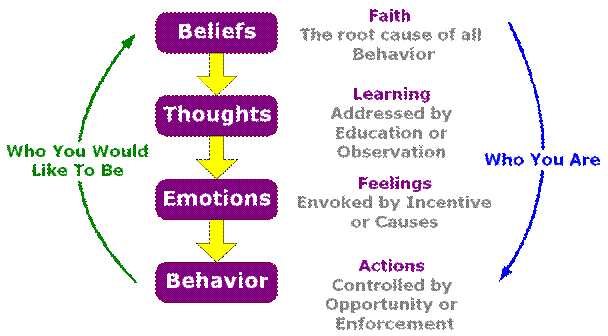
  • Look at the diagram Figure of a  Model of Human Behavior – How does this support the Scriptural message?
  • How does our modern society influence our thoughts?
  • Is society’s influence greater or lesser today on our children than it was on us?
  • Who is held accountable for one’s beliefs? Is this the same for thoughts, emotions, and behavior?

Philippians 4:8-9
8 Finally, brothers, whatever is true, whatever is noble, whatever is right, whatever is pure, whatever is lovely, whatever is admirable—if anything is excellent or praiseworthy—think about such things. 9 Whatever you have learned or received or heard from me, or seen in me—put it into practice. And the God of peace will be with you.

Background3http://en.wikipedia.org/wiki/Epistle_to_the_Philippians

The letter was written to the church at Philippi, one of the earliest churches to be founded in Europe. They were very attached to Paul, just as he was very fond of them. Of all the churches, their contributions (which Paul gratefully acknowledges) are among the only ones he accepts. (Acts 20:33-35; 2 Cor. 11:7-12; 2 Thess. 3:8). The generosity of the Philippians comes out very conspicuously (Phil. 4:15). “This was a characteristic of the Macedonian missions, as 2 Cor. 8 and 9 amply and beautifully prove. Remarkably, the Macedonian converts were, as a class, very poor (2 Cor. 8:2), though the very first converts were of all classes (Acts 16); and the parallel facts, their poverty and their open-handed support of the great missionary and his work, are deeply harmonious. At the present day, the missionary liberality of poor Christians is, in proportion, really greater than that of the rich” (Moule).

Biblical Truths

Let’s look at what the dictionary says about Paul’s choice of words:

True – not false, by the actual state of affairs, reality

Honorable – deserving of respect, something of superior standing, worthy of recognition

Right – not wrong, being by what is just, good, and proper

Pure – unmixed with any other matter, free from dirt, dust, or taint

Lovely – delightful for beauty, harmony, or grace, attractive

Good Repute – good reputation, being favorably known, spoken of, thought of, or esteemed

Excellence – valuable qualities, superior, eminently good

Worthy of Praise – something worth speaking well of

Items for Discussion

  • What on television fits this description?
  • What kind of music fits this description?
  • What kind of literature fits this description?
  • What movies fit this description?
  • What other types of entertainment fit this description?
  • How then does one “put into practice” those things that bring peace?

Discussion Challenge

  • What is the role of the church in facilitating the “practice?”

Living in Harmony

Psalm 951NIV New International Version
1 Come, let us sing for joy to the LORD; let us shout aloud to the Rock of our salvation. 2 Let us come before him with thanksgiving and extol him with music and song. 3 For the LORD is the great God, the great King above all gods. 4 In his hand are the depths of the earth, and the mountain peaks belong to him. 5 The sea is his, for he made it, and his hands formed the dry land. 6 Come, let us bow down in worship, let us kneel before the LORD our Maker; 7 for he is our God and we are the people of his pasture, the flock under his care. Today, if you hear his voice, 8 do not harden your hearts as you did at Meribah, as you did that day at Massah in the desert, 9 where your fathers tested and tried me, though they had seen what I did. 10 For forty years I was angry with that generation; I said, “They are a people whose hearts go astray, and they have not known my ways.” 11 So I declared on oath in my anger, “They shall never enter my rest.”

clip_image020Background

Psalm 95 serves as the introduction to a series of Psalms devoted to the theme of worship and praise (Psalms 95–100). Psalm 95 has long been regarded as an invitation to worship. It has been a vital part of liturgies from ancient times. This psalm helps the believer to reorient his thinking and practice concerning the vital matter of worship. It turns our attention and affection toward God. When our role in worship is addressed, the focus is on obedience and reverence.

In the Hebrew text the psalm lacks a superscription. Thus we are uninformed with respect to the author of the psalm and its historical setting. The Septuagint (the Greek translation of the Old Testament) names David as the author, although modern day scholars dispute this.

Some scholars have noted the dramatic change in mood from the first half of the psalm to the second and have concluded that this must originally have been two psalms. This view can be refuted, for these reasons: The sudden change in mood is required not only by the nature of worship, but also by the nature of man.

Biblical Truths

It would be correct to divide this psalm into an invitation and a warning: C.H Spurgeon chooses make the division at the end of Ps 95:5 thus forming (1) an invitation with reasons, and (2) an invitation with warnings.

Items for Discussion

  • What are the reasons for Worship?
  • What are the Warnings?
  • How has worship changed in your lifetime? From the point of the clergy and from your viewpoint.
  • In what ways can worship go wrong? At the clergy level and at the worshiper level.
  • How should we guard against drifting away from the spirit of this Psalm?


Romans 12:14-18
14 Bless those who persecute you; bless and do not curse. 15 Rejoice with those who rejoice; mourn with those who mourn. 16 Live in harmony with one another. Do not be proud, but be willing to associate with people of low position. Do not be conceited. 17 Do not repay anyone evil for evil. Be careful to do what is right in the eyes of everybody. 18 If it is possible, as far as it depends on you, live at peace with everyone.

Background2http://en.wikipedia.org/wiki/Epistle_to_the_Romans

The Epistle of St. Paul the Apostle to the Romans is one of the letters of the New Testament canon of the Christian Bible. Often referred to simply as Romans, it is one of the seven currently undisputed letters of Paul.
It was probably written at Corinth or possibly in nearby Cenchrea, transcribed by Tertius (16:22). Phoebe (16:1) of Cenchrea, the Aegean port of Corinth, conveyed it to Rome, and Gaius of Corinth entertained the Apostle Paul at the time of its composition (16:23; 1 Corinthians 1:14); Erastus was chamberlain of the city, that is, of Corinth (2 Timothy 4:20).

The precise time at which it was written is not mentioned in the epistle, but it was obviously written when the collection for Jerusalem had been assembled and Paul was about to “go unto Jerusalem to minister unto the saints”, that is, at the close of his second visit to Greece, during the winter preceding his last visit to that city (Rom 15:25; cf. Acts 19:21; (Rom 20:2-3, 20:16; 1 Cor 16:1-4) early in 58.

At this time, the Jews made up a substantial number in Rome, and their synagogues, frequented by many, enabled the Gentiles to become acquainted with the story of Jesus of Nazareth. Consequently, a church composed of both Jews and Gentiles was formed at Rome. According to Irenaeus, one of the earliest Church Fathers, the church at Rome was founded directly by the apostles Peter and Paul. However, many modern scholars disagree with Irenaeus, holding that while little is known of the circumstances of the church’s founding, it was not founded by Paul.

Many of the brethren went out to meet Paul on his approach to Rome. There is evidence that Christians were then in Rome in considerable numbers and probably had more than one place of meeting (Rom 16:14-15).

Biblical Truths

Verse 12:14 – … as for those who try to make your life a misery, bless them. Don’t curse, bless.

Verse 12:15 – Share the happiness of those who are happy, the sorrow of those who are sad.

Verse 12:16 – Live in harmony with each other. Don’t become snobbish but take a real interest in ordinary people. Don’t become set in your own opinions.

Verse 12:17 – Don’t pay back a bad turn by a bad turn, to anyone. Don’t say “it doesn’t matter what people think”, but see that your public behavior is above criticism.

Verse 12:18 – As far as your responsibility goes, live at peace with everyone.

Items for Discussion

  • How in other religions are one’s enemies treated?
  • Is Paul’s call to us easy or hard to do and why?
  • Where is the Christian church successful in this area?
  • Where does the Christian church fail?
  • How do you personally feel when someone acts like Paul is directing us to do?
  • Since mankind is basically sinful, it this an impossible task we are being asked to do?

Discussion Challenge

  • How can a body of Christ teach this?

Celebrate the Journey

Psalm 146:5-101NIV New International Version Translations
5 Blessed is he whose help is the God of Jacob, whose hope is in the LORD his God, 6 the Maker of heaven and earth, the sea, and everything in them—the LORD, who remains faithful forever. 7 He upholds the cause of the oppressed and gives food to the hungry. The LORD sets prisoners free, 8 the LORD gives sight to the blind, the LORD lifts up those who are bowed down, the LORD loves the righteous. 9 The LORD watches over the alien and sustains the fatherless and the widow, but he frustrates the ways of the wicked. 10 The LORD reigns forever, your God, O Zion, for all generations. Praise the LORD.

clip_image019Background

Bible students call the last 5 psalms The Hallelujah Psalms. This is because they all start and end with the Hebrew word “Halelujah”. The Jews spoke the Hebrew language and wrote their psalms in Hebrew. “Halel” means “praise”, or “tell someone that they are very great”. The “u” means “you” … all of you! “Jah” is one of God’s names. Most Bibles translate it LORD with 4 capital letters. It has a meaning and a use. The meaning may be that he will always be alive. The use is as a covenant name. A covenant is when two people (or groups of people) agree. Here, God agrees to love and give help to his people. And his people agree to love and obey him. Bible translators do not often translate the word “halelujah” into another language. Usually we spell it “hallelujah”, but the Hebrew word is “halelujah”.

We do not know who wrote Psalms 146-150. And we do not know when they wrote them. Most Bible students think that the psalmist wrote them for the new temple in Jerusalem. The psalmist was the person that wrote the psalms. For half of the psalms David was the psalmist. But there were many other psalmists, most of them after David died. Some Bible students think that maybe Ezra or Nehemiah was the psalmist for Psalms 146-150. The temple was God’s house in Jerusalem. Enemies destroyed it 600 years before Jesus came to the earth. But 70 years after the army of Babylon destroyed it, the Jews built it again. They made the Book of Psalms at this time to use in the new temple.

Biblical Truths

Verses 5-6 The God of Jacob may mean the God of the people of Israel; but it may mean just the God of the man Jacob. But that God is the LORD. He gives help to people that ask him for it.

Verses 7-9. Oppressed people are people that stronger people are not kind to. The stronger people make the weaker people work for them. They do not pay them much money for the work. Also, the oppressed people are not free to do what they want to do. So, they are often hungry. And they feel that life is like being in a prison. A blind person cannot see. But God will help people like this, if they ask him.

In verse 8, the word “righteous” here means God’s people. The word “righteous” itself means “very, very good”. Only God is really righteous. But he says his own people are righteous too. He makes them righteous because he is with them.

In verse 9, “protects strangers” means “does not let anyone hurt strangers”. These strangers were people from foreign countries. They lived in the country round Jerusalem. Today we would call them aliens or perhaps refugees. God also protects children that have no fathers. And he protects widows (women whose husbands have died). God does not protect, or send help, to wicked people.

Verse 10. The LORD will always be king! Again, for Christians this means something else than it does for the psalmist. Jesus is the Lord who will always be king. Zion could be a name for his new people, the Church. Jesus will come back to the earth as king, one day. Then everybody will see that this psalm is true.

Items for Discussion

  • Does this Psalm really say that to gain God’s help one must be oppressed or have other issues such as hunger or become a widow or orphan?
  • What can we conclude about our God when we hear that He frustrates the wicked?
  • What is our part in this relationship according to this psalm?
  • What symbolism can you find in the statement that God watches over the alien?
  • Is God’s protection physical, spiritual, or something else?
  • What is the greatest frustration of wicked people?


John 8:30-38
30 Even as he spoke, many put their faith in him. 31 To the Jews who had believed him, Jesus said, “If you hold to my teaching, you are really my disciples. 32 Then you will know the truth, and the truth will set you free.” 33 They answered him, “We are Abraham’s descendants and have never been slaves of anyone. How can you say that we shall be set free?” 34 Jesus replied, “I tell you the truth, everyone who sins is a slave to sin. 35 Now a slave has no permanent place in the family, but a son belongs to it forever. 36 So if the Son sets you free, you will be free indeed. 37 I know you are Abraham’s descendants. Yet you are ready to kill me, because you have no room for my word. 38 I am telling you what I have seen in the Father’s presence, and you do what you have heard from your father.”

Background2http://en.wikipedia.org/wiki/Gospel_of_John

The Gospel of John (literally, According to John) is the fourth gospel in the New Testament, traditionally ascribed to John the Evangelist. Like the three synoptic gospels, it contains an account of some of the actions and sayings of Jesus, but differs from them in ethos and theological emphases. The Gospel appears to have been written with an evangelistic purpose, primarily for Greek-speaking Jews who were not believers: “these are written so that you may come to believe that Jesus is the Messiah, the Son of God, and that through believing you may have life in his name”(John 20:30-31). A second purpose was to counter criticisms or unorthodox beliefs of Jews, John the Baptist’s followers, and those who believed Jesus was only spirit and not flesh.

Of the four gospels, John presents the highest Christology, describing him as the Logos who is the Arche (a Greek term for “existed from the beginning” or “the ultimate source of all things”), teaching at length about his identity as savior, and possibly declaring him to be God.

Compared to the Synoptic Gospels, John focuses on Jesus’ mission to bring the Logos (“Word”, “Wisdom”, “Reason” or “Rationality”) to his disciples. Only in John does Jesus talk at length about himself, including a substantial amount of material Jesus shared with the disciples only. Certain elements of the synoptics (such as parables, exorcisms, and possibly the Second Coming) are not found in John

Biblical Truths3http://www.ccel.org/ccel/calvin/calcom34.xiv.vi.html From the Commentary on John by John Calvin

Verse 30. While he spoke these things. Though the Jews, at that time, almost resembled a dry and barren soil, yet God did not permit the seed of his word to be entirely lost. Thus, contrary to all hopes, and amidst so many obstructions, some fruit appears. But the Evangelist inaccurately gives the name of faith to that which was only a sort of preparation for faith For he affirms nothing higher concerning them than that they were disposed to receive the doctrine of Christ, to which also the preceding warning refers.

Verse 31. If you continue in my word. Here Christ warns them, in the first place, that it is not enough for any one to have begun well, if their progress to the end do not correspond to it; and for this reason he exhorts to perseverance in the faith those who have tasted of his doctrine. When he says that they who are firmly rooted in his word, so as to continue in him, will truly be his disciples, he means that many profess to be disciples who yet are not so in reality, and have no right to be accounted such. He distinguishes his followers from hypocrites by this mark that they who falsely boasted of faith give way as soon as they have entered into the course, or at least in the middle of it; but believers persevere constantly to the end. If, therefore, we wish that Christ should reckon us to be his disciples, we must endeavor to persevere.

Verse 32. And you shall know the truth. He says that they who have arrived at some knowledge of it shall know the truth True, those whom Christ addresses were as yet uneducated, and scarcely knew the first elements, and therefore we need not wonder if he promises them a more full understanding of his doctrine. But the statement is general. Wherefore, whatever progress any of us have made in the Gospel, let him know that he needs new additions. This is the reward which Christ bestows on their perseverance, that he admits them to greater familiarity with him; though in this way he does nothing more than add another gift to the former, so that no man ought to think that he is entitled to any reward. For it is he who impresses his word on our hearts by his Spirit, and it is he who daily chases away from our minds the clouds of ignorance which obscure the brightness of the Gospel. In order that the truth may be fully revealed to us, we ought sincerely and earnestly to endeavor to attain it. It is the same unvarying truth which Christ teaches his followers from the beginning to the end, but on those who were at first enlightened by him, as it were with small sparks, he at length pours a full light. Thus believers, until they have been fully confirmed, are in some measure ignorant of what they know; and yet it is not so small or obscure a knowledge of faith as not to be efficacious for salvation.

The truth shall make you free. He commends the knowledge of the Gospel from the fruit which we derive from it, or — which is the same thing — from its effect, namely, that it restores us to freedom This is an invaluable blessing. Hence it follows, that nothing is more excellent or desirable than the knowledge of the Gospel. All men feel and acknowledge that slavery is a very wretched state; and since the Gospel delivers us from it, it follows that we derive from the Gospel the treasure of a blessed life.

We must now ascertain what kind of liberty is here described by Christ, namely, that which sets us free from the tyranny of Satan, sin, and death. And if we obtain it by means of the Gospel, it is evident from this that we are by nature the slaves of sin. Next, we must ascertain what is the method of our deliverance. For so long as we are governed by our sense and by our natural disposition, we are in bondage to sin; but when the Lord regenerates us by his Spirit, he likewise makes us free, so that, loosed from the snares of Satan, we willingly obey righteousness. But regeneration proceeds from faith, and hence it is evident that freedom proceeds from the Gospel.
Let Papists now go and proudly vaunt of their free-will, but let us, who are conscious of our own slavery, glory in none but Christ our Deliverer. For the reason why the Gospel ought to be reckoned to have achieved our deliverance is, that it offers and gives us to Christ to be freed from the yoke of sin. Lastly, we ought to observe, that freedom has its degrees according to the measure of their faith; and therefore Paul, though clearly made free, still groans and longs after perfect freedom, (Romans 7:24.)

Verse 33. We are Abraham’s seed. It is uncertain if the Evangelist here introduces the same persons who formerly spoke, or others. My opinion is, that they replied to Christ in a confused manner, as usually happens in a promiscuous crowd; and that this reply was made rather by despisers than by those who believed. It is a mode of expression very customary in Scripture, whenever the body of a people is mentioned, to ascribe generally to all what belongs only to a part.

Those who object that they are Abraham’s seed, and have always been free, easily inferred from the words of Christ that freedom was promised to them as to people who were slaves But they cannot endure to have it said that they, who are a holy and elect people, are reduced to slavery For of what avail was the adoption and the covenant, (Romans 9:4,) by which they were separated from other nations, but because they were accounted the children of God? They think, therefore, that they are insulted, when freedom is exhibited to them as a blessing which they do not yet possess. But it might be thought strange that they should maintain that they never were enslaved, since they had been so frequently oppressed by various tyrants, and at that time were subjected to the Roman yoke, and groaned under the heaviest burden of slavery; and hence it may be easily seen how foolish was their boasting.

Yet they had this plausible excuse that the unjust sway of their enemies did not hinder them from continuing to be free by right. But they erred, first, in this respect, that they did not consider that the right of adoption was founded on the Mediator alone; for how comes it that Abraham’s seed is free, but because, by the extraordinary grace of the Redeemer, it is exempted from the general bondage of the human race? But there was another error less tolerable than the former, that, though they were altogether degenerate, yet they wished to be reckoned among the children of Abraham, and did not consider that it is nothing else than the regeneration of the Spirit that makes them lawful children of Abraham And indeed, it has been too common a vice in almost all ages, to refer to the origin of the flesh the extraordinary gifts of God, and to ascribe to nature those remedies which Christ bestows for correcting nature. Meanwhile, we see how all who swelled with false confidence, flatter themselves on their condition drive away from them the grace of Christ. And yet this pride is spread over the whole world, so that there is scarcely one person in a hundred who feels that he needs the grace of God.

Verse 34. Every man who committed sin is the slave of sin. This is an argument drawn from contrary things. They boasted that they were free. He proves that they are the slaves of sin, because, being enslaved by the desires of the flesh, they continually sin. It is astonishing that men are not convinced by their own experience, so that, laying aside their pride, they may learn to be humble. And it is a very frequent occurrence in the present day, that, the greater the load of vices by which a man is weighed down, the more fiercely does he utter unmeaning words in extolling free-will.

Christ appears to say nothing more here than what was formerly said by philosophers, that they who are devoted to their lusts are subject to the most degrading slavery. But there is a deeper and more hidden meaning; for he does not argue what evil men bring on themselves, but what is the condition of human nature. The philosophers thought that any man is a slave by his own choice, and that by the same choice he returns to freedom. But here Christ maintains, that all who are not delivered by him are in a state of slavery, and that all who derive the contagion of sin from corrupted nature are slaves from their birth. We must attend to the comparison between grace and nature, on which Christ here dwells; from which it may be easily seen that men are destitute of freedom, unless they regain it from some other quarter. Yet this slavery is voluntary, so that they who necessarily sin are not compelled to sin.
35. Now the slave remaineth not in the house always. He adds a comparison, taken from the laws and from political law, to the effect that a slave, though he may have power for a time, yet is not the heir of the house; from which he infers that there is no perfect and durable freedom, but what is obtained through the Son In this manner he accuses the Jews of vanity, because they hold but a mask instead of the reality; for, as to their being Abraham’s offspring, they were nothing but a mask. They held a place in the Church of God, but such a place as Ishmael, a slave, rising up against his freeborn brother, usurped for a short time, (Galatians 4:29.) The conclusion is that all who boast of being Abraham’s children have nothing but an empty and deceitful pretense.

Verse 36. If then the Son shall make you free. By these words he means that the right of freedom belongs to himself alone, and that all others, being born slaves, cannot be delivered but by his grace. For what he possesses as his own by nature he imparts to us by adoption, when we are ingrafted by faith into his body, and become his members. Thus we ought to remember what I said formerly, that the Gospel is the instrument by which we obtain our freedom So then our freedom is a benefit conferred by Christ, but we obtain it by faith, in consequence of which also Christ regenerates us by his Spirit. When he says that they shall be truly free, there is an emphasis on the word truly; for we must supply the contrast with the foolish persuasion by which the Jews were swelled with pride, in like manner as the greater part of the world imagine that they possess a kingdom, while they are in the most wretched bondage.

Verse 37. I know that you are Abraham’s seed. I explain this as said by way of concession. Yet at the same time he ridicules their folly in glorying in so absurd a title, as if he had said: “Granting that on which you flatter yourselves so much, still what avails it that those men are called the children of Abraham, who are enraged against God and his ministers, and who are actuated by such wicked and detestable hatred of the truth, that they rush headlong to shed innocent blood?” Hence it follows that nothing is farther from their true character than what they wished to be called, because they have no resemblance to Abraham.

You seek to kill me, because my word has no place in you. He means that they are not merely murderers, but are driven to such rage by hatred of God and his truth, which is far more heinous; for such an enormity does not merely extend to men, but likewise dishonors God. He says that they cannot receive his words, because through malice they keep their minds shut, so that they cannot admit anything wholesome.

Verse 38. I speak what I have seen with my Father. He had already made frequent mention of his Father; and now, by an argument drawn from contrary things, he infers that they are enemies to God, and are the children of the devil, because they oppose his doctrine. “For my part,” says he, “I bring nothing forward, but what I have learned from my Father. How comes it then that the word of God excites you to such fury, but because you have an opposite father?” He says that he speaks, and they do, because he discharged the office of a teacher, while they labored strenuously to extinguish his doctrine. At the same time, he protects the Gospel against contempt, by showing that it is not wonderful if it be opposed by the children of the devil Instead of you do, some render it, Do you what you have seen with your father; as if Christ had said, “Come, show that you are the children of the devil, by opposing me; for I speak nothing but what God has commanded.”

Items for Discussion

  • How is it that truth can set you free? If you did something wrong and told the truth, wouldn’t you be punished?
  • How is a person held captive by sin?
  • How is it that we are to know the truth?
  • How do you know that what you learn is from Christ?
  • What is Christ’s argument in verse 38?

Discussion Challenge

  • How is life like a journey?

Why Do You Look for the Living Among the Dead?

Isaiah 11:1-91NIV New International Version Translations
1 A shoot will come up from the stump of Jesse; from his roots a Branch will bear fruit. 2 The Spirit of the LORD will rest on him—the Spirit of wisdom and of understanding, the Spirit of counsel and of power, the Spirit of knowledge and of the fear of the LORD—3 and he will delight in the fear of the LORD. He will not judge by what he sees with his eyes, or decide by what he hears with his ears; 4 but with righteousness he will judge the needy, with justice he will give decisions for the poor of the earth. He will strike the earth with the rod of his mouth; with the breath of his lips he will slay the wicked. 5 Righteousness will be his belt and faithfulness the sash around his waist. 6 The wolf will live with the lamb, the leopard will lie down with the goat, the calf and the lion and the yearling together; and a little child will lead them. 7 The cow will feed with the bear, their young will lie down together, and the lion will eat straw like the ox. 8 The infant will play near the hole of the cobra, and the young child put his hand into the viper’s nest. 9 They will neither harm nor destroy on all my holy mountain, for the earth will be full of the knowledge of the LORD as the waters cover the sea.

clip_image018Background2http://www.iclnet.org/pub/resources/text/taize/johannine/web/jh9711.html

At a time when the kings of Israel were disappointing the expectations placed in them, the prophet Isaiah found hope for a new beginning in his faith in God. He saw that God would place on the throne a son of David who would reign according to the desires of God’s heart. This king would not find in himself the wisdom and strength necessary to rule; he would receive them directly from God. His action would be based on “fear of the Lord,” which means here the recognition that God is the source of his activity, that everything is a gift.

Animated by the breath of the Lord, the new king would be able to “judge,” in other words to bring justice to society, above all by taking care of the least fortunate. He would accomplish this task by the power of his word alone: in v. 4b, images of violence are applied to the act of speaking, of pronouncing judgments. As a result, the whole of creation will be pacified, reconciled; even snakes will lose their power to harm. The passage thus concludes on an “ecological” note, a vision of the created universe brought back to the peace of paradise, just as when it left the hands of God.

Since in the Bible the king is a figure of the human being par excellence, here the ideal king seems to restore and bring to fulfillment the vocation of Adam (Gen 2-3). Instead of stealing the fruit of knowledge, he receives it as a gift. And so this knowledge spreads out and becomes a source of reconciliation, enabling the whole of creation to recover its original harmony, desired by God from all eternity.

Biblical Truths3Matthew Henry Commentaries http://www.christnotes.org/commentary.php?com=mhc&b=23&c=11

The Messiah is called a Rod, and a Branch. The words signify a small, tender product; a shoot, such as is easily broken off. He comes forth out of the stem of Jesse; when the royal family was cut down and almost leveled with the ground, it would sprout again. The house of David was brought very low at the time of Christ’s birth. The Messiah thus gave early notice that his kingdom was not of this world. But the Holy Spirit, in all his gifts and graces, shall rest and abide upon him; he shall have the fullness of the Godhead dwelling in him, Colossians 1:19; 2:9. Many consider that seven gifts of the Holy Spirit are here mentioned. And the doctrine of the influences of the Holy Spirit is here clearly taught. The Messiah would be just and righteous in all his government. His threatening shall be executed by the working of his Spirit according to his word. There shall be great peace and quiet under his government. The gospel changes the nature, and makes those who trampled on the meek of the earth, meek like them, and kind to them. But it shall be more fully shown in the latter days. Also Christ, the great Shepherd, shall take care of his flock, that the nature of troubles, and of death itself, shall be so changed, that they shall not do any real hurt. God’s people shall be delivered, not only from evil, but from the fear of it. Who shall separate us from the love of Christ? The better we know the God of love, the more shall we be changed into the same likeness and the better disposed to all who have any likeness to him. This knowledge shall extend as the sea, so far shall it spread. And this blessed power there have been witnesses in every age of Christianity, though it’s most glorious time, here foretold, is not yet arrived. Meanwhile let us aim that our example and endeavors may help to promote the honor of Christ and his kingdom of peace.

Items for Discussion

  • What type of kingdom is being described here—physical or spiritual?
  • Who are the “needy” and the “poor” in your situation (v. 4)?
  • What can each of us do to support them?
  • What enables us to become a source of peace for those around us?
  • What are the signs of the presence of God’s Spirit in our life?
  • Can you find the seven gifts of the Holy Spirit in these verses?


Luke 24:1-12
1 On the first day of the week, very early in the morning, the women took the spices they had prepared and went to the tomb. 2 They found the stone rolled away from the tomb, 3 but when they entered, they did not find the body of the Lord Jesus. 4 While they were wondering about this, suddenly two men in clothes that gleamed like lightning stood beside them. 5 In their fright the women bowed down with their faces to the ground, but the men said to them, “Why do you look for the living among the dead? 6 He is not here; he has risen! Remember how he told you, while he was still with you in Galilee: 7 ‘The Son of Man must be delivered into the hands of sinful men, be crucified and on the third day be raised again.’” 8 Then they remembered his words. 9 When they came back from the tomb, they told all these things to the Eleven and to all the others. 10 It was Mary Magdalene, Joanna, Mary the mother of James, and the others with them who told this to the apostles. 11 But they did not believe the women, because their words seemed to them like nonsense. 12 Peter, however, got up and ran to the tomb. Bending over, he saw the strips of linen lying by themselves, and he went away, wondering to himself what had happened.

Background4Matthew Henry Commentaries http://www.ccel.org/ccel/henry/mhc5.Luke.xxv.html

We are now entering into the labors of another evangelist; his name Luke, which some take to be a contraction of Lucilius; born at Antioch, so St. Jerome. Some think that he was the only one of all the penmen of the scripture that was not of the seed of Israel. He was a Jewish proselyte, and, as some conjecture, converted to Christianity by the ministry of St. Paul at Antioch; and after his coming into Macedonia (Acts xvi. 10) he was his constant companion. He had employed himself in the study and practice of physic; hence, Paul calls him Luke the beloved Physician, Col. iv. 14.

The manner of the re-uniting of Christ’s soul and body in his resurrection is a mystery, one of the secret things that belong not to us; but the infallible proofs of his resurrection, that he did indeed rise from the dead, and was thereby proved to be the Son of God, are things revealed, which belong to us and to our children. Some of them we have here in these verses, which relate the same story for substance that we had in Matthew and Mark.

Biblical Truths

Our Lord Jesus went gloriously down to death, in spite of the malice of his enemies, who did all they could to make his death ignominious; but he rose again more gloriously, of which we have an account in this chapter; and the proofs and evidences of Christ’s resurrection are more fully related by this evangelist than they were by Matthew and Mark. Here is, I. Assurance given by two angels, to the woman who visited the sepulcher, that the Lord Jesus was risen from the dead, according to his own word, to which the angels refer them (ver. 1-7), and the report of this to the apostles, ver. 8-11. II. The visit which Peter made to the sepulcher, and his discoveries there, ver. 12.

Items for Discussion

  • As you look at history’s evolution of our judicial process, what steps do you see in these verses that parallel our system of justice and proof we require today?
  • Why do you think women were chosen to be the first witnesses of Christ’s resurrection?
  • Why was it important for Christ to die and be buried before his resurrection? Why didn’t he just rise from the cross? (plenty of witnesses and drama up on that hill!)
  • What elements of our beliefs are restated in this story?

Discussion Challenge

  • What will you do today to celebrate Christ’s victory over death?

The Family of God

Psalm 41NIV New International Version Translations
For the director of music – With stringed instruments – A psalm of David.
1 Answer me when I call to you, O my righteous God. Give me relief from my distress; be merciful to me and hear my prayer. 2 How long, O men, will you turn my glory into shame? How long will you love delusions and seek false gods? 3 Know that the LORD has set apart the godly for himself; the LORD will hear when I call to him. 4 In your anger do not sin; when you are on your beds, search your hearts and be silent. 5 Offer right sacrifices and trust in the LORD. 6 Many are asking, “Who can show us any good?” Let the light of your face shine upon us, O LORD. 7 You have filled my heart with greater joy than when their grain and new wine abound. 8 I will lie down and sleep in peace, for you alone, O LORD, make me dwell in safety.

clip_image017Background2http://www.easyenglish.info/psalms/psalm004-taw.htm

Absalom was one of King David’s sons. He tried to kill David because he wanted to become king. David ran away. One evening, David prayed to God, “Show my enemies that you are fighting for me”. God answered David and made him very happy. David slept in peace. The peace that God gives means that we do not feel afraid deep down inside us.

Verses 1 – 2: DAVID PRAYS TO GOD. David was a good man. This did not make him righteous. Only God can make someone righteous. David asked God for help. “Listen to me” in Hebrew means “answer me”. David told God what he (David) wanted to say to his enemies. He really wanted God to tell them. David wanted to say to them, “You cannot win”. This is because the enemies of David were fighting God. Their stupid ideas were that they wanted David dead and that they wanted Absalom to become king.

Verses 3 – 4: IN HIS MIND DAVID TALKS TO HIS ENEMIES. David gives more reasons why his enemies cannot win:

  • the LORD chose David as king
  • the LORD did not choose Absalom
  • the LORD made David different from his enemies
  • the LORD will listen to David and answer him

This will make the enemies of David angry. They must do nothing wrong, though. They can argue in their thoughts. They must not speak their ideas aloud.

Verses 5 – 8: GOD GIVES DAVID JOY. “Offer the right gifts” means “kill animals on the temple altar”. A part of the Bible called Leviticus tells us what they are. It also means offer bread and wine. Christians do not do that now. They offer themselves to become the servants of God. Many people still say, “Who will do anything good or us?” Our answer is the same as the answer of David: the LORD. He will shine the light of his face on them. This can mean many things. One is that the LORD will give help to poor people.

Biblical Truths

An individual lament emphasizing trust in God. The petition is based upon the psalmist’s vivid experience of God as savior (Psalm 4:2). That experience of God is the basis for the warning to the wicked: revere God who intervenes on the side of the faithful (Psalm 4:3-6). The faithful psalmist exemplifies the blessings given to the just (Psalm 4:7-8).

For the leader: many psalm headings contain this rubric. Its exact meaning is unknown but may signify that such psalms once stood together in a collection of “the choirmaster.” Cf 1 Chron 15:21.

Tremble: be moved deeply with religious awe. The Greek translation understood the emotion to be anger, and it is so cited in Eph 4:26.

Items for Discussion

  • Where do you go to find God-the quiet places where you seem to know He is listening to you?
  • Do you go to this place when you are overwhelmed or seeking advice? Maybe blessed and offering praise and thanks? What about seeking forgiveness?
  • How do you weave into your conversations with God, those who generally seek to hurt you?
  • David is seeking to offer the right gifts to God. What are today’s right gifts?
  • Why is it so important not to let anger take hold?


I John 3:1-8
1 How great is the love the Father has lavished on us, that we should be called children of God! And that is what we are! The reason the world does not know us is that it did not know him. 2 Dear friends, now we are children of God, and what we will be has not yet been made known. But we know that when he appears, we shall be like him, for we shall see him as he is. 3 Everyone who has this hope in him purifies himself, just as he is pure. 4 Everyone who sins breaks the law; in fact, sin is lawlessness. 5 But you know that he appeared so that he might take away our sins. And in him is no sin. 6 No one who lives in him keeps on sinning. No one who continues to sin has either seen him or known him. 7 Dear children, do not let anyone lead you astray. He who does what is right is righteous, just as he is righteous. 8 He who does what is sinful is of the devil, because the devil has been sinning from the beginning. The reason the Son of God appeared was to destroy the devil’s work.

Background3http://en.wikipedia.org/wiki/First_Epistle_of_John

The First Epistle of John is a book of the New Testament, and is the fourth catholic or “general” epistles. Written in Ephesus about 90-110 AD, the epistle is traditionally attributed to the same author or authors who wrote the Gospel of John and the other two epistles of John. Not actually a letter, the epistle is a sermon written to counter heresies that Jesus did not come “in the flesh,” but only as a spirit. It also defines how Christians are to discern true teachers: by their ethics, their proclamation of Jesus in the flesh, and by their love.

The epistle is traditionally held to have been written by John the Evangelist, and probably also at Ephesus, and when the writer was in advanced age. The Epistle’s content, language and conceptual style are an indication that a common authorship existed between this letter, the two other letters attributed to the Apostle John, as well as the Gospel of John. Whether the author was the Apostle John himself, someone who wrote under his name and spoke “for him”, or whether a body of authors contributed to the writing of all four Johannine texts is an open question. However, “The three Epistles and the Gospel of John are so closely allied in diction, style, and general outlook that the burden of proof lies with the person who would deny their common authorship” (B. H. Streeter, The Four Gospels, rev. ed. (London: Macmillan, 1930) 460).

Biblical Truths4http://www.mun.ca/rels/restmov/texts/bjohnson/hg1/PNT23-03.HTM

Verses 1-3. Behold, what manner of love, etc. The last verse of chapter 2 speaks of the saints as born of God. That thought suggests the wonderful love in allowing us to be born again and thus to become God’s children. Sons of God. What greater glory than to be acknowledged as sons of the King of Kings! Therefore. If the world does not know the Father it will not know his children. 2. Now are we, etc. Already we have the great privilege of being sons, and it doth not yet appear what we shall be. Our future glory is not yet manifest. Even we ourselves cannot understand it. But we know. One glorious revelation has been made. At the coming of Christ we shall be like him. Then we shall be like him in body. See Phil. 3:21. We shall also be found morally in his image. For we shall see him as he is. To look upon him has power to change us into his glory. See 2 Cor. 3:18. 3. Every man that hath this hope. To have a hope of being like Christ leads us to try to be like Christ; hence, to be pure as he is pure.

Verses 4-8. Whosoever committeth sin, etc. The very act of sinning is a breaking of law. “Sin is lawlessness”. 5. Was manifested to take away our sins. Christ came, not only to take away our sins by their remission, but to take away our disposition to sin. 6. Whosoever abideth in him sinneth not. One ceaseth to abide in him when he engages in sinning. Hath not seen him, etc. “Whosoever sinneth,” that is, sins habitually, thereby shows that he hath not experimental insight and knowledge of Christ. There is no fellowship with the Sinless One. 7. Let no man deceive you. Do not be deluded into the belief that any one can be righteous unless he practices righteousness. 8. He that committeth sin is of the devil. A sinful life is a proof of the devil’s power. Christ came to destroy the works of the devil, and it is his work to destroy sin in all his disciples.

Items for Discussion

  • In what ways do you treat family members differently than strangers?
  • Do you find that mannerisms, likes/dislikes, other attributes of personality run in your family or can be traced to a family member?
  • If we are truly reborn with a new father and that father is God, how would you expect to be different?
  • Why is Christ an important part of this process?
  • If practice makes perfect, what lesson would we find if this was applied to becoming Christ-like?

Discussion Challenge

  • How can our church help others practice Christ-like behavior?

Jesus on a Mountainside in Galilee

Psalm 32:8-111NIV New International Version Translations
8 I will instruct you and teach you in the way you should go; I will counsel you and watch over you. 9 Do not be like the horse or the mule, which have no understanding but must be controlled by bit and bridle or they will not come to you. 10 Many are the woes of the wicked, but the LORD’S unfailing love surrounds the man who trusts in him. 11 Rejoice in the LORD and be glad, you righteous; sing, all you who are upright in heart!

clip_image016Background2C.H. Spurgeon & Matthew Henry’s Concise Commentaries

A Psalm of David. Maschil — That David wrote this gloriously evangelic Psalm is proved not only by this heading, but by the words of the apostle Paul, in Ro 4:6-8. “Even as David also described the blessedness of the man unto whom God imputed righteousness without works. Probably his deep repentance over his great sin was followed by such blissful peace, that he was led to pour out his spirit in the soft music of this choice song. In the order of history it seems to follow the fifty-first.

Maschil is a new title to us, and indicates that this is an instructive or didactic Psalm. The experience of one believer affords rich instruction to others; it reveals the footsteps of the flock, and so comforts and directs the weak. Perhaps it was important in this case to prefix the word, that doubting saints might not imagine the Psalm to be the peculiar utterance of a singular individual, but might appropriate it to themselves as a lesson from the Spirit of God. David promised in the fifty-first Psalm to teach transgressors the Lord’s ways, and here he does it most effectually.

The happiness of a pardoned sinner. (1,2) The misery that went before, and the comfort that followed the confession of sins. (3-7) Sinners instructed, believers encouraged. (8-11)

Biblical Truths

Commentary on Psalm 32:1-2
Sin is the cause of our misery; but the true believer’s transgressions of the Divine law are all forgiven, being covered with the atonement. Christ bare his sins, therefore they are not imputed to him. The righteousness of Christ being reckoned to us, and we being made the righteousness of God in him, our iniquity is not imputed, God having laid upon him the iniquity of us all, and made him a sin-offering for us. Not to impute sin, is God’s act, for he is the Judge. It is God that justifies. Notice the character of him whose sins are pardoned; he is sincere, and seeks sanctification by the power of the Holy Ghost. He does not profess to repent, with an intention to indulge in sin, because the Lord is ready to forgive. He will not abuse the doctrine of free grace. And to the man whose iniquity is forgiven, all manner of blessings are promised.

Commentary on Psalm 32:3-7
It is very difficult to bring sinful man humbly to accept free mercy, with a full confession of his sins and self-condemnation. But the true and only way to peace of conscience, is, to confess our sins, that they may be forgiven; to declare them that we may be justified. Although repentance and confession do not merit the pardon of transgression, they are needful to the real enjoyment of forgiving mercy. And what tongue can tell the happiness of that hour, when the soul, oppressed by sin, is enabled freely to pour forth its sorrows before God, and to take hold of his covenanted mercy in Christ Jesus! Those that would speed in prayer, must seek the Lord, when, by his providence, he calls them to seek him, and, by his Spirit, stirs them up to seek him. In a time of finding, when the heart is softened with grief, and burdened with guilt; when all human refuge fails; when no rest can be found to the troubled mind, then it is that God applies the healing balm by his Spirit.

Commentary on Psalm 32:8-11
God teaches by his word, and guides with the secret intimations of his will. David gives a word of caution to sinners. The reason for this caution is that the way of sin will certainly end in sorrow. Here is a word of comfort to saints. They may see that a life of communion with God is far the most pleasant and comfortable. Let us rejoice, O Lord Jesus, in thee, and in your salvation; so shall we rejoice indeed.

Items for Discussion

  • Why is confession, a comfort to one’s mental state?
  • How does repentance differ from confession?
  • If confession is good, is guilt good?
  • When is guilt not good?
  • How do you define trust?
  • How does a believer demonstrate trust in God?


Matthew 28:16:20
16 Then the eleven disciples went to Galilee, to the mountain where Jesus had told them to go. 17 When they saw him, they worshiped him; but some doubted. 18 Then Jesus came to them and said, “All authority in heaven and on earth has been given to me. 19 Therefore go and make disciples of all nations, baptizing them in the name of the Father and of the Son and of the Holy Spirit, 20 and teaching them to obey everything I have commanded you. And surely I am with you always, to the very end of the age.”

Background

In Christian tradition, the Great Commission is the instruction of the resurrected Jesus Christ to his disciples, that they spread his teachings to all the nations of the world. It has become a tenet in Christian theology emphasizing mission work, evangelism, and baptism. It has been a primary basis for Christian missionary activity.

Some version of the great commission appears in Matthew, Luke, John, and in Acts, which is the second part of Luke-Acts. Details vary from book to book. In Matthew, Jesus directs the disciples to baptize people of all nations in the name of Father, Son, and Holy Spirit, the Trinitarian formula. In Luke, Jesus tells the disciples to preach repentance and forgiveness, and promises that they will have divine power. In John, Jesus says the disciples will have the Holy Spirit and the authority to forgive sins and to withhold forgiveness. In Acts, Jesus promises the disciples that the Holy Spirit will inspire them. In Mark, Jesus never speaks with his disciples after his resurrection, since modern scholars agree that the original gospel of Mark ends at verse Mark 16:8 with the women leaving the tomb. The most familiar version of the Great Commission is depicted in the Gospel of Matthew 28:16-20. Other versions of the Great Commission are found in Mark 16:14-18, Luke 24:44-49, Acts 1:4-8, and John 20:19-23. All these passages are composed as words of Christ spoken after his resurrection.

Biblical Truths

All that see the Lord Jesus with an eye of faith will worship him. Yet the faith of the sincere may be very weak and wavering. But Christ gave such convincing proofs of his resurrection, as made their faith to triumph over doubts. He now solemnly commissioned the apostles and his ministers to go forth among all nations. The salvation they were to preach is a common salvation; whoever will, let him come, and take the benefit; all are welcome to Christ Jesus. Christianity is the religion of a sinner who applies for salvation from deserved wrath and from sin; he applies to the mercy of the Father, through the atonement of the incarnate Son, and by the sanctification of the Holy Spirit, and gives up himself to be the worshipper and servant of God, as the Father, Son, and Holy Ghost, three Persons but one God, in all his ordinances and commandments.

Baptism is an outward sign of that inward washing, or sanctification of the Spirit, which seals and evidences the believer’s justification. Let us examine ourselves, whether we really possess the inward and spiritual grace of a death unto sin, and a new birth unto righteousness, by which those who were the children of wrath become the children of God. Believers shall have the constant presence of their Lord always; all days, every day.

There is no day, no hour of the day, in which our Lord Jesus is not present with his churches and with his ministers; if there were, in that day, that hour, they would be undone. The God of Israel, the Savior, is sometimes a God that hide himself, but never a God at a distance. To these precious words Amen is added. Even so, Lord Jesus, be thou with us and all your people; cause your face to shine upon us, that your way may be known upon earth, your saving health among all nations.

Items for Discussion

  • What does it mean to “make disciples?”
  • What then is a “disciple?”
  • How do these two definitions from the dictionary vary?3The emphasis on the meaning of words changes over time – definitions were taken from dictionaries separated by 60+ years
  • Definition a:
    • One who embraces and assists in spreading the teachings of another.
    • An active adherent, as of a movement or philosophy.
    • Often Disciple One of the original followers of Jesus.
    • Disciple a member of the Disciples of Christ.
  • Definition b:
    • One of the twelve personal followers of Jesus Christ
    • Any follower of Christ
    • An adherent of the doctrine of another; a follower.
  • Why is discipleship so important to the Christian Faith?

Discussion Challenge

  • How do you honor the “Great Commission?”
  • 1
    NIV New International Version Translations
  • 2
    C.H. Spurgeon & Matthew Henry’s Concise Commentaries
  • 3
    The emphasis on the meaning of words changes over time – definitions were taken from dictionaries separated by 60+ years

The Spirit Jesus Promised

Proverbs 3:5-71NIV New International Version Translations
5 Trust in the LORD with all your heart and lean not on your own understanding; 6 in all your ways acknowledge him, and he will make your paths straight. 7 Do not be wise in your own eyes; fear the LORD and shun evil. 8 This will bring health to your body and nourishment to your bones.

clip_image015Background

The Book of Proverbs is one of the books of the Ketuvim of the Tanakh, and thus also one of the books of the Old Testament. The original Hebrew title of the book of Proverbs is “Míshlê Shlomoh” (“Proverbs of Solomon”). When translated into Greek and Latin, the title took on different forms. In the Greek Septuagint (LXX) the title became “paroimai paroimiae” (“Proverbs”). In the Latin vulgate the title was “proverbial”, from which the English title of Proverbs is derived.

Biblical Truths

The word בְּטַח (bÿtakh, “trust”) is used in the OT in

  1. literal physical sense: to physically lean upon something for support and
  2. figurative sense: to rely upon someone or something for help or protection. The verb is often used with false securities, people trusting in things that prove to be worthless. But here the object of the secure trust is the Lord who is a reliable object of confidence.

The “heart” functions as a metonymy2a figure of speech in which an attribute of something is used to stand for the thing itself, e.g. “laurels” when it stands for “glory” or “brass” when it stands for “military officers” of subject encompassing mind, emotions and will.

Heb “do not lean.” The verb שָׁעַן (sha’an, “to lean; to rely”) is used in (1) literal physical sense of leaning upon something for support and (2) figurative sense of relying upon someone or something for help or protection. Here it functions figuratively (hypocatastasis: implied comparison); relying on one’s own understanding is compared to leaning on something that is unreliable for support (e.g., Isa 10:20).

Heb “your understanding.” The term בִּינָה (binah, “understanding”) is used elsewhere in this book of insight given by God from the instructions in Proverbs (Prov 2:3; 7:4; 8:14; 9:6, 10; 23:23). Here it refers to inherent human understanding that functions in relative ignorance unless supplemented by divine wisdom (Job 28:12-28; 39:26). The reflexive pronoun “own” is supplied in the translation to clarify this point. It is dangerous for a person to rely upon mere human wisdom (Prov 14:12; 16:25).

Items for Discussion

  • Why do we trust? It is apparent that humans would be much safer if they did not trust so why is it that trust is a human trait?
  • Can society exist without trust?
  • Can you describe any modern societies that have no trust?
  • What is the difference between trusting in someone who is strong versus someone who is weak?
  • What is wrong with the human heart that God says it is not reliable?
  • God says that “He will make your paths straight.” That is a proactive statement. How do you interpret this?
  • Why do you think that God has tied shunning evil with a healthy body?


Acts 2
1 When the day of Pentecost came, they were all together in one place. 2 Suddenly a sound like the blowing of a violent wind came from heaven and filled the whole house where they were sitting. 3 They saw what seemed to be tongues of fire that separated and came to rest on each of them. 4 All of them were filled with the Holy Spirit and began to speak in other tongues as the Spirit enabled them. 5 Now there were staying in Jerusalem God-fearing Jews from every nation under heaven. 6 When they heard this sound, a crowd came together in bewilderment, because each one heard them speaking in his own language. 7 Utterly amazed, they asked: “Are not all these men who are speaking Galileans? 8 Then how is it that each of us hears them in his own native language? 9 Parthians, Medes and Elamites; residents of Mesopotamia, Judea and Cappadocia, Pontus and Asia, 10 Phrygia and Pamphylia, Egypt and the parts of Libya near Cyrene; visitors from Rome 11 (both Jews and converts to Judaism); Cretans and Arabs—we hear them declaring the wonders of God in our own tongues!” 12 Amazed and perplexed, they asked one another, “What does this mean?” 13 Some, however, made fun of them and said, “They have had too much wine.” 14 Then Peter stood up with the Eleven, raised his voice and addressed the crowd: “Fellow Jews and all of you who live in Jerusalem, let me explain this to you; listen carefully to what I say. 15 These men are not drunk, as you suppose. It’s only nine in the morning! 16 No, this is what was spoken by the prophet Joel: 17 “‘In the last days, God says, I will pour out my Spirit on all people. Your sons and daughters will prophesy, your young men will see visions, your old men will dream dreams. 18 Even on my servants, both men and women, I will pour out my Spirit in those days, and they will prophesy. 19 I will show wonders in the heaven above and signs on the earth below, blood and fire and billows of smoke. 20 The sun will be turned to darkness and the moon to blood before the coming of the great and glorious day of the Lord. 21 And everyone who calls on the name of the Lord will be saved.’ 22 “Men of Israel, listen to this: Jesus of Nazareth was a man accredited by God to you by miracles, wonders and signs, which God did among you through him, as you yourselves know. 23 This man was handed over to you by God’s set purpose and foreknowledge; and you, with the help of wicked men, put him to death by nailing him to the cross. 24 But God raised him from the dead, freeing him from the agony of death, because it was impossible for death to keep its hold on him. 25 David said about him: “‘I saw the Lord always before me. Because he is at my right hand, I will not be shaken. 26 Therefore my heart is glad and my tongue rejoices; my body also will live in hope, 27 because you will not abandon me to the grave, nor will you let your Holy One see decay. 28 You have made known to me the paths of life; you will fill me with joy in your presence.’ 29 “Brothers, I can tell you confidently that the patriarch David died and was buried, and his tomb is here to this day. 30 But he was a prophet and knew that God had promised him on oath that he would place one of his descendants on his throne. 31 Seeing what was ahead, he spoke of the resurrection of the Christ, that he was not abandoned to the grave, nor did his body see decay. 32 God has raised this Jesus to life, and we are all witnesses of the fact. 33 Exalted to the right hand of God, he has received from the Father the promised Holy Spirit and has poured out what you now see and hear. 34 For David did not ascend to heaven, and yet he said, “‘The Lord said to my Lord: “Sit at my right hand 35 until I make your enemies a footstool for your feet.”’ 36 “Therefore let all Israel be assured of this: God has made this Jesus, whom you crucified, both Lord and Christ.” 37 When the people heard this, they were cut to the heart and said to Peter and the other apostles, “Brothers, what shall we do?” 38 Peter replied, “Repent and be baptized, every one of you, in the name of Jesus Christ for the forgiveness of your sins. And you will receive the gift of the Holy Spirit. 39 The promise is for you and your children and for all who are far off—for all whom the Lord our God will call.” 40 With many other words he warned them; and he pleaded with them, “Save yourselves from this corrupt generation.” 41 Those who accepted his message were baptized, and about three thousand were added to their number that day. 42 They devoted themselves to the apostles’ teaching and to the fellowship, to the breaking of bread and to prayer. 43 Everyone was filled with awe, and many wonders and miraculous signs were done by the apostles. 44 All the believers were together and had everything in common. 45 Selling their possessions and goods, they gave to anyone as he had need. 46 Every day they continued to meet together in the temple courts. They broke bread in their homes and ate together with glad and sincere hearts, 47 praising God and enjoying the favor of all the people. And the Lord added to their number daily those who were being saved.

Background

The traditional title of this book is, in some respects, a misnomer: it primarily deals with the “acts” of Peter (Chapters 1-12) and Paul (Chapters 13-28). It really should be called “The Acts of the Holy Spirit.” Jesus had indicated that the next phase of God’s program would be “The Comforter’s.” Certainly He, the Holy Spirit, is the principal mover behind the scenes in the Book of Acts.

Biblical Truths

As the Father had promised (see note on 1:4), the church was constituted and empowered for its world-wide task (see 1:8) on the Day of Pentecost (50 days after the first Easter Sunday). God often uses symbols which are signs that have a special meaning for particular occasions. We use the symbol of a wedding ring, the firing of canons for royal occasions, the use of flags, fireworks, and the Olympic flame. And there is rich meaning in the wind (see note on 2:2) and the fire (see note on 2:3) and the tongues understood by people of different nations (2:4).

This filling of the Spirit according to Joel’s prophecy (Joel 2:28-29) was not an individual experience. It was the church being brought into existence and animated by the Spirit to form a body (Romans 12:4, 1 Corinthians 12:12-13, Ephesians 4:16) through which the Messiah would be able to express himself in every city of the world (see notes on 1:5 and 1:8). This church would become a temple of living stones (Ephesians 2:21-22, 1 Peter 2:5) to replace the dead stones of the Jerusalem temple (which would soon be thrown down, Matthew 24:2). And this temple would move and grow where it was needed in every city of the world.

Items for Discussion

  • Why is it important for you to be separated from the world by your faith in Christ?
  • By selling all of their possessions, the early Christians became dependent upon each other. Why is dependence upon each other important to a strong faith?
  • Why is it important for Christians to meet in their homes and break bread with each other?
  • Why did the early Church grow? See 2:47
  • Peter used the Old Testament. Why is it important to you that our church still uses the Old Testament?

Discussion Challenge

  • How do we keep the Spirit alive and well in our lives and in our church?
  • 1
    NIV New International Version Translations
  • 2
    a figure of speech in which an attribute of something is used to stand for the thing itself, e.g. “laurels” when it stands for “glory” or “brass” when it stands for “military officers”

Silver from the Spirit

Psalm 86:1-101NIV New International Translations
1 Hear, O LORD, and answer me, for I am poor and needy. 2 Guard my life, for I am devoted to you. You are my God; save your servant who trusts in you. 3 Have mercy on me, O Lord, for I call to you all day long. 4 Bring joy to your servant, for to you, O Lord, I lift up my soul. 5You are forgiving and good, O Lord, abounding in love to all who call to you. 6 Hear my prayer, O LORD; listen to my cry for mercy. 7 In the day of my trouble I will call to you, for you will answer me. 8 Among the gods there is none like you, O Lord; no deeds can compare with yours. 9 All the nations you have made will come and worship before you, O Lord; they will bring glory to your name. 10 For you are great and do marvelous deeds; you alone are God.

clip_image014Background2http://www.easyenglish.info/psalms/psalm086-taw.htm

The psalmist, most likely David, had trouble. His enemies were attacking him. We do not know why or when. He prayed to God about it. This psalm is his prayer, his lament. This prayer is special because David’s own words and words that Moses wrote in the Book of Exodus were used to create it. The psalmist took some bits from Psalms 25-28, some pieces from Psalms 54-58 and some from other psalms and other parts of the Bible. And he made a new psalm from them.

Biblical Truths

In verse 2, “one of your people” is a special Bible word. It is someone that has accepted God’s love. Some Bibles translate it “*saints”. “I lift myself to you” in verse 4 means “I give myself to you”. Some Christians show this by lifting their hands when they pray. In verse 5, the word “forgive” means more to Christians than maybe it did to the psalmist. To him it meant “excuse”. To Christians it means that God gave their sin to Jesus for them when Jesus died for them. That was when God punished Jesus for our sin!

“Answer me” in verses 1 and 7 does not mean that the psalmist will hear God speak. It means that God will give him help. The gods of verse 8 are the false gods of the people attacking the psalmist.

Items for Discussion

  • What are the false gods that seem to attach us today? (see verse 8)
  • Why do we quickly go to God when we are in trouble but reluctantly call out to God when things are going well?
  • How can we warn our children about the false gods of this world?
  • Why would repentance be such a critical part of communicating with God?


Ephesians 1:13-14
13 And you also were included in Christ when you heard the word of truth, the gospel of your salvation. Having believed, you were marked in him with a seal, the promised Holy Spirit, 14 who is a deposit guaranteeing our inheritance until the redemption of those who are God’s possession—to the praise of his glory.

Background

Paul’s Letter to the Ephesians amounts to a short course in theology. Because of its majestic and exalted content, it has been hailed as “The Queen of the Epistles.” Although it does not cover every theological topic, several central truths that are not explicitly stated are nevertheless assumed or implied. A firm theological foundation leads to spiritual stability, so that God’s people will not be tossed here and there by every wind of doctrine. It is all the more important for us to insist on the biblical gospel, that it is God alone who, through Christ alone, sovereignly predestined (1:3-14), regenerates (1:15-2:10), reconciles (2:11-20), sanctifies (4:1-6:9), and establishes (6:10-20) his people.

Biblical Truths

The Holy Spirit delivers us from death and leads us to the gift of eternal life. We inherit mortal life through Adam, but God gives His Spirit to endow eternal life on His faithful and obedient children. Since the Spirit is God’s gift, neither are we born with it, nor can we earn it.

Though Jesus says God gives the Holy Spirit to those who ask, the Bible further qualifies this with conditions. God will give His Spirit only to those who have demonstrated in attitude and behavior that they have repented. Then they must be baptized and obey His commandments. No one who continues to live a lifestyle apart from God’s law has received the Spirit of God or has the power of God working in him.

Jesus and His Father give us a guarantee of His promise to marry us. On the Feast of Pentecost (Acts 2), fifty days after Jesus’ resurrection, God sent a “deposit,” the “earnest” of the Holy Spirit—the guarantee of the full payment to come later, when we are changed from flesh to spirit. There may be more here than some realize.

The Greek word for “earnest” is arrabon. When taken in the context of our understanding of a glorious wedding coming, it is a word packed with meaning. Vine’s Expository Dictionary of New Testament Words comments:

  • Originally, “earnest-money” deposited by the purchaser and forfeited if the purchase was not completed, [arrabon] was probably a Phoenician word, introduced into Greece. In general usage it came to denote “a pledge” or “earnest” of any sort; in the NT it is used only of that which is assured by God to believers; it is said of the Holy Spirit as the divine “pledge” of all their future blessedness, particularly of their eternal inheritance.

Items for Discussion

  • Why is the analogy of marriage such a good way to describe our relationship with Christ?
  • Could we function without the gift of the Holy Spirit?
  • Are there societies/religions who do not share the gift of the Holy Spirit and how is their behavior different than that of the Christian Church?
  • In what ways does the Holy Spirit facilitate our faith and salvation?
  • What are the differences between biological, material and spiritual inheritance?
  • Why would God use the concept of inheritance to teach us about Salvation?

Discussion Challenge

  • How do we share the Holy Spirit with others?

Even More on the Prodigal Son

Psalm 119:33-401NIV New International Version Translations
33 Teach me, O LORD, to follow your decrees; then I will keep them to the end. 34 Give me understanding, and I will keep your law and obey it with all my heart. 35 Direct me in the path of your commands, for there I find delight. 36 Turn my heart toward your statutes and not toward selfish gain. 37 Turn my eyes away from worthless things; preserve my life according to your word. 38 Fulfill your promise to your servant, so that you may be feared. 39 Take away the disgrace I dread, for your laws are good. 40How I long for your precepts! Preserve my life in your righteousness.

clip_image013Background2http://en.wikipedia.org/wiki/Psalm_119

Psalm 119 (Greek numbering: Psalm 118) is the longest psalm as well as the longest chapter in the Bible. It is referred to in Hebrew by its opening words, “Ashrei temimei derech” (“happy are those whose way is perfect”). It is the prayer of one who delights in and lives by the Torah, the sacred law.

This psalm is one of about a dozen alphabetic acrostic poems in the Bible. Its 176 verses are divided into twenty-two stanzas of eight lines each, and in Hebrew forms an acrostic, with each stanza starting with successive letters of the Hebrew alphabet (alef (or aleph), bet, etc.). Further, within each stanza, each line begins with that same letter.

Employed in almost (but not quite) every verse of the psalm is a synonym for the Torah, such as dabar (“word, promise”) mishpatim (“rulings”), etc.

The acrostic form and the use of the Torah words constitute the framework for an elaborate prayer. The grounds for the prayer are established in the first two stanzas (alef and beth): the Torah is held up as a source of blessing and right conduct, and the psalmist pledges to dedicate himself to the law. The prayer proper begins in the third stanza (gimel, v. 17). Like many other psalms, this prayer includes both dramatic lament (e.g. verses 81-88) joyous praise (e.g., verses 45-48) and prayers for life, deliverance and vindication (e.g., verses 132-134). What makes Psalm 119 unique is the way that these requests are continually and explicitly grounded in the gift of the Torah and the psalmist’s loyalty to it.

Biblical Truths and Theology3http://www.htmlbible.com/kjv30/henry/H19C119.htm

Verse 33-40 – Teach me thy statutes, not the mere words, but the way of applying them to myself. God, by his Spirit, gives a right understanding. But the Spirit of revelation in the word will not suffice, unless we have the Spirit of wisdom in the heart. God puts his Spirit within us, causing us to walk in his statutes. The sin here prayed against is covetousness. Those that would have the love of God rooted in them must get the love of the world rooted out; for the friendship of the world is enmity with God. Quicken me in thy way; to redeem time, and to do every duty with liveliness of spirit. Beholding vanity deadens us, and slackens our pace; a traveler must not stand gazing upon every object that presents itself to his view. The promises of God’s word greatly relate to the preservation of the true believer. When Satan has drawn a child of God into worldly compliances, he will reproach him with the falls into which he led him. Victory must come from the cross of Christ. When we enjoy the sweetness of God’s precepts, it will make us long for more acquaintance with them. And where God has wrought to will, he will work to do.

Items for Discussion

  • Our psalm is comprised of many requests to God but each appears to be proceeded by some action on our part – What are those requests and what is our responsibility with each?
  • How does God teach, provide understanding, direct, turn toward good things, turn eyes, preserve life, keep his promises, and take away disgrace?
  • What is the one you have the hardest time accepting?


Luke 15:11-20
11 Jesus continued: “There was a man who had two sons. 12 The younger one said to his father, ‘Father, give me my share of the estate.’ So he divided his property between them. 13 “Not long after that, the younger son got together all he had, set off for a distant country and there squandered his wealth in wild living. 14 After he had spent everything, there was a severe famine in that whole country, and he began to be in need. 15 So he went and hired himself out to a citizen of that country, who sent him to his fields to feed pigs. 16 He longed to fill his stomach with the pods that the pigs were eating, but no one gave him anything. 17 “When he came to his senses, he said, ‘How many of my father’s hired men have food to spare, and here I am starving to death! 18 I will set out and go back to my father and say to him: Father, I have sinned against heaven and against you. 19 I am no longer worthy to be called your son; make me like one of your hired men.’ 20 So he got up and went to his father. “But while he was still a long way off, his father saw him and was filled with compassion for him; he ran to his son, threw his arms around him and kissed him.”

Background

Luke was a doctor and it is only logical that medical matters should be stressed. (Luke 4:38; 7:15; 8:55; 14:2; 18:15; 22:50) Luke was not a Jew and directed his message to Greeks, as a Gentile speaking to Gentiles. He writes in an orderly fashion giving careful attention to historical details. Luke stresses events which point to Christ’s humanity and uses the phrase the Son of Man rather than the term Son of God. He places more space and emphasis on the birth of Christ than any other writer. There is a special emphasis on individuals and prayer, the sick, women, poverty and wealth. The compassion of the Son of Man is displayed everywhere.

Biblical Truths

The parable of the prodigal son has many truths and symbolism. Lets look at just some of them:

The first theme is historical – the theme of God’s chosen people and the pagans. The elder son in the parable could be an image of Israel, and the younger son that of the pagan nations. It is possible to clarify for oneself the significance of the Old Testament period, when men, having committed the original sin, withdrew from God. “The Father grieves over the departure of the beloved son. But, not infringing upon his filial dignity and filial freedom, He waits until the son himself, on having come to know all the bitterness of evil, and having remembered his past life in the Father’s home, begins to yearn for this home and opens his heart to the Father’s love. Thus it was with the human race”.

The second theme is about the nature of sin, about preparing yourself for cleansing from sins through the endeavor [podvig] of repentance.

Repentance is the third theme. Nowhere better does the Gospel disclose to us what the essence of repentance is, than, namely, in the parable of the Prodigal Son. It reveals to us the gradual, inner process of the sinner’s turnabout and the fullness of repentance, which consists of consciousness of one’s fall, sincere remorse and turning humbly to the Heavenly Father.

The fourth theme is the Church and her liturgical life. The best robe, in which the father arrays the son who has returned, can be interpreted as Baptism; the ring – as the seal of the Holy Spirit; the feast with the eating of the fatted calf – as the Mystery of Communion. The music and dancing are the symbol of the Church’s celebration on the restoration of her fullness and oneness.

The fifth theme that we encounter in the parable of the Parable Son is the Savior Himself, Who appears here in the image of the slaughtered calf, for, He is referred to in Scripture as the Lamb of God, which takes away the sin of the world (John 1:29).

The image of the elder son reveals the theme of envy, self conceit, legalism and the theme of the necessity for mutual, brotherly forgiveness.

The younger, prodigal son is a symbol of all fallen mankind, and, at the same time, of each individual sinner. The portion of goods that falls to him, that is, the younger son’s share of the property – these are God’s gifts, with which each man is endowed. These are the mind and heart, and especially the grace of the Holy Spirit, given to each Christian. The demand made of the father for the portion of goods falling to the son in order to use it arbitrarily is the striving of man to thrown off from himself submissiveness to God and to follow his own thoughts and desires. In the father’s consent to hand over the property there is depicted the absolute authority with which God has honored man in the use of God’s gifts.

Items for Discussion

  • Who do you relate to the most in the parable, the prodigal son, the faithful brother, or the father?
  • What is amazing about the father’s generosity and forgiveness?
  • How would this parable relate to those in our church who fall away and come back?
  • Why is it hard for us to be like the father?
  • What is it we need to practice at so that we are like him?
  • Why is it so hard to be like the prodigal son?

Discussion Challenge

  • How does a church to become like the father?

More on the Prodigal Son

Isaiah 12:1-31More on the Prodigal Son
1In that day you will say: “I will praise you, O LORD. Although you were angry with me, your anger has turned away and you have comforted me. 2Surely God is my salvation; I will trust and not be afraid. The LORD, the LORD, is my strength and my song; he has become my salvation.” 3With joy you will draw water from the wells of salvation.

clip_image012Background2http://www.answers.com/topic/isaiah-

The prophetic vision that affirmed principles of absolute justice and morality emerged in the Jerusalem of the First Temple period (1006-586 BCE). This, together with the traditions related to the genesis of the three monotheistic faiths, transformed Jerusalem into a major city in the history of human civilization. The prophets emphasized the concept of historical linearity, which maintains that the flawed present, with its rampant suffering and injustice, will ultimately undergo a radical metamorphosis, and that finally absolute justice, peace, harmony, and spiritual awareness will prevail. It was in Jerusalem that people first lifted their eyes toward a more hopeful future.

Isaiah was a Prophet of ancient Israel after whom the biblical book of Isaiah is named. He is believed to have written only some of the book’s first 39 chapters; the rest are by one or more unknown authors. Isaiah’s call to prophesy came c. 742 BC, when Assyria was beginning the westward expansion that later overran Israel. A contemporary of Amos, Isaiah denounced economic and social injustice among the Israelites and urged them to obey the Law or risk cancellation of God’s covenant. He correctly predicted the destruction of Samaria, or northern Israel, in 722 BC, and he declared the Assyrians to be the instrument of God’s wrath. The Christian Gospels lean more heavily on the book of Isaiah than on any other prophetic text, and its “swords-into-plowshares” passage has universal appeal.

Biblical Truths and Theology3http://www.ccel.org/contrib/exec_outlines/isa/isa_05.htm

A HYMN OF PRAISE

Because of the salvation God brings them – 12:1-3

  • Though once angry, the Lord will be the source of comfort – cf. 2 Co 1:3-4
  • God will become their salvation, their strength and song – cf. Ep 6:10; Ph 4:13
  • With joy they will draw from the wells of salvation – cf. Jn

Items for Discussion

  • What is anger?
  • Anger is a basic human emotion that is experienced by all people. Typically triggered by an emotional hurt, anger is usually experienced as an unpleasant feeling that occurs when we think we have been injured, mistreated, opposed in our long-held views, or when we are faced with obstacles that keep us from attaining personal goals. (Definition taken from (http://www.mentalhealth.net/)
  • How often do people get angry? How often do you get angry?
  • Is any part of anger good? When is it bad?
  • Why should a person be concerned if God is angry at them?
  • What emotions do you feel when someone who was angry at you is no longer angry?


Luke 15:25-32
25 “Meanwhile, the older son was in the field. When he came near the house, he heard music and dancing. 26 So he called one of the servants and asked him what was going on. 27 ‘your brother has come,’ he replied, ‘and your father has killed the fattened calf because he has him back safe and sound.’ 28 “The older brother became angry and refused to go in. So his father went out and pleaded with him. 29 But he answered his father, ‘Look! All these years I’ve been slaving for you and never disobeyed your orders. Yet you never gave me even a young goat so I could celebrate with my friends. 30 But when this son of yours who has squandered your property with prostitutes comes home, you kill the fattened calf for him!’ 31 “‘My son,’ the father said, ‘you are always with me, and everything I have is yours. 32 But we had to celebrate and be glad, because this brother of yours was dead and is alive again; he was lost and is found.’”

Background

Luke was a doctor and it is only logical that medical matters should be stressed. (Luke 4:38; 7:15; 8:55; 14:2; 18:15; 22:50) Luke was not a Jew and directed his message to Greeks, as a Gentile speaking to Gentiles. He writes in an orderly fashion giving careful attention to historical details. Luke stresses events which point to Christ’s humanity and uses the phrase the Son of Man rather than the term Son of God. He places more space and emphasis on the birth of Christ than any other writer. There is a special emphasis on individuals and prayer, the sick, women, poverty and wealth. The compassion of the Son of Man is displayed everywhere.

Biblical Truths

As the older brother of the prodigal son returns from his work in the field, he hears the sounds of the celebration inside the house and, upon inquiring, is told their significance: “Your brother has come, and because he has received him safe and sound, your father has killed the fatted calf” (15:27). The older son is far from pleased with this information about his father’s party for his younger brother. In fact, “he was angry and would not go in” (15:28). As his subsequent words make plain, he is not really angry with his brother, but with his father for giving him such a lavish welcome. In short, he does not share the joy that his father feels on this occasion.
The older brother thus represents a type of Christian whose attitude toward a wayward Christian brother is far less charitable than is that of God, his heavenly Father. The successors of the older brother in this parable have been numerous in the history of the church. Let us look at his attitude more carefully.

The father of this angry brother is gracious enough to come out to talk to him, and his dad “pleaded with him” to join in the celebration (15:28). Although he might well have ordered his son into the party, that would have been foreign to the whole tenor of the occasion. God Himself, of course, has no intention of commanding us to feel joy for the restoration of a wayward Christian brother, since true joy must necessarily be spontaneous. Needless to say, such joy must always spring from the work of the Holy Spirit in our hearts.

Items for Discussion

  • Does the brother have a good argument to make?
  • Have you ever felt the same way?
  • Do you think that maybe the father was being too generous to his prodigal son?
  • While it is easy to say the brother should have been forgiving to his brother, why was forgiveness such a hard thing to do?
  • How do we do similar things to people today?

Discussion Challenge

  • Where in our church are we like the brother?
« Older posts Newer posts »

"For it is by grace you have been saved" - Ephesians 2:8-9  

Copyright: © 2001 - 2025 Lostpine

Translate »