Biblical wisdom, historical insight, and personal growth — all in one place

Category: Snapshots (Page 25 of 45)

Citizens of Heaven

Job 19:25-271NIV New International Version Translations
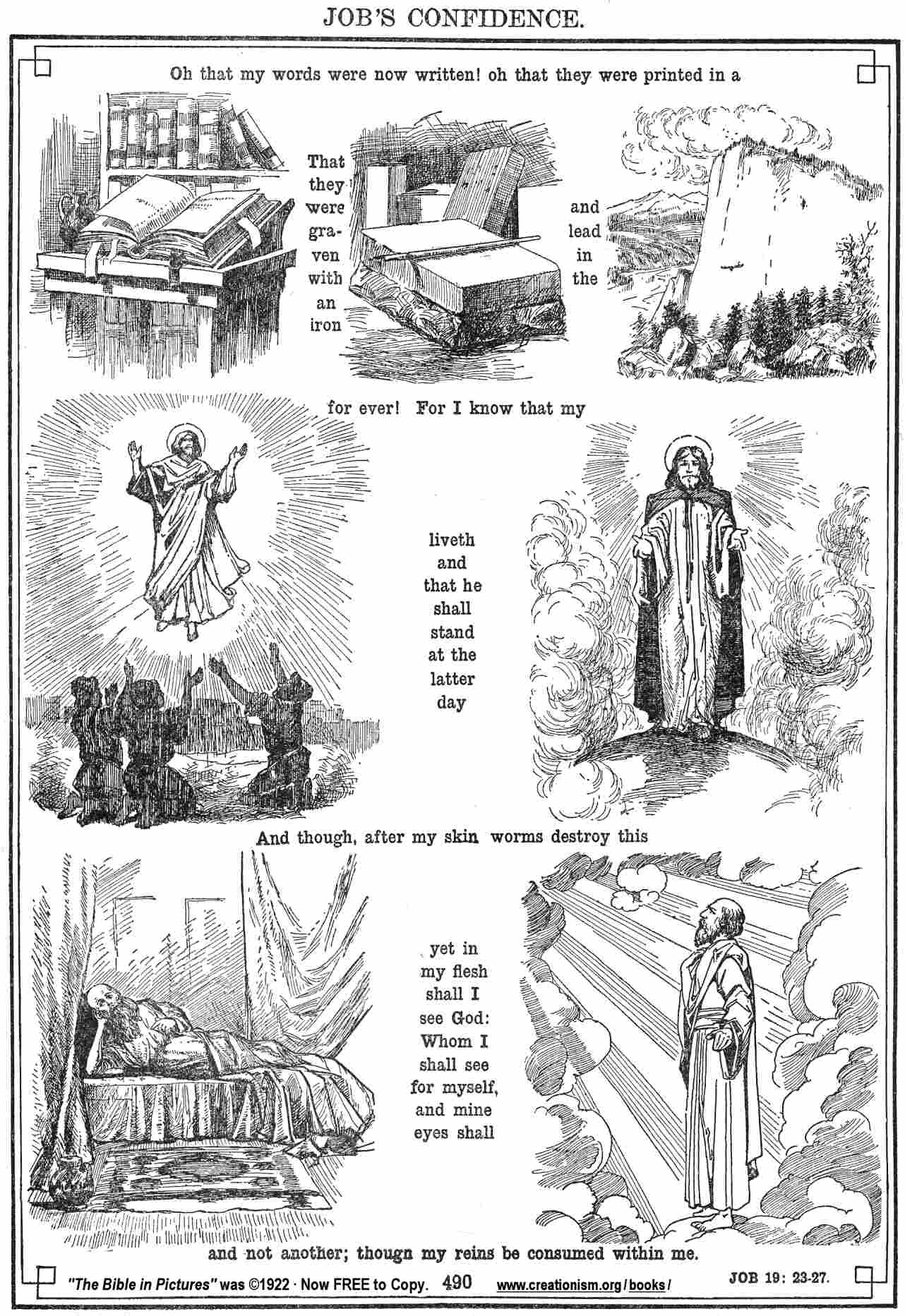
25 I know that my Redeemer lives, and that in the end he will stand upon the earth. 26 And after my skin has been destroyed, yet in my flesh I will see God; 27 I myself will see him with my own eyes—I, and not another. How my heart yearns within me!
clip_image035Background2Wikipedia

Job is the main figure in the Book of Job in the Hebrew Bible. In brief, the book begins with an introduction to Job’s character — he is described as a rich, blessed man who fears God and lives righteously. Satan, however, challenges Job’s integrity, and so God gives Job into Satan’s hand, resulting in tragedy for Job: the loss of his children, wealth, and physical soundness. The main portion of the text consists of the discourse of Job and his three friends concerning why Job was so punished, ending in God answering Job. The Lord blessed the latter days of Job more than his beginning and he lived 140 years (Job 42:10, 17); the book of Job takes place for about 9 months. Job is also a prophet in Islam.

Biblical Truths3http://www.pfrs.org/commentary/job19_25.html

This passage in Job is the oldest declaration we have of the blessed hope, the coming of our Redeemer to this planet to raise us up bodily from the grave and to dwell among His people in His Kingdom. Not only does this passage seem very plain in its meaning, but it was also understood this way by the early church. A contemporary and disciple of the apostles, Clement, who became an elder in the church at Rome, wrote in the first century,

“Do we then deem it any great and wonderful thing for the Maker of all things to raise up again those that have piously served Him in the assurance of a good faith, when even by a bird [referring to a previous illustration he had given of the resurrection] He shows us the mightiness of His power to fulfil His promise? For [the Scripture] saith in a certain place, ‘Thou shalt raise me up, and I shall confess unto Thee;’ and again, ‘I laid me down, and slept; I awaked, because Thou art with me;’ and again, Job says, ‘Thou shalt raise up this flesh of mine, which has suffered all these things.’ Having then this hope, let our souls be bound to Him who is faithful in His promises, and just in His judgments.” (Clement of Rome, Epistle to the Corinthians, xxvi)

For I know that my Redeemer lives… (veani yadati goeli chay) The Hebrew verb here “I know” carries the first person singular pronoun “I” with it. However, the pronoun “I” (ani) is also used emphatically. The sense is, “I myself know” or “I know for myself”). What Job so emphatically knows and declares is that his Redeemer lives. The word for Redeemer is found in Exodus 6:6 where Jehovah describes Himself as the Redeemer of Israel.

And He shall stand at last on the earth… (ve’acharon al-aphar yakum) The word “stand” actually means “to arise” or “stand up.” The word “at last” means “at the last” or “at the final” day. This corresponds to Christ’s words in John 6:39, “I will raise him up on the last day.” The word for “earth” is peculiar. It is “aphar” rather than the usual word for earth which is “aretz.” “Aphar” means “dry, fine particles of dirt; dust; loose soil, rubble.” The imagery is of the very dust and dirt with which man’s decomposed body becomes mingled with burial. It is this very dirt and dust upon which the Redeemer will stand on the last day.

And after my skin is destroyed, this I know… (va’achar ori nikfu-zot) “This I know” is supplied by the translators but is not in the Hebrew. It is need however because the following clause refers grammatically back to the verb “For I know” at the beginning of verse 25. This does not refer to Job’s present illness from which he hoped to be healed. The skin is destroyed through the process of decomposition after death – corruption – having been buried in the dirt.
That in my flesh I shall see God… (umibasari echeze elohai) Job expected to see God with his own eyes. That this refers to vision with the eyes of the body is proved from the following verse. Objections to this interpretation will be dealt with later in this article.

Whom I shall see for myself… (asher ani echeze-li) The first person pronoun “I” “me” occurs three times in this short clause and could not be more emphatic. The word for “see” is the same as in the previous clause.
And my eyes shall behold, and not another… (ve’eynai ra’u velo-zar) “Eyes,” that is the physical eyes of the body, is in the emphatic position. Job is not simply declaring but repeatedly emphasizing that he will see his Redeemer with his own two physical eyes. The expression “and not another” means “not as a stranger.” However Job or his friends may have interpreted his present circumstances and tribulations, Job was certain that he would behold his Redeemer as a friend and not as one estranged from Him.

How my heart yearns within me… (kalu kilotai becheki) The word “yearns” means “become weak, be consumed, and waste away.” Compare with Psalm 143:7, “my spirit fails.” “Heart” means the inmost and most secret part of man. Compare with Jeremiah 11:20. “Within me” means in my lap or bosom, that is, the lower part of the body where one clasps one’s beloved children.

Conclusion

The bottom line is Job, like all the other Old Testament saints, looked forward to a physical resurrection and renewal of the body. This was the hope he expressed in the midst of extreme physical suffering. This was Job’s hope. It was Enoch’s hope. It was Paul’s hope. And it remains the hope of His saints today until He returns.

Items for Discussion

  • When you think about what God has done or let happen to mankind, how do you rationalize the difference between a God of ruthlessness and a God of justice?
  • How is this moment of Job’s confidence in God key to his own salvation?
  • Do you think about the after life? In what ways, heaven as a physical place? Filled with people? Who are those people?
  • What would a day in your heaven look like?
  • If heaven is filled with the saints of the past, who would you like to visit with?


Philippians 3:20-21
20 But our citizenship is in heaven. And we eagerly await a Savior from there, the Lord Jesus Christ, 21 who, by the power that enables him to bring everything under his control, will transform our lowly bodies so that they will be like his glorious body.

Background

The letter was written to the church at Philippi, one of the earliest churches to be founded in Europe. They were much attached to Paul, just as he was very fond of them. Of all the churches, their contributions (which Paul gratefully acknowledges) are among the only he accepts. (Acts 20:33-35; 2 Cor. 11:7-12; 2 Thess. 3:8). The generosity of the Philippians comes out very conspicuously (Phil. 4:15). “This was a characteristic of the Macedonian missions, as 2 Cor. 8 and 9 amply and beautifully prove. It is remarkable that the Macedonian converts were, as a class, very poor (2 Cor. 8:2), though the very first converts were of all classes (Acts 16); and the parallel facts, their poverty and their open-handed support of the great missionary and his work, are deeply harmonious. At the present day the missionary liberality of poor Christians is, in proportion, really greater than that of the rich” (Moule).

Bible Truths4http://www.studylight.org/com/bnn/view.cgi?book=php&chapter=003

Our thoughts should be much in heaven, Philippians 3:20. Our home is there; our citizenship is there. Here we are strangers and pilgrims. We are away from home, in a cold and unfriendly world. Our great interests are in the skies; our eternal dwelling is to be there; our best friends are already there. There is our glorious Savior, with a body adapted to those pure abodes, and there are many whom we have loved on earth already with him. They are happy now, and we should not love them less because they are in heaven. Since, therefore, our great interests are there, and our best friends there; and since we ourselves are citizens of that heavenly world, our best affections shoed be there.
We look for the Savior, Philippians 3:20,21. He will return to our world. He will change our vile bodies, and make them like his own glorious body. And since this is so, let us:

  1. bear with patience the trials and infirmities to which our bodies here are subject. These trials will be short, and we may well bear them for a few days, knowing that soon all pain will cease, and that all that is humiliating in the body will be exchanged for glory.
  2. Let us not think too highly or too much of our bodies here. They may be now beautiful and comely, but they are “vile” and degraded, compared with what they will soon be. They are subject to infirmity, and to numerous pains and sicknesses. Soon the most beautiful body may become loathsome to our best friends. Soon, too offensive to be looked upon, it will be hidden in the grave. Why, then, should we seek to pamper and adorn these mortal frames? Why live only to decorate them? Why should we idolize a mass of molded and animated clay? Yet
  3. let us learn to honor the body in a true sense. It is soon to be changed. It will be made like the glorified body of Christ. Yes, this frail, diseased, corruptible, and humbled body; this body, that is soon to be laid in the grave, and to return to the dust, is soon to put on a new form, and to be clothed with immortality. It will be what the body of Christ now is–glorious and immortal. What a change! Christian, go and look on the creeping caterpillar, and see it changed to the gay and gilded butterfly–yesterday, a crawling and offensive insect; to-day, with gaudy colors, an inhabitant of the air, and a dweller amidst flowers; and see an image of what thy body shall be, and of the mighty transformation which thou wilt soon undergo. See the change from the cold death of winter to the fragrance and life of spring, and behold an image of the change which thou thyself wilt ere long experience, and a proof that some such change awaits thee.
  4. Let us look for the coming of the Lord, Philippians 3:21. All that we hope for depends on his reappearing. Our day of triumph, and of the fullness of our joy, is to be when he shall return. Then we shall be raised from the grave; then our vile bodies shall be changed; then we shall be acknowledged as his friends; then we shall go to be for ever with him. The earth is not our home; nor is the grave to be our everlasting bed of rest. Our home is heaven–and the Savior will come, that he may raise us up to that blessed abode. And who knows when he may appear? He himself commanded us to be ready, for he said he would come at an hour when we think not. We should so desire his coming, that the hours of his delay would seem to be heavy and long; and should so live that we can breathe forth with sincerity, at all times, the fervent prayer of the beloved disciple, “Come, Lord Jesus, COME QUICKLY !” Revelation 22:20.

Items for Discussion

  • How does the world today misunderstand the body we have today?
  • What are the dangers in not focusing on our ultimate shape in heaven, whatever it may be?
  • What does it mean to be a citizen?
  • What are the rights and obligations of citizenship?
  • If we have already died to sin with our faith in Christ, are we already citizens of heaven?
  • What special rights do you think a citizen of heaven would have?

Discussion Challenge

  • How can we balance our feet in this world, our pride in our bodies, with the understanding that they are temporal?

But, I didn’t do anything!

Psalm 91:14-161NIV New International Version Translations
14  “Because he loves me,” says the LORD, “I will rescue him; I will protect him, for he acknowledges my name. 15 He will call upon me, and I will answer him; I will be with him in trouble, I will deliver him and honor him. 16 With long life will I satisfy him and show him my salvation.”

clip_image034Background2C.H. Spurgeon http://www.biblebb.com/files/spurgeon/TOD/chstp91.htm

This Psalm is without a title, and we have no means of ascertaining either the name of its writer, or the date of its composition, with certainly. The Jewish doctors consider that when the author’s name is not mentioned we may assign the Psalm to the last named writer; and, if so, this is another Psalm of Moses, the man of God. Many expressions here used are similar to those of Moses in Deuteronomy, and the internal evidence, from the peculiar idioms, would point towards him as the composer. The continued lives of Joshua and Caleb, who followed the Lord fully, make remarkably apt illustrations of this Psalm, for they, as a reward for abiding in continued nearness to the Lord, lived on “amongst the dead, amid their graves.” For these reasons it is by no means improbable that this Psalm may have been written by Moses, but we dare not dogmatize. If David’s pen was used in giving us this matchless ode, we cannot believe as some do that he this commemorated the plague which devastated Jerusalem on account of his numbering the people. For him, then, to sing of himself as seeing “the reward of the wicked” would be clean contrary to his declaration, “I have sinned, but these sheep, what have they done?”; and the absence of any allusion to the sacrifice upon Zion could not be in any way accounted for, since David’s repentance would inevitably have led him to dwell upon the atoning sacrifice and the sprinkling of blood by the hyssop.

Biblical Truths3http://www.bible.ca/ef/expository-psalm-91-14-16.htm

Here the psalmist mentions some of the distinguishing characteristics of those who truly love God, and tells us what God will do for them. Notice them with me:

They have set their love upon the Lord (verse 14). The Christian’s heart has been turned away from the world in the direction of God. Paul described the Thessalonians as those who had “turned unto God from idols, to serve a living and true God” (1 Thessalonians 1:9-10). Thus, God’s child has turned to Him, and away from sin (see also Romans 6:17-18; Colossians 3:1-2). It is only when we have this understanding and, thus, this kind of commitment that we can be acceptable. Many people have a passing interest in Christ (Luke 8:11-14; Mark 7:6), but this is not enough. Those who love the Lord have set their love on Him (John 14:15; Matthew 22:37-39).

They know His name (verse 14). All of us know people whom we are very close to; our dear friends are people we have spent considerable time with. They are ones we have tested and tried; their friendship has been proven. To “know” God is to trust Him, to believe Him. The psalmist says elsewhere, “And they that know thy name will put their trust in thee; for thou, Jehovah, hast not forsaken them that seek Thee,” (9:10). Abraham knew God – he trusted Him (Romans 4:3; 17-23). On the other hand, the wicked do not “know” God, and they are cursed because of it: “The ox knoweth his owner, and the ass his master’s crib; but Israel doth not know, my people doth not consider” (Isaiah 1:24).

They pray effectively (verse 15). “He shall call upon me, and I will answer him.” Those who love the Lord have the assurance that their prayers will be answered; they may confidently express their dependence on God. Some men, of course, God will not hear. “Jehovah is far from the wicked; but he hear the prayer of the righteous” . . . “He that turn away his ear from hearing the law, even his prayer is an abomination” (Proverbs 15:29; 28:9; see also 1:24-31 and Job 27:8-9). However, God’s ears are open and receptive to His faithful followers (1 Peter 3:12; Psalm 18:3,6).

The Lord is with them in trouble (verse 15). Notice, please, that they are not immune to trouble. We must see that there is actually some benefit to us when trouble arises. “Count it all joy, my brethren, when ye fall into manifold trials; knowing that the proving of your faith work patience. And let patience have its perfect work, that ye may be perfect and entire, lacking in nothing” (James 1:2-4). Trials serve to make our faith stronger, so we will have testing times in this life. However, we have the assurance that God is with us in all our troubles. “God is our refuge and strength, a very present help in trouble” (Psalm 46:1). “So that with good courage we say, The Lord is my helper; I will not fear: what shall man do unto me?” (Hebrews 13:6; see also Romans 8:31-39 and Philippians 4:13).

They will be saved (verse 16). When God “shows us His salvation,” it will be worth it all. Paul said, “For I am already being offered, and the time of my departure is come. I have fought the good fight, I have finished the course, I have kept the faith: henceforth there is laid up for me the crown of righteousness, which the Lord, the righteous judge, shall give to me at that day; and not to me only, but also to all them that have loved his appearing” (2 Timothy 4:6-8; see also 1 Peter 1:3-9; Luke 18: 29-30) .

What a wonderful description the psalmist gives us here of those who love the Lord. If you will “set your love” on the Lord and “know” Him, all these things – and more – will be yours.

Items for Discussion

  • We live in a world filled with distractions and affluence. How do you know you love God enough?
  • When do you pray? Are your prayers consistent with the intent of this Psalm?
  • What would the outward evidence look like of someone who loved God with all their body and soul?
  • What are the dangers we have in our society that dilute our love of God?


Luke 16:19-31
19 “There was a rich man who was dressed in purple and fine linen and lived in luxury every day. 20 At his gate was laid a beggar named Lazarus, covered with sores 21 and longing to eat what fell from the rich man’s table. Even the dogs came and licked his sores. 22 “The time came when the beggar died and the angels carried him to Abraham’s side. The rich man also died and was buried. 23 In hell, where he was in torment, he looked up and saw Abraham far away, with Lazarus by his side. 24 So he called to him, ‘Father Abraham, have pity on me and send Lazarus to dip the tip of his finger in water and cool my tongue, because I am in agony in this fire.’ 25 “But Abraham replied, ‘Son, remember that in your lifetime you received your good things, while Lazarus received bad things, but now he is comforted here and you are in agony. 26 And besides all this, between us and you a great chasm has been fixed, so that those who want to go from here to you cannot, nor can anyone cross over from there to us.’ 27 “He answered, ‘Then I beg you, father, send Lazarus to my father’s house, 28 for I have five brothers. Let him warn them, so that they will not also come to this place of torment.’ 29 “Abraham replied, ‘They have Moses and the Prophets; let them listen to them.’ 30 “‘No, father Abraham,’ he said, ‘but if someone from the dead goes to them, they will repent.’ 31 “He said to him, ‘If they do not listen to Moses and the Prophets, they will not be convinced even if someone rises from the dead.’”

Background4http://www.geocities.com/k9ocu/Luke.htm

“Luke was an Antiochian of Syria, a physician by profession. He was a disciple of the apostles and later accompanied Paul until the latter’s martyrdom. He served the Lord without distraction [or ‘without blame’], having neither wife nor children, and at the age of eighty-four he fell asleep in Boeotia, full of the Holy Spirit. While there were already Gospels previously in existence—that according to Matthew written in Judaea and that according to Mark in Italy—Luke, moved by the Holy spirit, composed the whole of this Gospel in the parts about Achaia. In his prologue he makes this very point clear, that other Gospels had been written before his, and that it was necessary to expound to the Gentile believers the accurate account of the [divine] dispensation, so that they should not be perverted by Jewish fables, nor be deceived by heretical and vain imaginations and thus err from the truth. . . . And afterwards the same Luke wrote the Acts of the Apostles [Geldenhuys, pp. 17-18].”

Bible Truths5http://www.jesuswalk.com/lessons/16_19-31.htm

Jesus has been teaching about materialism and money — the unjust steward, serving Mammon, and stewardship. His audience includes his disciples (16:1) as well as “the Pharisees who loved money” and ridiculed his stand on money (16:14). Jesus affirms the validity of the Law, rightly interpreted (16:16-18) — important to the Pharisees. The parable we are studying this week condemns the Pharisees for their love of money and neglect of showing compassion for the poor (16:19-31).

A parable is a story intended to convey a spiritual truth. The story doesn’t have to be about real people or even real situations (such as a camel passing through the eye of a needle). But to achieve its teaching goal, a parable must be striking and memorable, so that as the story is retold and remembered, the spiritual truth is reinforced again and again. The hearers must be able to imagine the situation.

Of course, Jesus is saying that riches don’t count for anything after we die, but that isn’t the thrust of this parable. I think he is making two points.

  1. Wealth without active mercy for the poor is great wickedness.
  2. If we close our eyes to the truth we are given, then we are doomed.

In the context, Jesus is condemning the Pharisees for their love of money but lack of mercy for the poor. Remember his comment about their scrupulous tithing? “Woe to you Pharisees, because you give God a tenth of your mint, rue and all other kinds of garden herbs, but you neglect justice and the love of God. You should have practiced the latter without leaving the former undone” (Luke 11:42). It isn’t their piety that he is condemning, but what they AREN’T doing — showing mercy to the poor, seeking justice for the downtrodden. It is ironic that the Pharisees who prided themselves on being such Bible scholars largely missed the spirit of the Old Testament — mercy and justice.

Items for Discussion

  • What was the rich man’s sin?
  • Why do some people have struggles being around poor people?
  • What are the difficulties we face in giving to the poor?
  • How do you feel when someone walks up to your car window at a stop light with a bucket asking for money? Do you roll down your window and give?
  • Should we separate those who are in need from those who try to swindle a handout?
  • What ministries and agencies in our community could you give to that directly aid the poor?
  • How is it that we pass on this message of Christ’s parable to our children?

Discussion Challenge

  • How can we, who are affluent, balance our lives with those in poverty around us?

Giving Rules

Exodus 16:11-181NIV New International Version Translations
11 The LORD said to Moses, 12 “I have heard the grumbling of the Israelites. Tell them, ‘At twilight you will eat meat, and in the morning you will be filled with bread. Then you will know that I am the LORD your God.’” 13 That evening quail came and covered the camp, and in the morning there was a layer of dew around the camp. 14 When the dew was gone, thin flakes like frost on the ground appeared on the desert floor. 15 When the Israelites saw it, they said to each other, “What is it?” For they did not know what it was. Moses said to them, “It is the bread the LORD has given you to eat. 16 This is what the LORD has commanded: ‘Each one is to gather as much as he needs. Take an omer2An omer is a unit of dry measure equal to one tenth of an ephah and roughly equivalent to 3.5 liters/3.7 Quartsfor each person you have in your tent.’” 17 The Israelites did as they were told; some gathered much, some little. 18 And when they measured it by the omer, he who gathered much did not have too much, and he who gathered little did not have too little. Each one gathered as much as he needed.

clip_image032Background3http://en.wikipedia.org/wiki/Exodus

Exodus is the second book of the Torah, the Tanakh, and the Old Testament. In Hebrew, it is called Shemot (שְׁמוֹת), based on its first words Ve-eleh shemot (Hebrew: ואלה שמות) (i.e., “And these are the names”). The Septuagint designates the second book of the Pentateuch as “Exodus” (Greek: Ἔξοδος), meaning “departure” or “out-going”. The Latin translation adopted the name, which passed into other languages.

The book opens with the Israelites in Egypt, having been welcomed there at the end of Genesis. The Israelites settle in Egypt and grow in numbers. A new Pharaoh oppresses them to the point of ordering that the male Israelite babies be massacred. A Levite couple hides their infant son to protect him, and a daughter of the Pharaoh finds him, names him Moses, and raises him as her son. After killing an Egyptian guard who had been whipping Israelites, Moses flees Egypt. He meets God, who tells him to return to Egypt to liberate the Israelites. Moses returns, and God sends plagues to demonstrate his power. Finally, the Pharaoh relents and lets Moses lead the Israelites away. They travel for years through the wilderness, receive a covenant and its laws, and then displease God by creating a golden calf to worship. Moses wins God’s forgiveness for his people, and they build the tabernacle.

Biblical Truths

The biblical truths in these verses are not complex. The Israelites journey into the desert, and once in the Wilderness of Sin, they complain about the lack of food. Listening to their complaint, God sends them a shower of quail, and subsequently provides a daily shower of manna from heaven. In other words, God provides all we need.

Items for Discussion

  • God hears the grumblings of the Israelites. Does He hear ours today? What is the significance of your answer?
  • What was the Israelites first response to the manna? Do you think we have problems today with recognizing the “manna from God?”
  • Why do you think that God made them gather the manna and not just pile loaves of bread up in their tents?
  • What do you see as the rational for what happened in verses 16 to 18?
  • What is the “bread” (resources) we have been given in our lives so that we might survive as individuals?
  • What is the “bread” that we have been given so that we might survive as a congregational community?
  • What is required of us as a congregation to “gather” that “bread”?


2 Corinthians 8:1-15
1 And now, brothers, we want you to know about the grace that God has given the Macedonian churches. 2 Out of the most severe trial, their overflowing joy and their extreme poverty welled up in rich generosity. 3 For I testify that they gave as much as they were able, and even beyond their ability. Entirely on their own, 4 they urgently pleaded with us for the privilege of sharing in this service to the saints. 5 And they did not do as we expected, but they gave themselves first to the Lord and then to us in keeping with God’s will. 6 So we urged Titus, since he had earlier made a beginning, to bring also to completion this act of grace on your part. 7 But just as you excel in everything—in faith, in speech, in knowledge, in complete earnestness and in your love for us—see that you also excel in this grace of giving. 8 I am not commanding you, but I want to test the sincerity of your love by comparing it with the earnestness of others. 9 For you know the grace of our Lord Jesus Christ, that though he was rich, yet for your sakes he became poor, so that you through his poverty might become rich. 10 And here is my advice about what is best for you in this matter: Last year you were the first not only to give but also to have the desire to do so. 11 Now finish the work, so that your eager willingness to do it may be matched by your completion of it, according to your means. 12 For if the willingness is there, the gift is acceptable according to what one has, not according to what he does not have. 13 Our desire is not that others might be relieved while you are hard pressed, but that there might be equality. 14 At the present time your plenty will supply what they need, so that in turn their plenty will supply what you need. Then there will be equality, 15 as it is written: “He who gathered much did not have too much, and he who gathered little did not have too little.”

Background

Paul’s contacts with the Corinthian church can be reconstructed as follows:

  1. Paul visits Corinth for the first time, spending about 18 months there (Acts 18:11). He then leaves Corinth and spends about 3 years in Ephesus (Acts 19:8, 19:10, 20:31). (Roughly from 53 to 57 AD).
  2. Paul writes the “warning letter”, probably from Ephesus.
  3. Paul writes 1 Corinthians from Ephesus (1 Corinthians 16:8).
  4. Paul visits the Corinthian church a second time, as he indicated he would in 1 Corinthians 16:6. This is probably still during his 3 years based in Ephesus. 2 Corinthians 2:1 calls this a “painful visit”.
  5. Paul writes the “letter of tears”.
  6. Paul writes 2 Corinthians, indicating his desire to visit the Corinthian church a third time (2 Cor 12:14, 2 Cor 13:1). The letter doesn’t indicate where he is writing from, but it is usually dated after Paul left Ephesus for Macedonia (Acts 20), from either Philippi Thessalonica in Macedonia.
  7. Paul presumably made the third visit after writing 2 Corinthians, because Acts 20:2-3 indicates he spent 3 months in Greece. In his letter to Rome, written at this time, he sent salutations from some of the principal members of the church to the Romans.

Biblical Truths

In verses 8:1 – 9:15 we find Paul’s instructions for the collection for the poor in the Jerusalem church. The mother church, Jerusalem, is again in financial need. Christians at Corinth began collecting funds for them “last year” (v. 10), but appear to have stopped – perhaps due to the disagreements mentioned earlier in the epistle. “Now finish doing it” (v. 11), Paul urges, but does not demand: “I do not say this as a command” (v. 8). Meanwhile, the churches of Macedonia (Philippi, Thessalonica and Beroea), far from affluent, have contributed beyond measure to the Jerusalem Fund.

The Christians at Corinth were quarrelsome and divided at times, even regarding baptism (1 Corinthians 1:10-17); so v. 7 is probably a pep talk, intended to damn his readers faintly (without them realizing it): spiritual gifts seem to have been rare at Corinth. Note the realism: “our love for you” not your love for us. The Macedonians have been earnest in their giving; may the Corinthians be as genuine, by putting their words into action. Our great example of self-giving is “Jesus” (v. 9): as Son, he was “rich”, being equal to the Father, but he became human (“poor”) so that we may enjoy salvation. One’s gift should be commensurate with one’s means (v. 12); commitment to the cause (“eagerness”) matters. Givers should attain a “fair balance” (v. 13): relieving the poverty of others but not impoverishing themselves. As a guideline, Paul quotes Exodus 16:18 (v. 15): when God supplied manna in the desert, all had just sufficient, so the Corinthians should avoid gross inequalities in wealth.

Items for Discussion

  • In verse 2 Paul tells us that three factors came together to cause the Macedonians to give to the poor saints in Jerusalem. What are those three factors?
  • Why do these factors generate or motivate people toward generosity?
  • If someone has not experienced any of the above factors, can they understand or be motivated toward generosity?
  • If a church or a family struggle with the concept of giving generously, not under compulsion as Paul states, could it be that they have not shared the three factors/experiences discussed by Paul?
  • How would one who is neither joyful, nor poor or had never been under a personal trial learn about generosity?
  • How do we pass these lessons onto children?

Discussion Challenge

  • How do we pass these lessons onto a congregation?
  • 1
    NIV New International Version Translations
  • 2
    An omer is a unit of dry measure equal to one tenth of an ephah and roughly equivalent to 3.5 liters/3.7 Quarts
  • 3

All People that on Earth do Dwell

Psalm 19
1 The heavens declare the glory of God; the skies proclaim the work of his hands. 2 Day after day they pour forth speech; night after night they display knowledge. 3 There is no speech or language where their voice is not heard. 4 Their voice goes out into all the earth, their words to the ends of the world. In the heavens he has pitched a tent for the sun, 5 which is like a bridegroom coming forth from his pavilion, like a champion rejoicing to run his course. 6 It rises at one end of the heavens and makes its circuit to the other; nothing is hidden from its heat. 7 The law of the LORD is perfect, reviving the soul. The statutes of the LORD are trustworthy, making wise the simple. 8 The precepts of the LORD are right, giving joy to the heart. The commands of the LORD are radiant, giving light to the eyes. 9 The fear of the LORD is pure, enduring forever. The ordinances of the LORD are sure and altogether righteous. 10 They are more precious than gold, than much pure gold; they are sweeter than honey, than honey from the comb. 11 By them is your servant warned; in keeping them there is great reward. 12 Who can discern his errors? Forgive my hidden faults. 13 Keep your servant also from willful sins; may they not rule over me. Then will I be blameless, innocent of great transgression. 14 May the words of my mouth and the meditation of my heart be pleasing in your sight, O LORD, my Rock and my Redeemer.

10COMMANDMENTSBackground1http://en.wikipedia.org/wiki/Psalms

The Book of Psalms is divided into 150 Psalms, each of which constitutes a religious song or chant, though one or two are atypically long and may constitute a set of related chants. When the Bible was divided into chapters, each Psalm was assigned its own chapter. Psalms are sometimes referenced as chapters, despite that chapter assignments postdate the initial composition of the “canonical” Psalms by at least 1,500 years.
The organization and numbering of the Psalms differs slightly between the (Masoretic) Hebrew and the (Septuagint) Greek manuscripts:

Hebrew Psalms  Greek Psalms
1-8
9-10 9
11-113 10-112
114-115 113
116 114-115
117-146 116-145
147  146-147
148-150
  • Psalms 9 and 10 in the Hebrew are together as Psalm 9 in the Greek
  • Psalms 114 and 115 in the Hebrew are Psalm 113 in the Greek
  • Psalms 114 and 115 in the Greek appear as Psalm 116 in the Hebrew
  • Psalms 146 and 147 in the Greek form Psalm 147 in the Hebrew

Christian traditions vary:

  • Protestant translations are based on the Hebrew numbering;
  • Eastern Orthodox translations are based on the Greek numbering;
  • Roman Catholic official liturgical texts follow the Greek numbering, but modern Catholic translations often use the Hebrew numbering, sometimes adding, in parenthesis, the Greek numbering as well.
  • Most manuscripts of the Septuagint also include a Psalm 151, present in Eastern Orthodox translations; a Hebrew version of this poem was found in the Psalms Scroll of the Dead Sea Scrolls. The Psalms Scroll presents the Psalms in an order different from that found elsewhere, and also contains a number of non-canonical poems and hymns.

Biblical Truths

Summary of this Psalm
  1. God reveals himself through his world, through nature.
  2. Verse 1 and 2 mentions the heavens, the day, night, etc. He says that they are telling of God’s glory, but then he adds in verse 3 that they do this without actual speech.
  3. Verse 4 shows us that natural revelation reaches every place on earth, therefore it reaches every person.
  4. I think the imagery in verse 5 is saying that natural revelation is dominating and powerful. It cannot be ignored. You have to respond to it. Romans 1:18 echoes that. We will discuss that passage later.
  5. Verse 6 shows us that nobody escapes the sun. Even if you are blind and cannot see it, you still feel the heat. Although it has no voice (vs 3), people still experience it. And you’ve got to ask the question, “How did it get there?” The story is told of a Mayan king who worshipped the sun until he realized that the sun couldn’t be god because it was sometimes hidden by the clouds. It made him wonder who was god.
  6. Notice how Ps 19 says the heavens are telling his glory. This is present tense for us. Special revelation, Scripture, has ceased, but the natural revelation continues. We can receive natural revelation fresh, daily.

Items for Discussion

  • Does anyone on earth have an excuse that they did not know about God?
  • If there is no excuse, we must have three states:
    • Those that know and choose God
    • Those that know and choose something else besides God
    • Those that don’t know
  • What are the Christian responsibilities that should go to each group?
  • While Psalm 19 speaks of God harnessing the physical sun above the earth, how does this become a metaphor for the Christian today?
  • If one takes this Psalm literally, no one can hide from God. This being the case, all sin is done in God’s view. What does this tell us about sin and its power?
  • Re-read verse 13 and discuss what this Psalm tells us about overcoming sin?


Hebrews 4:12-13
12 For the word of God is living and active. Sharper than any double-edged sword, it penetrates even to dividing soul and spirit, joints and marrow; it judges the thoughts and attitudes of the heart. 13 Nothing in all creation is hidden from God’s sight. Everything is uncovered and laid bare before the eyes of him to whom we must give account.

Background2http://en.wikipedia.org/wiki/Epistle_to_the_Hebrews

Controversy exists over the authorship of Hebrews since the author is not specifically mentioned in the text nor is the style of writing typical of the Apostle Paul.

Most modern scholars believe the document was written to prevent apostasy. (Apostasy is the abandonment of a political or religious belief.) Some have interpreted apostasy to mean a number of different things, such as a group of Christians in one sect leaving for another more conservative sect, one in which the author disapproves. Some have seen apostasy as a move from the Christian assembly to pagan ritual. In light of a possibly Jewish-Christian audience, the apostasy in this sense may be in regard to Jewish-Christians leaving the Christian assembly to return to the synagogue. In light of Pauline doctrine, the epistle dissuades non-Jewish Christians from feeling a need to convert to Judaism. Therefore the author writes, “Let us hold fast to our confession” (4:14).

The Bible’s Epistle to the Hebrews affirms special creation. It affirms that God by His Son, Jesus Christ, made the worlds. “God…hath in these last days spoken unto us by his Son…by whom also he made the worlds” (1:1-2). The epistle also states that the worlds themselves do not provide the evidence of how God formed them. “Through faith we understand that the worlds were framed by the Word of God, so that things which are seen were not made of things which do appear” ((Hebrews 11:3).

Biblical Truths

In Heb 4:12-13, the author digresses, discoursing about the word of God; he compares the word of God to a sharp, two-edged sword. (He loosely connects his digression to what precedes with the conjunction gar [“for”].) The phrase “the word of God” (ho logos tou theou) is a subjective genitive: God’s word. For the author, the word of God means God’s communication to human beings, which has taken many forms at different times in history (see Heb 1:1-2). The word of God is said to be active and living, meaning that it produces results in those to whom it comes.

The author then compares its effectiveness to a two-edged sword, the most effective cutting tool known to him (see Rev 1:16; 19:15, 21; Eph 6:17). The word of God can metaphorically cut between the spirit and the soul, two aspects or substantial entities that are difficult to distinguish, in the same way that a literal sword can divide between joints and marrow. The use of the metaphor of the sword to express the idea of the effectiveness of the word of God is not original to the author. Parallel to Heb 4:12-13, the author of Wisdom of Solomon identifies the word of God is personified as a warrior who wields a sharp word (xiphos oxu) representing God’s decree of death against the Egyptians as judgment during the time of the exodus (18:14-16).

The point made by the author is that there is nothing that cannot be affected (“cut”) by the word of God. One result of the word of God is to judge the thoughts and intentions of the human being, which means that God’s communication to human beings has the result that those who receive it come under God’s judgment. (The two terms translated as “thoughts and intentions,” enthumêsis and ennoia, do not seem to have a clearly discernible difference in meaning.) This is why in Heb 4:13 the author concludes that all creatures lay totally exposed before God (“naked and exposed to view”), so that nothing can be hidden from God’s penetrating word. (The word tetrachêlismena translated as “be exposed to view” is a hapaxlegomena in the New Testament and the Greek Old Testament, and has a different meaning in texts outside of the Bible; in its context in Hebrews, it can only mean “to expose to view.”) The author concludes by saying that it is to God that “we” (human beings) have to give an account. He is referring to the fact that all must stand in judgment before God. The word for “account” is logos, so that there results a play on words: the logos of God necessarily leads to giving a logos to God.

Items for Discussion

  • Why was the Roman sword feared so much?
  • How does the word of God “cut” someone?
  • What analogies can you assign to the meaning of the “double edged” sword?
  • Think back to the Psalm; is it possible to hide from light? How and what happens if you do this for a long time?
  • Would you conclude that it is not possible to hide from light (God)?
  • If this is not possible, then what is the risk to those who try to hide?
  • If these verses are describing the Word of God, then what does this tell us about how we should treat Scripture?

Discussion Challenge

  • How can our congregation increase exposure to the Word of God?

Would the Real Jesus Please Stand Up

Isaiah 9:1-71NIV New International Version Translations
1 Nevertheless, there will be no more gloom for those who were in distress. In the past he humbled the land of Zebulun and the land of Naphtali, but in the future he will honor Galilee of the Gentiles, by the way of the sea, along the Jordan—2 The people walking in darkness have seen a great light; on those living in the land of the shadow of death a light has dawned.3 You have enlarged the nation and increased their joy; they rejoice before you as people rejoice at the harvest, as men rejoice when dividing the plunder. 4 For as in the day of Midian’s defeat, you have shattered the yoke that burdens them, the bar across their shoulders, the rod of their oppressor. 5 Every warrior’s boot used in battle and every garment rolled in blood will be destined for burning, will be fuel for the fire. 6 For to us a child is born, to us a son is given, and the government will be on his shoulders. And he will be called Wonderful Counselor, Mighty God, Everlasting Father, Prince of Peace. 7 Of the increase of his government and peace there will be no end. He will reign on David’s throne and over his kingdom, establishing and upholding it with justice and righteousness from that time on and forever. The zeal of the LORD Almighty will accomplish this.

clip_image029Background

It was during times of apostasy (a total desertion of or departure from one’s religion, principles, party, cause, etc. ) and sin that God sent prophets to Israel and Judah. The work of a prophet was to proclaim God’s word as the Lord gave it to him through His Holy Spirit (II Peter 1:20-21). This would include the foretelling of future events, though it was not limited to that. Prophets also reminded the people of past events and gave instruction about what they ought to do at the present.

One of the most well known of these prophets was Isaiah. He has come to be known by some as “The Messianic Prophet” because so much of his message had to do with the coming Messiah and His kingdom. In one such section, Isaiah tells of a time to come when a great light will come and shine throughout the land now draped in darkness. This prophecy was fulfilled about seven centuries later by Jesus, of Nazareth, our Messiah and Redeemer. Let us consider Isaiah’s text and how it is fulfilled in Jesus. (Isaiah 9:1-7).

Biblical Truths2http://www.bible.ca/ef/expository-isaiah-9-1-7.htm

Let’s look at the prophesy: It includes a description of the Messiah “For a child will be born to us, a son will be given to us; and the government will rest on His shoulders; and His name will be called Wonderful Counselor, Mighty God, Eternal Father, Prince of Peace.” (Isaiah 9:6). The Messiah came to us first as a child; an infant born in Bethlehem.

He grew into manhood and fulfilled this and all prophecies made concerning Him. Notice the various aspects of His reign:

  • First, “the government shall rest on His shoulders”. Today, in His spiritual kingdom, Jesus has all authority (Matthew 28:18-20). When we obey the gospel, we leave “the domain of darkness” and are transferred into “the kingdom of His beloved Son” (Colossians 1:12,13).
  • Second, Jesus has become our “Wonderful Counselor”. In the Hebrew, the idea is that His counsel is a thing of wonder and awe. In Jesus’ teachings we have the absolute best advice on how to live our lives to be eternally successful. Though the Law came through Moses, “grace and truth comes through Jesus Christ” (John 1:17).
  • Third, Our Lord Jesus is also our “Mighty God”. The word for “mighty” also means “hero” teaching not only the Deity of Christ but also His action in our behalf to save us from doom. He is the greatest hero of all time, for nothing compares to His sacrifice, his love and His power. And He is “Immanuel” which means “God with us” (Isaiah 7:14; Matthew 1:23; Philippians 2:5-11; II Peter 1:1).
  • Fourth, Jesus is also referred to as “Eternal Father”. Jesus, the eternal Word of God, has indeed become our spiritual Father by giving us “the right to become children of God” (John 1:12-13). Jesus also reveals the Heavenly Father to us (John 1:18) and since the Son of God bears His Father’s characteristics we can truly say when we have seen Jesus we have been shown the Father (John 14:8-11).
  • And Finally, Jesus is the “Prince of Peace”. Only He could bring about reconciliation between God and man (II Corinthians 5:18-19). Though faith in Christ brings conflict with the forces of darkness, and sometimes hardships and persecution and betrayal, it also brings harmony with God and a “peace that passes understanding.” Even the announcement of the angels at His birth refer to this peace that we may have with God and His goodwill toward us because of the Savior (Luke 2:11-14).

Items for Discussion

  • What makes a prophecy a prophecy?
  • What other persons or events in history have fulfilled or came close to fulfilling what Isaiah was saying?
  • What is the role of a counselor?
  • What does it mean to be mighty?
  • In what ways does Jesus act like out eternal father?
  • How has Jesus demonstrated that He is truly the “Prince of Peace?”


Matthew 16:13-28
13 When Jesus came to the region of Caesarea Philippi, he asked his disciples, “Who do people say the Son of Man is?” 14 They replied, “Some say John the Baptist; others say Elijah; and still others, Jeremiah or one of the prophets.” 15 “But what about you?” he asked. “Who do you say I am?” 16 Simon Peter answered, “You are the Christ, the Son of the living God.” 17 Jesus replied, “Blessed are you, Simon son of Jonah, for this was not revealed to you by man, but by my Father in heaven. 18 And I tell you that you are Peter, and on this rock I will build my church, and the gates of Hades will not overcome it. 19 I will give you the keys of the kingdom of heaven; whatever you bind on earth will be bound in heaven, and whatever you loose on earth will be loosed in heaven.” 20 Then he warned his disciples not to tell anyone that he was the Christ. 21 From that time on Jesus began to explain to his disciples that he must go to Jerusalem and suffer many things at the hands of the elders, chief priests and teachers of the law, and that he must be killed and on the third day be raised to life. 22 Peter took him aside and began to rebuke him. “Never, Lord!” he said. “This shall never happen to you!” 23 Jesus turned and said to Peter, “Get behind me, Satan! You are a stumbling block to me; you do not have in mind the things of God, but the things of men.” 24 Then Jesus said to his disciples, “If anyone would come after me, he must deny himself and take up his cross and follow me. 25 For whoever wants to save his life will lose it, but whoever loses his life for me will find it. 26 What good will it be for a man if he gains the whole world, yet forfeits his soul? Or what can a man give in exchange for his soul? 27 For the Son of Man is going to come in his Father’s glory with his angels, and then he will reward each person according to what he has done. 28 I tell you the truth, some who are standing here will not taste death before they see the Son of Man coming in his kingdom.”

Background

We now come to a turning point in Jesus’ ministry when he acknowledged to his disciples that he was the Christ. He also informed them of His ensuing death. He had brought them to a place near the town of Caesarea Philippi (not the seaport Caesarea on the eastern Mediterranean). At that time it was a Gentile frontier town on the southern slope of Mount Hermon at one of the headwaters of the Jordan River. It is significant that Jesus chose this place to reveal His Messiahship because it was known for a shrine to the pagan god, Pan, the Greek and Roman god of nature. Caesarea Philippi had belonged to Herod the Great, and now to his son. Yet it was here that Jesus said to Peter after he confessed Jesus as Christ: “Upon this rock I will build My church; and the gates of Hades shall not overpower it.” (Matt. 16:18) Still, Jesus instructed the disciples to tell no one that He was the Christ.

Biblical Truths

Matthew 16:13-20; Mark 8:27-30; Luke 9:18-21
Jesus brings his disciples to Caesarea Philippi and asks them who people are saying He is. They tell him some believe he is John the Baptist, others say Elijah, and others believe him to be one of the prophets. When Jesus asked: “Who do you say I am?” it was Peter who spoke up and said: “You are the Christ, the Son of the Living God.” Jesus had not revealed this to them and he acknowledged that it was God Who had revealed it to Peter. And he said that it was upon that premise His church would be built. This is the first reference in the Scriptures to His Church. And he continued to instruct the disciples to tell no one He was the Christ.

Matthew 16:21-23; Mark 8:31-33; Luke 9:22
Jesus now began to prepare his disciples for the things He must suffer in Jerusalem. He told them he would be killed at the hands of the Jewish religious leaders but would be raised on the third day. Peter was very disturbed to hear his Master say such things and disputed it, for which Jesus refuted him.

Matthew 16:24-26; Mark 8:34-37; Luke 9:23-25
Jesus forewarned his disciples that in order to follow Him faithfully would be a life of suffering. He compared it to the suffering of one condemned to be crucified and forced to carry their cross.

Matthew 16:27-28; Mark 8:38-9:1; Luke 9:26-27
Jesus told them that He would return with the glory of His father and His angels for judgment. He declared that some of them would still be living when he would come into His kingdom.

Items for Discussion

  • What is the “Church” mean to you?
  • Look at verse 26 – How do you think today’s society is responding to this point Christ is making?
  • Verse 27 sounds like good works count for something – What is the balance between good works and salvation by faith?
  • How do you personally interpret verse 28?
  • How is this Scripture a good definition of Discipleship?

Discussion Challenge

  • How does a church grow disciples while it waits for Christ?

Angels of Peace

Genesis 28:10-221NIV New International Version Translations
10 Jacob left Beersheba and set out for Haran. 11 When he reached a certain place, he stopped for the night because the sun had set. Taking one of the stones there, he put it under his head and lay down to sleep. 12 He had a dream in which he saw a stairway resting on the earth, with its top reaching to heaven, and the angels of God were ascending and descending on it. 13 There above it stood the LORD, and he said: “I am the LORD, the God of your father Abraham and the God of Isaac. I will give you and your descendants the land on which you are lying. 14 Your descendants will be like the dust of the earth, and you will spread out to the west and to the east, to the north and to the south. All peoples on earth will be blessed through you and your offspring. 15 I am with you and will watch over you wherever you go, and I will bring you back to this land. I will not leave you until I have done what I have promised you.” 16 When Jacob awoke from his sleep, he thought, “Surely the LORD is in this place, and I was not aware of it.” 17 He was afraid and said, “How awesome is this place! This is none other than the house of God; this is the gate of heaven.” 18 Early the next morning Jacob took the stone he had placed under his head and set it up as a pillar and poured oil on top of it. 19 He called that place Bethel, though the city used to be called Luz. 20 Then Jacob made a vow, saying, “If God will be with me and will watch over me on this journey I am taking and will give me food to eat and clothes to wear 21 so that I return safely to my father’s house, then the LORD will be my God 22 and this stone that I have set up as a pillar will be God’s house, and of all that you give me I will give you a tenth.”

clip_image028Background

Genesis (Greek: “birth,” “origin”) is the first book of the Torah, the Tanakh, and the Old Testament of the Bible. Jewish tradition considers the Pentateuch to have been written by God.
Genesis recounts a history of the world from the Creation to the descent of the Children of Israel into Ancient Egypt. It contains some of the best-known stories of the Old Testament, including Adam and Eve, Cain and Abel, Noah’s Ark, the Tower of Babel, the biblical Patriarchs—Abraham, Isaac, Jacob—and the story of Joseph. It also has important clues to ancient Israelite cosmology and theology, notably the Covenant linking God to his Chosen People and the people to the Promised Land.

Biblical Truths

28:10-11 On his journey north, his second or third stopping place was 50 miles, 80 km, north of Beersheba (later called Bethel, 28:19). As the night fell Jacob realized he was alone, and he was probably getting apprehensive realizing he had only come one tenth of the way to Haran. He slept on the ground, and used a flat stone as a pillow.

28:12-14 In a dream he saw a ladder going right up into heaven with angels moving up and down. Between him and the ladder he saw the LORD who introduced himself as the one who had been revealed to Abraham and Isaac (the second Person of the Trinity, see notes on 12:1, 7: 13:4, 14; 15:1, 7, 18; 17:1; 18:1, 22; 21:1; 26:2, 24). He repeated the blessing given to Isaac concerning the land (28:4) and concerning becoming a large nation (28:3). But he also reminded him of the third strand of the promise he had given of Abraham’s heirs being a blessing to all peoples of the world (given to Abraham, 12:3; and repeated to Isaac, 26:4).

28:15-19 The LORD also promised to be with him on the long journey to Haran, care for him there, and bring him back safely to fulfill all that he had promised him. Jacob woke up awed, and he named the place Bethel (beth-el meaning the house of God). He probably did not know that Abraham had built an altar and offered sacrifice in that very place (13:7-8). Being unable to offer animal sacrifice, he used the stone he had slept on as a altar and poured on it some of the olive oil he had with him.

28:20-22 Jacob then made a vow that if God protected him on the way, and brought him home safely, the LORD would be his God. Jacob also promised to give the LORD a tithe of all that God blessed him with (see Genesis 14:20; Numbers 18:21-24; Leviticus 27:30-33; Deuteronomy 26:12-14). God reminded him of his vow after twenty years in Haran (31:13, 41). We wonder if it was in his wrestling with the LORD that Jacob finally came to an assured faith in him (32:24-30). But at this stage he still seemed to be trying to gain an advantage by bargaining with God (as he had done in the deal he had made with Esau, 25:29-33).

Items for Discussion

  • What are your thoughts and feelings about our God communicating through dreams?
  • What direction was the ladder reaching, up or down and does this give significance to the story?
  • How is Jacob’s ladder like our Christ?
  • What might the steps represent?
  • Consider the humiliations of Christ
  • Who would the angels represent if we keep with our analogy of Christ as the ladder?
    • Consider this idea that the angels are God’s promises to the human race
    • Angels as ministers of God’s relationship with humans
  • How does Jacob respond to the dream (see verse 22)?


Luke 2:8-20
8 And there were shepherds living out in the fields nearby, keeping watch over their flocks at night. 9 An angel of the Lord appeared to them, and the glory of the Lord shone around them, and they were terrified. 10 But the angel said to them, “Do not be afraid. I bring you good news of great joy that will be for all the people. 11 Today in the town of David a Savior has been born to you; he is Christ the Lord. 12 This will be a sign to you: You will find a baby wrapped in cloths and lying in a manger.” 13 Suddenly a great company of the heavenly host appeared with the angel, praising God and saying, 14  “Glory to God in the highest, and on earth peace to men on whom his favor rests.” 15 When the angels had left them and gone into heaven, the shepherds said to one another, “Let’s go to Bethlehem and see this thing that has happened, which the Lord has told us about.” 16 So they hurried off and found Mary and Joseph, and the baby, who was lying in the manger. 17 When they had seen him, they spread the word concerning what had been told them about this child, 18 and all who heard it were amazed at what the shepherds said to them. 19 But Mary treasured up all these things and pondered them in her heart. 20 The shepherds returned, glorifying and praising God for all the things they had heard and seen, which were just as they had been told.

Background

The Gospel of Luke is a synoptic Gospel, and the third and longest of the four canonical Gospels of the New Testament. The text narrates the life of Jesus, with particular interest concerning his birth, ministry, death, and resurrection. It ends with an account of the ascension.

The author is characteristically concerned with social ethics, the poor, women, and other oppressed groups. Certain well-loved stories on these themes, such as the prodigal son and the good Samaritan, are found only in this gospel. This gospel also has a special emphasis on prayer, the activity of the Holy Spirit, and joyfulness.

Biblical Truths2Matthew Henry’s Commentary

Angels were heralds of the new-born Savior, but they were only sent to some poor, humble, pious, industrious shepherds, who were in the business of their calling, keeping watch over their flock. We are not out of the way of Divine visits, when we are employed in an honest calling, and abide with God in it. Let God have the honor of this work; Glory to God in the highest. God’s good-will to men, manifested in sending the Messiah, redounds to his praise. Other works of God are for his glory, but the redemption of the world is for his glory in the highest. God’s goodwill in sending the Messiah, brought peace into this lower world. Peace is here put for all that good which flows to us from Christ’s taking our nature upon him. This is a faithful saying, attested by an innumerable company of angels, and well worthy of all acceptation, That the good-will of God toward men, is glory to God in the highest, and peace on the earth. The shepherds lost no time, but came with haste to the place. They were satisfied, and made known abroad concerning this child, that he was the Savior, even Christ the Lord. Mary carefully observed and thought upon all these things, which were so suited to enliven her holy affections. We should be more delivered from errors in judgment and practice, did we more fully ponder these things in our hearts. It is still proclaimed in our ears that to us is born a Savior, Christ the Lord. These should be glad tidings to all.

Items for Discussion

  • The job of shepherd was not a glorious job, sort of the bottom of the job-chain. Why do you think that the manifestations of our Christ would occur first to such a group?
  • Why would they have responded with fear?
  • How should their example of a response of interest relate to the world today?
  • Did they have a sense of urgency? Is that important in today’s Christian church?
  • The shepherds shared their new knowledge and story. What is the obligation that is expected of Christians today?
  • How did the shepherds worship Christ? Do we do the same today?

Discussion Challenge

  • What is the Christmas message we need to send to those who will come to our service this year who are not regular attendees?
  • 1
    NIV New International Version Translations
  • 2
    Matthew Henry’s Commentary

Which One Are You?

Isaiah 60:1-61NIV New International Version Translations{/ref]
1 “Arise, shine, for your light has come, and the glory of the LORD rises upon you. 2 See, darkness covers the earth and thick darkness is over the peoples, but the LORD rises upon you and his glory appears over you. 3 Nations will come to your light, and kings to the brightness of your dawn. 4 “Lift up your eyes and look about you: All assemble and come to you; your sons come from afar, and your daughters are carried on the arm. 5 Then you will look and be radiant, your heart will throb and swell with joy; the wealth on the seas will be brought to you, to you the riches of the nations will come. 6 Herds of camels will cover your land, young camels of Midian and Ephah. And all from Sheba will come, bearing gold and incense and proclaiming the praise of the LORD.

clip_image025Background

One of the most well known of these prophets was Isaiah. He has come to be known by some as “The Messianic Prophet” because so much of his message had to do with the coming Messiah and His kingdom. In one such section, Isaiah tells of a time to come when a great light will come and shine throughout the land now draped in darkness. This prophecy was fulfilled about seven centuries later by Jesus, of Nazareth, our Messiah and Redeemer.

Biblical Truths1Wesley’s Notes: http://www.ccel.org/ccel/wesley/notes.ii.xxiv.lxi.ii.html

Verse 1 – Arise – A word of encouragement accommodated to the Jewish, or Hebrew style, wherein, as by lying down, is described a servile and calamitous condition, chap. xlvii, 1, so by rising, and standing up, a recovery out of it, into a free, and prosperous one, as may be seen frequently; Rouze up, intimating her deliverance to be at hand. Here under a type, of Jerusalem’s restoration, is displayed the flourishing state of the Gentile – church, under the Messiah. Thy light – Thy flourishing and prosperous state.

Verse 2 – The darkness – All kinds of errors. The Lord – Christ. Shall be seen – Shall be conspicuous; as the Lord’s arising, to the darkness covering the earth, so the glory being seen, answers to that gross darkness.

Verse 3 – The Gentiles – A plain prophecy of the calling of the Gentiles.

Verse 5 – See – With delight the multitudes of thy children running to thee. Flow – They shall flock together to behold such an amazing sight. Fear – Or stand amazed. Enlarged – Both with joy, and love. The abundance – The islands of the sea, the nations, shall turn to thee in religion, and affection.

Verse 6 – The multitude – The treasure, that is brought upon camels. By these, and such like figurative expressions in several verses of this chapter is implied the coming in of all nations to Christ, and therefore they are brought in as presenting the chief commodities of their respective countries. Dromedaries – A smaller sort of camel. Ephah – The Midianites, and Ephrathites dwelt beyond Arabia. Sheba – A country in Arabia Felix, whose queen it was, that came to visit Solomon, and her bringing gifts might be a type of this, Solomon being a type of Christ. Gold – The principal commodities with which this country abounded, by which we are to understand whatever is precious.

Items for Discussion

  • To what degree do stories, prophecies of the Scripture serve to strengthen our faith in God?
  • When modern science attacks the very nature of our Scriptures, how should we respond: (a) to our selves; (b) to our friends and family; and (c) to our children?


Matthew 2:1-12
1 After Jesus was born in Bethlehem in Judea, during the time of King Herod, Magi from the east came to Jerusalem 2 and asked, “Where is the one who has been born king of the Jews? We saw his star in the east and have come to worship him.” 3 When King Herod heard this he was disturbed, and all Jerusalem with him. 4 When he had called together all the people’s chief priests and teachers of the law, he asked them where the Christ was to be born. 5 “In Bethlehem in Judea,” they replied, “for this is what the prophet has written: 6 “‘But you, Bethlehem, in the land of Judah, are by no means least among the rulers of Judah; for out of you will come a ruler who will be the shepherd of my people Israel.’” 7 Then Herod called the Magi secretly and found out from them the exact time the star had appeared. 8 He sent them to Bethlehem and said, “Go and make a careful search for the child. As soon as you find him, report to me, so that I too may go and worship him.” 9 After they had heard the king, they went on their way, and the star they had seen in the east went ahead of them until it stopped over the place where the child was. 10 When they saw the star, they were overjoyed. 11 On coming to the house, they saw the child with his mother Mary, and they bowed down and worshiped him. Then they opened their treasures and presented him with gifts of gold and of incense and of myrrh. 12 And having been warned in a dream not to go back to Herod, they returned to their country by another route.

Background

The primary purpose of the gospel of Matthew is to present Jesus of Nazareth as the Messiah, the Redeemer for whom the Jews had been waiting for thousands of years, and as the King of the Jews.

This is the only place in the entire New Testament where you can find the Star of Bethlehem. The account of the ‘star of Bethlehem’ in Matthew 2:1-12 is a factual account without mythical or imaginary content. There is no indication in the text that any other person actually saw the star. The shepherds in the field did not see the star, Herod did not see the star, Mary and Joseph did not see the star, and there is no contemporary record of a big star. Mark, Luke, and John do not record a big star. Astronomers running their planetariums backwards through time are not unanimous about it, and scholars trying to date the birth of Christ with its appearance have been confounded. Possible candidates for the star simply do not match the gospel’s chronology and dating. The reason for this is that Matthew never alleged a conspicuous star.

Biblical Truths

INTERESTING FACTS

A. FOR WHAT MATTHEW DOESN’T TELL US…
1. Who exactly were these “wise men from the East”?
a. Some think they were a group of priests from Persia
b. Others believe they were astrologers from Babylon
2. How many were there?
a. No actual number is given
b. Three types of gift are mentioned (Mt 2:11), but quality of gifts does not necessarily imply
the quantity of givers!
3. What was the nature of the “star”?
a. Was it an actual “star”?
b. Was it the planet Jupiter, often associated with the birth of kings
c. Was it a conjunction of Jupiter and Saturn in the Sign of the Fish?
d. Was it a comet acting erratically?
4. How did these wise men connect the star with the birth of the king of the Jews?
a. Had they been taught by Jews of the Dispersion to expect the Messiah?
b. Had they been given special revelation from God not recorded in the Scriptures?

B. FOR WHAT LEGENDS HAVE RISEN…
1. That these wise men were “three kings from the Orient”
2. That their names were Melchior, Balthasar, and Caspar
3. That they visited Baby Jesus together with the shepherds the night of His birth
a. But it was some time later (up to two years!) – Mt 2:1,16
b. They visited Mary and the child in a house, not a stable! – Mt 2:11
4. That they were later baptized by Thomas

The facts are the Biblical record says little about WHO these men were. Perhaps because the emphasis is upon WHAT they did: “We have come to WORSHIP Him.” (Mt 2:2,11) What is important is that Jesus is worthy of worship, which can only mean that He is truly DEITY (“Immanuel”, or “God with us”)!

Items for Discussion

  • What would the implications be around a fact that a star was not conspicuous?
  • What can these magi teach us today?
  • What example do they give us to live by?
  • Discuss the following characteristics of the magi and how the modern day church might benefit if more members had these characteristics:
    • An Attitude of Expectancy
    • A Willingness to Take Risks
    • An Openness to Discovery
    • A Heart to Worship
    • A Determination to Obey

Discussion Challenge

  • How do we keep the pageantry of Christmas, the stories of Christmas alive so that Christ is honored?
  • 1
    NIV New International Version Translations{/ref]
    1 “Arise, shine, for your light has come, and the glory of the LORD rises upon you. 2 See, darkness covers the earth and thick darkness is over the peoples, but the LORD rises upon you and his glory appears over you. 3 Nations will come to your light, and kings to the brightness of your dawn. 4 “Lift up your eyes and look about you: All assemble and come to you; your sons come from afar, and your daughters are carried on the arm. 5 Then you will look and be radiant, your heart will throb and swell with joy; the wealth on the seas will be brought to you, to you the riches of the nations will come. 6 Herds of camels will cover your land, young camels of Midian and Ephah. And all from Sheba will come, bearing gold and incense and proclaiming the praise of the LORD.

    clip_image025Background

    One of the most well known of these prophets was Isaiah. He has come to be known by some as “The Messianic Prophet” because so much of his message had to do with the coming Messiah and His kingdom. In one such section, Isaiah tells of a time to come when a great light will come and shine throughout the land now draped in darkness. This prophecy was fulfilled about seven centuries later by Jesus, of Nazareth, our Messiah and Redeemer.

    Biblical Truths1Wesley’s Notes: http://www.ccel.org/ccel/wesley/notes.ii.xxiv.lxi.ii.html

The Highest Form of Knowledge

Isaiah 4:1-61NIV New International Version Translation
1 In that day seven women will take hold of one man and say, “We will eat our own food and provide our own clothes; only let us be called by your name. Take away our disgrace!” 2 In that day the Branch of the LORD will be beautiful and glorious, and the fruit of the land will be the pride and glory of the survivors in Israel. 3 Those who are left in Zion, who remain in Jerusalem, will be called holy, all who are recorded among the living in Jerusalem. 4 The Lord will wash away the filth of the women of Zion; he will cleanse the bloodstains from Jerusalem by a spirit of judgment and a spirit of fire. 5 Then the LORD will create over all of Mount Zion and over those who assemble there a cloud of smoke by day and a glow of flaming fire by night; over all the glory will be a canopy. 6 It will be a shelter and shade from the heat of the day, and a refuge and hiding place from the storm and rain.

clip_image024a (2)Background

One of the most well known of these prophets was Isaiah. He has come to be known by some as “The Messianic Prophet” because so much of his message had to do with the coming Messiah and His kingdom. In one such section, Isaiah tells of a time to come when a great light will come and shine throughout the land now draped in darkness. This prophecy was fulfilled about seven centuries later by Jesus, of Nazareth, our Messiah and Redeemer.

Biblical Truths and Theology2http://www.ao.net/~fmoeller/isa3-6.htm

Verse 2: Branch: The introduction of the future day, describing it as the day of the “Branch.,” means that the words are full of symbolism and the rest of the chapter describing Zion in the day of the Messiah is illustrated with figurative events which are to be understood spiritually, not literally. It must also relate this verse to other symbolic “Branch” prophesies.

Two words: .”tsemach” and “natser” are used in these prophecies. The second word is related to Nazareth and Nazarene as in Isa. 11:1 and other places referring to the Messiah: those are Isa. 1:8; 14:19; 26:3; 27:3; especially messianic are 42:6; 48:6; 49:6; 49:8; and also see 60:21; 65:4. The Holy Spirit called the name of Nazareth in Isa. 48:6. It is these passages with those in Zechariah that Matthew had in mind when he said in Matthew 2:23 “And he came and dwelt in a city called Nazareth: that it might be fulfilled which was spoken by the prophets, He shall be called a Nazarene. The Aramaic Targum of Isaiah (probably 300 B.C.) paraphrases “Messiah” for “branch” here as it also does in 11:1. It is clearly established that all inter-testament Jewish scholars saw all branch prophecies as Messianic.

Verse 4: Spirit of burning: The forgiveness of sins in the day of the “Branch” in this verse is another connection to the messianic visitation about which Isaiah will yet speak many things. In chapter 9 he contrasts the visitation of Tiglath Pileser which destroyed Galilee with the future visitation of the Messiah. When he changes from the physical destruction wrought by the Assyrian to the Messiah in 9:5 he uses similar language to describe the messianic visitation (which is properly translated in the KJV but is missed by those who use the method of “dynamic parallelism”) Messiah’s coming, he says, is to be in contrast to the noise and blood of battle. He says of the Messiah: “this will be with burning and fuel of fire, for unto us a child is born…etc.”

Verse 5: Establishment: This word “ma-kon” (long “o”) is found 10 times in the O.T. In each and every case it refers to the place where the shekina glory dwells, whether in earth or heaven. The rest of the verse has other references to the same “motif” of the shekina glory, i.e. the pillar of fire and the pillar of cloud which led the nation of Israel in the wilderness in their travels but inhabited the sanctuary of the tabernacle when they were settled. These further references to the shekina glory confirm that “ma-kon” is to be understood as the place of the sanctuary of the habitation of the Almighty. In the Mosaic dispensation that would refer to the Holy of holies in the temple in Jerusalem. But in the messianic period Isaiah is predicting here it would be a picture of the restoration of Zion under the Messiah when Zion’s churches would be inhabited by the Holy Spirit. That would be hard to miss in this highly figurative section.

Items for Discussion

  • Why is symbolism in Scripture important to us today?
  • What is so important about having a name (surname)?
  • How would you connect that to our relationship with Christ?
  • What basic precepts of Christianity are being established by these verses?


1 Corinthians 2:1-5
1 When I came to you, brothers, I did not come with eloquence or superior wisdom as I proclaimed to you the testimony about God. 2 For I resolved to know nothing while I was with you except Jesus Christ and Him crucified. 3 I came to you in weakness and fear, and with much trembling. 4 My message and my preaching were not with wise and persuasive words, but with a demonstration of the Spirit’s power, 5 so that your faith might not rest on men’s wisdom, but on God’s power.

Background3http://en.wikipedia.org/wiki/First_Epistle_to_the_Corinthians

The epistle was written from Ephesus (16:8). According to Acts of the Apostles, Paul founded the church in Corinth (Acts 18:10-17), then spent approximately three years in Ephesus (Acts 19:8, 19:10, 20:31). The letter was written during this time in Ephesus, which is usually dated as being in the range of 53 to 57 AD.

The traditional subscription to the epistle, translated in the Authorized Version, states that this epistle was written at Philippi, perhaps arising from a misinterpretation of 16:5, “For I do pass through Macedonia,” as meaning, “I am passing through Macedonia.” In 16:8 Paul declares his intention of staying in Ephesus until Pentecost. This statement, in turn, is clearly reminiscent of Paul’s Second Missionary Journey, when Paul travelled from Corinth to Ephesus, before going to Jerusalem for Pentecost (cf. Acts 18:22). Thus, it is possible that I Corinthians was written during Paul’s first (brief) stay in Ephesus, at the end of his Second Journey, usually dated to early 54 AD.

Biblical Truths4http://www.nccbuscc.org/nab/bible/1corinthians/1corinthians2.htm

Verse 1 The mystery of God: God’s secret, known only to him, is his plan for the salvation of his people; it is clear from 1 Cor 1:18-25; 2:2, 8-10 that this secret involves Jesus and the cross. In place of mystery, other good manuscripts read “testimony” (cf 1 Corm 1:6).

Verse 3 The weakness of the crucified Jesus is reflected in Paul’s own bearing (cf 2 Cor 10-13). Fear and much trembling: everential fear based on a sense of God’s transcendence permeates Paul’s existence and preaching. Compare his advice to the Philippians to work out their salvation with “fear and trembling” (Philippians 2:12), because God is at work in them just as his exalting power was paradoxically at work in the emptying, humiliation, and obedience of Jesus to death on the cross (Philippians 2:6-11).

Verse 4  Among many manuscript readings here the best is either “not with the persuasion of wisdom” or “not with persuasive words of wisdom,” which differ only by a nuance. Whichever reading is accepted, the inefficacy of human wisdom for salvation is contrasted with the power of the cross.

Verses 2:6-3:4 Paul now asserts paradoxically what he has previously been denying. To the Greeks who “are looking for wisdom” (1 Cor 1:22), he does indeed bring a wisdom, but of a higher order and an entirely different quality, the only wisdom really worthy of the name. The Corinthians would be able to grasp Paul’s preaching as wisdom and enter into a wisdom-conversation with him if they were more open to the Spirit and receptive to the new insight and language that the Spirit teaches.

Verses 7-10a God’s wisdom: his plan for our salvation. This was his own eternal secret that no one else could fathom, but in this new age of salvation he has graciously revealed it to us. For the pattern of God’s secret, hidden to others and now revealed to the Church, cf also Romans 11:25-36; 16:25-27; Eph 1:3-10; 3:3-11; Col 1:25-28.

Items for Discussion

  • Why is the Holy Spirit such an important part of Christianity?
  • How would a Church like Corinth benefit from the Holy Spirit?
  • How is the modern Christian Church like the church of Corinth?
  • Are there times when you stepped out in faith to know that it was the Holy Spirit at work providing the prompting and guidance?

Discussion Challenge

  • What evidence can you see that the Holy Spirit is at work in your church?

Cain: In Cold Blood

Genesis 4:1-101NIV New International Version Translations
1 Adam lay with his wife Eve, and she became pregnant and gave birth to Cain. She said, “With the help of the LORD I have brought forth a man.” 2 Later she gave birth to his brother Abel. Now Abel kept flocks, and Cain worked the soil. 3 In the course of time Cain brought some of the fruits of the soil as an offering to the LORD. 4 But Abel brought fat portions from some of the firstborn of his flock. The LORD looked with favor on Abel and his offering, 5 but on Cain and his offering he did not look with favor. So Cain was very angry, and his face was downcast. 6 Then the LORD said to Cain, “Why are you angry? Why is your face downcast? 7 If you do what is right, will you not be accepted? But if you do not do what is right, sin is crouching at your door; it desires to have you, but you must master it.” 8 Now Cain said to his brother Abel, “Let’s go out to the field.” And while they were in the field, Cain attacked his brother Abel and killed him. 9 Then the LORD said to Cain, “Where is your brother Abel?” “I don’t know,” he replied. “Am I my brother’s keeper?” 10 The LORD said, “What have you done? Listen! Your brother’s blood cries out to me from the ground.

clip_image023Background2http://en.wikipedia.org/wiki/Genesis

Genesis (Greek: “birth”, “origin”) is the first book of the Bible. It recounts a description of the world from the creation to the descent of the children of Israel into Egypt, and contains some of the best-known stories of the Old Testament, including Adam and Eve, Cain and Abel, Noah’s Ark, the Tower of Babel, and the biblical Patriarchs.

For Christians or Jews the theological importance of Genesis centers on the Covenants linking God to his Chosen People and the people to the Promised Land. Christianity has reinterpreted Genesis as the prefiguration of Christian beliefs, notably the Christian view of Christ as the new Adam and the New Testament as the culmination of the covenants.

Biblical Truths3http://www.bible.ca/ef/expository-genesis-4-1-10.htm

There are several Old Testament characters about whom we know a great deal, such as Abraham, Moses, and David. There are others about whom we know very little, sometimes not even their names, such as Lot’s wife, the butler and baker in Egypt, and David’s little child who died. Then there are those in between, about whom we know some but not a whole lot. The story of Abel, found in Genesis 4:1-10, would fall into the latter category.

However, the lives of all people recorded in the Old Testament, whether we know much or little, are there for a reason. “For whatever things were written before were written for our learning, that we through the patience and comfort of the scriptures might have hope (Rom. 15:4). It is not just to give us some interesting biographical or historical information, but to provide important lessons by which we can learn something about God’s will for us. What can we learn from the example of Abel?

Obeying

To begin, we see that Abel obeyed. “Now Adam knew Eve his wife, and she conceived and bore Cain, and said, ‘I have acquired a man from the LORD.’ Then she bore again, this time his brother Abel. Now Abel was a keeper of sheep, but Cain was a tiller of the ground. And in the process of time it came to pass that Cain brought an offering of the fruit of the ground to the LORD. Abel also brought of the firstborn of his flock and of their fat. And the LORD respected Abel and his offering” (Gen. 4:1-4).

Why did God respect Abel and his offering? The Bible says that it was because Abel acted by faith. “By faith Abel offered to God a more excellent sacrifice than Cain, through which he obtained witness that he was righteous, God testifying of his gifts; and through it he being dead still speaks” (Heb. 11:4). There is only one way to act by faith. “So then faith comes by hearing, and hearing by the word of God” (Rom. 10:17). Thus, we conclude that God must have spoken. We do not know exactly what God told Cain and Abel about sacrifices. The most logical conclusion is that He wanted animals offered. But whatever He said, Abel did exactly as He commanded.

From Abel’s example we can see the importance of obeying God’s will. We must obey God to meet His conditions for our salvation. “But God be thanked that though you were slaves of sin, yet you obeyed from the heart that form of doctrine to which you were delivered. And having been set free from sin, you became slaves of righteousness” (Rom. 6:17-18). However, even after we become Christians, we must continue to obey God in all things. Paul wrote to the saints at Philippi and said, “Therefore, my beloved, as you have always obeyed, not as in my presence only, butnow much more in my absence, work out your own salvation with fear and trembling” (Phil. 2:12). We need to obey as Abel did.

Suffering

Next, we see that Abel suffered because He obeyed God. In contrast to God’s acceptance of Abel’s sacrifice, it is said, “But He did not respect Cain and his offering. And Cain was very angry, and his countenance fell. So the LORD said to Cain, ‘Why are you angry? And why has your countenance fallen? And if you do not do well, sin lies at the door. And its desire is for you, but you should rule over it.’ Now Cain talked with Abel his brother; and it came to pass, when they were in the field, that Cain rose up against Abel his brother and killed him” (Gen. 4:5-8).

Why did this event occur? It is an example of the righteous being persecuted by the unrighteous. “Not as Cain who was of the wicked one and murdered his brother. And why did he murder him? Because his works were evil and his brother’s righteous” (1 Jn. 3:12). Cain chose to follow the will of the evil one in offering a sacrifice that was not acceptable to God. Rather than repenting, he continued to listen to the evil one in venting his frustration by murdering his righteous brother. Jesus warned us that such things would happen. “Blessed are those who are persecuted for righteousness’ sake, for theirs is the kingdom of heaven. Blessed are you when they revile and persecute you, and say all kinds of evil against you falsely for My sake” (Matt. 5:10-11).

Christians in the first century often were persecuted for righteousness’ sake (Acts 5:40-42). And even though we may not be put to death, as were Abel and many in the first century, we are told, “Yes, and all who desire to live godly in Christ Jesus will suffer persecution” (2 Tim. 3:12). From the example of Abel, we can learn to expect it.

Speaking

Finally, we see that Abel still speaks. “Then the LORD said to Cain, ‘Where is Abel your brother?’ He said, ‘I do not know. Am I my brother’s keeper?’ And He said, ‘What have you done? The voice of your brother’s blood cries out to Me from the ground” (Genesis 4:9-10). Even then, though Abel was dead, his blood spoke to God. And remember that the writer of Heb. 11:4 said that he, being dead, still speaks. Though now long dead, Abel still speaks to us because his obedience and suffering for righteousness’ sake are recorded in the scriptures, so that Jesus was able to make reference to him (Matt. 23:34-35).

Items for Discussion

  • How do the dead still speak to us today?
  • In what ways can we conclude that a sacrifice is sufficient in the eyes of God?
  • Why would God care about the type of sacrifice given by us to Him?
  • How does the modern Christian follow Cain’s Sacrifice? Abel’s sacrifice?


Hebrews 11:1-4
1 Now faith is being sure of what we hope for and certain of what we do not see. 2 This is what the ancients were commended for. 3 By faith we understand that the universe was formed at God’s command, so that what is seen was not made out of what was visible. 4 By faith Abel offered God a better sacrifice than Cain did. By faith he was commended as a righteous man, when God spoke well of his offerings. And by faith he still speaks, even though he is dead.

Background4http://www.studylight.org/com/bnn/view.cgi?book=heb&chapter=011 Barnes Notes

In the close of the previous chapter the apostle had incidentally made mention of faith, Hebrews 10:38,39, and said that the just should live by faith. The object of the whole argument in this epistle was to keep those to whom it was addressed from apostatizing, from the Christian religion, and especially from relapsing again into Judaism. They were in the midst of trials, and were evidently suffering some form of persecution, the tendency of which was to expose them to the danger of relapsing. The indispensable means of securing them from apostasy was faith; and with a view to show its efficacy in this respect, the apostle goes into an extended account of its nature and effects, occupying this entire chapter. As the persons whom he addressed had been Hebrews, and as the Old Testament contained an account of numerous instances of persons in substantially the same circumstances in which they were, the reference is made, to the illustrious examples of the efficacy of faith in the Jewish history. The object is to show that faith, or confidence in the Divine promises, has been in all ages the means of perseverance in the true religion, and consequently of salvation. In this chapter, therefore, the apostle first describes or defines the nature of faith, (Hebrews 11:1,) and then illustrates its efficacy and power by reference to numerous instances, Hebrews 11:2-40. In these illustrations he refers to the steady belief which we have that God made the worlds, and then to the examples of Abel, Enoch, Noah, Abraham, Sarah, Isaac, Jacob, Joseph, Moses, and Rahab in particular, and then to numerous other examples without mentioning their names. The object is to show that there is power in faith to keep tile mind and heart in the midst of trials, and that, having these examples before them, those whom he addressed should continue to adhere steadfastly to the profession of the true religion.

Biblical Truths

Verse 1. Now faith is being sure of what we hope for. On the general nature of faith, the margin here is, “ground, or confidence.” There is scarcely any verse of the New Testament more important than this, for it states what is the nature of all true faith, and is the only definition of it which is attempted in the Scriptures. Eternal life depends on the existence and exercise of faith, (Mark 16:16,) and hence the importance of an accurate understanding of its nature. Of things hoped for. In heaven. Faith gives them reality in the view of the mind. The Christian hopes to be admitted into heaven; to be raised up in the last day from the slumbers of the tomb; to be made perfectly free from sin; to be everlastingly happy. Under the influence of faith he allows these things to control his mind as if they were a most affecting reality.

Of what we do not see. Of the existence of God; of heaven; of angels; of the glories of the world prepared for the redeemed.

Verse 2. This is what the ancients were commended for. That is, by that faith which gives reality to things hoped for, and a certain persuasion to the mind of the existence of those things which are not seen. The elders. The ancients; the Hebrew patriarchs and fathers.

Verse 3. By faith we understand that the universe was formed. The first instance of the strength of faith, which the apostle refers to, is that by which we give credence to the declarations of the Scriptures about the work of creation, Genesis 1:3, This is selected first, evidently, because it is the first thing that occurs in the Bible, or is the first thing there narrated in relation to which there is the exercise of faith. He points to no particular instance in which this faith was exercise–for none is especially mentioned–but refers to it as an illustration of the nature of faith which every one might observe in himself. The faith here exercised is confidence in the truth of the Divine declarations in regard to the creation. The meaning is, that our knowledge on this subject is a mere matter of faith in the Divine testimony. It is not that we could reason this out, and demonstrate that the worlds were thus made; it is not that profane history goes back to that period and informs us of it; it is simply that God has told us so in his word. The strength of the faith, in this case, is measured

Verse 4. By faith Abel offered. See Genesis 4:4,5. In the account in Genesis of the offering made by Abel, there is no mention of faith –as is true also indeed of most of the instances referred to by the apostle. The account in Genesis is, simply, that Abel “brought of the firstlings of his flock and of the fat thereof. And the Lord had respect unto Abel and to his offering.” Men have speculated much as to the reason why the offering of Abel was accepted, and that of Cain rejected; but such speculation rests on no certain basis, and the solution of the apostle should be regarded as decisive and satisfactory, that in the one case there was faith, in the other not. It could not have been because an offering of the fruits of the ground was not pleasing to God, for such an offering was commanded under the Jewish law, and was not in itself improper. Both the brothers selected that which was to them most obvious; which they had reared with their own hands; which they regarded as most valuable. Cain had cultivated the earth, and he naturally brought what had grown under his care; Abel kept a flock, and he as naturally brought what he had raised: and had the temper of mind in both been the same, there is no reason to doubt that the offering of each would have been accepted. To this conclusion we are led by the nature of the case, and the apostle advances substantially the same sentiment–for he says that the particular state of mind on which the whole turned was, that the one had faith and the other not.

Items for Discussion

  • Why do you think that God requires an element of faith with each sacrifice?
  • Was God unfair to Cain?
  • What does this study say about good people who do not believe in God or Christ?
  • How do these verses address our need for teaching creationism over evolution?
  • What are the dangers of not believing in creation?

Discussion Challenge

  • What is the role of the church in the struggle in the classroom over evolution and creationism?


Prefer the Possible

Exodus 3:1-81NIV New International Version Translations
1 Now Moses was tending the flock of Jethro his father-in-law, the priest of Midian, and he led the flock to the far side of the desert and came to Horeb, the mountain of God. 2 There the angel of the LORD appeared to him in flames of fire from within a bush. Moses saw that though the bush was on fire it did not burn up. 3 So Moses thought, “I will go over and see this strange sight—why the bush does not burn up.” 4 When the LORD saw that he had gone over to look, God called to him from within the bush, “Moses! Moses!” And Moses said, “Here I am.” 5 “Do not come any closer,” God said. “Take off your sandals, for the place where you are standing is holy ground.” 6 Then he said, “I am the God of your father, the God of Abraham, the God of Isaac and the God of Jacob.” At this, Moses hid his face, because he was afraid to look at God. 7 The LORD said, “I have indeed seen the misery of my people in Egypt. I have heard them crying out because of their slave drivers, and I am concerned about their suffering. 8 So I have come down to rescue them from the hand of the Egyptians and to bring them up out of that land into a good and spacious land, a land flowing with milk and honey—the home of the Canaanites, Hittites, Amorites, Perizzites, Hivites and Jebusites.

clip_image022Background

This book in the Holy Bible tells the story of God’s chosen people’s struggles with slavery and the beginning of the Hebrew nation later called Israel. It follows the development of the race from Jacob’s twelve sons (Tribes of Israel) to the deliverance from bondage and the beginning of the journey to the Promised Land by the leading of the glory of the LORD GOD. The testimony of both the Jewish community and the Christian church is that Moses was author of the book that emphasizes God’s covenant faithfulness.

Biblical Truths2Adam Clarke’s Commentary http://www.godrules.net/library/clarke/clarkeexo3.htm

Verse 1. Jethro his father-in-law] Concerning Jethro – Learned men are not agreed on the signification of the word, which we translate father-in-law, and which in Gen. xix. 14, we translate son- in-law. It seems to be a general term for a relative by marriage, and the connection only in which it stands can determine its precise meaning. It is very possible that Reuel was now dead, it being forty years since Moses came to Midian; that Jethro was his son, and had succeeded him in his office of prince and priest of Midian; that Zipporah was the sister of Jethro; and that consequently the word should be translated brother-in-law in this place: as we learn from Gen. xxxiv. 9, Deut. vii. 3, Josh.

xxiii. 12, and other places, that it simply signifies to contract affinity by marriage. If this conjecture be right, we may well suppose that, Reuel being dead, Moses was continued by his brother- in-law Jethro in the same employment he had under his father.

[Mountain of God] Sometimes named Horeb, at other times Sinai. The mountain itself had two peaks; one was called Horeb, the other Sinai. Horeb was probably the primitive name of the mountain, which was afterwards called the mountain of God, because God appeared upon it to Moses; and Mount Sinai, a bush, because it was in a bush or bramble, in a flame of fire, that this appearance was made.

Verse 2. [The angel of the Lord] Not a created angel certainly; for he is called Jehovah, ver. 4, &c., and has the most expressive attributes of the Godhead applied to him, ver. 14, &c. Yet he is an angel, ûalm malach, a messenger, in whom was the name of God, chap. xxiii. 21; and in whom dwelt all the fullness of the Godhead bodily, Col. ii. 9; and who, in all these primitive times, was the Messenger of the covenant, Mal. iii. 1. And who was this but JESUS, the Leader, Redeemer, and savior of mankind? See the note on “Genesis xvi. 7”.

A flame of fire, out of the midst of a bush] Fire was, not only among the Hebrews but also among many other ancient nations, a very significant emblem of the Deity. God accompanied the Israelites in all their journeys through the wilderness as a pillar of fire by night; and probably a fire or flame in the holy of holies, between the cherubim, was the general symbol of his presence; and traditions of these things, which must have been current in the east, have probably given birth to the general opinion that God appears in the likeness of fire.

And the bush was not consumed.] 1. An emblem of the state of Israel in its various distresses and persecutions: it was in the fire of adversity, but was not consumed. 2. An emblem also of the state of the Church of God in the wilderness, in persecutions often, in the midst of its enemies, in the region of the shadow of death-yet not consumed. 3. An emblem also of the state of every follower of Christ: cast down, but not forsaken; grievously tempted, but not destroyed; walking through the fire, but still unconsumed! Why are all these preserved in the midst of those things which have a natural tendency to destroy them! Because GOD IS IN THE MIDST OF THEM; it was this that preserved the bush from destruction; and it was this that preserved the Israelites; and it is this, and this alone, that preserves the Church, and holds the soul of every genuine believer in the spiritual life. He in whose heart Christ dwells not by faith, will soon be consumed by the world, the flesh, and the devil.

Verse 5. Put off thy shoes] It is likely that from this circumstance all the eastern nations have agreed to perform all the acts of their religious worship barefooted. All the Mohammedans, Brahmins, and Parsees do so still. The Jews were remarked for this in the time of Juvenal; hence he speaks of their performing their sacred rites barefooted.

The place whereon thou standest is holy ground.] It was not particularly sanctified by the Divine presence; but if we may credit Josephus, a general opinion had prevailed that God dwelt on that mountain; and hence the shepherds, considering it as sacred ground, did not dare to feed their flocks there. Moses, however, finding the soil to be rich and the pasturage good, boldly drove his flock thither to feed on it.

Verse 6. I am the God of thy father] Though the word, father, is here used in the singular, St Stephen, quoting this place, Acts vii. 32, uses the plural. The God of thy FATHERS; and that this is the meaning the following words prove: The God of Abraham, the God of Isaac, and the God of Jacob. These were the fathers of Moses in a direct line. This reading is confirmed by the Samaritan and by the Coptic.

ABRAHAM was the father of the Ishmaelites, and with him was the covenant first made. ISAAC was the father of the Edomites as well as the Israelites, and with him was the covenant renewed. JACOB was the father of the twelve patriarchs, who were founders of the Jewish nation, and to him were the promises particularly confirmed. Hence we see that the Arabs and Turks in general, who are descendants of Ishmael; the Edomites, now absorbed among the Jews, (see the note on “Gen. xxv. 23”,) who are the descendants of Esau; and the Jewish people, wheresoever scattered, who are the descendants of Jacob, are all heirs of the promises included in this primitive covenant; and their gathering in with the fullness of the Gentiles may be confidently expected.

And Moses hid his face] For similar acts, see the passages referred to in the margin. He was afraid to look – he was overawed by God’s presence, and dazzled with the splendor of the appearance.

Verse 7. I have surely seen] seeing, I have seen – I have not only seen the afflictions of this people because I am omniscient, but I have considered their sorrows, and my eye affects my heart.

Verse 8. And I am come down to deliver them] This is the very purpose for which I am now come down upon this mountain, and for which I manifest myself to thee.

A land flowing with milk and honey] Excellent for pasturage, because abounding in the most wholesome herbage and flowers; and from the latter an abundance of wild honey was collected by the bees. Though cultivation is now almost entirely neglected in this land, because of the badness of the government and the scantiness of the inhabitants, yet it is still good for pasturage, and yields an abundance of honey. The terms used in the text to express the fertility of this land, are commonly used by ancient authors on similar subjects. It is a metaphor taken from a breast producing copious streams of milk.

Items for Discussion

  • What is the significance of the bush that is not consumed?
  • We no longer acknowledge Holy Ground by taking off our shoes, yet in other religions, they still do – Have we diminished our respect for God?
  • God promises Moses a land flowing with milk and honey – if we were to rewrite this in modern English for our times, what do you think God would promise us today?
  • What do verses 7 & 8 say about the character of our God?
  • God promised the Israelites someone else’s land – How do your rationalize this today when we consider the conflicts in the Middle East?


Mark 10:23-27
23 Jesus looked around and said to his disciples, “How hard it is for the rich to enter the kingdom of God!” 24 The disciples were amazed at his words. But Jesus said again, “Children, how hard it is to enter the kingdom of God! 25 It is easier for a camel to go through the eye of a needle than for a rich man to enter the kingdom of God.” 26 The disciples were even more amazed, and said to each other, “Who then can be saved?” 27 Jesus looked at them and said, “With man this is impossible, but not with God; all things are possible with God.”

Background3http://www.studylight.org/com/bnn/view.cgi?book=mr&chapter=010 Barnes Notes

Of Mark, the writer of this gospel, little is certainly known. He is commonly supposed to be the same that is several times mentioned in the New Testament. He was not an apostle, or companion of the Lord Jesus, during his ministry, though some of the Fathers affirm that he was one of the seventy disciples. This is improbable, as he is mentioned by Peter (1 Peter 5:13) as his son; from which it is supposed that he was converted by the instrumentality of Peter.
From the New Testament, we learn that he was sister’s son to Barnabas, (Colossians 4:10;) and that his mother’s name was Mary, a pious woman in Jerusalem, at whose house the apostles and primitive Christians often assembled, Acts 12:12.

His Hebrew name was John, (Acts 12:12,) and it is probable that he adopted a name better known, or more familiar, when he visited the Gentiles, a practice not uncommon in that age. He was at first the companion of Paul and Barnabas, in their journeys to propagate Christianity, Acts 13:5. He chose not to attend them through their whole journey, but left them in Pamphylia, and probably returned to Jerusalem, Acts 15:38. Probably at this time he was the companion of Peter, and travelled with him to Babylon, 1 Peter 5:13. Afterwards he went with Barnabas to Cyprus, Acts 15:39. Subsequently he went to Rome, at the express desire of Paul, in company with Timothy, 2 Timothy 4:11. He remained at Rome while Paul was a captive there, but how long is uncertain, Colossians 4:10; Philemon 1:24. From Eusebius, Epiphanius, and Jerome, we hear that Mark went from Rome to Alexandria, in Egypt, where he planted a church, and died and was buried in the eighth year of the reign of Nero, A.D. 64.

The time when this gospel was written is not certainly known. It is supposed to have been between the years 56 and 63. It is allowed by all that it was written at Rome; of course, it was during the latter years of his life, after the apostles had left Judea, Mark 16:20. Mark was, for a considerable time, the companion of Peter. Though he had not himself been with the Saviour in his ministry, yet, from his long acquaintance with Peter, he was familiar with the events of his life, and with his instructions. The uniform testimony of the Fathers is that he was the interpreter of Peter, and that he wrote this Gospel under the eye of Peter, and with his approbation. It has come down to us, therefore, with the sanction of Peter’s authority. Its right to a place among the inspired books has never been questioned. That it was written by Mark; that it was with Peter’s approbation; that it was a record of the facts which Peter stated in his ministry; and that it was, therefore, an inspired book has never been questioned.

Biblical Truths

Verse 24. Children. An expression of affection, perhaps also implying a reproof that their slowness of understanding was like children. When they should have seen at once the truth of what he said, they were slow to learn it. It became necessary, therefore, to repeat what he had said.

How hard. With how much difficulty.

Verse 26. Out of measure. Very much, or exceedingly. The Greek means no more than this.

Items for Discussion

  • Are we all wealthy people?
  • If a camel cannot fit through the head of a needle, is the Scriptures telling us that it is impossible for anyone with wealth to get to Heaven?
  • Why would Christ call His disciples children?
  • What are the characteristics of children that apply here?
  • If one is wealthy, what is the instruction and lesson in these verses?

Discussion Challenge

  • How is affluence and wealth a risk to the modern Christian church?
« Older posts Newer posts »

"For it is by grace you have been saved" - Ephesians 2:8-9  

Copyright: © 2001 - 2025 Lostpine

Translate »