Biblical wisdom, historical insight, and personal growth — all in one place

Category: Snapshots (Page 16 of 45)

They Met Jesus: James the Son of Zebedee

Psalm 112:1-91NIV New International Version Translations
1 Praise the Lord. Blessed are those who fear the Lord, who find great delight in his commands. 2 Their children will be mighty in the land; the generation of the upright will be blessed. 3 Wealth and riches are in their houses, and their righteousness endures forever. 4 Even in darkness light dawns for the upright, for those who are gracious and compassionate and righteous. 5 Good will come to those who are generous and lend freely, who conduct their affairs with justice. 6 Surely the righteous will never be shaken; they will be remembered forever. 7 They will have no fear of bad news; their hearts are steadfast, trusting in the Lord. 8 Their hearts are secure, they will have no fear; in the end they will look in triumph on their foes. 9 They have freely scattered their gifts to the poor, their righteousness endures forever; their horn will be lifted high in honor.

Background

Psalm 112 has a special interconnection with the prior psalm, 111. Psalm 111 is about a righteous God.  Psalm 112 is about the man that God makes righteous. Now the work “righteous” in the Bible is a special word meaning “always doing what is right.” In fact, only God is completely righteous. But the people who love and obey God are also considered righteous. They are not righteous because they alway do what is right; they are righteous because God gives them the gift of righteousness.  This means that when God looks at them, he sees them as righteous.  Righteousness is a gift that God gives to people who:

  • Are sorry that they have done wrong things;
  • Promise to try not to do them again;
  • Take the help that God gives to them.

We do not know who wrote Psalm 112 nor do we know why it was written. The psalm begins with an invitation to praise the Lord and then goes on to say what happens when we do. If we fear (honor and respect) then we will find delight in God’s commandments.  This should be considered a nice contrast to those who gripe and complain about God’s commandments. We are to think of them as a joy instead of a burden.

Bible Truths and Theology

According to the psalm, their descendents will be mighty. It indicates that strength comes from the Lord and the generation of the upright will be blessed. This suggests to us that such blessings are generation specific.  In other words, each generation must respond to God on their own. One cannot depend upon the righteousness of parents or grandparents or any of our forbears.  We ourselves as a generation must be upright. The psalm speaks of tangible blessings – in fact wealth and riches. Wealth being an abundance of valuable possessions or money; and riches meaning valuable material possessions.

Notice that the people discussed in the psalm are not lazy. They get up early and serve as the “light” for the righteous.  This is the way it is done, other righteous people inspire us to be righteous.  We want to emulate them, learn from them, and follow them, as one follows a light. From a godly point of view, it is good that they conduct their business in an above board manner.

Verse 7: In Hebrew poems, “heart” means “mind,” the part of us that thinks. A steady heart is one that does not change. It does not think something different when bad news comes because the the heart trusts in the Lord. To trust in the Lord is to KNOW that the Lord will give you help when you need it.

Verse 8: Until (God) destroys His enemies “is” until what the good man wants to happen to his enemies when a person lives righteously. It is a good advertisement or incentive or encouragement to do exactly that.

Items for Discussion

  • What are the qualities of righteousness?
  • How can a person achieve righteousness?
  • What are the blessings of righteousness? Which of those stands out for you and why?
  • How can a righteous person serve as a light for others?
  • How does being righteous and asking God to destroy one’s enemies “fit?”
  • In Hebrew poetry makes people think with their heart. What does it mean to think with your heart?

Mark 1:19-20
19 When he had gone a little farther, he saw James son of Zebedee and his brother John in a boat, preparing their nets. 20 Without delay he called them, and they left their father Zebedee in the boat with the hired men and followed him.

Background

Jesus is on the shore of the Sea of Galilee.  He had just called Peter and Andrew and now he is calling James and John to become His followers or disciples.  Although this is a short passage, we can find much in its words to help us with understanding the Christian life.

Bible Truths and Theology

First, notice that Jesus “goes on a little farther”. The sense we have is that he is walking with a purpose. This is no ordinary stroll Jesus is taking. He has a group of followers to invite. He has  a plan for their lives. We want to remember this when we are in challenging times. Jesus is going on a little farther. He is going farther than we might hope or expect him to go. Christ has a purpose for each of us. He is the one who invites, and who leads, and who teaches us. If you are discouraged, please try to picture Jesus going on a little farther, for you.

Next, we read that Christ saw James the son of Zebedee and his brother John. James is mentioned first here, even though we know more about John and might expect John to be mentioned first. James may have been the elder brother, and that would be reason enough for James to be the first of the pair who were mentioned. Or there may be other reasons.

Zebedee would have been moderately well off as a fisherman-middle class even though they did not use that term. He operated his own small business. A family business no doubt of many years standing. Probably Zebedee’s father and grandfather were fishermen before him.

At the point that Jesus sees them, they are in their boat and they are mending their nets. The boat is not out on the water. It is at the shore. The work they are doing is the background work, the preparation work. It is like when you put the blue tape up before you paint a room. Painting is more enjoyable than putting up the tape. Putting the tape up can take longer than painting. But it is important. Mending the nets, while not as glamorous and exciting as being out on the sea, must be done. Mending the nets will make the next day’s fishing more successful. Without mending them, the catch would be less. There may be some net mending things that are waiting our attention today.

When Jesus called, they left “immediately”. This is one of Mark’s favorite words, along with “astonished” and “amazed”. Mark’s whole Gospel is filled with things happening “immediately”. We like that. We live in an age where if it doesn’t happen immediately, we get frustrated. Maybe people have been like that always, but it seems more pronounced in our era. In this instance, the brothers leaving the boat, and the nets, and their father, immediately, may indicate that an eager response to Jesus’ call is “the norm”. Or it may be that an immediate response to Christ was in keeping with these two men who were nicknamed “Sons of Thunder”.

They followed Him. We want to consider that word “followed” -it is the action word in the phrase. What does it mean to follow? If you follow someone on Facebook, you keep aware of their posts-their words and their photos, the things that are going on in their lives. You develop a relationship with them, as you like or respond to what they post. The same is true when you follow Jesus. You check in with him often. You know what is happening in the world of faith, you see things that are important to him. You “like” (praise) and “respond” (pray).

Items for Discussion

  • In life, what does it mean to go on a little farther? How does Jesus go on a little farther for us?
  • Why do you think that James is usually mentioned first when he are John are both mentioned?
  • What did James give up when he followed Jesus? What did he gain?
  • What kind of things are like “mending our nets?”
  • James and John followed Jesus immediately.  What do you think of that? What about people who follow Jesus eventually?
  • Is it harder to follow or lead? Please explain?

Discussion Challenge

  • What is the roll of the church in enabling its members to “immediately” follow Jesus?
  • 1
    NIV New International Version Translations

They Met Jesus: John the Apostle

Deuteronomy 30:15-201NIV New International Version Translations
15 See, I set before you today life and prosperity, death and destruction. 16 For I command you today to love the Lord your God, to walk in obedience to him, and to keep his commands, decrees and laws; then you will live and increase, and the Lord your God will bless you in the land you are entering to possess. 17 But if your heart turns away and you are not obedient, and if you are drawn away to bow down to other gods and worship them, 18 I declare to you this day that you will certainly be destroyed. You will not live long in the land you are crossing the Jordan to enter and possess. 19 This day I call the heavens and the earth as witnesses against you that I have set before you life and death, blessings and curses. Now choose life, so that you and your children may live 20 and that you may love the Lord your God, listen to his voice, and hold fast to him. For the Lord is your life, and he will give you many years in the land he swore to give to your fathers, Abraham, Isaac and Jacob.

Background2http://www.biblestudytools.com/commentaries/matthew-henry-complete/deuteronomy/30.html

One would have thought that the threats in the close of the prior chapter had made a major impact on the people of Israel, and had left their case  to be forever desperate; but in this chapter we have a plain intimation of the mercy God had in store for them in the latter days, so that mercy at length rejoices against judgment, and has the last word. Here we have:

  • Exceedingly great and precious promises made to them, upon their repentance and return to God (v. 1-10).
  • The righteousness of faith set before them in the plainness and easiness of the commandment that was now given them (v. 11-14).
  • A fair reference of the whole matter was to be their choice (v. 15-20).

Bible Truths and Theology3http://www.easyenglish.info/bible-commentary/deuteronomy-im-lbw.htm

Moses made it clear that the people had a choice. They were responsible for what they chose. Either they could choose to live or they could choose death. If they chose to live, they would have good things in their lives. If they chose death, they would suffer the bad things of death. Moses explained what these choices meant.

To choose to live they must love the LORD their God. They must obey his commands, rules and laws. Then the LORD would give all the blessings of the covenant to them.

They may refuse to obey the LORD. They may turn from the LORD to other gods. Then the LORD would bring all the curses of the covenant on them. In the end, he would send them out of the country that he was giving to them.

Moses urged the people to choose the right thing. He called on heaven and earth to be witnesses. God had created them and they would be there for each generation. It was a serious decision that the people had. The choice was between blessings and curses. Moses told them that they must choose to live. That choice would consist of love for the LORD. They would obey all his commands. And they would be loyal to him. Then they and their descendants would live. They would continue to live in the country that God promised to their ancestors.

Items for Discussion

  • How do you make your decisions? Right from wrong and right from right (these are the ones that have two paths both seem OK)
  • Why do people believe in other gods?
  • Do you think that people see sin as a curse today? why or why not?
  • How does sin impact our ability to be a witness for God?


Luke 9:49-50
49 “Master,” said John, “we saw someone driving out demons in your name and we tried to stop him, because he is not one of us.” 50 “Do not stop him,” Jesus said, “for whoever is not against you is for you.”

Background4http://www.easyenglish.info/bible-commentary/luke1-4-im-lbw.htm

Luke’s purpose was to write a good and true account of the life of Jesus. This Gospel tells the story of Jesus from the time before he was born. And it ends when Jesus went back to heaven. Luke wanted Theophilus (who Luke was writing to) and all people to know the truth about Jesus. The Gospel of Luke tells us about the things that Jesus said the things that He did. This helps us to understand how God saves people from sin. Luke shows us that Jesus is the Saviour of the world and how our sin ruins people’s lives.  Luke’s Gospel tells us that after we die, punishment is certain and that we cannot save ourselves. It is Jesus who came to look for and to save us. Luke shows that Jesus was a real man the Son of God.

So what is unique about John?

  • He wrote 5 books of the New Testament: The Gospel of John; 1st John; 2nd John; and 3rd John, all short letters; and the Book of Revelations.
  • John wrote last, frequently answering those nagging questions that early Christians had about Jesus.
  • John lived a long life, dying of natural causes – the remaining Apostles were all martyred.
  • The Bible often refers to John as the Disciple Jesus Loved.
  • He was the brother of James (both nicknamed “Sons of Thunder”).
  • John was one of the first four to be chosen and part of the what was considered the “inner circle.”
  • While on the Cross, Jesus assigned John the task of taking care of Mary, His mother.

Bible Truths and Theology5http://www.easyenglish.info/bible-commentary/luke4-9-im-lbw.htm

The apostle John now told Jesus about a man who freed people from the power of demons. This man forced the demons out in the name of Jesus. But the man was not with the disciples who followed Jesus. John and some other disciples saw this man, and they told him to stop. To do this work, the man should be one of their group.  Jesus told John that they were wrong to stop the man. Someone who does a miracle in the name of Jesus will not soon say anything bad about Jesus (Mark 9:39). This man was not against Jesus and his disciples. People are either on the side of Christ, or they are against him.

Items for Discussion

  • Do we still have jealousy in the Church today? Where, if any?
  • Why would John be so concerned with someone (not authorized?) doing miracles? What would have happened if John asked Him to join forces and work with the other Apostles?
  • What is the point Jesus is making about the power of a miracle?
  • Jesus says life is a “binary” decision. You are either with Him or against Him – Is it that simple?
  • In what ways do we try to take the middle of the road with Jesus today?
  • Why don’t we hear about more miracles today?
  • So what were the attributes of John’s personality that equipped him to be a disciple? In other words, what do the Bible Verses tell us about John?

Discussion Challenge

  • How do we help those in the church today, take the side of Christ in all things?

They Met Jesus: Simon Peter

Micah 6:1-81NIV New International Version Translations

1 Listen to what the Lord says: “Stand up, plead my case before the mountains; let the hills hear what you have to say. 2 “Hear, you mountains, the Lord’s accusation; listen, you everlasting foundations of the earth. For the Lord has a case against his people; he is lodging a charge against Israel. 3 “My people, what have I done to you? How have I burdened you? Answer me. 4 I brought you up out of Egypt and redeemed you from the land of slavery. I sent Moses to lead you, also Aaron and Miriam. 5 My people, remember what Balak king of Moab plotted and what Balaam son of Beor answered. Remember your journey from Shittim to Gilgal, that you may know the righteous acts of the Lord.” 6 With what shall I come before the Lord and bow down before the exalted God? Shall I come before him with burnt offerings, with calves a year old? 7 Will the Lord be pleased with thousands of rams, with ten thousand rivers of olive oil? Shall I offer my firstborn for my transgression, the fruit of my body for the sin of my soul? 8 He has shown you, O mortal, what is good. And what does the Lord require of you? To act justly and to love mercy and to walk humbly with your God.

Background2http://www.biblestudytools.com/commentaries/matthew-henry-complete/micah/6.html

After the precious promises in the two foregoing chapters, relating to the Messiah’s kingdom, the prophet is then directed to set the sins of Israel before them, for their conviction and humiliation, as necessary step to make way for the comfort of gospel of grace. Christ’s forerunner, John the Baptist would be someone who disapproved of sin and would preach repentance. By this action, Christ’s way would be prepared for Him. In these verses:

  • God enters an action against his people for their base ingratitude, and the bad returns (their behavior) they had made toward Him for His favors (blessings) (v. 1-5).
  • He shows them the wrong course (behavior) they thought of as following God (v. 6-7).
  • God ends with the characters of heart and soul that matter to Him the most (v. 8)

Biblical Truths and Theology3http://www.easyenglish.info/bible-commentary/micah-lbw.htm

Here we find a change in the subject that Micah is writing about. Micah leaves the message about the future (which was in chapters 4-5). He returns to Israel’s present troubles. Verses 1 and 2 are the preparation for the case in court. God tells Micah to stand up. It is God who is actually making this protest, not Micah. Micah is speaking on behalf of God. Micah calls the mountains to be God’s witnesses. Verse 2 tells the reason why the LORD is accusing the people in Israel. This is the reason: Israel is not obeying God’s covenant.

In order to start His defence, the LORD asks two questions. First, he asks, ‘Have I done anything wrong to you?’ He tries to prove that he has not done anything wrong. The second question is ‘How have I made life too hard for you?’ The people in Israel think that they have a good explanation. They think that God’s actions have not helped them. They have worshipped Him. They have sacrificed (killed) animals to give honor to him. They have thought about what things would satisfy Him. And they have done those things. But God has not accepted any efforts that they have made. So they think that they have a good reason to complain. But the truth is that Israel has done wrong things. So God has the right to complain.

God therefore asks the people in Israel to accuse him. They should say any wrong deed that he has done. But of course, God never does anything wrong. He has always been loyal to the covenant. But the people have not been loyal to God. He does not give a list of Israel’s crimes and sins. Micah has already spoken about those.

God’s people have not answered him. So again he accuses them. But God speaks with great love for his people. His speech is full of kindness and truth. God’s purpose is to bring his people, the nation called Israel, back to himself. He wants them to remember his covenant with them. God wants his people to obey their part of the agreement. He speaks to them about two main subjects.

God reminds them about his other wonderful deeds. These were acts that he did with great power. They happened when Israel was still a weak nation. God protected the people from evil political leaders. Balak, the king of Moab, was one such leader. And God protected the people from evil spiritual leaders such as Balaam, Beor’s son. God now tells Israel’s people to remember the time when Balak and Balaam lived. Balak, the king of Moab, fought against Israel’s people then. He asked Balaam to curse Israel. But God would not listen to Balaam. God would not let Balaam curse Israel. The result was that God did good things for Israel. He rescued its people from Balak’s power (Joshua 24:9-10).

A man’s oldest son is more precious than anything else in that man’s life. The man might try to offer his son to God. But this gift is not enough to pay for the man’s sin. Even the death of that son is not sufficient payment.

God mentions the many gifts that a person might offer to Him. That rich person has many animals. And he has rivers (a lot) of olive oil (oil from a fruit called an olive). He will offer them to God. The rich person thinks that such gifts will please God. And then all will be well. That rich person may hope that God would accept those valuable gifts. The person would kill those animals and he would burn them. He would then offer them to God. Young cows that were a year old would be the best ones. Thousands of male sheep are a great quantity. Ten thousand rivers of olive oil is a very large amount. You could not even measure it. Such gifts may seem to be generous but is is about each person’s relationship with God.

Micah continues to speak to the people. He wants to give hope to Israel. The people in Israel need to obey God’s covenant. Only then will the nation have peace and safety. The nation’s safety depends on this. Its people must know ‘what goodness is’. The prophets referred to this many times (Isaiah 1:17; 5:20; Amos 5:14-15; Micah 3:2).

The prophets emphasised three examples of ‘what goodness is’ (Isaiah 5:7; Hosea 4:1; 6:6; 12:6; Amos 5:24). These three examples are:

  • Do to your neighbor (to other people) what is fair and right. (Look at Micah chapter 3.)
  • Love kindness.
  • Walk humbly with your God.

Items for Discussion

  • In what ways is today’s world like the people of Israel were during Micah’s time? In what ways are we different?
  • How might society try to argue with God today that God is not helping us or the world enough? In other words, keeping His end of the covenant?
  • Explain from God’s perspective, what justice, mercy and humility mean in today’s world?
  • How might today’s definitions differ from God’s view of what He expects from the world? 
  • Look at Verse 8 – What should the verbs mean to us?
  • Is it important to look for these attributes of human behavior when we chose our friends or leaders – why or why not?
  • What is the difference between justice and mercy?
  • How might these three attributes of character relate to Jesus’ selection of disciples?


Mark 1:11-17
11 And a voice came from heaven: “You are my Son, whom I love; with you I am well pleased.” 12 At once the Spirit sent him out into the wilderness, 13 and he was in the wilderness forty days, being tempted[a] by Satan. He was with the wild animals, and angels attended him. 14 After John was put in prison, Jesus went into Galilee, proclaiming the good news of God. 15 “The time has come,” he said. “The kingdom of God has come near. Repent and believe the good news!” 16 As Jesus walked beside the Sea of Galilee, he saw Simon and his brother Andrew casting a net into the lake, for they were fishermen. 17 “Come, follow me,” Jesus said, “and I will send you out to fish for people.”


John 18″15-27
15 Simon Peter and another disciple were following Jesus. Because this disciple was known to the high priest, he went with Jesus into the high priest’s courtyard, 16 but Peter had to wait outside at the door. The other disciple, who was known to the high priest, came back, spoke to the servant girl on duty there and brought Peter in. 17 “You aren’t one of this man’s disciples too, are you?” she asked Peter. He replied, “I am not.” 18 It was cold, and the servants and officials stood around a fire they had made to keep warm. Peter also was standing with them, warming himself.
19 Meanwhile, the high priest questioned Jesus about his disciples and his teaching. 20 “I have spoken openly to the world,” Jesus replied. “I always taught in synagogues or at the temple, where all the Jews come together. I said nothing in secret. 21 Why question me? Ask those who heard me. Surely they know what I said.” 22 When Jesus said this, one of the officials nearby slapped him in the face. “Is this the way you answer the high priest?” he demanded. 23 “If I said something wrong,” Jesus replied, “testify as to what is wrong. But if I spoke the truth, why did you strike me?” 24 Then Annas sent him bound to Caiaphas the high priest. 25 Meanwhile, Simon Peter was still standing there warming himself. So they asked him, “You aren’t one of his disciples too, are you?” He denied it, saying, “I am not.” 26 One of the high priest’s servants, a relative of the man whose ear Peter had cut off, challenged him, “Didn’t I see you with him in the garden?” 27 Again Peter denied it, and at that moment a rooster began to crow.

Background

Mark4https://www.theologyofwork.org/new-testament/mark

Mark tells us that Jesus’ coming is the beginning of the kingdom of God as a present reality on earth. Jesus says plainly, “The time is fulfilled, and the kingdom of God has come near; repent, and believe in the good news” (Mark 1:15). The kingdom is not fulfilled yet because it does not yet govern the earth, and will not do so until Christ returns. But it is here now, and it is real.

Therefore, we are called to submit to the reign of God and to proclaim His kingdom.  God’s kingdom has very real consequences in the world around us. It may well bring us into conflict, and, indeed, suffering. The Christian Church today clearly is  held in low esteem by much of the world. Mark 1:14, like Matthew 4:12, draws attention to John’s imprisonment and links this to the commencement of Jesus’ own proclamation that “the kingdom has come near” (Mark 1:15). The kingdom is thus set over against the powers of the world and we are forcefully shown that to serve the gospel and to honor God will not necessarily bring success in this life. Yet at the same time, by the Holy Spirit’s power, Christians are called to serve God for the benefit of those around them, as the healings Jesus has performed have demonstrated.

John

John wrote his Gospel because he wanted his readers to believe ‘that Jesus is the *Messiah, God’s Son’ (John 20:31).  Matthew, Mark and Luke recorded many *miracles in their *Gospels. But John chose to record only 7 *miracles, calling them ‘*signs’. John also emphasised that Jesus was human. John recorded that Jesus was tired (John 4:6). John also recorded that Jesus needed food (John 4:31). Jesus was very sad when his friend Lazarus died. At that time, Jesus cried (John 11:35). On another occasion, Jesus became angry with the people who did business in the *Temple (John 2:15). And John also recorded that Jesus was *thirsty (John 19:28). It is an important point to understand that John was NOT saying Jesus was half human and half God but was recording events to prove that Jesus was completely human and completely God

John was the perfect person to give us this information. John and the other *disciples had lived with Jesus for about three years. John knew that Jesus was a real man. Also John had seen the *miracles that Jesus did. John also watched Jesus die on a *cross and then saw Jesus after he (Jesus) had become alive again. John knew that Jesus had defeated death. And John had seen Jesus rise up to heaven.

Biblical Truths and Theology

Mark

Jesus was among the people who came to see John the Baptist and John *baptised Him. Then something happened that surprised John the Baptist, the sky seemed to opened, the *Holy Spirit descended from *heaven and rested on Jesus. God spoke saying that Jesus was His son.
Jesus then left John the Baptist and prayed for 40 days. No people were there, but God’s *angels attended Him. During those 40 days, *Satan spoke to Jesus, wanting Him not to obey God. Afterwards, Jesus went about to find His disciples.

Jesus found 4 men working as fishermen on the lake called Galilee. They had their own boats and this was a family business. In other words, their families had done this work for a long time. Then Jesus came telling the men that God had other work for them. They must leave their work, their boats and their families. The men had worked with fish. But soon, the men would work with people. Jesus would teach the men to be His disciples.

John5http://www.easyenglish.info/bible-commentary/john-ma-lbw.htm

The woman who was guarding the gate probably knew the other disciple was with so she allowed Peter to enter with him. Since this is John’s Gospel, we can only guess, possibly the other disciple was John. She  did recognised Peter as one of Jesus’ disciples. Peter denied this. The leaders had already arrested Jesus. They would want to arrest his followers, too. Peter was afraid of what would happen to him. So he lied to the woman. He wanted to stay near to Jesus. Peter wanted to know what would happen to Jesus. But Peter was not brave enough to say that he knew Jesus.

Before his trial in front of the Jewish leaders (Mark 14:53-65), Annas asked Jesus questions. Many Jews considered that Annas was still the High Priest. This was because the High Priest’s job should have lasted for his whole life (see note on John 18:12-13). Jesus was not afraid of Annas. Jesus only told the truth. But, outside in the yard, Peter was not telling the truth. He was afraid, so he lied. Jesus was polite when he spoke to the High Priest. But one of the guards became angry and he hit Jesus. However, Jesus remained calm. He told them to prove it if he had said something wrong. Of course, they could not prove it, because Jesus was telling the truth. So they sent him to Caiaphas, the official High Priest.

Peter had tried to defend Jesus when the guards came to arrest him. Most of Jesus’ disciples had run away. But Simon Peter, with the other disciple, had followed Jesus to the High Priest’s home. Peter could have run away at any time. But instead, he waited outside to see what would happen to Jesus. However, he was very afraid. So, twice more, he said that he did not know Jesus. Jesus had said already that Peter would do this (John 13:38).

Items for Discussion

  • Why chose a fisherman for a disciple?
  • What do you think Jesus saw in Simon Peter that He liked?
  • Why do you think that these first disciples gave up their family business and chose to follow Christ?
  • Do you think that Jesus was disappointed in Simon Peter for denying Him three times?
  • What characteristics can we visibly see in a person that would indicate that they could become a faithful follower and believer of Christ?
  • What emotions do you think Peter had when he was witnessing the beating of Christ?
  • Was Simon Peter wrong to deny Jesus?
  • How do we prepare ourselves and strengthen ourselves so that we do not become consumed by fear of the world around us?

Discussion Challenge

  • Discipleship is not a gift, grace is the gift. Courage is not genetic, it is learned and practiced before it can be displayed. How then does the church equip its believers to become disciples of Christ? That is to be courageous about their faith and accept the gift of grace from our God every day.

They Met Jesus: Andrew

Isaiah 9:1-41NIV New International Version Translations

1 Nevertheless, there will be no more gloom for those who were in distress. In the past he humbled the land of Zebulun and the land of Naphtali, but in the future he will honor Galilee of the nations, by the Way of the Sea, beyond the Jordan—2 The people walking in darkness have seen a great light; on those living in the land of deep darkness a light has dawned. 3 You have enlarged the nation and increased their joy; they rejoice before you as people rejoice at the harvest, as warriors rejoice when dividing the plunder. 4 For as in the day of Midian’s defeat, you have shattered the yoke that burdens them, the bar across their shoulders, the rod of their oppressor.

Background

Isaiah is prophesying to a day into the future when the Messiah would come to his people. Verse 2 is often heard in churches worldwide during the Advent and Christmas seasons. Isaiah’s emphasis is on the arrival of the Messiah and the lack of righteousness coming from the people.  However, the Messiah’s power will be born of righteousness.

While the people had walked in hopefulness, their hope would not be fulfilled until the coming of Christ. When Christ came, it would change lives.  It would be as dramatic as night and day. Specifically, this message was pointing to a land beyond the Jordan, pointo to Nazareth in Galilee.

Bible Truths and Theology2http://www.easyenglish.info/bible-commentary/isaiah1-9-lbw-nh.htm

Zebulun and Naphtali were two of the 12 tribes of Israel. The territory of Zebulun was west of the Sea of Galilee (see Joshua 19:10-16). The territory of Naphtali was north of Zebulun (see Joshua 19:32-39). These two areas were the first to fall when the Assyrian army attacked. A vast number of the inhabitants became prisoners in Assyria. The ‘foreigners along the coast’ refers to the former Zebulun. The country ‘across the river Jordan’ refers to the former Naphtali. The region north of Naphtali became international Galilee. In the very area where the Assyrians first attacked, God promises to cause a complete change of the situation. The inhabitants will have done nothing to deserve this change. It is God’s free gift.

‘In deep darkness’ is a powerful description describing the feelings of people who had long been prisoners in a foreign land. They could see no possible hope ever again. When Isaiah spoke these words to them, they felt an enormous relief as if a very heavy weight had gone from their shoulders.

  • Centuries earlier, God’s people had been slaves of another enemy called Midian, for 7 years. But then God appointed Gideon, a most unlikely hero, to free them (see Judges 7:15-25). It was such a wonderful surprise that the nation long remembered the story. Isaiah himself mentions it twice more (see 10:26 and 60:6).

Items for Discussion

  • Isaiah’s message is one of hope and encouragement for the future.  How do you think the people felt when they heard it?
  • Isaiah’s message says that the Messiah will come from Galilee.  This, at the time, would have been considered a small, backward place.  Why do you think this was a surprise to the people?
  • Was the darkness a spiritual darkness or a societal darkness or both or more?
  • What does light offer to people who have been in darkness?
  • The yoke “a heavy burden” would be lifted from their shoulders. When this happened, was it spiritual, physical, societal or some part or combination of these?


John 1:35-40
35 The next day John was there again with two of his disciples. 36 When he saw Jesus passing by, he said, “Look, the Lamb of God!” 37 When the two disciples heard him say this, they followed Jesus. 38 Turning around, Jesus saw them following and asked, “What do you want?” They said, “Rabbi” (which means “Teacher”), “where are you staying?” 39 “Come,” he replied, “and you will see.” So they went and saw where he was staying, and they spent that day with him. It was about four in the afternoon. 40 Andrew, Simon Peter’s brother, was one of the two who heard what John had said and who had followed Jesus.

Background

In this passage of Scripture, we begin the start of Jesus’ selection of His disciples. Notice that it is John the Baptist who points out Christ to the two disciples in this story. John the Baptist came to prepare the way for Christ, thus part of his own calling was to point others to Jesus. This is exactly what the church has been doing ever since.

When John the Baptist used the phrase, “the Lamb of God,” he was pointing to the Passover story of the exodus from Egypt when the blood of the lamb was placed on the doorposts of homes to prevent the visitation of the angel of death.  This is Christ’s role, to save us from certain spiritual death. The reaction from Andrew and the other disciple (whom we believe was John) was to follow Jesus. Andrew did not answer directly but indirectly wanting to know where Jesus was staying.  By calling Jesus Rabbi, we must conclude that even though their personal growth as disciples had not yet started, they could recognize something special in Jesus.

Jesus makes them an invitation, come and see.  This is the same invitation that is made to all of us.  Their visit was both physical, to see where Jesus was staying and spiritual, to allow Jesus into their hearts. As Andrew saw Christ’s personality, His compassion, His concern for the people of need, Andrew’s heart changed too.

As we get to know Andrew more, we find that he also became the first evangelist by bringing Simon Peter to meet Jesus.

Bible Truths and Theology3http://www.easyenglish.info/bible-commentary/john-ma-lbw.htm

Two of John the Baptist’s disciples left him and they followed Jesus instead. John the Baptist expected this to happen. He had emphasised that Jesus was greater than himself. Then, he pointed out Jesus again to these two disciples. But John the Baptist was doing the work that God had sent him to do. He was pointing out who Jesus was. He wanted people to follow Jesus, not himself. Jesus asked the two disciples a very important question. He asked, ‘What do you want?’ It is a question that Jesus asks us, too. Some people want to get a lot of money. They want to buy a lot of things. Some people want to have an important job. Some people want to have power over other people. Some people want to have security. But other people want to know God. They want to serve him and to obey him. They want to have the peace that only he can give. They want this more than anything else. And they realise that a right relationship with God matters more than anything else. However, the two disciples did not answer Jesus’ question. Perhaps they did not really know what they wanted at that time. Instead, they asked him where he was staying.

Jesus answered, ‘Come and see.’ He invited them to spend time with him and to learn from him. He invited them to become his disciples.
‘The time was about the 10th hour.’ The Jews counted time from 6 o’clock. So many Bible teachers think that John means 4 o’clock in the afternoon.  Andrew was one of these two disciples. The author did not name the other disciple. It is likely that the other disciple was John, the author of the Gospel. This passage contains many details, such as the time when the disciples met Jesus (verse 39). Also, John was writing in Greek. But he recorded several words in Aramaic, the language that Jesus spoke. Perhaps he wanted to record the exact words that he had heard. When he met Jesus, everything changed for him. So he would remember everything about that wonderful day.

Items for Discussion

  • Have you ever been encouraged to go talk with someone, by someone else, the way the two disciples were encouraged by John the Baptist?
  • How did that encouragement work out?
  • How important is it for people to point out Christ to others?
  • The idea “Lamb of God” is meant to say that Christ saves people from death.  How do you think that Christ did that in this story?
  • What do we learn about people when we have long conversations with them? What do they learn about us?
  • Since all of Scripture is “God Breathed,” why do you think it was important for us to know the time of day of their meeting?

Discussion Challenge

  • How do we equip ourselves and others to point out Christ to the world?

They Met Jesus – John the Baptist

Isaiah 49:1-71NIV New International Version Translation
1 Listen to me, you islands; hear this, you distant nations: Before I was born the Lord called me; from my mother’s womb he has spoken my name. 2 He made my mouth like a sharpened sword, in the shadow of his hand he hid me; he made me into a polished arrow and concealed me in his quiver. 3 He said to me, “You are my servant, Israel, in whom I will display my splendor.” 4 But I said, “I have labored in vain; I have spent my strength for nothing at all. Yet what is due me is in the Lord’s hand, and my reward is with my God.” 5 And now the Lord says—he who formed me in the womb to be his servant to bring Jacob back to him and gather Israel to himself, for I am honored in the eyes of the Lord and my God has been my strength—6 he says: “It is too small a thing for you to be my servant to restore the tribes of Jacob and bring back those of Israel I have kept. I will also make you a light for the Gentiles, that my salvation may reach to the ends of the earth.” 7 This is what the Lord says—the Redeemer and Holy One of Israel—to him who was despised and abhorred by the nation, to the servant of rulers: “Kings will see you and stand up, princes will see and bow down, because of the Lord, who is faithful, the Holy One of Israel, who has chosen you.”

Background

Glorious things had been spoken in the previous chapters concerning the deliverance of the Jews out of Babylon. But when this would be accomplished, it would have been much greater and brighter in the prophecy than in the actual performance of the deliverance.  The return of about 40,000 Jews in a poor condition out of Babylon to Jerusalem would not be an event as being described in the prophecy. Isaiah continues, however, to show that the prophecy had a further intention, and was to have its full accomplishment in a redemption that should outdo what he was describing, the redemption of the world by Jesus Christ. In this chapter we have:

  1. The designation of Christ, by Isaiah, to His office as Mediator (v. 1-3).
  2. The assurance given him of the success of His undertaking among the Gentiles (v. 4-8).
  3. The redemption that would be earned by Him, and the progress of that redemption (v. 9-12).
  4. The encouragement given then to the afflicted church (v. 13-17).

Bible Truth and Theology

Many Israelites lived abroad. But here the reference is to foreign nations, rather than to Israelites. Isaiah repeats the command to listen. This is to emphasise that the message is for foreigners.  In the Bible, ‘call’ is a technical word. It means to appoint to a task. Isaiah’s ‘call’ came before he was even born. (See Jeremiah 1:4-5 for a similar thought).  Using words like ‘sword’ and ‘arrow’  show that Isaiah’s message from God will have a powerful effect on people’s lives. Like a sword or an arrow, Isaiah’s words will be sharp (clear, sudden and powerful).  The mere ‘shadow’ of a hand may seem strange ‘protection’. But with God, even His shadow is always sufficient (see Psalm 17:8). The shadow reminds God’s people that He is very close to each believer. When God originally called Isaiah to speak for him, he had warned Isaiah about people’s reaction. People would not listen to Isaiah (see Isaiah 6:9-12). But Isaiah wisely realized that his own duty was to obey God. What happened when others did not listen would not be Isaiah’s responsibility (see Isaiah 40:4-8). It was God’s responsibility.

In verse 5, the first words are similar to those in Isaiah 43:1 and 49:1. But here Isaiah adds that the Lord provides him with the necessary help.
The Lord has an even greater task for Isaiah. He is to tell all nations that the Lord can rescue every person from the result of an evil life. Much of what appears here will appear again in the 4th Servant Song (see Isaiah 52:13 to 53:12). There is a double meaning of ‘Servant’ in this verse. The name refers to the experience of the nation called Israel. But it also refers to the experience of Messiah.  When Israel failed to carry out the Lord’s purpose,  the Messiah did so instead of Israel.

Items for Discussion

  • Isaiah’s encounter with God changed him.  From what he tells us, how can we tell if we have had an encounter with our God?
  • How can you tell if you have had a “call from God?”
  • What did Isaiah mean by “a sharpened sword?” How does this differ from a “polished arrow?”
  • What would constitute God’s shadow in today’s world?
  • What are the responsibilities of the “prophet” and the “people?”
  • How successful were the Israelites in living up to their end of the covenant with God? Why does this make Christ so important to the world?


Matthew 3:1-17
1 In those days John the Baptist came, preaching in the wilderness of Judea 2 and saying, “Repent, for the kingdom of heaven has come near.” 3 This is he who was spoken of through the prophet Isaiah: “A voice of one calling in the wilderness, ‘Prepare the way for the Lord, make straight paths for him.’” 4 John’s clothes were made of camel’s hair, and he had a leather belt around his waist. His food was locusts and wild honey. 5 People went out to him from Jerusalem and all Judea and the whole region of the Jordan. 6 Confessing their sins, they were baptized by him in the Jordan River. 7 But when he saw many of the Pharisees and Sadducees coming to where he was baptizing, he said to them: “You brood of vipers! Who warned you to flee from the coming wrath? 8 Produce fruit in keeping with repentance. 9 And do not think you can say to yourselves, ‘We have Abraham as our father.’ I tell you that out of these stones God can raise up children for Abraham. 10 The ax is already at the root of the trees, and every tree that does not produce good fruit will be cut down and thrown into the fire. 11 “I baptize you with water for repentance. But after me comes one who is more powerful than I, whose sandals I am not worthy to carry. He will baptize you with the Holy Spirit and fire. 12 His winnowing fork is in his hand, and he will clear his threshing floor, gathering his wheat into the barn and burning up the chaff with unquenchable fire.” The Baptism of Jesus 13 Then Jesus came from Galilee to the Jordan to be baptized by John. 14 But John tried to deter him, saying, “I need to be baptized by you, and do you come to me?” 15 Jesus replied, “Let it be so now; it is proper for us to do this to fulfill all righteousness.” Then John consented. 16 As soon as Jesus was baptized, he went up out of the water. At that moment heaven was opened, and he saw the Spirit of God descending like a dove and alighting on him. 17 And a voice from heaven said, “This is my Son, whom I love; with him I am well pleased.”

Background2http://www.biblestudytools.com/commentaries/matthew-henry-complete/matthew/3.html

At the start of this chapter, concerning the baptism of John, begins the gospel (Mk. 1:1 ); what went before is basically a preface or introduction; this is “the beginning of the gospel of Jesus Christ.’’ And Peter observes the same date, Acts. 1:22 , beginning from the baptism of John, for then Christ began first to appear in him, and then to appear to him, and by him to the world. Here is

  • The glorious rising of the morning-star—John the Baptist (v. 1).
  • The doctrine he preached (v. 2).
  • The fulfilling of the scripture in him (v. 3).
  • How John lived (v. 4).
  • How the multitudes came to him, and their submission to his baptism (v. 5, v. 6).
  • His sermon that he preached to the Pharisees and Sadducees, wherein he endeavours to bring them to repentance (v. 7-10), and so to bring them to Christ (v. 11, v. 12).
  • The more glorious shining forth of the Sun of righteousness
  • Immediately after, we have  the honor done by Christ to the baptism of John (v. 13-15). The honor done to Christ by the descent of the Spirit upon Christ, and a voice from heaven (v. 16, v. 17).

Bible Truth and Theology3http://www.easyenglish.info/bible-commentary/matthew-lbw.htm

Matthew does not tell us exactly when John began his work. But Luke tells us the names of all the rulers at that time (Luke 3:1-2). It was about 30 years after Jesus was born. Judea’s wild country was the desert area on the west side of the Dead Sea. John may have stayed in the desert with the Essenes. They were a group of Jews who lived a very strict life together. They lived at Qumran, which was by the Dead Sea. Nobody had given the people a message from God for about four hundred years. Then John suddenly arrived in the desert.

John said that people must turn from their sins. They must prepare themselves for God to rule as he does in heaven. The Jews greatly respected God and his name. They would not use God’s name. Instead, they used the word ‘heaven’. God rules in heaven. But now God wants to rule in a person’s life. It is not a political idea. People should obey Jesus the king. Then they can become citizens of where God rules. John made Isaiah’s words (Isaiah 40:3) come true. All four gospels agree with that. In those days, people had to repair a road before a king travelled on it. John was like someone who gave orders to the people. He described himself as ‘a voice that is calling out in the desert’ (John 1:23). He was telling people to prepare for the Messiah.

John had made rough clothes from camel’s hair. They were like the clothes that God’s servant Elijah wore long ago (2 Kings 1:8). The Jews believed that Elijah would return. Then he would announce that the Messiah was coming (Malachi 4:5).  Even John’s food was simple.
When people were not Jews wanted to become Jews, they asked for baptism. They did not usually baptize people who were Jews already but John even baptized Jews in water. They had confessed their sins and they wanted to obey God. Water cleans a person’s body. In a similar way, baptism shows that a person is ‘clean’ from their sins. They would then be ready to meet the Messiah.

Verse 7 The Pharisees were Jews who wanted to obey God’s Law. There were many good Pharisees. One was called Gamaliel (Acts 5:33-39). But there were also many proud Pharisees. They believed that they were the only people who obeyed God’s law. But they destroyed what the law really meant. Through the years, the official writers (called ‘scribes’) had introduced hundreds of extra rules. The Pharisees said that people must also obey all those extra rules. The Sadducees came from the families of priests. They were wealthy. They wanted to keep their political power. So they opposed any religious ideas that might make them lose their authority.

John called the Pharisees and the Sadducees ‘a family of poisonous snakes’. Later, Jesus used the same words about the Pharisees (Matthew 12:34; 23:33). They were dangerous. They were like poisonous snakes. John said that they were like snakes that were trying to escape from a fire in a forest. He meant that God was angry with them. They were trying to escape from God.

A person’s actions show whether they have sincerely changed their way of life. The Jews believed that Abraham’s actions were good enough for himself and for all his children and their families always. So Jews thought that they were safe after they died. But John said that that was not enough. A person may have Abraham as his ancestor but each person must change his own actions. A farmer cuts down trees that do not produce good fruit. He throws them into the fire. God is like a farmer. He will punish those people who do not live in the right way. John knew that he was preparing the way for someone. That person was much greater than he himself was, John said. Only a slave carried other people’s shoes. John said that he was not good enough to do even this humble task for the Messiah.

John baptized people with water. This showed that people desired to be free from sin. The Messiah would give the Holy Spirit. The Jews had looked forward to the time when the Spirit would come. ‘It shall happen that I will pour out my Spirit on everyone’, God’s servant had said long ago (Joel 2:28). The Spirit teaches people how to live in the true way. The Spirit also gives people the power to live in the right way. Fire is very powerful. Fire can also destroy. Therefore, it is picture language for God’s judgement. In describing grain at harvest time, John showed that the Messiah would separate people. The people who believed him would be like the grain. They would be his people. But some people did not accept the Messiah. They were like the part of the plant that the farmer burned. God would judge them.

Jesus came from Galilee to the river Jordan. He wanted John to baptize him. v14 But John tried to refuse. ‘I need you to baptize me’, John said to Jesus. ‘So why do you come to me?’ v15 Jesus replied to him. ‘Let it be this way now’, Jesus said. ‘It is right for us to do this. It carries out God’s good plan.’ Then John agreed to baptize Jesus. v16 Jesus went up out of the water as soon as John had baptized him. At that moment, heaven opened, and Jesus saw God’s Spirit. The Spirit came down like a gentle bird on Jesus. v17 Then a voice from heaven spoke. ‘This is my son whom I love. I am very pleased with him’, the voice said. Jesus was perfect. He had no sins to confess. Jesus did not need John’s baptism. But he was showing that John’s work was right. Jesus had come to rescue people from their sins. He wanted to show people that he was a real person too. His baptism also showed that he was going to begin his own public work. Only Matthew’s gospel records that John protested. Jesus was greater than John was. So John thought that Jesus ought to baptize him.

We end our lesson verses with a gentle bird, a sign of peace. . Jesus would bring peace between people and God. He would also bring peace between different people. The gentle bird was also a sign of a new start. It would remind Matthew’s readers about Genesis 8:8-11. The same kind of gentle bird came back to Noah after the flood. This bird was a sign that Jesus would do his work in a gentle way. It was also a sign of the Holy Spirit. The Spirit gave Jesus the power to do God’s work. The voice from heaven links words from Psalm 2:7 and Isaiah 42:1. Psalm 2 describes God’s ‘son’. He is the king, and all the rulers on earth must serve him. Bible teachers call Isaiah 42 one of the ‘Servant Songs’. God was very pleased with this special Servant and he would have God’s Spirit. This Servant would then be able to do God’s work. The last of the ‘Servant Songs’ was in Isaiah 53. It spoke about a Servant who would suffer and die for other people.

Items for Discussion

  • Who are the “strange” people in our world that we might compare to John the Baptist?
  • Why do you think the people responded to someone dressed in camel hair, eating bugs?
  • Explain in your own words, what is baptism?
  • What must a person do to be baptized?
  • Why do you think Jesus, who was without sin, insisted on being baptized?

Discussion Challenge

  • What is the role of the church today in keeping the spirit of John the Baptist alive?

New Gifts

Isaiah 7:10-161NIV New International Version Translations
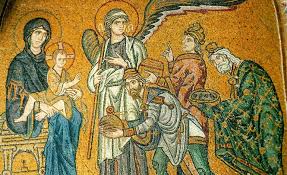
10 Again the Lord spoke to Ahaz, 11 “Ask the Lord your God for a sign, whether in the deepest depths or in the highest heights.” 12 But Ahaz said, “I will not ask; I will not put the Lord to the test.” 13 Then Isaiah said, “Hear now, you house of David! Is it not enough to try the patience of humans? Will you try the patience of my God also? 14 Therefore the Lord himself will give you[a] a sign: The virgin[b] will conceive and give birth to a son, and will call him Immanuel. 15 He will be eating curds and honey when he knows enough to reject the wrong and choose the right, 16 for before the boy knows enough to reject the wrong and choose the right, the land of the two kings you dread will be laid waste.

Background

We read Isaiah for many reasons, one is its many prophecies of the coming of the Messiah. One of the most familiar is the this one and it is also found in Matthew’s Gospel. It is the story of the birth of Jesus.

Isaiah was writing this message for the common people.  He is known as “the Prophet.” However, Isaiah held high standings and also gave his prophetic messages to the kings.  Here, Isaiah is giving his message to King Ahaz.  Ahaz became king at the age of 20 and reigned for 16 years (735 to 715 BC). History would record him as a bad king. To avoid war, Ahaz swore homage to the Assyrian king Tiglath-Pileser along with all of the Assyrian gods. It would take Hezekiah, Ahaz’s son this entire reign to undo the damage done by his father’s lack of faith in the one true God.

Isaiah goes ahead and gives Ahaz a prophesy that is uplifting and hopeful. King Ahaz refuses to accept it. Isaiah would tell the king that although he was unworthy, God would honor is covenant.  There would be a sign through miracles that a Savior would be sent by God for the people of Israel. The message, God was sending the world a baby, Immanuel which means, God is with Us.

Biblical Truths and Theology2http://www.easyenglish.info/bible-commentary/isaiah1-9-lbw-nh.htm

Verse 12: Ahaz refuses the Lord’s offer. And he pretends to be very holy (see Deuteronomy 6:16). In fact, Ahaz has already decided what he will do. He prefers to trust the Assyrians for help against Syria and Israel. He can see soldiers and weapons. He cannot see God.

Verse 14; The name Immanuel means ‘God is with us’. The immediate meaning was that God was with Judah. So God would save Judah from the nations that opposed it. And this would happen while Isaiah’s own son was still a child. The writers of the New Testament saw another meaning in this verse. The Christ (Messiah) was ‘God with us’. And Christ would rescue his people from all that opposed them. That is, from all human enemies and from all evil powers.

Verses 15-16: ‘Curds and honey’ were poor foods for hard times. During the next 3 years, Damascus (capital of Syria) would fall to the Assyrian army. So did Samaria (capital of Israel), 13 years later.

Items for Discussion

  • Through prophecies, God foretold the coming of the Messiah.  Why did some see this and some did not see Christ in the message?
  • God gives his message to both those who are worthy and those who are unworthy – Why?
  • What is the significance of having a young woman bearing a son?
  • What are the differences between the God in heaven and the God with us?
  • What does it take to lead a Christ-like life?


Matthew 1:18:25
18 This is how the birth of Jesus the Messiah came about[a]: His mother Mary was pledged to be married to Joseph, but before they came together, she was found to be pregnant through the Holy Spirit. 19 Because Joseph her husband was faithful to the law, and yet[b] did not want to expose her to public disgrace, he had in mind to divorce her quietly. 20 But after he had considered this, an angel of the Lord appeared to him in a dream and said, “Joseph son of David, do not be afraid to take Mary home as your wife, because what is conceived in her is from the Holy Spirit. 21 She will give birth to a son, and you are to give him the name Jesus,[c] because he will save his people from their sins.” 22 All this took place to fulfill what the Lord had said through the prophet: 23 “The virgin will conceive and give birth to a son, and they will call him Immanuel”[d] (which means “God with us”). 24 When Joseph woke up, he did what the angel of the Lord had commanded him and took Mary home as his wife. 25 But he did not consummate their marriage until she gave birth to a son. And he gave him the name Jesus.

Background

The story of the birth of Jesus is found in only two of the four Gospels: Luke and Matthew. In Luke, the story is told from the point of view of Mary, to an audience made up of Christians who were Gentiles prior to their conversions. In Matthew, the story is told from the point of view of Joseph, to an audience who would have been Jews prior to their conversion.

Matthew is aware of the prophecy in Isaiah stated above. Matthew connects the prophecy directly to the birth of Jesus. He includes these key elements: A visit from an angel; a message from God delivered in a dream; a prophecy of the Old Testament fulfilled in the New Testament; and a naming event that is important.

God uses dreams to convey messages that might not “get through” the chatter of human life. Joseph seemed to be open and responsive to God’s messages. Prophecies reenforce that God does what God says. This is a foundational truth of our faith. The naming of someone throughout Scriptures is always given significance.  We are to note that Jesus’ naming is no different.

Biblical Truths and Theology3http://www.easyenglish.info/bible-commentary/matthew1-4-im-lbw.htm

Verses 18-19: To be engaged to marry was a more serious state than it is in many societies today. It was a legal contract by the couple about a year before the marriage. Then, even before the marriage, people called the couple husband and wife. The girl would remain in her parent’s house until the marriage. And the couple would not have sex until the marriage. To break off the agreement to marry would be a legal divorce.
Joseph’s first thought was that Mary had not been loyal to him. That was until the angel told him otherwise. Joseph found that Mary was expecting a baby. She had not had sex with a man. The baby was by the Holy Spirit. We are sure that Mary would have told Joseph the truth. But he could not believe it then. He thought that it was impossible to have a baby without sex.

Joseph was a good man. In the circumstances, he thought that the marriage could not happen. However, he would not make the matter public. He decided to have a private divorce. This would be the kindest thing to do for Mary. In this way, he could avoid open shame. A secret divorce was not difficult for a man. He must give to Mary a letter of divorce. There had to be two witnesses to the divorce. Then he could send her away from him.

Verses 20-21: Joseph did not act in a hurry. He thought about the situation. He had decided what to do. Then he had a dream. God sent an angel to Joseph in that dream. The angel called Joseph ‘son of David’. This may have been to emphasise that Jesus would be a king from the family of David. The angel then told Joseph not to be afraid to take Mary as his wife. This does not mean that Joseph was afraid. Rather it means that he should not hesitate to take Mary as his wife. To take her meant to complete the marriage. The man would go to the bride’s house. And he would take her from there to his own house. Then they would have the wedding meal to complete the marriage.

The angel explained to Joseph the truth about this situation. The child inside Mary was not because of sex with a man. The power of the Holy Spirit had done this. Joseph was not the father of the child. But by his marriage to Mary, he would make Jesus legally his child.

Mary’s child would be a son. It was normal for the father to choose the child’s name. But God told Joseph to give to the child the name Jesus. To give the name to the child would be to accept the child as if it was his own. So, by Joseph, Jesus was a descendant of David. Also, Jesus was a descendant of David by Mary. But it was important to the Jews that Jesus was a descendant by the father of the family.
The name Jesus was the same as the Old Testament name Joshua. The name means ‘the Lord saves.’ The angel told Joseph that Jesus would save his people from their sins. Jesus came to deal with sins. He did this by his life and death. He took the punishment for the sins of the world. So, he is able to save people from their sins.
Verses 22-25 God had spoken by the prophets about future events. Much of what the prophets said happened in Jesus. Jesus was the Christ that God promised to send. In this Gospel, Matthew shows how the prophecies actually happened (Matthew 1:22, 2:15, 2:17, 2:23, 4:14, 8:17, 12:17, 13:35, 21:4, 26:56, 27:9).

The prophecy here is what God spoke by the prophet Isaiah (Isaiah 7:14). As Matthew often does, here he follows the Old Testament in the Greek language. The Old Testament that we use is a translation from the Hebrew language. That explains why some of the words are different from our Old Testament. Isaiah had written about how a young woman would give birth. That birth was evidence that God would save his people from their enemies. His word for a young woman could mean a woman who had never had sex. That is how Matthew understood Isaiah’s prophecy. Mary had not had sex. And her son, Jesus, is the Christ who saves his people from their sins.

We do not read that anyone called Jesus by the name Emmanuel. But we know Jesus by that name. In his birth, Jesus was human. His birth was not his beginning. Before he came to earth, he was God. And when he came to earth, he was still God. He was Emmanuel. Emmanuel means ‘God is with us.’

Joseph woke up from his sleep. He did what the angel had said to him. Joseph publicly accepted Mary as his wife. He took her to his home. But Joseph and Mary did not have sex until after the birth of her first son. Later they had other children. Among them were James, Joseph, Simon and Judas (Matthew 13:55).

Joseph gave to Jesus the name Jesus. By this act, he legally adopted Jesus as his son.

Items for Discussion

  • Why do you think God sends angels to visit people? Is this effective?
  • Why do you think that messages sometimes come in dreams?
    • What other ways does God communicate with us?
  • Why did the Old Testament prophets foretell what God was doing to do?
  • Do we have prophets at work today?
  • Names and their meanings have always been important in the Bible.  How did you go about naming someone?
  • What does the name Emmanuel (God is with Us) mean to you?

Discussion Challenge

  • How does the Christian Church keep our Christmas Story alive in a world that is hostile to it?

Let Heaven and Nature Sing Gloria

A Christmas Cantata

On this day a recent cantata collaboration by Mark Hayes and John Parker provides an innovative presentation of the beloved Christmas story. The inspired music covers the dynamic spectrum from poignant and introspective prayers for God’s mercy to angelic proclamations of God’s majesty and glory. It is a unique blend of new Christmas anthems with favorite yuletide carols. The distinctive use of familiar Latin phrases in each selection serves as a common thread throughout the work and capitalizes on a current trend in many churches-reaching back to embrace ancient worship. The allusion to aspects of nature in each anthem underscores the overall theme and uniquely highlights the familiar progression of the Christmas story which includes the angels, shepherds, Mary and the Wise Men.

The music and story opens with the story of the “people walking in darkness” … our Advent story. You are asked to notice the light and the hope of the music and words of this part of the cantata … “awaken us, O Lord, to a brighter day, dawning of new hope, dispersing fears away.” The story will continue with the silver wings of the angels touching the earth with their announcement of the Christ child’s birth … their excitement and joy … “Laudamus te (we praise you), Benedicimus te (we bless you), Adoramus te (we adore you), Glorificamus te (we glorify you!)! Then, on to the shepherds who swoop us up in their excitement to go and see what the angel voices have told them … yes, “run to the village, rush to the town, spread the glad tidings of Jesus around! Sing from the roof-top, shout it with joy!” The music and text are intended to make you want to sing and praise our God who made us in His image.

Music

  1. Awaken Us O Lord

Since our beginning, no human ear or eye and heard or seen but one God. You bless those who wait on You. Help the righteous, do not forsake us. Please hurry! We are all like the thirsty, our souls panting for you.

2. Silver Wings

You are called the Wonderful Counselor, Mighty God, Everlasting Father, Prince of Peace. As in those days that a census was decreed, Joseph and Mary went to Bethlehem to be counted. In a simple stable, a Son was born. Lying there, wrapped in swaddling cloth, in a manger.   Angels would bring news of your birth to the shepherds in nearby fields.

3. Shepherd´s Proclamation

Shepherds, servants of the sheep, would become your first witnesses. They would spread the word that you too have come as a shepherd of the people.

4.Tender Rose of God

So who are you? God’s only Son, the manifestation of God’s Glory, like the Rose of Sharon. Foretold by prophets, announced by angels, worshiped by shepherds and adored by the faithful.

5. Song of the Wise Men

Wise men would see God’s ordained plans in the heavens and follow a star from the east. Recognizing who you were, they would worship you and give you gifts of gold, incense and myrrh.

6. Let Heaven and Nature Sing

Yes, the Messiah has come. Joy to the world, let earth receive her King. As our hearts prepare room for Christ, heaven and all of nature sings Glory to the Highest.

Items for Discussion

  • Look at the songs that were chosen for this Cantata:
    • Why would you say that people without Christ walk in darkness?
    • Angels are always part of Christmas – Why is this important to include them?
    • Shepherds were witnesses to Christ’s birth – What significance comes from this?
    • We are reminded of the tenderness of our God – How does this help us with our faith?
    • The Christmas Story always includes the journey of the Wise Men – Why is their journey significant to the Story?
    • The Cantata ends with both heaven and earth (nature) acknowledging the birth of Christ – How do we keep this part of the story alive all year long?
  • How is it that Christ becomes our “light?”
  • Many people have favorite Christmas carols. What are yours and why do you call them your favorites?
  • A Cantata is joy and praise set to music. Why does music enhance the spirit and joy of Christmas for you?
  • When recounting the Christmas Story of Christ’s birth, what parts are your favorites?
  • Why is it important to retell this story year after year as a holiday?

Discussion Challenge

  • What do you do to KEEP Christ in Christmas and how to you share those ideas with others?

Other Snapshots on the Cantata

A Noel Celebration

Living Light

The Christmas Cantata


Come, Thou Long Expected Jesus

Isaiah 2:1-51NIV New International Version Translations

1 This is what Isaiah son of Amoz saw concerning Judah and Jerusalem: 2 In the last days the mountain of the Lord’s temple will be established as the highest of the mountains; it will be exalted above the hills, and all nations will stream to it. 3 Many peoples will come and say, “Come, let us go up to the mountain of the Lord, to the temple of the God of Jacob. He will teach us his ways, so that we may walk in his paths.” The law will go out from Zion, the word of the Lord from Jerusalem. 4 He will judge between the nations and will settle disputes for many peoples. They will beat their swords into plowshares and their spears into pruning hooks. Nation will not take up sword against nation, nor will they train for war anymore. 5 Come, descendants of Jacob, let us walk in the light of the Lord.

godmountainBackground

We begin a new sermon in chapter 2 and it continues for the next two chapters. The subject of this sermon is Judah and Jerusalem as we see in verse 1.

Biblical Truths and Theology

Isaiah speaks of:

  • the glory of the Christians, Jerusalem, the gospel-church in the latter days;
  • in the accession of many to it (v. 2, v. 3) to this new church; and
  • the great peace it will bring into the world (v. 4).

Verse 5 calls all to the duty to walk in this new “light.” (v. 5).

Items for Discussion

  • Why do you think that virtually every religion has as a component of it, an ending of these times and a beginning of eternal times?
  • What are the major differences between now and then (the end times)?
  • Why is peace so impossible in this world? Or in other words, why do we have to wait for another time to have peace?
  • How do you think God will settle the disputes between people? Why will this bring peace?
  • In what way(s) was Isaiah talking about Christ here?

Matthew 24:36-44
36 “But about that day or hour no one knows, not even the angels in heaven, nor the Son, but only the Father. 37 As it was in the days of Noah, so it will be at the coming of the Son of Man. 38 For in the days before the flood, people were eating and drinking, marrying and giving in marriage, up to the day Noah entered the ark; 39 and they knew nothing about what would happen until the flood came and took them all away. That is how it will be at the coming of the Son of Man. 40 Two men will be in the field; one will be taken and the other left. 41 Two women will be grinding with a hand mill; one will be taken and the other left. 42 “Therefore keep watch, because you do not know on what day your Lord will come. 43 But understand this: If the owner of the house had known at what time of night the thief was coming, he would have kept watch and would not have let his house be broken into. 44 So you also must be ready, because the Son of Man will come at an hour when you do not expect him.

Background

In Matthew chapter 24 we find a sermon from Jesus himself. While Christ’s preaching was mostly practical, in this chapter, we have a prophecy, a prediction of things to come. Its purpose had a practical side, as it was intended, not to gratify the curiosity of his disciples, but to guide their consciences and conversations. It ends with a practical application. The church has always had prophecies, besides general promises, both for direction and for encouragement to believers; but they have been mostly observable. Here Christ preached this prophetical sermon in the close of his ministry, just as the Apocalypse is the last book of the New Testament, and the prophetical books of the Old Testament are also placed last. This order is important because we must be well grounded in plain truths and understand them before we dive into those things that are dark and difficult to understand.

Biblical Truths and Theology

In chapter 24 we begin with:

  • The timing of this discourse
  • The discourse itself, in which we have,
    • The prophecy of diverse events, especially referring to the destruction of Jerusalem, and the utter ruin of the Jewish church and nation about forty years after Christ’s death
    • The events that led to that destruction and consequences of those events.

We end, however with a practical application of this prophecy for the awakening and quickening of his disciples to prepare for these great and awful things (v. 32-51).

Items for Discussion

  • When reading this prophesy from Christ, do you feel it is still pertinent in today’s times?
  • Should people take this seriously? Why or why not?
  • How would you expect people to act if they believed in this prophecy?
  • Is Jesus’ return going to be a good thing or a bad thing?
  • Why do we need to learn about our God and Savior before we delve into the latter days?

Discussion Challenge

  • What is the church’s role in removing the fear that might be generated by prophecies of this type?
  • 1
    NIV New International Version Translations

Just Do Your Best

Isaiah 55:1-131NIV New International Version Translations 

1 “Come, all you who are thirsty, come to the waters; and you who have no money, come, buy and eat! Come, buy wine and milk without money and without cost. 2 Why spend money on what is not bread, and your labor on what does not satisfy? Listen, listen to me, and eat what is good, and you will delight in the richest of fare. 3 Give ear and come to me; listen, that you may live. I will make an everlasting covenant with you, my faithful love promised to David. 4 See, I have made him a witness to the peoples, a ruler and commander of the peoples. 5 Surely you will summon nations you know not, and nations you do not know will come running to you, because of the Lord your God, the Holy One of Israel, for he has endowed you with splendor.” 6 Seek the Lord while he may be found; call on him while he is near. 7 Let the wicked forsake their ways and the unrighteous their thoughts. Let them turn to the Lord, and he will have mercy on them, and to our God, for he will freely pardon. 8 “For my thoughts are not your thoughts, neither are your ways my ways,” declares the Lord. 9 “As the heavens are higher than the earth, so are my ways higher than your ways and my thoughts than your thoughts. 10 As the rain and the snow come down from heaven, and do not return to it without watering the earth and making it bud and flourish, so that it yields seed for the sower and bread for the eater, 11 so is my word that goes out from my mouth: It will not return to me empty, but will accomplish what I desire and achieve the purpose for which I sent it. 12 You will go out in joy and be led forth in peace; the mountains and hills will burst into song before you, and all the trees of the field will clap their hands. 13 Instead of the thorn bush will grow the juniper, and instead of briers the myrtle will grow. This will be for the Lord’s renown, for an everlasting sign, that will endure forever.”

do-your-best-and-god-will-do-the-restBackground

In the prior two chapters, Isaiah talked of Christ of the church of Christ. In chapter 55 we have much of the covenant of grace made with us in Christ. This chapter begins with the “sure mercies of David,’’ which are promised (v. 3) and are applied by Luke to the benefits which flow to us from the resurrection of Christ (Acts. 13:34). Here is:

  1. A free and gracious invitation to all to come and take the benefit of gospel grace (v. 1)
  2. Pressing arguments to enforce this invitation (v. 2-4).
  3. A promise of the success of this invitation among the Gentiles (v. 5).
  4. An exhortation to repentance and reformation, with great encouragement given to hope for pardon thereupon (v. 6-9).
  5. The ratification of all this, with the certain efficacy of the word of God (v. 10, v. 11).
  6. And an instance of the accomplishment of it in the return of the Jews out of their captivity, which was intended for a sign of the accomplishment of all these other promises.

Biblical Truths and Theology2http://www.easyenglish.info/bible-commentary/isaiah49-57-lbw-nh.htm

Verses 1-2: The word pictures of familiar things to eat and to drink show God’s great care for his people. His free gifts truly satisfy what people need.

Verse 3: The Lord will repeat the covenant that he made with David long ago (see 2 Samuel 7:8-12 and Psalm 89:33-37). This time the covenant will not be with David’s family (see 2 Samuel 7:16), but with the whole nation called Israel.

Verse 4-5: David’s extraordinary defeat of much greater armies was evidence to the nations of the power of David’s God (see Psalm 18:43-45).

Verse 6: God is not a distant God. People can easily reach him. He is close to them. He hears their prayers.

Verse 7: God tells evil people to repent, that is, to stop their wicked practices and plots. And to return to God and to live in his way. Then God will forgive them completely.

Verse 8: God’s plans are totally different in nature from human plans. There is no certainty that human plans will succeed. But there is no doubt that God will carry out his plans perfectly.

Verse 9: God uses ‘sky’ and ‘earth’ as picture words to show how different are God’s actions from human actions — God’s plans are much more wonderful than any human plan.

Verses 10-11: God’s kind purposes are for the benefit of all people. That is why he carries out his purposes.
Note: See Isaiah 40:8 for another passage about the nature and effect of God’s word.

Items for Discussion

  • What is the difference between a command and an invitation and why is this important here?
  • How are these verses an invitation to mankind?
  • What is Isaiah’s argument as to why we should accept it?
  • What is humanities arguments against accepting God’s invitation?
  • How does the metaphor of rain and snow versus God’s Word help you understand our God better?
  • So, what are we being held accountable to and for?

Luke 19:11-27
11 While they were listening to this, he went on to tell them a parable, because he was near Jerusalem and the people thought that the kingdom of God was going to appear at once. 12 He said: “A man of noble birth went to a distant country to have himself appointed king and then to return. 13 So he called ten of his servants and gave them ten minas. ‘Put this money to work,’ he said, ‘until I come back.’ 14 “But his subjects hated him and sent a delegation after him to say, ‘We don’t want this man to be our king.’ 15 “He was made king, however, and returned home. Then he sent for the servants to whom he had given the money, in order to find out what they had gained with it. 16 “The first one came and said, ‘Sir, your mina has earned ten more.’ 17 “‘Well done, my good servant!’ his master replied. ‘Because you have been trustworthy in a very small matter, take charge of ten cities.’ 18 “The second came and said, ‘Sir, your mina has earned five more.’ 19 “His master answered, ‘You take charge of five cities.’ 20 “Then another servant came and said, ‘Sir, here is your mina; I have kept it laid away in a piece of cloth. 21 I was afraid of you, because you are a hard man. You take out what you did not put in and reap what you did not sow.’ 22 “His master replied, ‘I will judge you by your own words, you wicked servant! You knew, did you, that I am a hard man, taking out what I did not put in, and reaping what I did not sow? 23 Why then didn’t you put my money on deposit, so that when I came back, I could have collected it with interest?’ 24 “Then he said to those standing by, ‘Take his mina away from him and give it to the one who has ten minas.’ 25 “‘Sir,’ they said, ‘he already has ten!’ 26 “He replied, ‘I tell you that to everyone who has, more will be given, but as for the one who has nothing, even what they have will be taken away. 27 But those enemies of mine who did not want me to be king over them—bring them here and kill them in front of me.’”

Background

In chapter 19 of we have the following:

  1. The conversion of Zaccheus the publican at Jericho (v. 1-10).
  2. The parable of the minas3In modern values, a silver mina would equal about US$100 and a gold mina about US$6,500 or equivalent to about 3 months wages. which the king entrusted with his servants, and of his rebellious citizens (v. 11-27).
  3. Christ’s riding in triumph (such triumph as it was) into Jerusalem; and his lamentation in prospect of the ruin of that city (v. 28-44). – Christ could see the coming siege of Jerusalem by the Roman General Titus
  4. His teaching in the temple, and casting the buyers and sellers out of it (v. 45-48).

Biblical Truths and Theology

Verses 11-14: The crowd came near to Jerusalem. They expected that the kingdom of God would come. Maybe they expected Jesus to declare that he was the king. Therefore, Jesus told this story about an important man. The man went to a country a long way from home. He went to receive a kingdom.

Verses 15-19: The man got his kingdom and he came back home. He told his servants to give to him an account of what they had done. The first one had gained 10 more minas. The second one had gained 5 more minas. The king gave them control over cities in his kingdom.

Verses 20-23: The third servant out of the 10 gave his account. We do not know what happened to the other 7 servants. The third servant gave to the king the mina that he had kept safe. He had done nothing with it. He did not trade with it, as his master had ordered him to do. He hid it because he was afraid of his master. He was afraid that he might lose his master’s mina. The servant’s explanation was that his master was a very severe man. His master took profit where he had not earned it. The master used what the servant had said against him. The servant knew what kind of man the master was. Therefore, he should at least have put the money in the bank. There it would have earned profit. The master had told the servants to trade. He expected them to take that risk. The third servant did not obey his master, so the master was angry with him.

Verses 24-27: The master took the mina from the third servant. He gave it to the servant who had 10 minas. The servant with 10 minas had proved that he was loyal and responsible. So, his master could trust him with much greater responsibility. The servant who returned his mina did not trade with it. He had neglected to use it as his master had ordered. He had shown that he was neither loyal nor responsible.

Items for Discussion

  • How was this parable like what Jesus was about to go through as He entered Jerusalem?
  • Do you think that God tests us? How and Why?
  • How does this parable show us what God expects from our personal talents?
  • Is this reasonable? What should our response be?
  • What do you think “Just do your best means?”

Discussion Challenge

  • What role do you think the church has in helping its members learn and grow their “minas?”

The Book of Books

Psalm 40:1-101New International Version (NIV)
1 I waited patiently for the Lord; he turned to me and heard my cry. 2 He lifted me out of the slimy pit, out of the mud and mire; he set my feet on a rock and gave me a firm place to stand. 3 He put a new song in my mouth, a hymn of praise to our God. Many will see and fear the Lord and put their trust in him. 4 Blessed is the one who trusts in the Lord, who does not look to the proud, to those who turn aside to false gods. 5 Many, Lord my God, are the wonders you have done, the things you planned for us. None can compare with you; were I to speak and tell of your deeds, they would be too many to declare. 6 Sacrifice and offering you did not desire—but my ears you have opened—burnt offerings and sin offerings you did not require. 7 Then I said, “Here I am, I have come—it is written about me in the scroll. 8 I desire to do your will, my God; your law is within my heart.” 9 I proclaim your saving acts in the great assembly; I do not seal my lips, Lord, as you know. 10 I do not hide your righteousness in my heart; I speak of your faithfulness and your saving help. I do not conceal your love and your faithfulness from the great assembly.

Some Facts about the Bible2http://www.whatchristianswanttoknow.com/10-amazing-bible-facts/scroll

Note: The facts will vary somewhat depending on the translation that is examined

The Bible was written over a 1600-year period by approximately 40 men. The time of the writing was from 1500 BC to AD 100.

While the Bible is 1 book, it contains 663The number will depend on your translation smaller books. The books of the Old Testament were written before the birth of Jesus Christ and the New Testament covers the life of Christ and beyond.

Each of the books, except 5, are divided into chapters and verses. The 5 which aren’t divided by chapters are Obadiah, Philemon, 2 John, 3 John, and Jude. These are short books which only have verse divisions.

Chapters were introduced to the Bible in 1238 by Cardinal Hugo de S. Caro. Verse divisions were not added until 1551 by Robertus Stephanus.

The longest chapter if the Bible is Psalm 119 with 176 verses. The shortest chapter is Psalm 117 with only 2 verses. Incidentally, the middle chapter of the Bible is also Psalm 117 (Psalm 118 in some translations).

The longest book of the Bible is Psalms with 150 chapters, or psalms. It contains 43,743 words. The shortest book is 3 John with only 1 chapter and 299 words.

The longest verse in the Bible is Esther 8:9 with 90 words. The shortest verse is John 11:35 with only 2 words, “Jesus wept.”

The oldest book of the Bible4http://lavistachurchofchrist.org/LVanswers/2007/11-03.html is believed to be Job, written around 1,500 BC, and not Genesis as you might think. The last to be written is Revelations.

As of September, 2016 the entire Bible has been translated into 554 languages, and 2,932 languages have at least some portion of the Bible in their native language.

Background

David probably penned this psalm after his deliverance, by the power and goodness of God, after some great and pressing trouble, which placed him in danger of being overwhelmed. We might speculate that it was some trouble with guilt arising from a sense of sin and of God’s displeasure against him. While for this we speculate, whatever it was, David is so moved to praise God for that deliverance. A Spirit of prophecy comes to David, testifying of the future sufferings of Christ and the glory that will follow.

  1. David records God’s favor to him in delivering him out of his deep distress, with thankfulness to his praise (v. 1-5).
  2. David takes this occasion to speak of the work of our redemption by Christ (v. 6-10).
  3. In the recalling of these thoughts it gives David encouragement to pray to God for mercy and grace both for himself and for his friends (v. 11-17).

Biblical Truths and Theology

Verse 2: It is not easy to get out of very wet (muddy) ground. It is entrapment, pulling you deeper and deeper.

Verse 5: No matter how faithful we are or smart we are, we do not know what God has planned for each of us.

Verse 6: This goes back to Exodus 20:5-6 where a slave might voluntarily choose to remain with his master. Especially if the master had given to him a wife and they had children. Then the master would take him to the judges. The man would declare in front of witnesses that he wanted to stay with his master. Then the master would make that a permanent arrangement. He would make a small hole in his slave’s ear. The slave heard his master’s orders with his ears. That hole in his ear was a visible sign that he would obey his master always.

Verse 7: In the New Testament Jesus said that this was about him. This is in Hebrews 10: 7.

Items for Discussion

  • What does it mean to be “proud” today, in the negative sense that David was addressing in the Psalm?
  • In today’s world, what are the “false gods?”
  • Why is David thankful to God?
  • What is David asking God to do for him?
  • How did David come to these conclusions?

2 Timothy 3:16
35 Jesus went through all the towns and villages, teaching in their synagogues, proclaiming the good news of the kingdom and healing every disease and sickness. 36 When he saw the crowds, he had compassion on them, because they were harassed and helpless, like sheep without a shepherd.

Background5http://www.easyenglish.info/bible-commentary/2tim-lbw.htm

At the end of the book of Acts, the apostle Paul was still in prison in Rome. When he came out of prison, he went to Macedonia (1 Timothy 1:3). After that, he travelled to other places. While on these journeys, he wrote the first letter to Timothy. Timothy was then in the city of Ephesus. Timothy was the leader of the church there. Later Paul was again in prison in Rome. It was from there that he wrote this second letter to Timothy. Timothy was still in Ephesus.

Timothy was the son of a Gentile father and a Jewish mother. His mother, Eunice, and grandmother, Lois, both believed the gospel of Christ (2 Timothy 1:5). They and Timothy probably became Christians when Paul first went to the town of Lystra (Acts 14). All the Christians in Lystra and in the church in the town of Iconium said good things about Timothy.

When Paul came the second time to Lystra, he asked Timothy to join his team (Acts 16:1-3). Timothy became a close friend and helper of Paul. He went with Paul as he travelled to many places. Then Paul appointed Timothy to lead and look after the church at Ephesus.

Paul wrote this second letter to Timothy from prison just before he died. Paul knew that the time of his death had come (2 Timothy 4:6-8). The Emperor Nero killed himself in the month of June AD 68. Paul asked Timothy to come to him before winter (2 Timothy 4:21). So, the date of the letter could not be later than AD 67.

Paul wanted to see Timothy again. He thinks about him as his own son (2 Timothy 1:4). Paul is lonely and the prison is cold. He urges Timothy to try to come before the winter (2 Timothy 4:21). He asks Timothy to bring the warm coat that he had left in the town of Troas. He also wants Timothy to bring his books and papers (2 Timothy 4:13). In the court for the first time, he had been successful. But all his friends except Luke had left him (2 Timothy 4:11, 16). Although he had succeeded that time, the Romans would not set him free. He expects that they will soon kill him (2 Timothy 4:6).

Paul writes to encourage Timothy in his Christian life. He urges him to be strong in what he believes. Timothy must use the gifts that God has given to him. He must preach the gospel and teach the truth.

This letter is much more personal than the first one. Paul urges him to be strong in his belief in the Lord (1:1-7). He should not be ashamed of the Lord or of Paul. He must be prepared to suffer for the gospel (1:8-2:13). As he had done in the first letter, Paul warns against the false teachers (2:14-19). Timothy must be a noble servant of Christ (2:20-26). In the last days, people will do awful things (3:1-9). But Timothy must continue to do what he has learned and knows. He must do what the scriptures say (3:10-17). He must preach the gospel because it is urgent that people hear it (4:1-5). Paul then talks about his own life and what he expects to happen (4:6-8). Then he asks Timothy to come and he tells him about his situation (4:9-18). He ends the letter with greetings to his friends and asks the Lord to bless Timothy (4:19-22).

Biblical Truths and Theology

God has given to us all the scriptures. It is as if he breathed them through the human writers. Peter tells us that holy men spoke by the Holy Spirit (2 Peter 1:21). The scriptures are then in a real sense the word of God. As the scriptures come from God, they must be important for us. He has given them for our use as a necessary guide to how we should live. Paul then gives four areas in which the use of the scriptures is of great benefit.

They show us what God is like. And they show us how God sees us. They teach us what pleases God. Christian teachers should teach the scriptures. This is because in them is the truth that God wants everyone to know.

The scriptures show us what sin is. By them God tells us that all people have sinned. He uses them to convince us that we have done wrong things. He shows us where we have wrong ideas and thoughts.

The scriptures teach that, as we trust in the Lord Jesus Christ, God can forgive us our sins. If we repent of them and bring them to God, he will remove them from us. By doing what the scriptures tell us, God can change us. He can correct the errors in our minds and in what we do.

The scriptures are there to educate us in all that is right. They teach us how to live, as God wants us to live. It is essential then that Christians read them and learn from them.

Items for Discussion

  • Where is the harassment and helplessness today?
  • Are Christian churches having compassion on those who are harassed and helpless? How or how not?
  • What did Paul mean by “like sheep without a shepherd?”
  • In what way(s) should the church interweave healing and the gospel’s message?
  • How does the church show compassion?
    • On its members
    • On its neighbors
    • On the needy in the world
  • What are the advantages to having a Bible in one’s own language?
  • What are the best ways to learn what is in the Bible?

Discussion Challenge

  • Scriptures show us what God is like, show us what sin is, teach us to trust Christ, and teach us how God wants us to live – How can the church do a better job at these goals?
« Older posts Newer posts »

"For it is by grace you have been saved" - Ephesians 2:8-9  

Copyright: © 2001 - 2025 Lostpine

Translate »