Inspiration for Today's World

Category: Snapshots (Page 13 of 45)

Charged Up

Isaiah 40:27-311NIV New International Version Translations
27 Why do you complain, Jacob? Why do you say, Israel, “My way is hidden from the Lord; my cause is disregarded by my God”? 28 Do you not know? Have you not heard? The Lord is the everlasting God, the Creator of the ends of the earth. He will not grow tired or weary, and his understanding no one can fathom. 29 He gives strength to the weary and increases the power of the weak. 30 Even youths grow tired and weary, and young men stumble and fall; 31 but those who hope in the Lord will renew their strength. They will soar on wings like eagles; they will run and not grow weary, they will walk and not be faint.

Background

Chapter 40 begins what is believed to be the second book of Isaiah.  Written by his students, the results of Isaiah’s teachings in the first 39 chapters. The verses point out that it is silly to worship false gods like the stars.  Just as silly  is to think that God can forget you!

The people of God receive a reprimand for their unbelief and distrust of God.  They are reminded that they took the names Jacob and Israel, from one who found God faithful to him  and then made a covenant with God.  The people are told that while they may have many troubles and fears, these would all go away  before they even have time to find out what they are and why they have occured. God is so great that we will never understand His mind.

It is bad to have evil thoughts rise in our minds, but worse to turn them into evil words.  The people are reminded that what they know and have heard is sufficient to silence all of these fears and distrusts.

Through the strength of God’s Divine grace the people can be above the problems of the world. They will run in the way of God’s commandments and do so cheerfully. The Scripture tells us to guard against unbelief, pride, and self-confidence. If we try to go ahead with only our own strength, we will faint, and fall completely.  Yet if our our hearts and our hopes are in heaven, we will be carried above all difficulties and be able to capture the prize of our highest calling in Christ Jesus. Where God had begun the work of grace, He will perfect it. God will help those who, in humble dependence on Him, help themselves.

Items for Discussion

  • Why is the question in Verse 28 such a good and powerful question?
  • Is there a difference, do you think, in God’s perspective for those who do not know God and those who know Him but choose to ignore Him?
  • What is it that God promises to us that allows us to move forward and do great things?
  • Why is God uniquely qualified to give humanity assistance in this world?
  • What is our role to receive the strength that God promises?

Romans 8:9-11
9 You, however, are not in the realm of the flesh but are in the realm of the Spirit, if indeed the Spirit of God lives in you. And if anyone does not have the Spirit of Christ, they do not belong to Christ. 10 But if Christ is in you, then even though your body is subject to death because of sin, the Spirit gives life[a] because of righteousness. 11 And if the Spirit of him who raised Jesus from the dead is living in you, he who raised Christ from the dead will also give life to your mortal bodies because of his Spirit who lives in you.

Background

True Christians do not need to worry about their human nature. God has sent the Holy Spirit to live in their lives. It is as if their human nature is no longer alive. Instead, their spirits, human spirits, are now alive in God. And God’s Holy Spirit will guide and direct their lives. In the end, the human body will die. But the death of the body will not be important, because the body’s spirit will remain alive. God raised Jesus from death. Those who share Christ’s life by the Holy Spirit will rise again too. They will have a new body that will never die again.

Items for Discussion

  • What is human nature?
  • Is human nature controllable? How?
  • How does the “World” affect human nature?
  • What does Christian Fellowship do to the human spirit?
  • What does regular time spend with God’s Word do to the human spirit?

Discussion Challenge

  • How can the body of a church be used to strengthen and recharge the human spirit?


  • 1
    NIV New International Version Translations

The True Vine

Psalm 22:25-311NIV New International Version Translations
25 From you comes the theme of my praise in the great assembly; before those who fear you I will fulfill my vows. 26 The poor will eat and be satisfied; those who seek the Lord will praise him—may your hearts live forever! 27 All the ends of the earth will remember and turn to the Lord, and all the families of the nations will bow down before him, 28 for dominion belongs to the Lord and he rules over the nations. 29 All the rich of the earth will feast and worship; all who go down to the dust will kneel before him—those who cannot keep themselves alive. 30 Posterity will serve him; future generations will be told about the Lord. 31 They will proclaim his righteousness, declaring to a people yet unborn: He has done it!

Background

We do not know  exactly when David wrote Psalm 22. He was very ill, or he was hurt badly and is writing about his suffering. But David also writes about the sufferings of other people. For example, people often torture other people. Near Judah was a place called Tyre. In Tyre the torture used was to nail them to wood, through their hands hands and feet.

So Psalm 22 is more than a psalm about just the sufferings of David. His own agony made him think about the agony of other people. we as Christians believe David wrote about the agony of one yet to come, Jesus Christ. In Acts 2 is something that Peter said seven weeks after Jesus died and rose again. In Acts 2:30 Peter said, “David was a prophet. He wrote about Christ”.

The Spirit of Christ was in the prophets as this psalm testifies . It proclaims clearly and fully, the sufferings of Christ, and the glory that will follow.  What we have is a sorrowful complaint of  what happens when God withdraws. This can be applied to any of us when we are pressed down, overwhelmed with grief and terror. Spiritual desertions are the saints’ our worst nightmares. Yet even when we complain, it is still a sign of spiritual life and the exercising of our spiritual senses. To cry out to  God, why am I sick? why am I poor? is nothing more than Christ’s cry, “Why hast thou forsaken me?” is the language of a heart binding up its happiness in God’s favor. Christ declared the holiness of God, His heavenly Father, in his worst sufferings. No one was ever made ashamed of their hope. Our Saviour  spoke of the state to which he was reduced. The history of Christ’s sufferings, and of his birth, explains this prophecy.

Items for Discussion

  • How do people gain hope from their despair and suffering? What are your tips you would pass on?
  • Is it wrong to feel guilt when we are suffering? What about even when we did something that we deserved to suffer for?
  • To suffer is human: How to do we prepare our future generations so that they have the same hopeful attitude expressed in David’s Psalm?
  • Why is the Christian testimony so important to those who are suffering?


John 15:1-8
1 “I am the true vine, and my Father is the gardener. 2 He cuts off every branch in me that bears no fruit, while every branch that does bear fruit he prunes[a] so that it will be even more fruitful. 3 You are already clean because of the word I have spoken to you. 4 Remain in me, as I also remain in you. No branch can bear fruit by itself; it must remain in the vine. Neither can you bear fruit unless you remain in me. 5 “I am the vine; you are the branches. If you remain in me and I in you, you will bear much fruit; apart from me you can do nothing. 6 If you do not remain in me, you are like a branch that is thrown away and withers; such branches are picked up, thrown into the fire and burned. 7 If you remain in me and my words remain in you, ask whatever you wish, and it will be done for you. 8 This is to my Father’s glory, that you bear much fruit, showing yourselves to be my disciples.

Background2https://www.christianity.com/bible/commentary.php?com=mhc&b=43&c=15

Jesus Christ is the Vine, the true Vine.  He is the union of the human and Divine, and the fulness of the Spirit that is in Him, resembles the root of the vine made fruitful by the moisture from a rich soil. Believers (us) are branches of this Vine. The root is unseen, and our our outward life can hide our connection to Christ. The root (Christ) bears the tree, diffuses sap to it, and in Christ supports and supplies us with our needs. In the Christian community are many branches, we too may have more than one. Yet, meeting at the root, we all make one vine.

While we are all part of the body of true Christians, just like the vines, we are gathered in different places and with differing opinions but still meet through Christ attached to the root. Believers, like the branches of the vine, are weak, and unable to stand on their own. Our responsibility is to be fruitful. From a vine we look for grapes, and from a Christian we look for a Christian temper, disposition, and life. We must honor God, and do good; this is bearing fruit. The unfruitful are taken away. And even fruitful branches need pruning; for the best have notions, passions, and humors, that require to be taken away, which Christ has promised to forward the sanctification of believers, they will be thankful, for them. The word of Christ is spoken to all believers; and there is a cleansing virtue in that word, as it works grace, and works out corruption. And the more fruit we bring forth, the more we abound in what is good, the more our Lord is glorified. In order to fruitfulness, we must abide in Christ, must have union with him by faith. It is the great concern of all Christ’s disciples, constantly to keep up dependence upon Christ, and communion with Him. True Christians find by experience, that any interruption in the exercise of their faith, causes their faithfulness to decline, their corruptions to revive, and their ability to comfort to droop. Those who abide not in Christ, though they may flourish for awhile will come to nothing. The fire is the fittest place for withered branches; they are good for nothing else.

Items for Discussion

  • What are the differences between the vine and the branches?
  • What are the “branches” of a Christian’s life?
  • Explain your reasoning as to what is the pruning of branches and why it must be done?
  • To the Christian life, what does it mean to bear fruit?
  • We are called to “abide” in Christ–How is this explained by the concept of a vine and branches?
  • What is the “Fruit” of a Christian life?

Discussion Challenge

  • How does the process of pruning occur from the perspective of a congregation/church? What does it look like?

Do Not Be Alarmed (Yeah Right!)

Psalm 1141NIV New International Version Translations
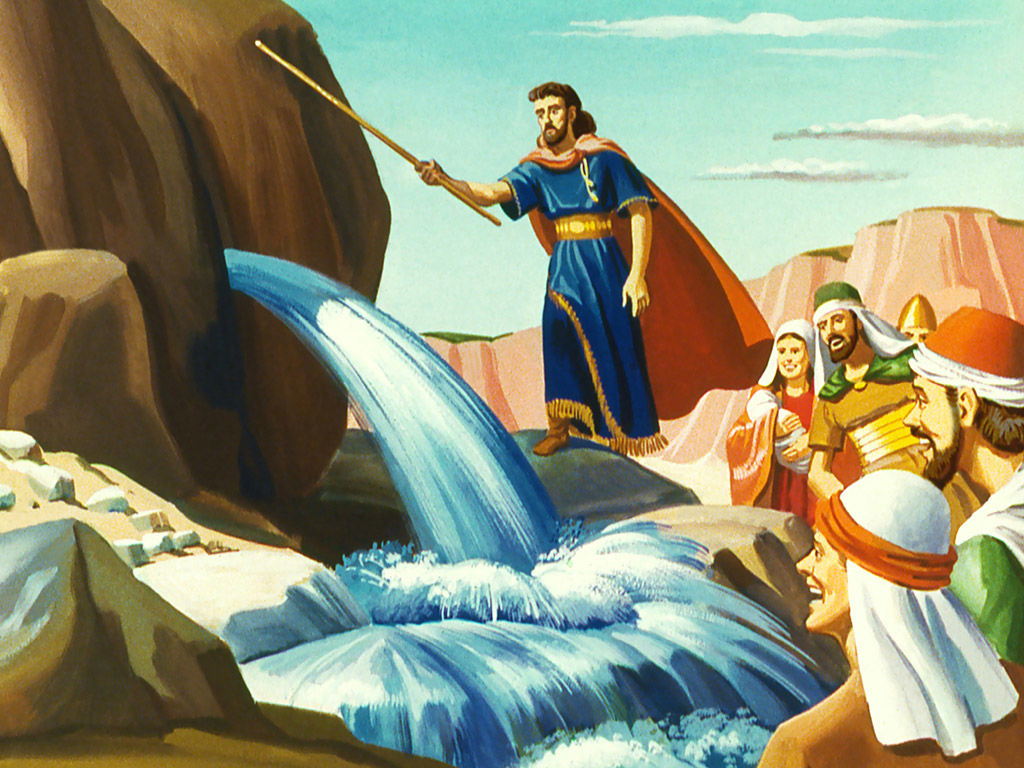
1 When Israel came out of Egypt, Jacob from a people of foreign tongue, 2 Judah became God’s sanctuary, Israel his dominion. 3 The sea looked and fled, the Jordan turned back; 4 the mountains leaped like rams, the hills like lambs. 5 Why was it, sea, that you fled? Why, Jordan, did you turn back? 6 Why, mountains, did you leap like rams, you hills, like lambs? 7 Tremble, earth, at the presence of the Lord, at the presence of the God of Jacob, 8 who turned the rock into a pool, the hard rock into springs of water.

Background

Last week, the concept of a hallel, a prayer about the exodus of Israel from Egypt was introduced.  Psalm 114 is called the second “Egyptian hallel. ” We are not sure who the psalmist was or when it was written. We know the reason for its writing, however. It was to remind people what God did when He led His people from Egypt, freeing them from slavery.

We need to know what verse 2 means in order to give the Psalm a date. If Judah and Israel are countries, then it means the psalmist wrote it between 950 and 650 B.C.  If Judah and Israel are the people, then the date could be earlier. This translation makes them places. But in verse 1, Israel means “the people of Jacob”. This is another name for the Jewish people. Therefore, we are not sure of exactly when this psalm was written.

The Psalm is restating what happened when the people of Israel as they left Egypt.

  • God led them to the Promised Land, (verse 2).
  • God led them through the Red Sea, which became dry for them, (verse 3).
  • God led them over the River Jordan. It also became dry for them, (verse 3).
  • Mountains and hills like Sinai seemed to jump like animals, (verse 4).
  • God gave them water from the rocks in dry places, (verse 8).

To understand this Psalm we first must acknowledge God’s power and goodness in what he did for Israel,. It will apply  to that much greater work of wonder, our redemption by Christ. The purpose of the Psalm is to encourage people to trust in God in their distress. When Christ comes for the salvation of His people, He redeems them from the power of sin and Satan. Redemption then takes on a meaning: Christ separates us from an ungodly world.

There is no sea, no Jordan, so deep, so broad, that when God’s time comes, God’s people can be divided and driven back. This applies today to the Christian church in the world. At the presence of our Lord, not only mountains, but the earth itself will well tremble. As the Israelites were protected, so we are provided by miracles; such was that fountain of waters into which the flinty rock was turned, and that rock is Christ. The Son of God, the Rock of ages, gave himself to death, to open a fountain to wash away our sins. We do not need to fear that any blessing is too difficult to expect God’s love, only the sinners should fear God’s just and holy judgment. The Church is in God’s capable hands.

Items for Discussion

  • What are the Old Testament miracles that you find hard to believe? Why?
  • What is it about the human mind that makes is difficult to accept them?
  • Why is it important to embrace the shear power and strength of God?
  • It seems a struggle for modern society to embrace God in that way, what do you think those reasons are?
  • How can we as Christians help each other with  understanding the supernatural powers of God?


Mark 16:1-8
1 When the Sabbath was over, Mary Magdalene, Mary the mother of James, and Salome bought spices so that they might go to anoint Jesus’ body. 2 Very early on the first day of the week, just after sunrise, they were on their way to the tomb 3 and they asked each other, “Who will roll the stone away from the entrance of the tomb?” 4 But when they looked up, they saw that the stone, which was very large, had been rolled away. 5 As they entered the tomb, they saw a young man dressed in a white robe sitting on the right side, and they were alarmed. 6 “Don’t be alarmed,” he said. “You are looking for Jesus the Nazarene, who was crucified. He has risen! He is not here. See the place where they laid him. 7 But go, tell his disciples and Peter, ‘He is going ahead of you into Galilee. There you will see him, just as he told you.’” 8 Trembling and bewildered, the women went out and fled from the tomb. They said nothing to anyone, because they were afraid.

Background

In these verses within Mark, you find a short account of the resurrection and ascension of Jesus along with the joys and triumphs which it gives to all believers.

  • Christ’s resurrection is confirmed  by an angel to the women that came to the grave to anoint him (v. 1-8).

Further in this chapter we have:

  • His appearance to Mary Magdalene, and the account she gave of it to the disciples (v. 9-11).
  • His appearance to the two disciples, going to Emmaus, and the report they made of it to their brethren (v. 12, v. 13).
  • His appearance to the eleven with the commission He gave them to set up his kingdom in the world, and full instructions and credentials , (v. 14-18).
  • His ascension into heaven, the apostles’ commitment to their work, and God’s acceptance of them in it (v. 19, v. 20).

Items for Discussion

  • Why do you think that Jesus didn’t just wait around for the disciples to show them He was alive – there was an angel instead as a messenger?
  • What type of pressing business do you think Jesus went on ahead to Galilee for?
  • Why would history have women discover that Jesus had risen before His own disciples? Are women different in a way that is more accepting of Jesus?
  • If God would have arranged history so that women had a dominant role within the miracles of Easter, why do you think so many “religions” exclude women from the taks of ministry?

Discussion Challenge

  • The miracle of the resurrection is the most amazing miracle in recorded history.  What makes is so hard for some to believe?
  • 1
    NIV New International Version Translations

The Shirts Off Our Backs

Psalm 1181NIV New International Version Translations
1 Give thanks to the Lord, for he is good; his love endures forever. 2 Let Israel say: “His love endures forever.” 3 Let the house of Aaron say: “His love endures forever.” 4 Let those who fear the Lord say: “His love endures forever.” 5 When hard pressed, I cried to the Lord; he brought me into a spacious place. 6 The Lord is with me; I will not be afraid. What can mere mortals do to me? 7 The Lord is with me; he is my helper. I look in triumph on my enemies. 8 It is better to take refuge in the Lord than to trust in humans. 9 It is better to take refuge in the Lord than to trust in princes. 10 All the nations surrounded me, but in the name of the Lord I cut them down. 11 They surrounded me on every side, but in the name of the Lord I cut them down. 12 They swarmed around me like bees, but they were consumed as quickly as burning thorns; in the name of the Lord I cut them down. 13 I was pushed back and about to fall, but the Lord helped me. 14 The Lord is my strength and my defense; he has become my salvation. 15 Shouts of joy and victory resound in the tents of the righteous: “The Lord’s right hand has done mighty things! 16 The Lord’s right hand is lifted high; the Lord’s right hand has done mighty things!” 17 I will not die but live, and will proclaim what the Lord has done. 18 The Lord has chastened me severely, but he has not given me over to death. 19 Open for me the gates of the righteous; I will enter and give thanks to the Lord. 20 This is the gate of the Lord through which the righteous may enter. 21 I will give you thanks, for you answered me; you have become my salvation. 22 The stone the builders rejected has become the cornerstone; 23 the Lord has done this, and it is marvelous in our eyes. 24 The Lord has done it this very day; let us rejoice today and be glad. 25 Lord, save us! Lord, grant us success! 26 Blessed is he who comes in the name of the Lord. From the house of the Lord we bless you. 27 The Lord is God, and he has made his light shine on us. With boughs in hand, join in the festal procession up to the horns of the altar. 28 You are my God, and I will praise you; you are my God, and I will exalt you. 29 Give thanks to the Lord, for he is good; his love endures forever.

Background

The Jewish nation had a legend about building the temple in Jerusalem. The legend goes like this:

They cut big stones to build the temple. One stone was the wrong shape and size. They threw it away. Later, they realized that they needed one the exact shape and size of the one that was discarded to fix two walls together. So, they found the stone that they threw away and put it in an important place at the top of the two walls. It held the two walls together.

The legend makes us believe that the psalmist wrote Psalm 118 after the Jewish nation had built something. Perhaps they had just built the temple, or the walls of Jerusalem. Solomon built the temple in 950 B.C. but was destroyed by the Babylonians in 586 B.C. The Jews rebuilt the again in 516 B.C. and added walls around Jerusalem again in 444 B.C. So based on this history, it is believed that the Psalm was written  around 444 B.C. The Jewish nation had a special feast in 444 B.C. called  “the feast of tree houses”. This was because they made little houses with branches from trees. They lived in them for a few days in October. This feast happened every year. But in 444 B.C., it was very important, because they had just built the walls of Jerusalem. The story is in Nehemiah 8:14-18. Why do we think this? There is a strange verse in the psalm, (verse 27). One way to translate the middle of the verse is, “With boughs in hand, join in the festal procession up to the horns of the altar.”

Psalm 118 is the sixth of the Egyptian Hallels. A Hallel is a Jewish prayer, a verbatim recitation from Psalms 113–118 which is recited by observant Jews on Jewish holidays as an act of praise and thanksgiving. The are named Egyptian Hallels because the theme of the Psalms made the Jews think of what God did in Egypt. He led them from Egypt hundreds of years before. He made them free. But he also led them from Babylon 900 years later. He made them free again. So the psalm starts, “Thank the LORD because he is good”.  Here, God agrees to love and give help to his people. They agree to love and obey him.

The account the psalmist here gives of his troubles is very applicable to those of Christ. Many hated him without cause. The Psalm is reminding us that God is sometimes the strength of His people even when He is not “their song.” Yes, we always have God’s support even when what we want is God’s delights but cannot see them. Whether the believer traces back his comfort to the everlasting goodness and mercy of God, or whether he looks forward to the blessing secured to him, he will always find abundant cause for joy and praise. Every answer to our prayers is an evidence that the Lord is on our side. We need not fear what man can do to us. Our call is to trust in Him alone to accept us and bless us.

The prophecy, verses 22,23, may refer to psalmist’s troubles but principally to Christ Himself:

  1. His humiliation; He is the Stone which the builders refused: they would go on in their building without Him. This proved the ruin of those who would make light of Him. Rejecters of Christ are rejected of God.
  2. His exaltation; He is the chief Cornerstone in the foundation. He is the chief Top-stone, in whom the building is completed, who must, in all things, have the preeminence of our faith.

Christ’s name is wonderful and the redemption He brought us is the most amazing part of all God’s wondrous works. We should rejoice and be glad in the Lord’s day. The psalmist praises God, and calls upon Him to give thanks to God for the glad tidings of great joy to all people, that there is a Redeemer.

Items for Discussion

  • What does it mean to give someone the “Shirt off of your back?”
  • Based on this Psalm, what has God done for His people?
  • Is there anything that God has not done?
  • What evidence do you have that God answers prayers?


Mark 11:1-11
1 As they approached Jerusalem and came to Bethphage and Bethany at the Mount of Olives, Jesus sent two of his disciples, 2 saying to them, “Go to the village ahead of you, and just as you enter it, you will find a colt tied there, which no one has ever ridden. Untie it and bring it here. 3 If anyone asks you, ‘Why are you doing this?’ say, ‘The Lord needs it and will send it back here shortly.’” 4 They went and found a colt outside in the street, tied at a doorway. As they untied it, 5 some people standing there asked, “What are you doing, untying that colt?” 6 They answered as Jesus had told them to, and the people let them go. 7 When they brought the colt to Jesus and threw their cloaks over it, he sat on it. 8 Many people spread their cloaks on the road, while others spread branches they had cut in the fields. 9 Those who went ahead and those who followed shouted, “Hosanna!” “Blessed is he who comes in the name of the Lord!” 10 “Blessed is the coming kingdom of our father David!” “Hosanna in the highest heaven!” 11 Jesus entered Jerusalem and went into the temple courts. He looked around at everything, but since it was already late, he went out to Bethany with the Twelve.

Background2https://www.christianity.com/bible/commentary.php?com=mhc&b=41&c=11

Christ’s coming into Jerusalem on Palm Sunday shows that He was not afraid of the power and malice of His enemies. His actions would serve to encourage His disciples who were full of fear. It also shows us that Christ was  not worried about His approaching sufferings. Christ would be treated as a king and in a few days, humiliated, beaten, and killed. We are to learn from His example that these matters should teach us not to seek the high things of the world but to make sure we do not miss the important but lowly things of the world. God has promised us not to abandon us, He has promised us forgiveness, God has promised us eternal salvation. What king would not want such an assurance. The good news is that it has been given to us by Christ Himself.

Items for Discussion

  • How can we recognize those things in the World that are a danger to our own eternal salvation?
  • Why does self interest always win?
  • What do you think the impact of social media would have had on Psalm Sunday if it were around back then?
  • The people literally “Shirts off their backs” – Yet in a few days would call for His death. What do you think were the influences on those people that allowed them to change so quickly?

Discussion Challenge

  • Do you think people know Christ well enough to recognize Him if he came into our Church today? Why or Why not? What can we do about that concern?

Magnetic

Jeremiah 31:31-341NIV New International Version Translations

31 “The days are coming,” declares the Lord, “when I will make a new covenant with the people of Israel and with the people of Judah. 32 It will not be like the covenant I made with their ancestors when I took them by the hand to lead them out of Egypt, because they broke my covenant, though I was a husband to them,” declares the Lord. 33 “This is the covenant I will make with the people of Israel after that time,” declares the Lord. “I will put my law in their minds and write it on their hearts. I will be their God, and they will be my people. 34 No longer will they teach their neighbor, or say to one another, ‘Know the Lord,’ because they will all know me, from the least of them to the greatest,” declares the Lord. “For I will forgive their wickedness and will remember their sins no more.”

Background

The first 29 chapters of Jeremiah mark the beginning of God’s redemptive plan for Judah and Israel. In those chapters, Jeremiah prophesied the punishment that Judah and Israel would endure for their sins. Now in chapters 30-33 we find  a second stage for God’s redemptive plan. These chapters are known as “The Book of Comfort” or “The Book of Consolation.” They promise restoration for Israel and Judah (chapter 30)—the joyful return of the exiles and a new covenant (chapter 31)—the assurance of the people’s return (chapter 32)—and healing after punishment and the establishment of a righteous branch (chapter 33).

The message in our verses is one of the greatest messages that the Old Testament contains. This is a prophecy that foretells Christianity, that anticipates the New Testament. When Jeremiah delivers this oracle, he speaks as a Christian born long before its time.  It was these words our Lord was thinking when He instituted the sacrament of the Last Supper, and said, “This cup is the new covenant in my blood.” That New Covenant was neither more nor less than the New Covenant of which Jeremiah prophesied.

To fully understand Jeremiah’s meaning, we need to change the word “covenant” to “religion.” If we think of the actual creation of Christianity, the significance of Jeremiah’s teaching will begin to dawn on us. The word “religion” does not occur in the Old Testament, but the word “covenant” is found some three hundred times. When it is used to describe the relation of the people to God, then it really means religion. The core of the covenant is, “I will be their God, and they shall be my people.” There are no better words than these to use for defining our relation to God.

This New Covenant:

  • is based on a new salvation experience—deliverance from exile;
  • cannot be broken;
  • is all encompassing. God has not set conditions;
  • under this new covenant, everyone will know God; and
  • for the most amazing part, while we will all still sin, we will not have evil hearts.

While there was forgiveness of sin under the former covenant, the blood of Christ was not yet been shed for it. Sin was categorized into types and allowances were more annual, with a remembrance of sin made every year. The people were never very clear about sin, hence the need for the constant application of laws.  Even forgiveness was not clearly understood as something attainable by all.

Items for Discussion

  • A magnet attracts objects and so does Christianity.  What is it about your faith that others would find appealing?
  • Can a person’s faith repel, just like a magnet? How does that work?
  • A magnetic field is defined as: a  force or region around magnetic material within which the force of magnetism (attraction or repulsion) acts. How would use this definition to describe a person’s faith walk and outreach to others they may encounter?
  • How does God empower our “magnetism?”


John 12:20-33
20 Now there were some Greeks among those who went up to worship at the festival. 21 They came to Philip, who was from Bethsaida in Galilee, with a request. “Sir,” they said, “we would like to see Jesus.” 22 Philip went to tell Andrew; Andrew and Philip in turn told Jesus. 23 Jesus replied, “The hour has come for the Son of Man to be glorified. 24 Very truly I tell you, unless a kernel of wheat falls to the ground and dies, it remains only a single seed. But if it dies, it produces many seeds. 25 Anyone who loves their life will lose it, while anyone who hates their life in this world will keep it for eternal life. 26 Whoever serves me must follow me; and where I am, my servant also will be. My Father will honor the one who serves me. 27 “Now my soul is troubled, and what shall I say? ‘Father, save me from this hour’? No, it was for this very reason I came to this hour. 28 Father, glorify your name!” Then a voice came from heaven, “I have glorified it, and will glorify it again.” 29 The crowd that was there and heard it said it had thundered; others said an angel had spoken to him. 30 Jesus said, “This voice was for your benefit, not mine. 31 Now is the time for judgment on this world; now the prince of this world will be driven out. 32 And I, when I am lifted up from the earth, will draw all people to myself.” 33 He said this to show the kind of death he was going to die.

Background

To find Jesus  we must look to death. To refuse to acknowledge the reality of death, to avoid or deny death, we will not ever see Jesus. Facing death is difficult work. There is a temptation to want to skip over death and get to resurrection. It is no coincidence that  as Holy Week approaches, we are reminded that death is  but a gateway to new life. Death must come first. Death is not always, however, physical. Sometimes it is spiritual or emotional. We can die a thousand deaths every day. There are the deaths of relationships, marriages, hopes, dreams, careers, health, beliefs, and so on. Within death is hidden Resurrection but there can be no resurrection without a death. If we avoid death we avoid life. To be afraid to die is to be afraid to live.

Jesus did not ask to be saved from death. He was unwilling to settle for survival when the fullness of God’s life was before Him. Jesus knew that in God’s world strength is found in weakness, victory looks like defeat, and life is born of death. This is what allowed Jesus to ride triumphantly into Jerusalem, a city that will condemn and kill him. It does the same for us. It is what allows us to ride triumphantly through life. Triumph doesn’t mean that we get our way or that we avoid death. It means death is a gateway not a prison and the beginning not the end.

Jesus’ death would be the only way that people could enter God’s kingdom.  Jesus used a familiar situation in nature to explain why he had to die. There is only one way for a seed to produce more seeds. The seed must fall into the ground. Jesus compared this to His death. If the seed does not die, it will not produce more seeds. Furthermore, Jesus had to die as a sacrifice, receiving the punishment that we all deserve. Jesus also he had to show that He had power over death, proving eternal life.

Jesus knew that he would suffer,  be rejected and  hated. Death would come in the cruellest way. Jesus was innocent, but He was suffering instead for guilty people. And everyone is guilty of sin. Jesus took upon himself every person’s sins, whether they are past, present or future.

In spite of the weight of death, Jesus’s life was magnetic. People joined Him, both in life and in death.  It is the powerful draw of eternal salvation that powers the magnet here.

Items for Discussion

  • When you think about the number of people who believe in Christ, how does that make you feel?
  • Why do you think people would be attracted to something as painful as Christ’s experience of the Cross?
  • Define this statement: “The power of TRUTH overcomes the fear of death.”
  • What are the most effective ways to demonstrate the power of TRUTH to the world?

Discussion Challenge

  • How should we describe Jesus to our family members, friends, congregation, workers, neighbors and people of the world?
  • 1
    NIV New International Version Translations
Light Has Come Into The World

Numbers 21:4-91NIV New International Version Translations

4 They traveled from Mount Hor along the route to the Red Sea, to go around Edom. But the people grew impatient on the way; 5 they spoke against God and against Moses, and said, “Why have you brought us up out of Egypt to die in the wilderness? There is no bread! There is no water! And we detest this miserable food!” 6 Then the Lord sent venomous snakes among them; they bit the people and many Israelites died. 7 The people came to Moses and said, “We sinned when we spoke against the Lord and against you. Pray that the Lord will take the snakes away from us.” So Moses prayed for the people. 8 The Lord said to Moses, “Make a snake and put it up on a pole; anyone who is bitten can look at it and live.” 9 So Moses made a bronze snake and put it up on a pole. Then when anyone was bitten by a snake and looked at the bronze snake, they lived.

Background2https://www.christianity.com/bible/commentary.php?com=mhc&b=4&c=21

The people of Israel were tired by a long march round the land of Edom. They speak discontentedly of what God had done for them, and distrustfully of what He would do next. What will they be pleased with? They are ungrateful for the manna that was provided for them.  This example warns us that many in our world cast doubt and contempt on the word of God. However, it does not make God’s word less valuable to each of us.

Like manna, the word of God is the bread of life, substantial bread, and will nourish those who by faith feed upon it, all the way to eternal life. There are those who call it “light bread.” What we see in Numbers is that for their murmuring, righteous judgment from God is brought upon them. God sent deadly serpents among them, which bit or stung many to death. To “murmur” against God and His word is to be feared. It is sinful in the eyes of God. If the people had not felt the punishment there would have been no repentance.

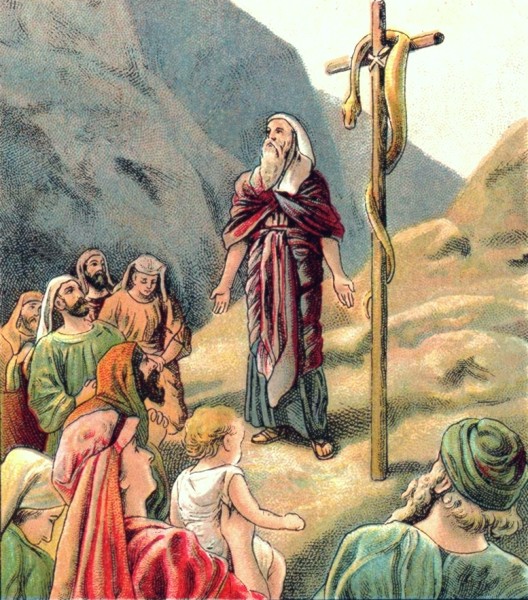
God made a wonderful provision for the relief of their anguish. The Jews themselves say it was not the sight of the brazen serpent that cured  but the faithful action of looking up to it. As they faithfully repented and prayed to their God, the Lord healed them.

Artists most typically portray the pole as a cross to indicate the coming of a Savior, who by His sacrifice will become the modern snake on a pole for all Christians. For examples of how our world attempts to darken God’s Word, we only need to look at these examples:

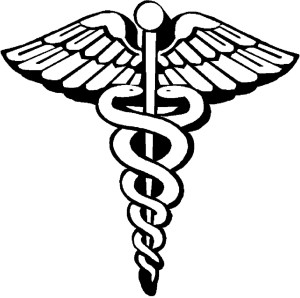
Rod of Asclepius

  • The Rod of Asclepius is described as an ancient Greek symbol associated with medicine, consisting of a serpent coiled around a rod. In ancient Greek religion and mythology, Asclepius was the god of medicine and healing.

Caduceus

  • The Caduceus symbol consisted of a rod with two snakes coiled around it. The English word comes from the Latin caduceus, which echoes the ancient Greek kèrix, translated as herald. The word was mainly used to indicate the rod assigned to the Greek god Hermes as herald (messenger) of the gods and patron of commerce.

Yet we can plainly see by history that the bronze snake upon the rod that Moses erected was clearly the first use of the snake coiled around a pole meant to direct the people of Israel to repentance and prayer for healing.


Items for Discussion

  • How are things, physical things, used in our world today as symbols of greater things?  e.g. our Flag
  • What worldly symbolism draws you to think of God and to prayer?
  • What worldly symbolism draws you to repentance?
  • Why do consequences for one’s actions often work as an effective stimulant for repentance?


John 3:14-21
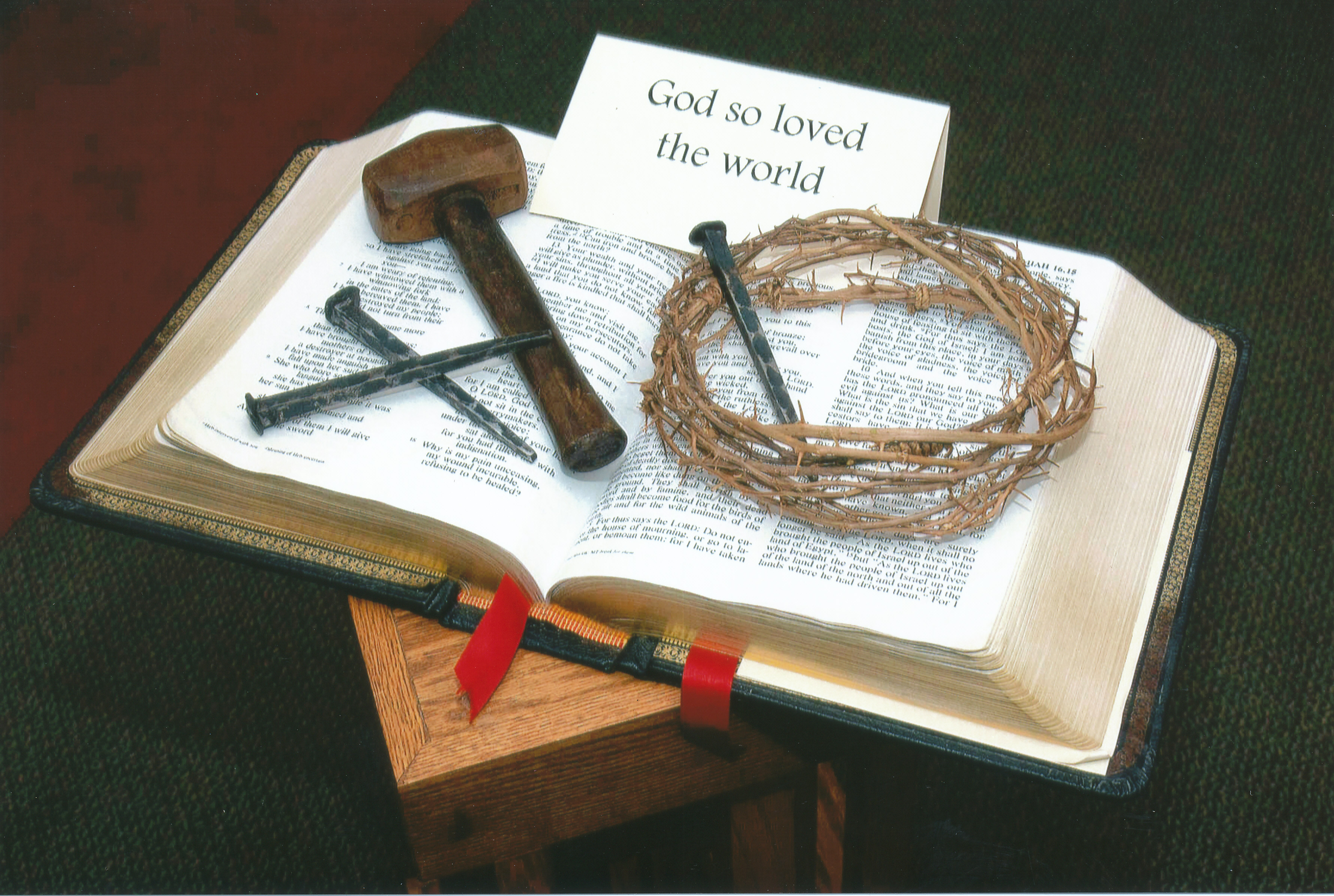
14 Just as Moses lifted up the snake in the wilderness, so the Son of Man must be lifted up, 15 that everyone who believes may have eternal life in him.” 16 For God so loved the world that he gave his one and only Son, that whoever believes in him shall not perish but have eternal life. 17 For God did not send his Son into the world to condemn the world, but to save the world through him. 18 Whoever believes in him is not condemned, but whoever does not believe stands condemned already because they have not believed in the name of God’s one and only Son. 19 This is the verdict: Light has come into the world, but people loved darkness instead of light because their deeds were evil. 20 Everyone who does evil hates the light, and will not come into the light for fear that their deeds will be exposed. 21 But whoever lives by the truth comes into the light, so that it may be seen plainly that what they have done has been done in the sight of God.

Background

Our verses follow a dialogue between Jesus and Nicodemus (John 3:1-10), verse 16 does fall within a discourse (3:11-21) in which Jesus offers a kind of summation of God’s good purposes for the world. Jesus’ speech takes the form of second order reflection upon the meaning of his own life, offering a His reflection on Himself.

We have a wonderful example of why the Old Testament is still an important part of God’s word. Our Saviour, declares in John 3:14,15, is the same as serpent Moses lifted up in the wilderness. Just as the serpent was lifted up, so the Son of man must be lifted up, so that who believes in Him, should not perish.

To compare:

  • Sin bites like a serpent and stings like an adder.
  • Without repentance, there is death.
  • If we believe, we shall not perish. It is by faith that we look to Jesus, Hebrews 12:2.

How many times have we heard that it is essential for us to “believe in Jesus” in order to be saved? Most recognize that it is impossible to stress the significance of the principle of “believe in Jesus” enough! Perhaps the most quoted verse in the Bible is one that makes clear the essential condition of salvation is believing in Jesus, John 3:16.

All people have been bitten by the fiery serpent of sin. To be healed each must go look upon the one God raised up on the cross to die for our healing. For our faith to be the kind of faith that brings us to spiritual healing, our belief must bring us to respond to “the Son of Man” being “lifted up” in the divinely prescribed manner. Just as the Israelites had to go to the center of the camp to look up at the bronze serpent, so we must do as God directs.

Placing our trust in this Jesus means confronting the inconvenient truth that God’s purposes for those God loves is not always synonymous with our own common-sense values of happiness, health, and safety. The trail of faith that Jesus blazed reveals that, while there is nothing in this world worth killing for, there are things worth dying for. The “lifting up” of Jesus reminds us that the true life God has promised us is not the life that we can secure for ourselves through self-interest and caution. It is a life found in pursuit of Christ.

Items for Discussion

  • Why is the example in Numbers such a good example of the plight of mankind?
  • What does “believing in Jesus” mean to you?
  • What does it mean to withhold our ultimate loyalty and trust from other things that ask us to pledge our allegiance over Christ?
  • Jesus offers us a new life – how to we find it?

Discussion Challenge

  • The story in both Numbers and John’s Gospel relate to the seriousness of sin, the urgency of repentance, and the necessity of Jesus. How can we bring this alive in our lives, our church and our families?

Leading With Love

Psalm 32:8-111NIV New International Version Translations

8 I will instruct you and teach you in the way you should go; I will counsel you with my loving eye on you. 9 Do not be like the horse or the mule, which have no understanding but must be controlled by bit and bridle or they will not come to you. 10 Many are the woes of the wicked, but the Lord’s unfailing love surrounds the one who trusts in him. 11 Rejoice in the Lord and be glad, you righteous; sing, all you who are upright in heart!


Background

We have a Psalm of David.

David probably wrote Psalm 32 after he had slept with Bathsheba and he sent Uriah to die in battle. After David married Bathsheba, it took him awhile to ask God to forgive him. As a result he was very unhappy. But when David confessed his sin to God, God forgave him and David’s happiness returned to him.

There are 7 Repentance Psalms: 6,38 51,102, 130 and 143.

David is telling us that God teaches by His word, and  God guides us through the power of His will by simply watching and caring for us. David gives a word of caution to sinners. The reason for this caution is, that the way of sin will certainly end in sorrow. Here is also a word of comfort to those who follow God’s commands. They may see a life of constant communication with God. This, of course, is the most pleasant and comfortable relationship to be in.

David concludes his verses by by reminding us to rejoice in the Lord and rejoice in our salvation.

Items for Discussion

  • What is the difference between instruction and teaching? God does both (see verse 8)
  • Why is God’s forgiveness so hard to understand for humans?
  • What does it tell you about our God that there is no sin too big that He will not forgive?
  • What does it mean to you that  “God’s eye is always upon you?” Why is that important?

Ephesians 4:1-6
1 As a prisoner for the Lord, then, I urge you to live a life worthy of the calling you have received. 2 Be completely humble and gentle; be patient, bearing with one another in love. 3 Make every effort to keep the unity of the Spirit through the bond of peace. 4 There is one body and one Spirit, just as you were called to one hope when you were called; 5 one Lord, one faith, one baptism; 6 one God and Father of all, who is over all and through all and in all.

Background

The apostle Paul was a prisoner literally on many occasions during his ministry (2 Corinthians 11:23), and specifically when he penned this letter to Ephesus (cf. 6:20). But in a greater way, Paul had become the prisoner “of” Jesus in that he had surrendered his self-interests to his Lord (Philemon 10,13) for whom he gladly suffered.

Paul tells us that there is far more to unity than  friendliness. There also is the unity of truth. Truth is consistent, meaning that Christians “all speak the same thing,” and that there are “no divisions” among each group. That seems pretty dramatic, especially when one considered the hundreds of differing denominations that exist just within the Christian Church. The idea of unity, therefore, is a goal, never to be achieved by our society of flawed people. However, that should not stop us from pursuing our goal of being united in Christ.

Seven times in verses four through six the numeral “one” (heis) is found. The term is used to indicate the singularity of something, emphasizing that there is but one only. While we may be flawed, the Holy Spirit is not.  The goal as a follower of Jesus is to:

  • Believe in one God
  • Have one faith
  • Celebrate one baptism
  • Be one body
  • Have one hope
  • Be united in one Love

Do you notice what is missing from Paul’s list? Being united does not mean we are united with one opinion.  We are, as Christians, expected to have differing opinions on worldly matters.  What is to bring us together is One Christ.

Items for Discussion

  • How would you define unity?
  • What evidence would you expect to find if you went to a “United” church, one that displayed Christian unity?
  • What is the significance of the Capital S on the word spirit?  How does that affect your definition of unity?
  • How do we assure ourselves that we are following “one Truth?”

Discussion Challenge

  • What activities would a congregation focus on if they were trying to build one Spirit?
  • 1
    NIV New International Version Translations

Bringing You To God

Genesis 9:8-171NIV New International Version Translations
8 Then God said to Noah and to his sons with him: 9 “I now establish my covenant with you and with your descendants after you 10 and with every living creature that was with you—the birds, the livestock and all the wild animals, all those that came out of the ark with you—every living creature on earth. 11 I establish my covenant with you: Never again will all life be destroyed by the waters of a flood; never again will there be a flood to destroy the earth.” 12 And God said, “This is the sign of the covenant I am making between me and you and every living creature with you, a covenant for all generations to come: 13 I have set my rainbow in the clouds, and it will be the sign of the covenant between me and the earth. 14 Whenever I bring clouds over the earth and the rainbow appears in the clouds, 15 I will remember my covenant between me and you and all living creatures of every kind. Never again will the waters become a flood to destroy all life. 16 Whenever the rainbow appears in the clouds, I will see it and remember the everlasting covenant between God and all living creatures of every kind on the earth.” 17 So God said to Noah, “This is the sign of the covenant I have established between me and all life on the earth.”

Background2https://www.christianity.com/bible/commentary.php?com=mhc&b=1&c=9

As the old world was ruined, to be a monument of justice, so this world remains to this day a monument to God’s mercy. But the sin, that drowned the old world, will remain. God’s covenant with Noah is not to remove sin from the world. When men create agreements, they are sealed, so that what is promised may be even more solemn, and the act of following the agreement will be viewed as an oath to all parties.  The seal of this covenant between God and Noah was the rainbow, which, it is likely, was seen in the clouds before, but was never a seal of the covenant till God it made so.

Why a rainbow? The rainbow appears when we have most reason to fear the prevailing rain; God then shows this seal of the promise, that the rains that destroyed the earth will never do so again. The thicker the cloud, the brighter the rainbow in the clouds. To humans, as threatening afflictions abound, encouraging consolations will abound even more.

The rainbow is the reflection of the beams of the sun shining upon or through the drops of rain: all the glory of the seals of the covenant are derived from Christ, the Sun (Son) of righteousness. And Christ will shed glory on the tears of his believers.

A bow speaks terror, it is a weapon but a rainbow has neither string nor arrow; and a bow alone will do little to hurt anyone. It is a bow, but it is directed upward, not toward the earth; for the seals of the covenant were intended to comfort, not to terrify mankind.

Anxious people need assurance, and they need to hear it over and over. God graciously repeats Himself (“covenant” occurs 7 times in 9:8-17), so that Noah and his family will not only hear the message, but also feel it. He promises never to destroy the earth again by a flood (9:11, 15). God’s promise to Noah was not a spiritual promise, since it concerned the physical destruction of the earth. But it points ahead to the spiritual promise He makes to us in Christ.

And what about God’s Assurance?

  1. It was unilateral.
  2. It was eternal (9:12, 16).
  3. It was universal (9:9-11).
  4. It was unconditional.
  5. It was confirmed by a sign (9:12-17).

Items for Discussion

  • What kind of covenants do we make in life between ourselves and our God?
  • Why is confirmation of any agreement or covenant important?
  • Why is it important not only to know (intellectually) that you’re forgiven, but to feel it?
  • How would you answer the person who said that if we emphasize God’s grace, people will take advantage of it to go on in sin?
  • What comfort do you take in the fact that God is quite aware of sin and that it exists?


1 Peter 3:18-22
18 For Christ also suffered once for sins, the righteous for the unrighteous, to bring you to God. He was put to death in the body but made alive in the Spirit. 19 After being made alive, he went and made proclamation to the imprisoned spirits— 20 to those who were disobedient long ago when God waited patiently in the days of Noah while the ark was being built. In it only a few people, eight in all, were saved through water, 21 and this water symbolizes baptism that now saves you also—not the removal of dirt from the body but the pledge of a clear conscience toward God. It saves you by the resurrection of Jesus Christ, 22 who has gone into heaven and is at God’s right hand—with angels, authorities and powers in submission to him.

Background

While Peter’s overall point is clear, the details are incredibly complex. Most commentators acknowledge that these are some of the most difficult verses in the New Testament to interpret. Peter’s illustration to explain the point made in the verses is that we are called to bear witness in a hostile world, but we can trust God to vindicate us. Peter uses Christ as the main example, showing that His unjust suffering resulted in being a witness and that He was vindicated through His resurrection and ascension to the right hand of God. Noah was another example of a man who bore witness to a hostile world and was vindicated by God who delivered him and his family through the flood. Peter goes on to say that each of us  should be willing to bear witness through baptism, even if it meant persecution, knowing that God will vindicate us in the end.

As this is the Lenten season, Lent offers us the opportunity to search our conscience, to consider the implications of our baptism, and to assess which side we are really on. The waters that wash us clean are the symbolic source of our salvation, but our actions sometimes suggest an allegiance to the chaos that lies just beyond the walls of Noah’s ark. Christ proclaims from the right hand of God that the spirits have been bound and we are forgiven.  Unfortunately, through our words and our deeds, it seems that we are often asking for those spirits to be set free.

Items for Discussion

  • Lent is a time of reflection.  What are the areas you find yourself thinking about most as we begin the season?
  • Christ died for sinners, for evil people, for the undeserving – How does that make you feel?
  • In a world with the storms of sin around us, how should we protect ourselves?
  • How do we explain to others our joy that Christ has washed us clean?

Discussion Challenge

  • How would you explain the similarity between the rainbow and baptism?

Jesus Heals, Prays, and Proclaims the Good News

Isaiah 40:21-311NIV New International Version Translations
21 Do you not know? Have you not heard? Has it not been told you from the beginning? Have you not understood since the earth was founded? 22 He sits enthroned above the circle of the earth, and its people are like grasshoppers. He stretches out the heavens like a canopy, and spreads them out like a tent to live in. 23 He brings princes to naught and reduces the rulers of this world to nothing. 24 No sooner are they planted, no sooner are they sown, no sooner do they take root in the ground, than he blows on them and they wither, and a whirlwind sweeps them away like chaff. 25 “To whom will you compare me? Or who is my equal?” says the Holy One. 26 Lift up your eyes and look to the heavens: Who created all these? He who brings out the starry host one by one and calls forth each of them by name. Because of his great power and mighty strength, not one of them is missing. 27 Why do you complain, Jacob? Why do you say, Israel, “My way is hidden from the Lord; my cause is disregarded by my God”? 28 Do you not know? Have you not heard? The Lord is the everlasting God, the Creator of the ends of the earth. He will not grow tired or weary, and his understanding no one can fathom. 29 He gives strength to the weary and increases the power of the weak. 30 Even youths grow tired and weary, and young men stumble and fall; 31 but those who hope in the Lord will renew their strength. They will soar on wings like eagles; they will run and not grow weary, they will walk and not be faint.

Background

So who is asking the questions? Is it God? Is it Isaiah? Chapter 40 is the beginning of the 2nd Book of Isaiah and separated by the 1st book by 150 years. Therefore, it is an excellent probability that a remnant, converted through the teachings of Isaiah are relating to others still captive, what they were taught by Isaiah. Most of us are told never to ask leading questions or to make sure our questions are open-ended. We are also told not to ask more than one question at at a time. Yet, here we have a series of questions, interspersed with teachings on the very nature of our God.

These verses tell us that it was God who created the world and  God has also created all that is in the world (see Genesis chapter 1).  We are reminded that nothing in human society is as temporary as political power. God can take it away in a moment. Nothing can ever compare with God’s power (verse 12); His wisdom (verses 13-14); His greatness (verses 15-17); His control (verses 22-23); His authority (verse 24); or His holiness (verse 25).

In Babylonian times, observing the heavens and tracking the stars was an important practice. The Israelites were captives of the Babylonians for several generations.  As a result, the practice became attractive to God’s people. They could see the bright stars but they could not see their God. So as a reminder, the verses restate that it was God who created the stars and remembers those stars all by name. So the God of Israel will certainly remember His own people, all by name too.

Because of the many generations of slavery and oppression, God’s people began to believe that their God has left them, thinking that God no longer cared about them. It is still a common experience today.  This, however, is not true. In fact, God continues to care about His people, especially when they suffer and will bring comfort and aid to them.

Staring at the stars can get people to forget the very character and nature of their God. Both God’s patience and his perfect knowledge are greater than human beings can ever imagine. God’s own strength is without limit. He is always ready to give new energy to weak and tired people who trust Him. That energy is a gift from God that will help His people to  find God’s ways.

Items for Discussion

  • Why is a question often an effective way to teach?
  • As the Book of Isaiah relates a series of questions from God to His people, what is God’s point that he is trying to make?
  • How do we, today, learn about the character of our God?
  • What are the questions that we should be asking our current generation?


Mark 1:29-39
29 As soon as they left the synagogue, they went with James and John to the home of Simon and Andrew. 30 Simon’s mother-in-law was in bed with a fever, and they immediately told Jesus about her. 31 So he went to her, took her hand and helped her up. The fever left her and she began to wait on them. 32 That evening after sunset the people brought to Jesus all the sick and demon-possessed. 33 The whole town gathered at the door, 34 and Jesus healed many who had various diseases. He also drove out many demons, but he would not let the demons speak because they knew who he was. 35 Very early in the morning, while it was still dark, Jesus got up, left the house and went off to a solitary place, where he prayed. 36 Simon and his companions went to look for him, 37 and when they found him, they exclaimed: “Everyone is looking for you!” 38 Jesus replied, “Let us go somewhere else—to the nearby villages—so I can preach there also. That is why I have come.” 39 So he traveled throughout Galilee, preaching in their synagogues and driving out demons.

Background

Mark does not use the name “Peter” until he finally gives the complete  list of the 12 apostles (Mark 3:16). Jesus gave Simon the name Peter when they met in Judea. John tells us that (John 1:42).

Peter was married. After the resurrection, he and his wife travelled together in God’s service (1 Corinthians 9:5). They told Jesus about Peter’s mother-in-law’s illness. Perhaps they were explaining why a meal was not ready. They may have hoped that Jesus would help her.  While normally, people who recover from an illness feel very weak after they have been ill, Jesus cured this lady completely. She was able to get up at once and she prepared a meal for them.

Jewish law stated that people could not carry their sick relatives on the Sabbath. The scribes said that to carry something was work.  Since the Sabbath ended when the sun set on Saturday, it was then that they brought their sick friends and relatives to Jesus. Here we have somewhat of an exaggeration.  Mark probably did not mean that all the inhabitants of Capernaum were outside Peter’s door. He meant that there was a large crowd.

Before we look at the rest of the verses, it is worthwhile to consider our beliefs when it comes to demons. The Bible describes them as beings that have invaded the innocent. What we know is that Jesus had power over demonic forces or demons.   In today’s language we modify the Biblical definition slightly by calling demons any source or agent of evil, harm, distress, or ruin.

Jesus would not allow the evil spirits to speak. They knew that he was the Messiah. Jesus did not want the endorsement of demons or evil spirits but wanted people to discover for themselves who He was. They could follow him for the wrong reason if they thought of Jesus as a political leader or only a healer. Jesus was the Messiah who came to this world as a Servant and would suffer to free them from sin.

After helping crowds of people, Jesus needed to pray to God in order to receive new strength and peace of mind. He also needed God to guide him. He must decide whether he should continue to work in Capernaum. He needed to know if it was right to move to other places. Simon and his friends realized that Jesus had gone. The people who were searching for Jesus probably hoped for more healing miracles. However, Jesus knew that His first task was to preach the good news He brought.  Jesus had come into the world to teach as many people as possible about God’s Kingdom.

Items for Discussion

  • What are the modern day demons that are controlling and destroying lives?
  • How can the Christian of today, repeat the kinds of healings that Jesus did in the world?
  • What do you think of the fact that Peter was married and yet, the Apostle who Jesus would build His Church upon?
  • What do you think we should learn from the fact that Jesus was praying for daily guidance?  On what types of things?
  • Where are your quiet places?
  • If Jesus always made time to invite people into His kingdom, then what priority must we place on also extending the same invitations?

Discussion Challenge

  • What does an invitation to God’s Kingdom sound like?
  • 1
    NIV New International Version Translations

He’s Lord of All

Deuteronomy 18:15-20
15 The Lord your God will raise up for you a prophet like me from among you, from your fellow Israelites. You must listen to him. 16 For this is what you asked of the Lord your God at Horeb on the day of the assembly when you said, “Let us not hear the voice of the Lord our God nor see this great fire anymore, or we will die.” 17 The Lord said to me: “What they say is good. 18 I will raise up for them a prophet like you from among their fellow Israelites, and I will put my words in his mouth. He will tell them everything I command him. 19 I myself will call to account anyone who does not listen to my words that the prophet speaks in my name. 20 But a prophet who presumes to speak in my name anything I have not commanded, or a prophet who speaks in the name of other gods, is to be put to death.”

Background1https://www.easyenglish.bible/bible-commentary/deuteronomy-im-lbw.htm

How can you tell a true prophet from a false prophet?  After Moses dies, how will the people know the will of God?  In the verses just before these, Deuteronomy 18:9-14, we see the prohibition against consulting soothsayers and mediums like the nations around Israel do. So how will the people know who speaks for God?

When the LORD spoke to the people at Mount Horeb (Sinai), they were afraid. They asked that the LORD would not speak to them again. They were afraid to hear the LORD’s voice and they were afraid of the fire on the mountain. However, they asked that he would speak to them by Moses. They promised to listen to Moses. And they would obey what the LORD said by him. What they said pleased the LORD.

Moses had become the prophet for his people. He told the Israelites that after his death the LORD would send another prophet like him. That prophet would come from their nation, Israel. After Moses, there would be many prophets. They would be Israelites that God would choose. The LORD would speak by them to his people. The LORD would put His words in their mouths. And they must tell the Israelites what the LORD ordered them to speak. Anyone who did not obey the message would have to answer to the LORD.

But the LORD said that he would send a particular prophet. This prophet would be like Moses but something more.  The LORD chose Moses to rescue His people when they were slaves. The LORD chose Moses to lead the people through the next 40 years and become their guide and their judge.

It would not be until the New Testament that we would start to fully understand what God meant.  Peter spoke about the Lord Jesus as the prophet who was like Moses (Acts 3:21-23). Stephen was the first Christian that the Jewish leaders killed. Stephen  spoke about Moses and the prophet like Moses that was yet to come. It was clear that Stephen meant the Lord Jesus (Acts 7:37). Philip who believed in Jesus went to his friend Nathanael. “We have found the person that Moses and the prophets wrote about. He is Jesus, Joseph’s son, from Nazareth (John 1:45).”

This is what Jesus said  in John 5:46,  “If you believed Moses, you would believe me. He wrote about me.” Jesus spoke what God gave to Him. He said, “I teach. However, what I teach is not my own. It is from him who sent me.’” (See John 7:16.) Again, “I have not spoken on my own. The Father sent me. And he has told me what I should say. And he has told me what I should speak.” (See John 12:49.)

These verses in Deuteronomy conclude with a warning.  A prophet may speak a message that does not come from God. He may suppose that it is from God. However, God did not give that message to him. He may pretend that it is from God. If a prophet does these things, the message would not be from God but nothing more than his personal opinion. Then the people may believe a lie. Perhaps the prophet may even  speak as from a false god. Moses ordered that any false prophet should die.

Items for Discussion

  • Who are the false prophets of our time?
  • How do you discern the truth when you hear it?
  • If we are to believe that Christ was sent to be Moses’ replacement, how might we confirm that Godly appointment?


Mark 1:21-28
21 They went to Capernaum, and when the Sabbath came, Jesus went into the synagogue and began to teach. 22 The people were amazed at his teaching, because he taught them as one who had authority, not as the teachers of the law. 23 Just then a man in their synagogue who was possessed by an impure spirit cried out, 24 “What do you want with us, Jesus of Nazareth? Have you come to destroy us? I know who you are—the Holy One of God!” 25 “Be quiet!” said Jesus sternly. “Come out of him!” 26 The impure spirit shook the man violently and came out of him with a shriek. 27 The people were all so amazed that they asked each other, “What is this? A new teaching—and with authority! He even gives orders to impure spirits and they obey him.” 28 News about him spread quickly over the whole region of Galilee.

Background

Jesus, the Son of God, had all the authority in the world, even in the universe. There is a fundamental truth of Christian beliefs, “God created all things through Christ and put all things under Christ”.  So even the spirits that turned evil, though Christ allowed them to exist, were completely subject to Him (see Colossians 1:16; Ephesians 1:20-21).

While this is a story about power beyond the comprehension of mankind, Jesus did not use His absolute authority the way we humans tend to use our own authority.  For many people, authority is all about  enriching oneself, getting one’s own way, suppressing the truth, and of getting and holding the power to keep doing those things. Witness the parade of totalitarian regimes, corporate executive, government and ecclesiastical scandals, tyrannical parents, bosses, teachers, government officials and the like. It shows like the evening news.

This was not the case with Jesus. He has all the authority there is to have, yet He uses it differently from the way many people would use their authority.

  • In the New Testament, we only see Jesus take action when necessary.  He didn’t try to hide His authority by posting lookouts at each door.  Jesus did not try to keep out other potential demon-possessed-looking people from coming in. He simply dealt with the problem decisively.
  • Jesus didn’t overreact. Jesus didn’t make a fight out of making the demon leave.. He just made the demons go.
  • Jesus didn’t brag about what He did. Jesus didn’t use the opportunity to further His image. Jesus didn’t send people out to publicly promote His achievements.

The big deal here is that Jesus only uses authority to serve, not to be served.  It is consistent throughout His life. If we are granted the gift of authority, that is exactly how Jesus intends for each of use to behave. Whether our authority is at home, at work, or somewhere else, Jesus wants us to use it to help others, not to make ourselves into something bigger and greater than we are.

Items for Discussion

  • What examples can you think of where authority is abused?
  • Can you also find examples where authority spawns servanthood?
  • How to we guard against the problems of too much authority destroying humility and our desire to serve others?
  • Can you think of examples where our natural authority over young people can be expressed as a servant?

Discussion Challenge

  • Why is the place where we encounter the holiness of God always also a place where we encounter human uncleanliness?
« Older posts Newer posts »

"For it is by grace you have been saved" - Ephesians 2:8-9  

Copyright: © 2001 - 2025 Lostpine

Translate »